
IT MATTERS WHAT YOU BELIEVE | Spiritual Freedom | Why Am I Still Struggling with the Same Sin

Get the Study Guide for This Week's Message

Pastor Dustin Woolam 
The Heart of the Message Summary

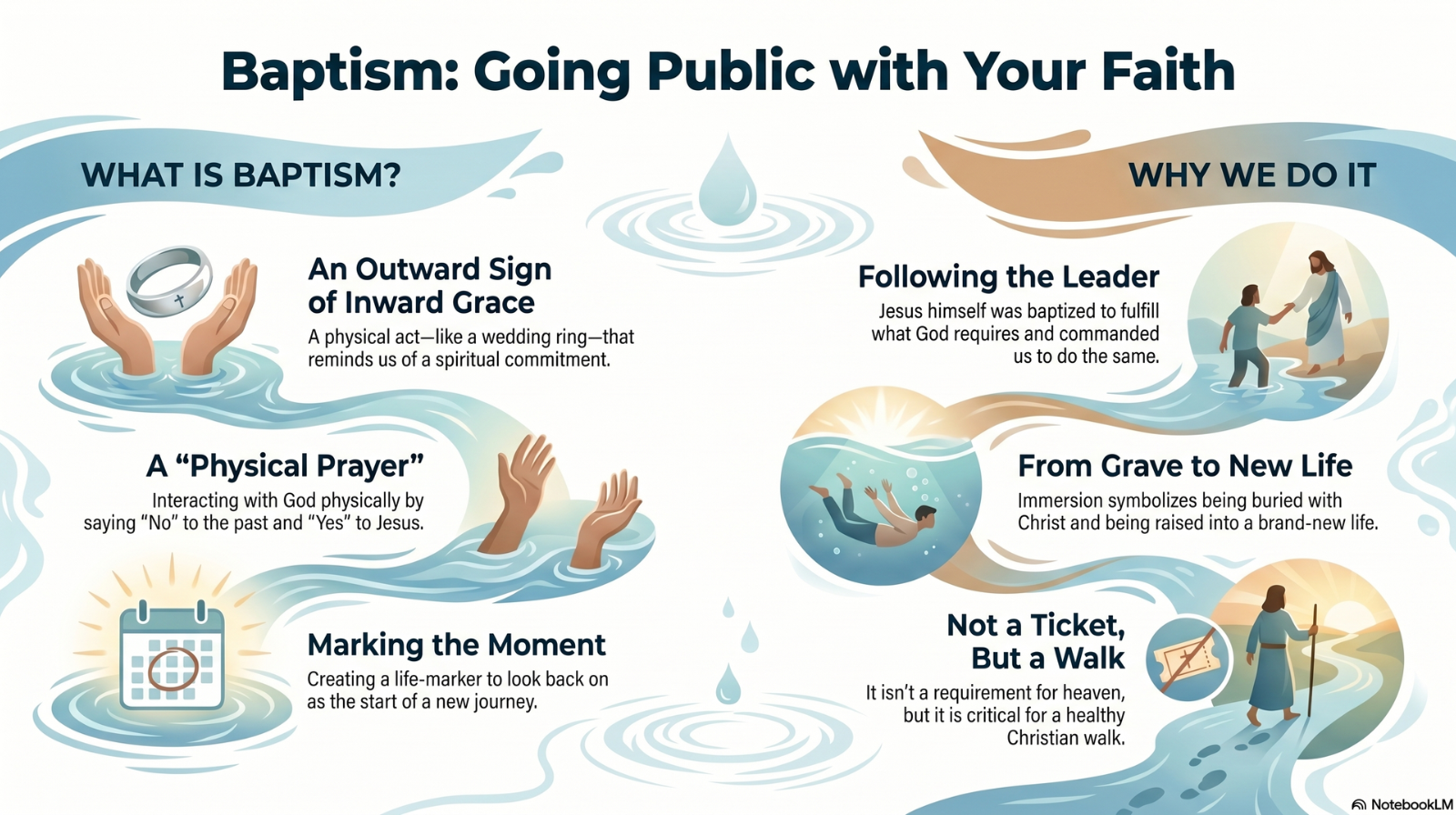
The core spiritual truth of this message is that baptism is far more than a religious ritual or a simple public profession; it is a profound act of identification and spiritual transition. Pastor Dustin calls the congregation to move beyond a superficial understanding of baptism to see it as a "physical prayer"—an outward sign of an inward grace.

By looking at Jesus’ own baptism to "fulfill all righteousness" and Paul’s teaching in Romans 6, we see that baptism represents a literal funeral for the old self and a resurrection into the newness of life in Christ. Furthermore, Dustin highlights the historical context of baptism as an act of spiritual warfare—a deliberate renunciation of the kingdom of darkness. The primary call to action is for believers to reflect on their identity in Christ and for those who haven't been baptized to prepare for this definitive "yes" to Jesus and "no" to the enemy.

TRANSCRIPT

Introduction and Prayer

Well, welcome to church. Let’s pray. Father, thank You for today. Thank You for the gift of Your Word and the gift of Your body. Lord, I say that every week, but I mean it every day. Lord, I am grateful that You’ve chosen to put us in a place where we can be together and meet together and share with each other. We can’t all be hands; we can’t all be feet. We need each other; we need someone to be our skin and our bones. We thank You that in all things, You are the head, Jesus. I pray You would come and speak to us. May the things that are of You remain, and the things that are not of You—whether they be from the kingdom of darkness or from our own flesh—may they not remain. Father, I pray that Your name would be honored in all that we do. In Jesus’ name, amen.

The Purpose of the "What We Believe" Series

We are in a long series—with a couple of shorter series running alongside it—about why what we believe matters. The origin of this series was not just to show "how the sausage is made," but I wanted content for the website. I was praying and talking to the Lord, and I realized that when I visit a church's website, the very first thing I do is look at their statement of faith. Reading through that statement often determines whether or not I will even consider visiting that church.

As we were building out our statement of faith, I thought it would be helpful to create a little podcast for each point to help people understand what is happening. For those who don’t want to read because we live in the TikTok age, they could click on something and hear what we believe. It makes it easier to share with friends or people who don’t know all the "Christianese" jargon; they can hear it explained in plain English. This series has been a long time in the making, and now it looks like it will be a long time in the teaching, which is fine. We will conclude this series when we get to the end of our statement of faith.

Defining the Sacraments

There are certain topics where we will take extra time. For instance, we spent three weeks on healing and three weeks on spiritual warfare. The next part I want to talk about involves concepts where different denominations and people mean different things. We are going to discuss what we would call the "sacraments".

If that sounds like "high church" to you, it’s because it is an old word. Some people jokingly call "high church" "smells and bells"—those formal environments with specific liturgies. It doesn’t mean it’s better; it’s just different. Different traditions use different words. For example, I attended a Church of God denomination for a couple of years in high school, and they practiced these but called them "ordinances." Whether you call them ordinances or sacraments, I personally like the word "sacrament" because it is distinct enough to make me wonder what is happening when we say the word and do the thing.

A definition I like for sacrament is: an outward, visible sign of an inward spiritual grace. I think of a sacrament almost like a physical prayer. When I pray, I am looking for a spiritual action—I want God to change my heart or do something specific. Some people have made sacraments much more than they should be, while others have not made them enough. I want to find that place in Scripture where we are doing something physically and looking for a spiritual response—for the Lord to meet us in what we are doing.

Differing Perspectives on Baptism and Communion

When we have communion, some denominations believe the bread and wine become the literal body and blood of Jesus. Others on the far opposite side say it is strictly a symbol and nothing else. There is a lot of space in between those views. Baptism is the same; there is a lot of conversation regarding what is going on, why we do it, and what it accomplishes. There is an entire denomination called Baptist, and we have John the Baptist. I remember becoming a Christian in a Baptist church where people would joke that Jesus was a Baptist because He was baptized by a Baptist.

The Importance of Physical Reminders

Stepping back from the theological parsing, we can all admit that we use physical things to celebrate significant life events, whether it’s a wedding ceremony or a graduation. I have worn a wedding ring for nearly 26 years. It is a physical reminder of something inward that occurred. I don't "need" the reminder to know I am married, but there is still something significant about the reminder.

I am, by nature, a very methodical and meticulous person. My mom tells stories about how I used to organize my toys and my closet as a child. For me, engaging with a memorial or a physical symbol is very natural. However, for others, it might be less so. Some people want their house to look like a hotel room, but when you have six animals, two kids, and a wife, it isn't going to look like that. As Proverbs suggests, "where there are no oxen, the manger is clean," but where there is life, there is a little bit of a mess. In the midst of that mess, God has given us things to help us slow down and remember Him. He has given us moments to meet Him in ways we don't meet Him elsewhere.

Identifying the Sacraments

We will talk about this for at least two weeks. Different churches have different ideas about how many sacraments there are. The Catholic Church has seven, while many other churches recognize only two: baptism and communion. The determination of a sacrament often comes down to whether Jesus did it in the Gospels and gave it to us. We know Jesus was baptized (Matthew 3), and we know He instituted communion (John 6). I am not overly concerned with the exact number; I am concerned with whether these are moments God has truly given us. I would argue marriage is a sacrament as well because Ephesians shows it is an image of Christ. For this study, we will focus on baptism, communion, and marriage.

Scriptural Foundation: The Baptism of Jesus

As we talk about baptism, we need to look at Matthew 3 and the book of Acts. In Acts, there is a story where believers are asked if they received the Holy Spirit, and they replied that they had only received John's baptism. John’s baptism was for the repentance of sins as he prepared the way for Jesus.

The Baptism of Jesus: Fulfilling All Righteousness

In Matthew 3:13, the Bible says: "Then Jesus came from Galilee to the Jordan to John, to be baptized by him. John would have prevented him, saying, 'I need to be baptized by you, and do you come to me?' But Jesus answered him, 'Let it be so now, for thus it is fitting for us to fulfill all righteousness.' Then he consented."

This is an interesting phrase. Why was Jesus baptized? We know He was without sin, and we know that John’s baptism was a baptism of repentance for the forgiveness of sins. Jesus didn’t have any sins to repent for. So why did He do it? He says it was to "fulfill all righteousness."

Think about the ministry of Jesus. He didn’t just come to be our substitute on the cross; He came to be our representative in life. To "fulfill all righteousness" means that Jesus was identifying with us. He was identifying with the humanity He came to save. He was stepping into the water to show that He was one with us in our need for God, even though He Himself was God.

Identifying with Christ in Baptism

When we get to the book of Acts and the Epistles, the conversation about baptism shifts. It moves from a baptism of repentance to a baptism into Christ. In Romans 6, Paul writes: "Do you not know that all of us who have been baptized into Christ Jesus were baptized into his death? We were buried therefore with him by baptism into death, in order that, just as Christ was raised from the dead by the glory of the Father, we too might walk in newness of life."

Baptism is a funeral and a resurrection. When you go under the water, you are identifying with the death of Jesus. You are saying that your old self—the person who lived for their own desires and followed the ways of the world—is dead. When you come up out of the water, you are identifying with His resurrection. You are being raised to walk in a brand new kind of life. It is an outward sign of an inward reality: you have died to sin and are now alive to God.

The Spiritual Warfare of Baptism

Historically, the church viewed baptism as more than just a nice ceremony. In the early centuries, the liturgy of baptism included a very specific and powerful act. The person being baptized would stand facing the West. In the ancient world, the West—where the sun sets—represented darkness, the domain of the devil, and the "world system." The person would literally spit toward the West as a way of saying, "I renounce you, Satan. I renounce your works and your ways."

Then, they would turn toward the East—where the sun rises—representing the light of Christ and the coming Kingdom of God. They would make their confession of faith in Jesus. It was an act of spiritual warfare. They were declaring their independence from the kingdom of darkness and their allegiance to the King of Kings.

I think we’ve lost some of that "grit" in our modern understanding of baptism. It’s not just a public profession; it is a declaration to the principalities and powers that you no longer belong to them. You belong to Jesus.

Preparing for Next Week

We are going to stop there for today because I want us to really chew on those concepts. Baptism is identification with Jesus. It is a participation in His death and resurrection. And it is a renunciation of the enemy.

Next week, we will talk more about the practical side: the "how" and the "who." We will talk about why we baptize the way we do and answer some of those common questions people have. But for this week, I want you to reflect on what it means to be buried with Him and raised with Him.

Closing Prayer

Lord, I thank You for the beauty of baptism. I thank You that You didn't just give us abstract ideas, but You gave us physical ways to experience Your grace. I pray for anyone here who has not taken that step—that they would feel the pull of Your Spirit.

Lord, we want to be a people who are fully identified with You. We want to be a people who have truly died to ourselves so that Christ might live in us. As we go through this week, remind us of our identity in You. Remind us that the old is gone and the new has come. We love You, Lord. In Jesus’ name, amen.


Tags


You may also like

Baptism Service May 16, 2026

Baptism Service May 16, 2026
Leave a Reply

Your email address will not be published. Required fields are marked

{"email":"Email address invalid","url":"Website address invalid","required":"Required field missing"}