
IT MATTERS WHAT YOU BELIEVE | Is Communion Just a Symbol?

Get the Study Guide for This Week's Message

Pastor Dustin Woolam 
The Heart of the Message Summary

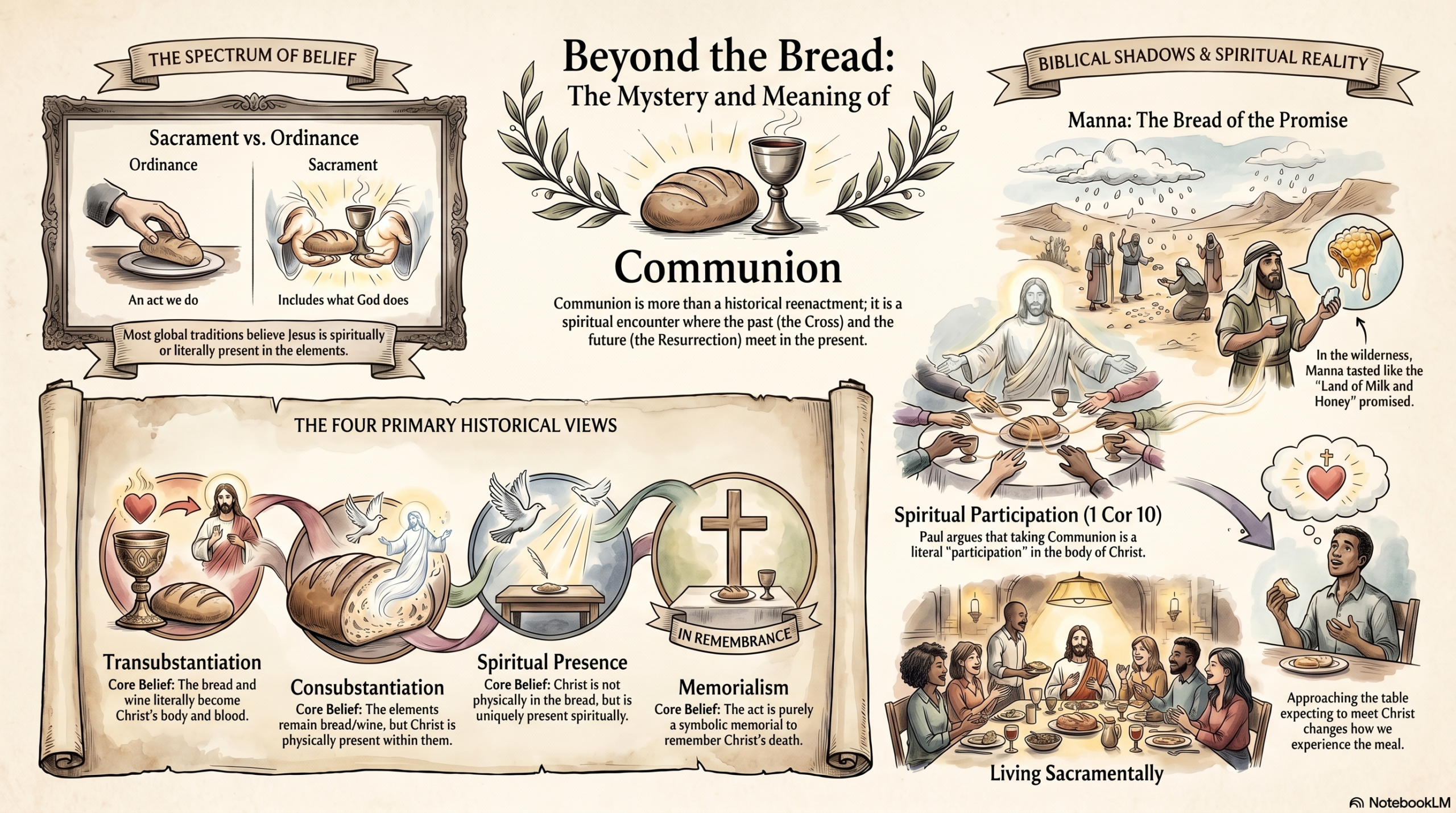
In this week's message, Pastor Dustin Woolam calls the church to experience a profound transformation in how we view and approach communion. Moving beyond a purely symbolic or memorial perspective that reduces the elements to mere bread and grape juice, the core biblical message emphasizes communion as a holy sacrament. Drawing from 1 Corinthians 10 and John 6, Pastor Dustin explains that the Lord's Supper is a spiritual reality where Christ is genuinely present, and God actively meets His people. The primary call to action is for believers to abandon a passive, routine attitude toward the table. Instead, we are challenged to approach communion with deep reverence, spiritual expectation, and an active awareness of God's presence, recognizing that we are truly participating in the body and blood of Christ for our spiritual sustenance and transformation.

TRANSCRIPT

Welcome and Ministry Updates
Welcome to church. I would like to look at my phone for a moment. If you have not been there, we have a church website at owcc.church. There is a page on the site that outlines our different leadership and ministry teams, and I thought it was worth mentioning because we have someone new to announce. In the midst of that, I want to talk about some of what is happening here. I have a lot to say about communion today, but this is also important.

You see Jamie and myself all the time, as well as Rufus and Brooke. But there are other ministry leaders who do an amazing job, such as Joe and Kim, who lead our men's and women's ministries. I have never been to a women's ministry event, but I hear wonderful things, so I am sure it is fantastic. For the men, I encourage you to come out on Wednesdays. If you miss a week, it is perfectly fine; you can just come the next week. You never know exactly what you are going to get, but the conversation is always great and consistent.

Diane oversees our hospitality ministry and does a wonderful job. Whenever we have events, she thinks of details that leave me wondering why I never thought of them before. Bob helps her with that as well; he is also the head of our church council.

Tyler and Shandy are leading our young adult ministry and doing a fantastic job. If they were not, my kids would definitely tell me. We also have our young adult worship team, which includes my son and daughter, Baylor, and occasionally others.

Additionally, my mom helps oversee and lead adult education. This means that if Kim, Joe, or anyone else needs assistance, they can go to her. That is just scratching the surface, as she does a million wonderful things for this church.

Honoring Social Media as Ministry
Our newest leadership announcement involves Anne. There are many different views on social media. Some people view it as brain rot and trash, while others see it as a quick way to make a million dollars. In the church world, the common perspective is that social media is simply a tool to promote our ministry. However, a speaker named Brady Shearer shared an insight years ago that my mom and I discussed: social media is not just a tool to promote ministry; social media is ministry. Its primary purpose is to minister to people. Anne and my mom have been working on this together, and it became clear that Anne should officially lead this area. Anne is now our social ministry leader. We are incredibly grateful she said yes. If you follow our church on Facebook or other platforms, you can see that she is doing a wonderful job.

Gratitude for Church Leadership
This leads me to express my gratitude for our church council. Every 501(c)(3) nonprofit organization requires a governing board by law, and our church council functions as that board. While some churches vote on elders who rotate through board roles, our council handles all of our finances, legal matters, and facilities. In the nearly two years that I have been here, I can say with a full heart that I could not do any of this without the help of these people. We are blessed with great leaders to serve alongside.

If you are interested in leadership development or growing as a leader, please speak with me or any of the leaders I mentioned. In a perfect world, leadership roles are filled when we recognize that someone is already doing the work, just as Anne was already doing the work. We simply identify the leadership that is already happening. While we certainly allow people to apply when specific roles open up, we prefer this organic recognition. For example, Rufus and I would love to have a third elder. It is rare, but on the occasions where we might disagree on benevolence or other matters, having a third voice would be helpful. However, we refuse to find someone just for the sake of having a third person. Our heart is that as someone in the body naturally does the work of an elder, the church will recognize it organically. This is not a campaign, but rather an opportunity to thank Anne and share some reflections on leadership that I have not mentioned in a while.

A Reflection on Memorial Day
As we move forward, let us pray. It is interesting to reflect on holidays like Veterans Day, where veterans can stand up and receive our thanks. On Memorial Day, however, there is no one to stand up because we are honoring those who gave their lives for us. We would not be where we are today without the men and women who made the ultimate sacrifice. For anyone here who has lost family members, friends, or connections, I am truly sorry you have had to bear that pain, and we are deeply grateful for their sacrifice. It is a sobering moment when you realize they chose to die for people they would never know, defending a nation and an ideal. It can be difficult for us to fully comprehend that level of sacrifice when our immediate reality involves having lunch with family or taking an afternoon nap. I do not want to let this moment pass without expressing our profound gratitude. Let us pray.

Opening Prayer
Father, thank you for the gift of your Word and the gift of your body. Thank you for placing it in the hearts of men and women to serve, even when that service cost them their lives or left them with physical, mental, or emotional challenges. Lord, I pray for your blessing upon all the families who have lost loved ones, either completely or in part. For those who returned home bearing the physical or emotional scars of service, I pray you watch over them, keep them, and encourage them today. May they know their service holds immense value and that we are deeply grateful. Lord, as we look into your Word today, I pray that what is of you would remain and what is not of you would fall away. Let everything be exactly as you intend. We give you our hearts, our lives, and these moments. In Jesus' name, amen.

Understanding Sacraments and Ordinances
We are nearing the end of our series exploring why what we believe matters, walking systematically through our statement of faith. Having recently covered baptism, we are shifting our focus to the sacraments. I want to share briefly why I personally prefer the word "sacrament" and believe it is the correct term to use.

Other traditions often use the word "ordinance," which shares a root with the word "order". This week, I was listening to an Anglican priest in the Dallas-Fort Worth area discuss the idea of living every day with a sacramental mindset. He highlighted a key distinction between these two terms. An ordinance is essentially an order that God gives us to perform. This is not a bad definition; we have many commands, like the Ten Commandments. For instance, if we view baptism strictly as an ordinance, we do it because we have been commanded to be baptized and to baptize disciples. That is good and true. However, the term "sacrament" is preferable because it explicitly includes what God is doing in that moment.

When we look at communion as a sacrament rather than just an ordinance, the focus shifts from our performance to God's presence. In an ordinance, we are the primary actors doing something because we were told to do it. But in a sacrament, God is the primary actor. He is the one extending grace, offering comfort, and meeting us in our brokenness. It means that something spiritually real is taking place when we gather around the table.

The Problem with Routine Memorialism
Many of us grew up in traditions where communion was viewed strictly as a memorial. We take the bread and the juice, we think about the cross for a few minutes, and we move on. While remembering Christ’s sacrifice is essential, reducing communion to a mere mental exercise robs it of its spiritual power. It turns the elements into nothing more than ordinary bread and grape juice.

If communion is only a routine reminder, it easily becomes cold and passive. We check a box, but our hearts remain unchanged. God wants more for us than empty rituals. He invites us into a dynamic, living encounter with His presence every time we come to the table.

A Deep Dive into Scripture
To understand this deeper reality, we have to look at how Scripture describes this practice. In 1 Corinthians 10, the Apostle Paul asks a powerful question. He writes that the cup of blessing we bless is a participation in the blood of Christ, and the bread we break is a participation in the body of Christ. The word he uses for participation is koinonia, which means deep fellowship, communion, or sharing in a shared reality. Paul is telling us that we are not just looking at symbols; we are actively participating in Christ Himself.

We see this theme expanded even further in John 6, where Jesus makes some of His most controversial statements. He tells the crowds that unless they eat the flesh of the Son of Man and drink His blood, they have no life in them. This teaching was so shocking that many people walked away from Him that day. They took Him literally and missed the profound spiritual truth He was communicating. Jesus was explaining that just as physical food sustains our physical bodies, He is the spiritual food that sustains our souls.

Navigating Theological Differences
As Protestants, historical believers have a distinct understanding of how Christ is present at the table. We do not hold to the doctrine of transubstantiation, which teaches that the bread and wine physically transform into the literal, physical flesh and blood of Jesus. We recognize that Christ resurrected in a physical body and ascended to heaven, where He sits at the right hand of the Father.

However, rejecting the literal physical transformation does not mean we reject Christ’s presence altogether. Between the extremes of literal physical transformation and mere empty symbolism lies the historical Protestant view of spiritual presence. Through the power of the Holy Spirit, Christ is genuinely present at the communion table. When we receive the elements in faith, the Holy Spirit lifts our hearts to commune with the living Christ, nourishing our souls with His life.

Our Response to the Invitation
This shifts how we must approach the table today. If Christ is truly present, and if God is actively working through this sacrament, we cannot treat it lightly. We must approach communion with holy expectation, deep reverence, and intentional hearts.

Before you take the bread and the juice, take a moment to examine your heart. Bring your worries, your failures, and your exhaustion to Him. Recognize that this table is a visual display of God's movement toward us. Every single thing God does is a movement toward relationship with you. He is inviting you to feast on His grace and find your ultimate satisfaction in Him.

Closing Prayer
Father, thank you for all that you have done. Thank you that we can be called your friends and that your goal is to interact with us and to commune with us. In communion, even as other people use the word Eucharist, which means thanksgiving, we recognize this as a thanksgiving meal and a time to come close to you. Everything you do is a movement toward relationship. It is your movement toward us. Maybe it feels a little weird to us, and that is okay and probably good because it jars us a little so that we have to think about it differently. Lord, we understand that you are in heaven in your physical body, so as Protestants, we do not believe that we are actually eating bread that turned into your literal physical flesh. But we know that your Holy Spirit is powerfully present here with us. Nourish our faith, strengthen our souls, and draw us closer to your heart. In Jesus' name, amen.


Tags

Doctrine


You may also like

Baptism Service May 16, 2026

Baptism Service May 16, 2026

The Danger of a Frustrated Heart

The Danger of a Frustrated Heart
Leave a Reply

Your email address will not be published. Required fields are marked

{"email":"Email address invalid","url":"Website address invalid","required":"Required field missing"}