
IT MATTERS WHAT YOU BELIEVE | Is Sabbath for Today?

Get the Study Guide for This Week's Message

Pastor Dustin Woolam 
The Heart of the Message Summary

In this message, Pastor Dustin Woolam bridges the universal human struggle of burnout and exhaustion with the biblical command of Sabbath. The core spiritual truth is that Sabbath is not an obsolete Old Testament ritual or an optional lifestyle choice; it is a creation-mandated principle built into the fabric of humanity. When we refuse to rest, we operate in rebellion, falsely believing that our labor, rather than God’s sovereignty, sustains our lives.

True biblical rest requires an intentional pause to remember that God is the one who makes us holy and sustains us. Pastor Dustin issues a direct pastoral call to action: repent of the pride of endless striving, choose one day a week to live slowly enough to think deeply about God, and trust His provision. Sabbath points us toward our ultimate, eternal rest in Jesus Christ.

TRANSCRIPT

Introduction, Orthodoxy, and Orthopraxy

Welcome to church, everybody. Glad you're here. Let's pray.

Father, thank you for today. Thank you for the gift of your body. Thank you for the gift of your word. Lord, those aren't just things we say, but these are things we're truly grateful for. Lord, we want to live grateful lives. So Lord, I pray as we gather that our hearts and minds will be turned towards you, for ultimately you're the audience. Lord, as we see you and chase after you, the thing that we ask for now is that you will come and speak to us. May the things of our own heart or of the enemy be removed, and may only you remain. We love you and thank you in Jesus' name. Amen.

So we've been in a series that is moving into the next series over the next couple of weeks. The series we've been in is Why What We Believe Matters. Generally speaking, when we talk about what we believe, we use a term like orthodox, which essentially means right words or right sayings. That's a basic way to describe it, but that's what it means. Orthodoxy means I want to believe the right things and say the right things. The thing that often goes with that, which we talk about less often, is orthopraxy. That means right action or right practice. There's a preacher—I don't know if he was the first one who said it, but he says it a lot, and my mom reminds me, and I'm grateful for the reminder—who says right believing leads to right action. We've talked a lot about what we believe: what I believe about humans, what I believe about marriage, what I believe about God, and what I believe about all these things. Now we're in this middle space where we're still going to be talking about the things that we believe, but more directly how they impact the ways that we live.

Sabbath as a Near-Sacrament

Today we're going to talk about Sabbath. Some of us grew up hearing a lot of different things: Sabbath is something that Jews do, Sabbath is Saturday, Jesus is our Sabbath, and all these different ideas. Let me tell you a little bit about why Sabbath matters to me individually as a human. My lack of Sabbath for decades led to two years of not working in my life. The Lord said to me in no uncertain terms—I know everybody says, "God, talk to me," but if I've ever heard God say anything, He said, "You owe me Sabbath." I wondered where this idea came from. I'm glad you asked; we'll get there. Put a pin in the back of your head that Israel went into captivity for 70 years because they owed Sabbath to the land.

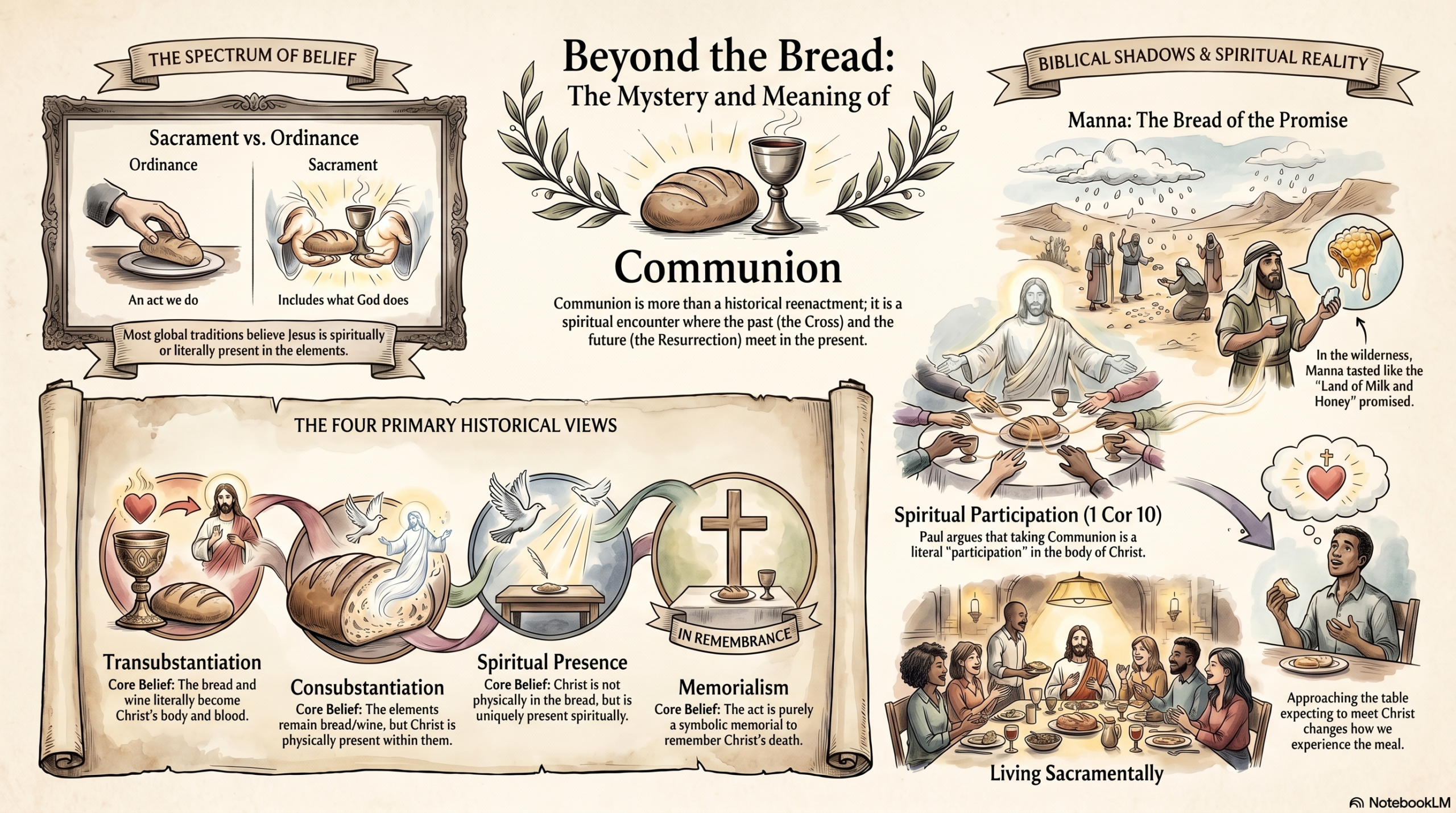
Sabbath is very, very important. We're going to talk about why it is important, how we live and interact with it, and what it means for the future. Sabbath is almost a sacrament. We talked about baptism and communion and how those things are sacraments. One of the rules the church determined way back is that a sacrament requires a few specific things. Sabbath has all of the things that are required for a sacrament except for one. The one that it's missing is that Jesus did not explicitly institute it while He was on earth, or bless it directly while He was here. You can make a case for this with Sabbath, but I'm unwilling to fully say Sabbath is 100% a sacrament. It is like 99.9%. We should take Sabbath as seriously as we take communion and as seriously as we take baptism. There's no room to take it less seriously than we do those things. It should be as serious as prayer and Bible reading. Yet, I think that we don't even think about it. We don't really rest. We don't really recover. We don't really do what God says that we should do.

The Origins of Sabbath in Genesis

So let's take a little journey. Where does Sabbath come from? It may surprise you to find that it's in the Book of Genesis. Exodus chapter 20 contains the Ten Commandments. The kids are learning about the Ten Commandments right now. I thought, wouldn't it be cool if we went through the Ten Commandments with the kids, so that if you have young people in your life who are in children's church, you would hear something on Sunday that you could go home and talk with them about? We are probably not going to do that, but maybe one day in the future.

In Genesis chapter 1, chapter 2, and chapter 3, we have the story of the creation and the fall. We'll read just a little bit, skipping a few parts. Genesis 1, verse 3 says: "God said let there be light and there was light and God saw the light was good and He separated the light from the darkness and God called the light day and the darkness night." This next phrase is important: "Evening passed and morning came, marking the first day." Then God said let there be a space between the waters to separate the waters of the heavens from the waters of the earth. That is what happened. God made a space to separate the waters of the earth from the waters of the heavens and God called the space sky. The phrase repeats: "And evening passed and morning came, marking the second day." Then God, in verse 9... we'll skip to 13 to catch this: "Evening passed and morning came, marking the third day." Then God creates some more: "Evening passed, morning came, marking the fourth day." God creates more in verse 23: "Evening passed, morning came, marking the fifth day." God decides to make humans. Verse 31: "God looked over all He had made and saw that it was very good evening passed and morning came, marking the sixth day."

Chapter 2, verse 1: "So the creation of the heavens and the earth and everything in them was completed. On the seventh day, God had finished His work of creation, so He rested from all His work. God blessed the seventh day and declared it holy because it was the day when He rested from all of His work of creation. This is the account of the creation of the heavens and the earth."

There is no morning and evening cycle for day seven. God's intent during creation, when He sabbathed from everything, was that humans would rest in His Sabbath continually. However, Adam and Eve ate the fruit and were kicked out of the garden. They now have to work and labor. It's part of the curse. It's not that they didn't have jobs to do before, but they are now laboring outside of the rest of God. They are laboring outside of the good rest that He gave us. You might think, Dustin, that's crazy, you can't get that from Genesis. You're right, but we will get it from Hebrews in just a little bit.

The Law, Punishment, and Broken Sabbaths

Let's go to Exodus chapter 20. This is the Ten Commandments. God says in Exodus chapter 20, verse 8: "Remember to observe the Sabbath day by keeping it holy." It is a command, but it's not brand new. He's telling them to remember it. He says: "You have six days each week for ordinary work, but the seventh day is a Sabbath day of rest dedicated to the Lord, your God. On that day no one in your household may do any work. This includes you, your sons, your daughters, your male and female servants, your livestock, and any foreigners living among you. For in six days the Lord made the heavens and the earth, the sea, and everything in them, but on the seventh day He rested. That is why the Lord blessed the Sabbath day and set it apart as holy."

Let's look at Exodus 31, starting in verse 13, to get an idea of what's going on. God says: "Tell the people of Israel be careful to keep my Sabbath day. For the Sabbath is a sign of the covenant between me and you from generation to generation. This is given to you so you may know that I am the Lord who makes you holy. You must keep the Sabbath day, for it is a holy day for you. Anyone who desecrates it must be put to death. Anyone who works on that day will be cut off from the community."

If you are freaking out, hold on. It's going to get a little bit more intense. Leviticus 26, starting in verse 34: "Then at last the land will enjoy its neglected Sabbath years as it lies desolate while you are in exile. While you are in exile in the land of your enemies, then the land will finally rest and enjoy the Sabbaths it missed. As long as the land lies in ruins, it will enjoy the rest you never allowed it to take every seventh year while you lived in it." Skip down to verse 43: "For the land must be abandoned to enjoy its years of Sabbath rest as it lies deserted. At last the people will pay for their sins, for they have continually rejected my regulations and despised my decrees."

The 70 Years of Captivity and Jesus Our Jubilee

Second Chronicles 36, verse 21 states: "So the message of the Lord spoken through Jeremiah was fulfilled. The land finally enjoyed its Sabbath rest, lying desolate until the 70 years were fulfilled, just as the prophet had said." If your Bible has titles, you may notice that Jeremiah 25 is titled The 70 Years of Captivity. We'll start in verse 8, which says: "Now the Lord of Heaven's armies"—your Bible may say the Lord of hosts—"says, because you have not listened to me... I will gather together all the armies of the North under King Nebuchadnezzar of Babylon, whom I have appointed as my deputy... This entire land will become a desolate wasteland. Israel and her neighboring lands will serve the King of Babylon for 70 years."

Let's look at chapter 29, verse 10. God says: "This is what the Lord says. You'll be in Babylon for 70 years, but then I will come and do for you all the good things I have promised, and I will bring you home again." The people are going into captivity, but there's a hope of God's redemption, a hope of God's forgiveness, and a hope that after all the Sabbath owed to the land is paid, God still has good plans. This 70-year period is part of God's good plan.

What does it mean to have a Sabbath for the land? If you read the Old Testament, the way the land received its Sabbath was that every seventh year you would not raise a crop. For six years you raise crops, but in year seven, you let the land rest. This would happen seven times—seven cycles of seven Sabbath years, equaling 49 years. Then, the 50th year was called the Year of Jubilee. In the Year of Jubilee, not only does the land continue to rest, but all debts are canceled, all slaves are released, everyone goes home, and there is a massive reset. What God had determined was that for something like 490 years, Israel had not let the land Sabbath. God said, "That is all owed to me."

That is why it is important in Isaiah 61 and Luke 4 when Jesus comes in and says, "Today is the day of the Lord's favor." He is talking about setting all the people free. Jesus is declaring that He Himself is our Jubilee. We don't have to wait every 50 years for this freedom. God built arrows into all of His ways that point directly to Jesus.

The Eternal Rest Promised in Hebrews

Hebrews 3:12 says: "Be careful, then, dear brothers and sisters. Make sure that your own hearts are not evil and unbelieving, turning you away from the living God. You must warn each other every day, while it is still today, so that none of you will be deceived by sin and hardened against God. For if we are faithful to the end, trusting God just as firmly as when we first believed, we will share in all that belongs to Christ. Remember what it says: Today when you hear his voice, don't harden your hearts, as Israel did when they rebelled."

Hebrews chapter 4, verse 1 continues: "God's promise of entering his rest still stands, so we ought to tremble with fear that some of you might fail to experience it. For this good news—that God has prepared this rest—has been announced to us just as it was to them, but it did them no good because they didn't share the faith of those who listened to God. For only we who believe can enter his rest... Even though this rest has been ready since he made the world." That is the connection back to the garden.

"So God set another time for entering his rest, and that time is today. God announced this through David much later in the words already quoted: Today, when you hear his voice, do not harden your hearts. Now, if Joshua had succeeded in giving them this rest, God would not have spoken about another day of rest still to come. So there is a special rest waiting for the people of God. For all who have entered into God's rest have rested from their labors, just as God did after creating the world. So let us do our best to enter that rest."

The Continuity of the Ten Commandments and the Lord of the Sabbath

When we talk about Sabbath, let me make a comment. There are a lot of views out there. They range from, "You have to keep the Sabbath on Saturday or else," which is certainly how the Bible reads in the Old Testament, to the other side that claims, "Well, Jesus is my rest, so I can do whatever I want to do." Modern psychologists and psychiatrists will tell you that living that way is crazy. Your body, your heart, your soul, and your mind require rest.

God placed the Sabbath not just in the ceremonial law, but right in the Ten Commandments. Nobody argues over whether the other nine apply to us today. There is no argument. Look at Exodus 20 again. Nobody has a problem with "Honor your father and mother." Verse 13 says, "You must not murder." No one has a problem with that being active today. Don't steal, don't lie, and don't envy or covet. Nobody debates any of those nine. Yet, there is a lot of debate over the Sabbath. People say, "Well, Jesus is my Sabbath." Jesus also didn't murder anybody; does that mean you get to? Jesus didn't covet; does that mean we are allowed to? We cannot simply say, "Ah, Jesus is my Sabbath, He fulfilled it." Even though He is our rest, we must take the past and the future, bring them together, and meet them in the present.

Matthew 11:28 states: "Jesus says, come to me all of you who are weary and carry heavy burdens and I will give you rest. Take my yoke upon you. Let me teach you because I am humble and gentle at heart, and you will find rest for your souls. For my yoke is easy to bear and the burden I give you is light."

About that time, Jesus was walking through some grain fields on the Sabbath, and His disciples were hungry. Some Pharisees saw them do it and protested, "Look, your disciples are breaking the law by harvesting grain on the Sabbath." Jesus said to them, "I tell you, there is one here who is even greater than the temple, but you would not have condemned my innocent disciples if you knew the meaning of this scripture: I want you to show mercy, not offer sacrifices. For the Son of Man is Lord even over the Sabbath."

Personal Brokenness, Restoration, and Eternal Hope

I made a comment earlier about learning this the hard way in my own life. I really didn't know how to take time off, and even when I did, I didn't do it well. I would work weekends, holidays, whatever. There came a time when I simply reached the end of myself, and I found myself unable to go to work. I haven't been medically diagnosed, but it felt like a mental breakdown. I came to the very end of all my rushing, all my working, and all my effort. I was way past burned out.

As I was seeking the Lord, I felt His presence profoundly. It was in that moment I believed strongly that the Lord was telling me I owed Him two years of Sabbath because I had never truly practiced Sabbath the way I was supposed to. It was during those two years off that God began to break and change the things in me that were rigid and hard—things I did not need in my life. It was during those two years that God not only healed me of depression but also restored hope to my life.

Set your heart to obey the Lord, and He will help you get there. The thing about Sabbath is that it is deeply regenerating to us. Beyond being regenerating, it is a place that reminds us that one day, at the end of all things, we will simply be with the Lord and will never have to labor or do weary work again. When the Bible says He will wipe every tear from every eye in Revelation 21, another key reality is that nobody is working anymore. We are just with Jesus.

Let's pray.

Father, thank you today for the gift of Sabbath. Lord, thank you even for the command of Sabbath—to rest, to take a day, and to give it to you. Lord, I pray that you would break our hearts so that we would learn to Sabbath. Help us to stop feeling like we have to do all this work on our own, and instead trust you to do the work. Lord, may we take those moments, as J.I. Packer says, to live slowly enough to think deeply about God. Lord, let us have a commitment in our hearts to live slowly enough one day a week to think deeply about you.

Lord, I pray you would help us in all areas of our lives where we are in rebellion against you. May we humble ourselves. Holy Spirit, point those things out to us. An unwillingness to Sabbath is rebellion against you, and we do not want to be in rebellion, Father. We want to Sabbath. We want to do what you said, and we want to live the way you command. We give you our hearts, our lives, our minds, and our souls. We love you. In Jesus' name, Amen.


Tags


You may also like

Leave a Reply

Your email address will not be published. Required fields are marked

{"email":"Email address invalid","url":"Website address invalid","required":"Required field missing"}