
How to Experience a Blessed Life Part One | It Matters How You Live

Get the Study Guide for This Week's Message

The New Testament for Everyone, Third Edition, Hardcover: A Fresh Translation

Pastor Dustin Woolam
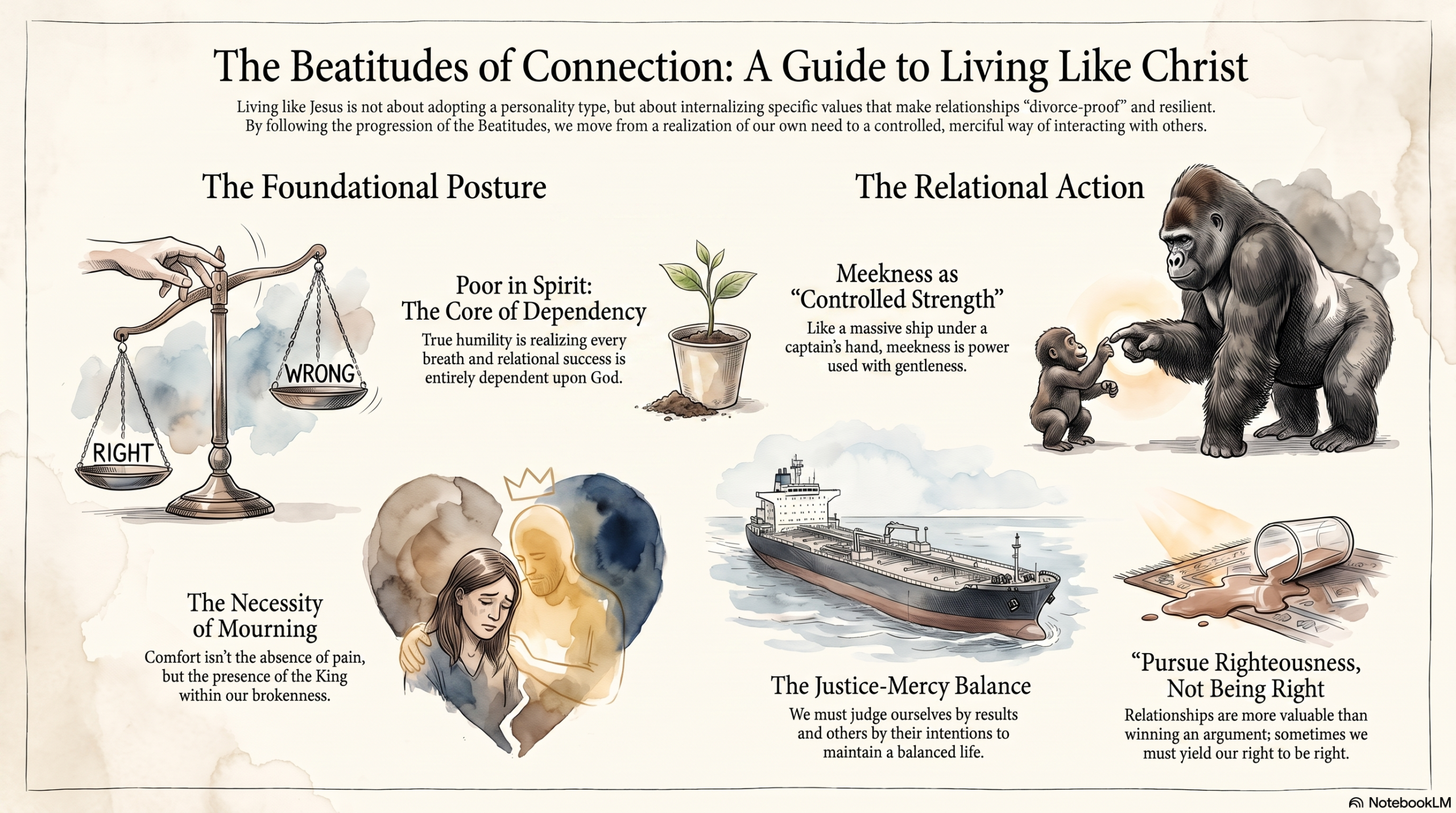
Beatitudes Infographic Blessed Life

The Heart of the Message Summary

In this sermon, Pastor Dustin Woolam examines the Beatitudes from Matthew chapter five to demonstrate what it means to truly live like Jesus in our daily relationships, marriages, and families. The core spiritual truth is that a shared, active pursuit of Christlikeness—marked by humility, meekness, and mercy—has the power to make our relationships resilient and aligned with God's kingdom. Rather than using Scripture for self-validation, believers are called to let God's Word challenge their cultural assumptions and personal behaviors. The primary call to action is to surrender our pride, rely fully on the Holy Spirit, and practice controlled strength and active mercy in our homes and workplaces. By moving beyond good intentions and embracing the counter-cultural values of Jesus, we experience true spiritual transformation and build community that honors God.

TRANSCRIPT (word for word)

Welcome and Opening Prayer

Welcome to church. Let's pray and let's get cracking. Father, thanks for today. Thank you for the gift of your word and for the gift of your body. Lord, you've given us both so that we could be more like Christ. I pray that you would help us to listen with a pure heart. Father, I pray that the work of the enemy will be stopped, and the work of our own minds and our own busyness will be stopped. Holy Spirit, let our hearts be made ready for you. Lord, I pray for where we go forth. Just as your word says that it doesn't return void, Father, I pray that no enemy would come and steal the seed, that the seed would have good roots, and that it would land in good soil. Lord, we love you and we give you all our heart, all our mind, and all our soul. In Jesus' name, amen.

Understanding Bible Translations

All right, I don't know if we're going to have this on the screen. Kind of at the last moment, I decided to read from a different translation. Let me say something about Bible translations right quick before I read one. The interesting thing about biblical translations is that they're copyrighted, like a book. Like if someone writes a novel, they copyright that novel, and it belongs to them, and you would say, well, how can someone copyright the Bible? So for example, this New Living Translation is published by Tyndale, I believe. Yes, Tyndale owns the rights to the English version of the text in the New Living Translation. That's both good and bad. It's good in the sense that they have to be responsible for their translation. We know who to go to and who has to be responsible. It's bad in the sense of asking why somebody owns the text of Scripture, and it's interesting because it forces translation decisions based on the fact that a certain percentage has to be a little bit different from another version of the Bible.

If all of that worries you, be at ease. I'll tell you why in a second. If all of that means nothing to you, be at ease; we're going to pass by this in a second. Essentially, what they're copyrighting is the work of the translator—someone who did a lot of work and did a whole bunch of stuff. It's just the way modern society works. The reason we don't have to really be too concerned is because in the world that we live in in 2026, if you get a Bible app—the app I've switched to is called Life Bible. I got rid of YouVersion because I had some questions about some translations they were choosing and also some of the Bible studies that were on there, so I transitioned from that. I said Life Bible app; let me not misquote it because in the midst of all these things, I don't want to lie to you—it is Life Bible, not Living Bible.

With this Life Bible app, if you go to your Bible app and scroll through the available translations, you're going to have to scroll a lot to get to the bottom of the English versions. Here's why that's helpful. If you read the same verse in these different English translations, you get a sense of what the original language meant without having to learn the original language. You can just learn English. Read five, six, or ten different English versions of a chapter, a book, or a verse, and get some sense of the full scope of what the original author was trying to communicate. So it's good, and it's good that we have this accountability. All of that said, I have a translation that you will not find in those apps. It's from an Anglican bishop who is a New Testament scholar and a historian. This is called the Kingdom New Testament, and the name of the man who translated it is N.T. Wright. The Message was paraphrased by Eugene Peterson, but this translation is from N.T. Wright. I'll read his version and we'll talk through it. It's an actual translation, not a paraphrase. Then we'll also look at the New Living Translation.

Reading the Beatitudes from the Kingdom New Testament

We're going to start in Matthew chapter five. I want to talk about following along with what Scott said last week. What does it look like to walk and live like Jesus or in Christ? How did Jesus open up these three chapters in the Sermon on the Mount? Matthew gives us this sermon. How did Jesus open up these three chapters? We're going to start in verse one. So when Jesus saw the crowds, he went up the hillside and sat down. His disciples came to him. He took a deep breath and began teaching:

"Blessings on the poor in spirit; the kingdom of heaven is yours. Blessings on the mourners; you're going to be comforted. Blessings on the meek; you're going to inherit the earth. Blessings on people who hunger and thirst for God's justice; you're going to be satisfied."

Justice often gets translated as righteousness.

"Blessings on the merciful; you will receive mercy yourselves. Blessings on the pure in heart; you will see God. Blessings on the peacemakers; you'll be called God's children. Blessings on people who are persecuted because of God's way; the kingdom of heaven belongs to you. Blessings on you when people slander you and persecute you and say all kinds of wicked things about you falsely because of me. Celebrate and rejoice; there's great reward for you in heaven. That's how they persecuted the prophets who went before you."

Christlikeness as the Foundation of Relationships

Jamie and I had a conversation earlier this week, and then it turned into a conversation with my breakfast friend, who was another Scott. I know five Scotts, so it's another Scott. If I say Scott, I don't mean the guy we saw last week. There are things that, if we distill it all the way down, are true, but there are things that we bracket onto to make it work. I've said for a lot of years—and this is a bold statement, I stand by it, and I'll argue with anyone who says different—if both people in the marriage are doing their best to be like Jesus, your marriage is divorce-proof. A hundred percent, you will not get divorced if both people are doing their best to be like Jesus.

You might ask, "Dustin, how can you say that? Because I'm trying to be like Jesus, and I don't like the way my husband's trying to be like Jesus." Well, there's a whole bunch of different ways and different things that Jesus teaches us to be. But if your heart is to be like Jesus, if your heart is to do the will of God, and we read the Old Testament and it says God hates divorce, then that pursuit matters. Now, is that all you need? Maybe at the core of everything, that's all that you really need, but what are the tools that we use to make that work? That is the question.

I don't just mean marriage—Jamie and I were talking about marriage, but this is true about being a parent, being a good employee, being a good employer, or being a member of a family. Whatever the case is, if you want to make something work and humans are involved, if all of those humans together are trying to be like Jesus, it will eventually work. Now, I'm not saying it'll be easy. I'm not saying it won't be rocky. I'm not saying things won't happen. As Jamie and I were talking, I was thinking through the Beatitudes and specifically toward marriage. So, I'll probably make a lot of marriage references today as we work through this.

Allowing the Word of God to Challenge Us

But this is the thing I want to say: the Lord is always faithful. There are things in life where when we struggle, when we wrestle, when we fight, it feels like the Lord is not faithful, it feels like He's not doing something, but a lot of times, what that means is that God's not doing what I want Him to do. Let me say this: if you read the Bible and it never challenges you, and you always like what it says, you're probably not reading the Bible right. If you go, "Oh, here's the verse of the day," and it always means something that you like, you're either closer to Jesus than any human has ever been, or you're not reading the Bible. You should read the Bible.

When I read something in the Bible that I don't like, I don't need to figure out how to make the Bible say what I want; I need to figure out how to make my life do what the Bible says. We need to transition our understanding and move into the New Living Translation to look at these specific descriptions Jesus gives.

Poor in Spirit: Embracing Total Dependency on God

Let's look at what it means to be poor in spirit. Matthew chapter five, verse three says, "God blesses those who are poor in spirit and realize their need for him, for the Kingdom of Heaven is theirs." Being poor in spirit is a recognition of complete dependency on God. It is not about pride or boasting in our own capabilities, but boasting in our need for Christ. It is like Paul in Second Corinthians, who talked about boasting in his weakness so that Christ's power could rest on him.

This applies directly to our relationships. There are times when you have to take a step back and say, "God, if you don't help me, I'm gonna mess this up." There have been times where Jamie and I have been at odds with each other, and I've just had to say that in my heart. We must recognize our deep need for Him in our marriages, our parenting, and our daily lives.

Mourning and the Promise of Comfort

Jesus then says, "God blesses those who mourn, for they will be comforted." This speaks to being broken over the things that are not working in our lives and in our world. When we experience grief, loss, or brokenness, Jesus promises that we will not be left alone. We will experience the comfort of His presence.

Meekness: Power under Control

Next, Jesus says, "God blesses those who are humble, for they will inherit the whole earth." Other translations use the word "meek". That idea of meekness is like controlled strength. Think about driving a semi-truck. There is a lot of strength in that vehicle; it can pull heavy loads and run over a bunch of stuff. If you're not careful, you can just mush street signs or whatever, but it is under control because it is being driven. Or consider a big giant ship—somebody somewhere is driving an aircraft carrier. It represents massive strength, yet it is guided precisely.

Another picture of meekness is a mother bear. People talk about mama bears all the time—"don't get between a bear and her cubs." I remember a story my dad told. He was at a zoo and could see in the distance a raw demonstration of a bear's power, yet that strength is controlled when dealing with her own cubs. Meekness means picking our battles, controlling our strength with our words and emotions, and choosing to be kind and gentle when we have the option to be otherwise. You are not practicing meekness if you are kind to a baby simply because you are too weak and frail to lift the baby to begin with. Meekness requires having power and choosing to restrain it. Across all relationships, if we are going to be like Jesus, we must be meek, kind, and gentle.

Choosing Righteousness Over Being Right

A guy once told me, "Dustin, sometimes you have to give up your right to be right, and you just need to pursue righteousness." It doesn't mean that the truth doesn't matter. It just means that the relationship is more valuable than you being right. You don't have to give up on the truth or deny it, but you do have to ask yourself why you are fighting certain battles. Why did I have to clean this pan? Why did I have to do this or that? I'm not saying give up on the truth, but I am saying let's pick our battles. I can control the strength that I have. I can control my strength by being kind and gentle to a baby, to my wife, or to anyone else. I can also control my strength with my words.

The Balance of Justice and Mercy

Jesus says, "God blesses those who hunger and thirst for justice, for they will be satisfied." There is an important dynamic regarding trying to figure out which one of your kids is guilty. A guy told a story about his family where his two kids were playing video games. He came into the room and saw a half-gallon of chocolate milk tipped over and spilled all over the carpet. He said, "Do you all not see this?" and they responded, "Was it me?"

We need both justice and mercy working together. You cannot just have justice, and you cannot just have mercy; you must have both for a balanced life. It is a full-hearted, full understanding of justice that helps me establish good boundaries and structure around my life. It allows me to say, "You're not going to treat me this way. You're not going to act this way toward me. I will be merciful, and I love you, but you don't get to treat me like this." Jesus says, "God blesses those who are merciful, for they will be shown mercy." We often have a tendency of judging ourselves based on our intentions—"I meant to do this, and I hoped for that"—while judging others based strictly on their results. But there is an old saying: "The road to hell is paved with good intentions." True mercy requires us to extend the same grace to others that we desire for ourselves.

Transforming Our Deepest Values

To live like Jesus means desiring to be like Him more than anything else. The Bible does not focus on giving us Jesus' personality type—whether He was an introvert or an extrovert—but it explicitly gives us His values and what is important to Him. Spiritual maturity happens when we cooperate with the Holy Spirit to change our core values so they align with His.

The Necessity of the Word, Spirit, and Community

To grow in this way, we need both the Word of God and the Spirit of God, expressed and lived out through the Body of Christ. There are things that no amount of my own private Bible reading will ever give me outside of Christian community. We need each other to truly practice what Jesus teaches.

Closing Pastoral Prayer

Lord, there are things that curses follow, and there are things that blessings follow. Lord, we want to do the things that blessings follow, as you say, Jesus, that we should make disciples and teach them to do what it is that you say. So Lord, we want to do what you say. Where we have failed in that, show us, Lord. Maybe we are failing because we don't understand, maybe we're confused, maybe we didn't see it, or maybe we didn't realize it was that big of a deal. Because Lord, like Scott said last week, we can be best re-tailers. So Lord, maybe we don't know. Help us to know, fill us with your Spirit, and guide our steps. Amen.


Tags


You may also like

Leave a Reply

Your email address will not be published. Required fields are marked

{"email":"Email address invalid","url":"Website address invalid","required":"Required field missing"}