
Unshakeable Happiness | Beatitudes Part Two | It Matters How You Live

Get the Study Guide for This Week's Message

The New Testament for Everyone, Third Edition, Hardcover: A Fresh Translation

Pastor Dustin Woolam
The Heart of the Message Summary

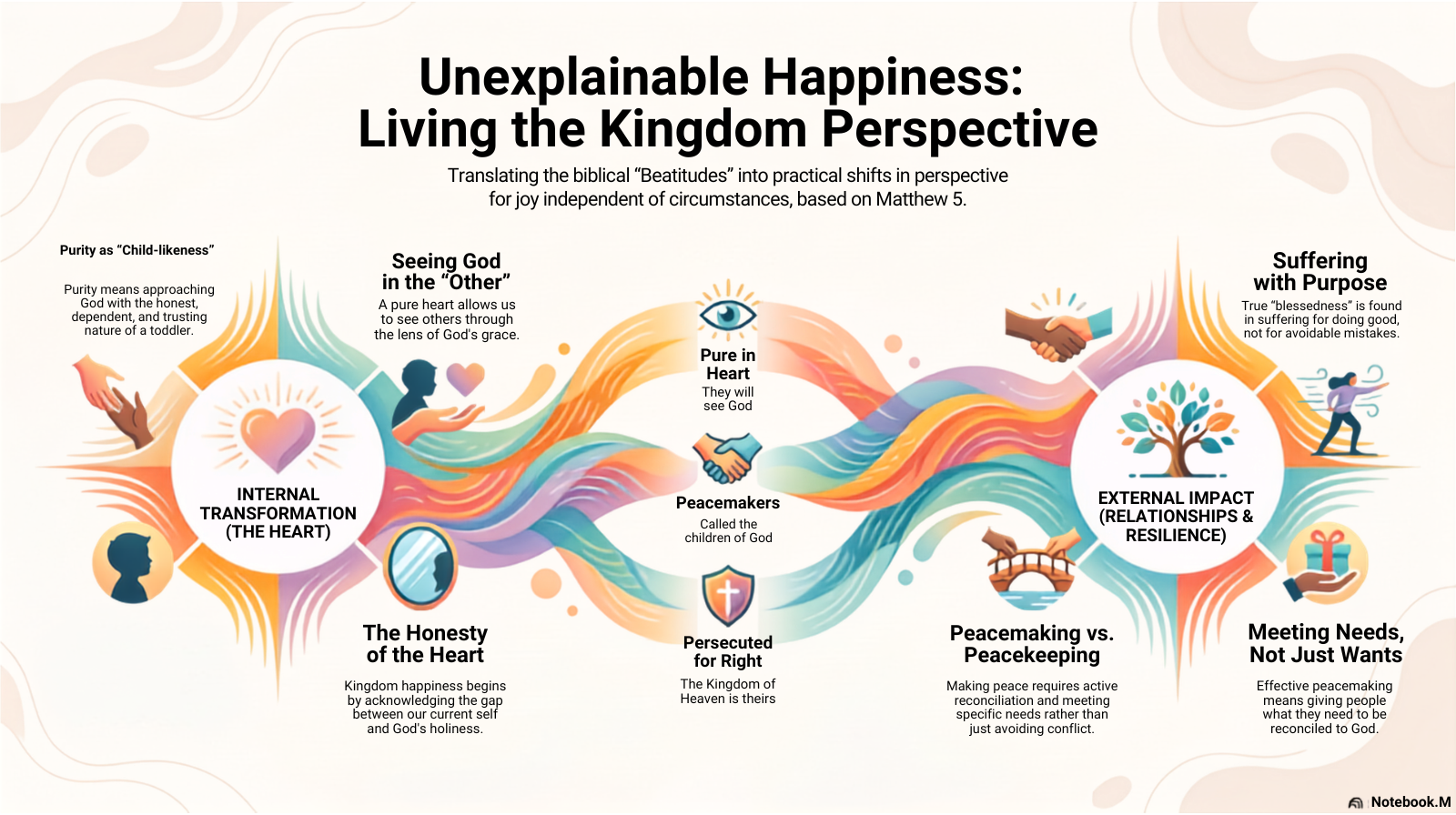
In part two of his series on the Beatitudes, Pastor Dustin Woolam calls the church to experience the radical, unexplainable joy of living under kingdom reality. True spiritual transformation occurs when we stop demanding that our circumstances make us happy and instead allow the Holy Spirit to align our perspectives with God. We are called to embody active purity of heart and step into the hard, messy work of being peacemakers rather than mere peacekeepers. Furthermore, we must embrace a healthy biblical view of suffering, understanding that when we are persecuted for doing right, our ultimate reward is secure in Christ. The primary call to action this week is to let the Lord pick us up to see our lives, our relationships, and our struggles from His sovereign perspective, stepping forward in grace.

TRANSCRIPT (word for word)

Experiencing the Story of Jesus Fresh

Good morning, welcome to church. I was thinking before I get started, I have come to really enjoy listening to the Bible. I've downloaded a couple of different apps with different narrators, but I've been listening through the Book of Matthew. I was reminded of something that I heard a long time ago that when I first heard it, I was surprised. I thought, "That's wild." As I was listening to Matthew, I had a similar experience.

There is a movie, I think it's called the Jesus movie, or something simple like that. It has been translated into something like a hundred different languages, and they use it for missionary purposes. They take it to show the life of Jesus, visiting places where people have barely seen movies at all and have not heard the story of Jesus. Or, if they have heard the story of Jesus, it has been really limited. They will play this movie and then they will talk to people about coming to belief in Jesus.

The story goes that they went to this one tribe and set up the projector. They were showing them this film, starting with the life of Jesus in the beginning, all the way through. Then it came to the point where Jesus is crucified, and they had to stop the movie because the crowd was rioting. They were saying, "There's no way they killed this guy. What's happening?" They calmed everybody down and said, "Hold on, it gets better," because the people had come to really enjoy Jesus. They got everybody to sit down and finally told them, "Just hold on, let's watch the movie." They finished the movie, and at the end of the film, when Jesus rises from the dead, the crowd just exploded in celebration because this guy who shouldn't have died actually wins.

I was listening to Matthew on an app called Streetlights, if you are interested. It uses the New Living Translation, and they have done a little bit of voice acting. Different people read different parts, and there is music in the background. You can tell the early books because the music is less good, but they have done most of the Bible now, so some of it sounds really cool. That is what I am listening to right now, not really thinking deeply about it other than trying to listen to the story of Matthew.

It gets to the section titled the death of Jesus, and you think, "Why would they kill this guy?" I had that moment where, even though I have grown up in church, listening to everything Jesus did all in one sitting—well, I was on day two, in the second half of Matthew—I found myself asking, "Why would they kill Jesus?" I know all of the theological and historical reasons that they killed Jesus. But in that moment, there was this jarring sense of, "This is a really good guy, why would they do this?"

As we look into part two of the Beatitudes today, getting into what it means to be persecuted for or because of Jesus, let us hold that dissonance in our minds. Someone from that time period and culture would immediately understand what Jesus had done that would make the Pharisees mad enough to kill him. But for us in our world, we look at it and say, "He healed people, he did good things, he loved people, why would they kill him?" Let us hold onto some of that dissonance.

Reading the Beatitudes

Let us go to Matthew chapter five. I am going to read it twice. This first version is from a translation called The Kingdom New Testament. It is a translation done by a biblical scholar and historian. I like the way it reads. We will start in Matthew chapter five, verse one:

When Jesus saw the crowds, he went up the hillside and sat down. His disciples came to him. He took a deep breath and began his teaching.

Blessings on the poor in spirit, the kingdom of heaven is yours.Blessings on the mourners, you're going to be comforted.Blessings on the meek, you're going to inherit the earth.Blessings on people who hunger and thirst for God's justice, you're going to be satisfied.Blessings on the merciful, you'll receive mercy yourselves.Blessings on the pure in heart, you will see God.Blessings on the peacemakers, you'll be called God's children.Blessings on people who are persecuted because of God's way, the kingdom of heaven belongs to you.Blessings on you when people slander you and persecute you and say all kinds of wicked things about you falsely because of me. Celebrate and rejoice, there's a great reward for you in heaven. That's how they persecuted the prophets who went before you.

Let us pray, and then we will switch translations.

Father, thank you for today. Thank you for the gift of your Word that speaks life into us and gives us direction. Thank you for the body that you have put us in that helps us to live a healthy, faithful life for you and keeps us all together in you. Father, I pray that in this time you will come and speak to us. Holy Spirit, teach us. Let what is of you remain, and let what is of our own flesh or the enemy just fade away. We give you this time and our hearts with full expectancy that your Word will not return void, just as you promised. In Jesus' name, amen.

Truth, Mercy, and the Next Right Step

Last week, we started looking at the Beatitudes from this fundamental principle. This is the statement I made and expanded out, and I think it is a true statement: if two people are married and both people are actively trying to be like Jesus with all their hearts—or even a little bit with the Holy Spirit's help, because Jesus promised the Holy Spirit would come and help us—your marriage is divorce-proof.

All of your relationships—whether it is parent and child, cousins, grandmothers, friends, coworkers, or business partners—if all the people involved are pursuing Christlikeness with a full heart, those relationships won't always be easy. I am not foolish. There will be struggle. I have been married for 26 years; I understand what it is to fight with my wife who loves Jesus when I am also loving Jesus. I am not saying it will be all smooth sailing, but your relationships don't have to break. In fact, you can anticipate that they won't break.

That is not an indictment on anyone. The Bible and God find us right where we are. In John chapter eight, there is the woman caught in adultery. The people bring her, and there is never any debate about whether or not she was an adulteress at that moment. But Jesus has a showdown with these guys and says, "Whoever is without sin among you, let him throw the first stone." Then he asks the woman, "Where are your accusers?" She says, "They're all gone." Jesus offers this wonderful sentiment: "Neither do I condemn you; go and sin no more." He is not saying she didn't sin, and he is not saying her sin is okay. He met her right where she was in her sin, caught in the act, and his response was simply to stop it and not do it anymore. He doesn't beat her up, he doesn't drag her through the mud, he doesn't whip her, and she doesn't have to pay for it for the rest of her life; she just has to change her ways.

If we find ourselves reading the Bible and feeling challenged by the scriptures because of what we are reading, that is not the end of the world. Today we are going to talk about the pure in heart and the peacemakers. If we find that we are not these things, or if last week we found that we were lacking, that is okay. We just have to move in the direction God wants us to move. There is truth, but there is also mercy. If I now have the truth, I am accountable for the truth. What am I going to do with it? I am just going to take the next right step. I don't have to build a giant building in one day. I just have to establish the foundation and take the necessary steps.

As we go through this, if you feel that twinge of realization that you are not quite that person yet, lean into it. Let the Lord shape you. Don't feel guilty; just let the discomfort move you forward.

Purity of Heart and Coming to God Like Children

We are going to pick up where we left off, reading from the New Living Translation. Matthew chapter five, verse eight says:

God blesses those whose hearts are pure, for they will see God.

I thought a lot about the pure in heart. What does that mean? Who are the pure in heart? I prayed about it and looked at it, and I think Jesus answers that question in Matthew chapter 19. In verse 13, it says:

One day some parents brought their children to Jesus so he could lay his hands on them and pray for them. But the disciples scolded the parents for bothering him. But Jesus said, "Let the children come to me. Don't stop them, for the Kingdom of Heaven belongs to those who are like these children." And he placed his hands on their heads and blessed them before he left.

I was thinking about that because it says the pure in heart will see God, and Jesus says the kingdom of God belongs to those who are like children. You may have heard before—and if you believe this, I am sorry, it is not explicitly in the Bible; it is not necessarily wrong, but it is not in the text—that this passage is about having faith like a child. It is actually about being like a child.

A couple of weeks ago when Scott was here, he shared the image of toddlers. That is the imagery. When my brother and I were young—we had to be in junior high or early high school, maybe I was 15—my mom and dad had friends named Leo and Alice who unexpectedly had a son late in life named Samuel. For whatever reason, my brother and I would end up supervising Samuel on occasion. I hesitate to say babysitting because I am a dude and it doesn't feel real manly to say I was babysitting, but let us be real: we were babysitting. Samuel was young, maybe five, six, or seven years old. My brother was also young—if I am 14 or 15, he is 11 or 12. We were talking with Samuel at the house, and he was showing us some kicks, saying, "Look, I can kick." My brother asked him, "Can you kick with both feet at the same time?" Samuel said, "Sure I can!" He tried to kick with both feet at the same time and immediately fell over. We all had a good laugh.

That is how kids are. "Hey, can you do that?" "Sure I can!" I think about Peter saying, "Jesus, if it's you, call me out on the water." Peter gets out of the boat and walks out there. There is a one-person play done by Dean Jones called St. John in Exile. In part of it, the character says, "We were foolish enough to believe in Jesus and just trust him at what he said."

Sometimes coming to God as a child really just means understanding the gap between us and God. If the best I can do is be God's kid, and in comparison to God, I am lucky if I am a toddler, then being pure in heart contains that absolute honesty. There is a purity in a child. If they are angry, they are angry. If they are happy, they are happy. Whatever they are, they are simply what they are.

There is another aspect to this. If you read Deuteronomy, Leviticus, and Numbers, where they lay out all the rules for the temple and the sacrifices, we see all the things that had to happen so that people could be pure in the presence of God. Later, Jesus does all of that on our behalf so that we are made pure because of him. This sense of purity comes both from understanding who we are and from understanding who God is.

If I understand that God is good, right, gracious, holy, and that without Christ I would die in His presence, it changes everything. In Exodus, Moses is on the mountain having a wonderful experience with God. There is lightning, thunder, and rocks being written on. Moses says, "God, I want to see you." God responds, "I'll kill you if you see me. You're just not holy; you're not worthy." God places him in the cleft of a rock, and the text says God passes before him. Depending on how you translate it, it says he sees God's after-parts, meaning he sees the residue of God having passed by. That experience completely changed Moses—in the movies, Charlton Heston suddenly goes gray, but the Bible says his face glowed so brightly he had to cover it with a veil because of the residual presence of God.

The pure in heart who will see God understand themselves and they understand God. When we pursue Christ, attempt to be pure in heart, and let the Holy Spirit make us pure, we also begin to see other humans as they are within the light of God. When I look at my wife, my kids, or my coworkers and realize that at best, we are all toddlers, it changes my perspective. When my kids were little and I would carry them and they would get sick on my clothes, I wasn't angry at them. I might have been unhappy with the situation, but it wasn't my son's fault that he had a sick stomach and vomited on me as a baby. I am not mad at him, even if I am mad at the situation.

We are blessed if we are pure in heart. If I understand my relationship with God, there is a blessing there. But there is also a blessing in understanding that my brother or sister in Christ is also working out their faith with fear and trembling. If I am trying to be like Jesus, trying to be pure in heart, and understanding who God is, who I am, and who my brothers and sisters are, then a sense of grace comes that makes it easier to live together.

I don't always know what the Lord is working on in people. I have told this story a couple of times: I had a moment where I realized I was depressed. Some months later, I was listening to a sermon where the speaker claimed everyone can be healed of their mental health problems if they just ask God. I wasn't sure I completely agreed with that premise, but I prayed, "Lord, I don't know if it's true that everyone can be healed, but if you want to heal me, I'll take it." I haven't been depressed from that day to this one. Does that happen to everybody? God knows; I don't know. But that does not mean the devil hasn't still tried to come and talk to me, and it doesn't mean there aren't still dark times where I have to resist those things. If that is true in my life, then surely it is true in everybody's life. Everyone has something they are wrestling with. Sometimes it is not what you are wrestling with, so it becomes difficult to understand. You wonder, "Why is that person wrestling with this? It drives me nuts." If one kid cannot get their left shoe on every day, the parent simply helps them with the left shoe and teaches them. Or, if you have siblings, they help each other get dressed. As we wrestle with this, wanting to see God and be pure in heart, let us not forget about the person to our left and to our right. Let us not forget about the people who are depending on us in relationship so that we can all serve God together.

Peacemakers vs. Peacekeepers

Jesus also says:

God blesses those who work for peace [or blessed are the peacemakers], for they will be called the children of God.

I was thinking about peacemakers and looking at Second Corinthians chapter five. As I was studying, I heard someone make a really great distinction: there is a huge difference between a peacemaker and a peacekeeper. You can keep the peace much easier than you can make peace. If there is already conflict, trouble, and dysfunction, how do you actually make peace?

Let us read Second Corinthians chapter five, starting in verse 11:

Because we understand our fearful responsibility to the Lord, we work hard to persuade others. God knows we are sincere, and I hope you know this, too. Are we committing ourselves to you again? No, we are giving you a reason to be proud of us, so you can answer those who brag about having a spectacular ministry rather than a sincere heart. If it seems we are crazy, it is to bring glory to God. If we are in our right minds, it is for your benefit. Either way, Christ’s love controls us [or compels us]. Since we believe that Christ died for all, we also believe that we have all died to our old life. He died for everyone, so that those who receive his new life will no longer live for themselves. Instead, they will live for Christ, who died and was raised for them.

So we have stopped evaluating others from a human point of view. At one time we thought of Christ merely from a human point of view, how differently we know him now! This means that anyone who belongs to Christ has become a new person. The old life is gone; a new life has begun! And all of this is a gift from God, who brought us back to himself through Christ. And God has given us this task of reconciling people to him. For God was in Christ reconciling the world to himself, no longer counting people’s sins against them. And he gave us this wonderful message of reconciliation. So we are Christ’s ambassadors; God is making his appeal through us. We speak for Christ when we plead, "Come back to God!" For God made Christ, who never sinned, to be the offering for our sin, so that we could be made right with God through Christ.

Jesus showed up and established the ministry of reconciliation. He makes the peace between God and humans. Prior to Christ, people would go to the temple, visit the priest, or a prophet would come to the people, and there would be sacrifices and offerings. Even then, they were just keeping the status quo, making sure things didn't get worse. God would still forgive people—we see Him forgiving David and others in the Old Testament—but there was no long-term victory over death and the grave.

Jesus comes and makes genuine peace between us and God. He doesn't just maintain an existing, distant coexistence; he makes a new and better way. We come to Christ, live in Him, experience Him, and God makes that peace between us. Jesus says, "Blessed are the peacemakers, because they'll be called the children of God." What more important peace is there than to help people be reconciled to God?

What does it look like to constantly try to reconcile people to God? It looks different in every situation. If I am trying to reconcile my child who lives with me to God, that looks like a lifetime of instruction. But sometimes it looks like a single interaction.

When I was in my early 20s, right before I was married—maybe I was 19—I had a Honda Civic CRX. It had two seats, was a lot of fun to drive, and probably wasn't very safe. A guy I went to church with, DJ, also had a little car that only had two seats. As we often did, a group of us were hanging out at IHOP late at night because there was nowhere else to be in Midland unless you wanted to go get drunk, which was not what we, as good church kids, wanted to do. We met random people there. One time we met someone, and she ended up coming with us to Hastings, which is no longer around. The cops showed up and asked DJ, "Why'd you kidnap this person?" He replied, "I didn't kidnap this person; I met her at IHOP and we came over here." I don't know why IHOP was the place to meet people, but for a while, it was.

One night, DJ and I were getting ready to leave IHOP. It was dark, past midnight, and these two guys asked for a ride home. I explained, "I only have one passenger seat." DJ said, "I only have one seat, too." We told them, "Great, we'll take you, you just have to tell us where to go." For whatever reason, I felt completely compelled to tell the guy in my car all about Jesus. That is not something I commonly feel driven to do in brief, single-serving interactions with strangers. I told him all about Jesus, and as I dropped him off, I said, "Hey man, this is the cost of the ride—you're going to hear about Jesus." DJ and I drove back to IHOP to talk, and it turned out DJ had done the exact same thing with the other guy in his car.

Sometimes, that is what being a peacemaker looks like: sitting and talking with someone you will never see again because God speaks to you, and you share His words to sow seeds of reconciliation.

Walking Through Sorrow and Avoiding Misdirected Peace

Sometimes being a peacemaker means walking with a family member or a friend through a really hard time while they wrestle with God. My wife had to do that with me. It was recently the six-year anniversary of my father's passing. When I found out he passed—and my brother didn't even know this until recently—I stopped keeping alcohol in my house entirely because I realized I am always just one bad day away from being super drunk. I have no interest in having it around. When I told my brother, he was shocked.

After my dad died, my wife had to walk with me through a year of me being angry and drinking because I was mad at God and mad at Christians. I somehow still believed in God; it always amuses me when people are furious at God but claim they don't believe in Him. If you don't believe in Him, being mad doesn't make sense. But I was furious. My wife walked patiently with me while I figured out my own heart, my feelings, my experiences, and everything I felt about God. Then God added other people to my life to help me walk through my anger at the church.

If you have ever been hurt by the church, on behalf of every Christian ever, I want to apologize to you. I do not think that behavior is God's will; I would actively say it is not. When my dad was sick, well-meaning people who loved me would walk up and say, "God's going to heal your dad." Well, it has been six years since he died, so it turns out that wasn't the case. I didn't want to hear those clichés. I just wanted to go to church and be anywhere but inside my own head with my own sorrow. People will come to you and say well-meaning things to encourage you, and it sounds great, but the truth is, it often just makes them feel better to say it. It isn't actually for you.

I remember when my dad's father died a long time ago. He was raised Methodist but became a confirmed atheist later in life. At the time, I was working as a youth pastor, and I had a shirt that read "Product of Intelligent Design" that I liked to wear. Without thinking about it, I wore it to go see my grandfather who was dying of cancer. He was a great, intentional guy who had family members come in to say goodbye. I went into the back bedroom to talk to him, and he was very tired. He looked at me and said, "Dustin, I see your shirt." I said, "Granddad, we don't have to talk about all this right now; we don't need to do this." He said, "No, Dustin, I want to talk to you." He told me, "I know people say that if I just say the words, I can go to heaven. But I don't think it matters unless you mean it. I just want you to know that if I can say the words and mean them before I die, I will."

I have no idea where my grandfather ended up, but I have peace knowing that he went with his eyes open to what the truth was. After he passed, fifty people wanted to come tell me he was definitely in heaven with Jesus. But I already had a peace that the Lord had given me in simply not knowing.

A lot of times, we as Christians stumble and fall in our effort to make peace because what we really want is comfort for ourselves. We feel awkward around someone else's grief, so we say, "God is going to heal your dad," or "I had a vision of your grandfather in heaven." That doesn't actually help. Can we just weep with those who weep, like the Bible tells us to do? Personally, that didn't bring me peace. I want to believe in something I can know, not in something someone has guessed or manufactured to ease the tension.

As we think about making peace, let us not give people merely what gives us peace. Believing my father would be healed or that my grandfather was in heaven gave those onlookers peace in the moment, but it wasn't what I needed. I love those people, and God blesses them for their kindness, but their kindness was misdirected. As peacemakers, we need to make peace with our spouses, our kids, and others in the way they need it, not the way we want to give it.

When Christ came, he didn't make peace based on his own convenience; he filled the gaps we couldn't meet. He lived a perfect life, died, rose again, and ascended to heaven because we couldn't, establishing the peace we required to be with Him.

There is a silly joke about this that I sent to my wife. When my wife gets hungry, she gets really angry. I look at her and think, "This is not the woman I married, I need to wait." Once she eats, things are good. She will tell you that freely. In my own life, when I come home from work stressed and worked up, she knows I just need to be left alone. I need time; she needs food. We have to work that out. If I want to make peace with her when she's upset, leaving her alone isn't the answer—taking her to dinner or buying her some M&Ms is how I make peace with her, even though that means nothing to me. Conversely, when I need peace, I want to be left alone. If she keeps asking, "Are you okay?" I am like, "Yes, will you just please stop?" In those moments, she leaves me alone until I am done being cranky, and then I will come out, be nice, and apologize for being cranky. Peace is made by understanding what the other person actually needs.

Jesus met people exactly where they were with what they needed. When a leper came to him, he healed the leprosy. But when the four friends lowered their paralytic friend through the roof, Jesus looked at him and said, "Your sins are forgiven." It was only later that Jesus healed his body—not because the man's primary eternal need was to walk, but to prove to the angry religious leaders that he had the divine authority to forgive sins. They were muttering, "How can this guy forgive sins? Only God can do that." Jesus essentially said, "Just so you know that I can forgive sins, get up, pick up your mat, and walk."

A Healthy View of Biblical Suffering

Let us look at the final Beatitudes in Matthew chapter five, verses 10 and 11:

God blesses those who are persecuted for doing right, for the Kingdom of Heaven is theirs. God blesses you when people mock you and persecute you and lie about you and say all sorts of evil things against you because you are my followers. Be happy about it! Be very glad! For a great reward awaits you in heaven. And remember, the ancient prophets were persecuted in the same way.

Let us look at Acts chapter four to see this in action. Peter and John go before the religious council, get into serious trouble, and then pray for boldness. In Acts chapter four, verse 14, the council is conferring:

"What should we do with these men?" they asked each other. "We can't deny they have performed a miraculous sign, and everybody in Jerusalem knows about it. But to keep them from spreading their propaganda any further, we must warn them not to speak to anyone in Jesus' name again." So they called the apostles back in and commanded them never again to speak or teach in the name of Jesus. But Peter and John replied, "Do you think God wants us to obey you rather than him? We cannot stop telling about everything we have seen and heard." The council then threatened them further, but they finally let them go because they didn't know how to punish them without starting a riot, for everyone was praising God for this miraculous sign—the healing of a man who had been lame for more than forty years.

Later on, they have a similar experience where they are arrested and beaten. The text says they left the council praising God that they had been counted worthy to suffer dishonor for the name of Jesus.

The Bible says that if you suffer for doing wrong, there is no credit in that. If you commit a crime and pay the penalty, you are not suffering for Jesus; you just got caught. But if you are suffering for doing good, that holds weight.

This goes right back to the death of Jesus. Jesus did all these good things, and they still killed him. There is a classic question: was Jesus killed by the Romans and the Jews, or was he killed by the devil? The answer is yes. In First Corinthians, Paul explains that the spiritual powers and principalities driving the human leaders were the ultimate reason Jesus was crucified. You can see an escalation in the plots to kill Jesus right after his declaration at Mount Hermon, where he spoke about what God was going to do, how He was going to fix things, and how the gates of hell would not prevail. After that, there is a fast track to get Jesus executed. Jesus wasn't just provoking the Pharisees and the Sadducees; he was provoking the devil as well.

The Bible tells us that if the rulers of this age had known what they were doing, they would not have crucified the Lord of glory. Looking back through the lens of the cross, God's plan of salvation in the Old Testament becomes clear, but in the moment, they did not understand that the Messiah was supposed to die. The devil and his demons had no idea; they thought they were winning. As a kid, I used to wonder, "Why would the devil kill Jesus? That makes him a moron. It's so clear in Isaiah that when Jesus dies, he wins." But First Corinthians clarifies that they killed him not knowing what the cosmic outcome would be.

We see Jesus suffer and die for doing good, for being the Messiah, and for being exactly who he was supposed to be. The Bible says we are blessed when that happens to us. We are not blessed when we suffer because of our own foolishness. If you receive a thousand dollars in the mail and you have a thousand-dollar bill due, but instead you go spend that money on something else, you will face double the interest or penalties. You aren't suffering for Jesus in that moment; you are suffering because you made a poor financial decision. God can certainly save us from our mistakes, but if we want a healthy, biblical view of suffering, we must recognize the difference between suffering for the sake of Jesus and suffering because we need Jesus to rescue us from our own bad behavior.

It is not a blessing simply to have a miserable life. Some people have taken this concept to an unhealthy extreme throughout history. There was a group of ancient monks, the Desert Fathers, who lived on top of isolated pillars. They would find a massive stone pillar, build a tiny platform, wrap a chain around their waist, secure themselves to the top, and just live up there in the elements because they believed they were suffering for Jesus. No, my guy, you are suffering because you chose to live on top of a rock. That is not the same thing.

A healthy view of suffering is vital. If all we expect from the Christian life is rainbows, butterflies, songbirds, and a Disney princess wonderland, that is bad theology. That is a description of the new heavens and the new earth, but it is not the reality of Christianity today. At the same time, Christianity is not a permanent "woe is me" mentality where we walk around beat up, sighing, "Of course my car broke down, it's because I love Jesus." No, maybe your car broke down because you didn't change the oil.

When we face genuine persecution for Christ, we will find strength in community. History is full of believers facing suffering together. The Coptic Church in Northern Africa has faced martyrdom so consistently throughout history that they traditionally name their children after martyrs so that they will grow up with the spiritual strength to die for their faith if called upon. We don't generally have to face that level of severity here. For most of us, the worst thing that happens is someone hears we are a Christian and immediately assumes we are the kind of person they don't like. Someone says hurtful words, and our feelings get hurt. We could afford to be a little tougher. But there will also be times of real consequence where you don't get the job, the promotion, or the opportunity because people learn you love Jesus. That is genuine persecution, and the Bible promises you are blessed when it happens because the Lord will intimately care for you. We sang this morning about the goodness, faithfulness, and kindness of God, and how He watches over us.

Unexplainable Joy

The core idea behind the word blessed is to be glad, joyful, or exceedingly happy. It describes the kind of happiness that occurs when you receive incredible news and you catch yourself smiling without even realizing it. This joy simply swells up out of your soul. Jesus says that is what this kingdom blessing is. There is a translation that replaces the word blessings with the phrase happy is the one.

Let us look at the list through that lens as we close:

Unexplainably happy are the poor in spirit. Unexplainably happy are the mourners. Unexplainably happy are the meek. Unexplainably happy are the people who hunger and thirst for justice. Unexplainably happy are the merciful, the pure in heart, and the peacemakers. Unexplainably happy are the people who are persecuted because of God's way.

All of these individuals possess a happiness that defies earthly explanation. Why? Because we will be comforted, we will inherit the earth, we will be deeply satisfied, we will find mercy, we will see God, we will be called children of God, and the Kingdom of Heaven belongs to us. Verse 12 tells us to celebrate and rejoice because a great reward awaits us in heaven, following in the footsteps of the prophets.

We are not called to live in a fantasy world. The broken world we inhabit is very real, but we do not have to interact with it on its terms. We can interact with it the exact way Jesus did.

As we read the Beatitudes and consider how we interact with other human beings, ask yourself: do I possess this unexplainable happiness? If you don't, it may be because you are viewing your circumstances wrongly and need to align your perspective with God's Word. You aren't necessarily an evil person; you might just be missing God's vantage point.

Let us pray.

Father, thank you for the gift of your Word. I pray that all of us would hear what you need us to hear and learn what we need to know. As we strive to be the kind of people the Beatitudes describe as blessed and happy, help us to look at those around us. How do I live in deep community with my brothers and sisters, and even with people who are far from you? How do I become a true peacemaker? How do I maintain purity of heart and live like a trusting child in your kingdom? How do I celebrate and maintain joy when facing opposition for your name?

Ultimately, help us to see everything from your perspective. We are often like a very short child running through rows of chairs, unable to see over the obstacles to know where we are going. But when a parent picks that child up, they can suddenly see the whole room and understand the path. Lord, pick us up today so we can see our lives from your perspective and understand where we are going. Help us to both keep the peace and make the peace. When we mourn, remind us that comfort is coming. When trials happen, help us not to respond the way we did before we met you. Change us, Lord, and teach us how to respond. Where we haven't learned yet, please be patient and teach us. I pray your blessing, goodness, and kindness over every person here. In Jesus' name, amen.


Tags


You may also like

Leave a Reply

Your email address will not be published. Required fields are marked

{"email":"Email address invalid","url":"Website address invalid","required":"Required field missing"}