
IT'S IMPORTANT WHAT YOU BELIEVE | MADE IN THE IMAGE OF GOD
Pastor Dustin Woolam | Recorded January 11, 2026
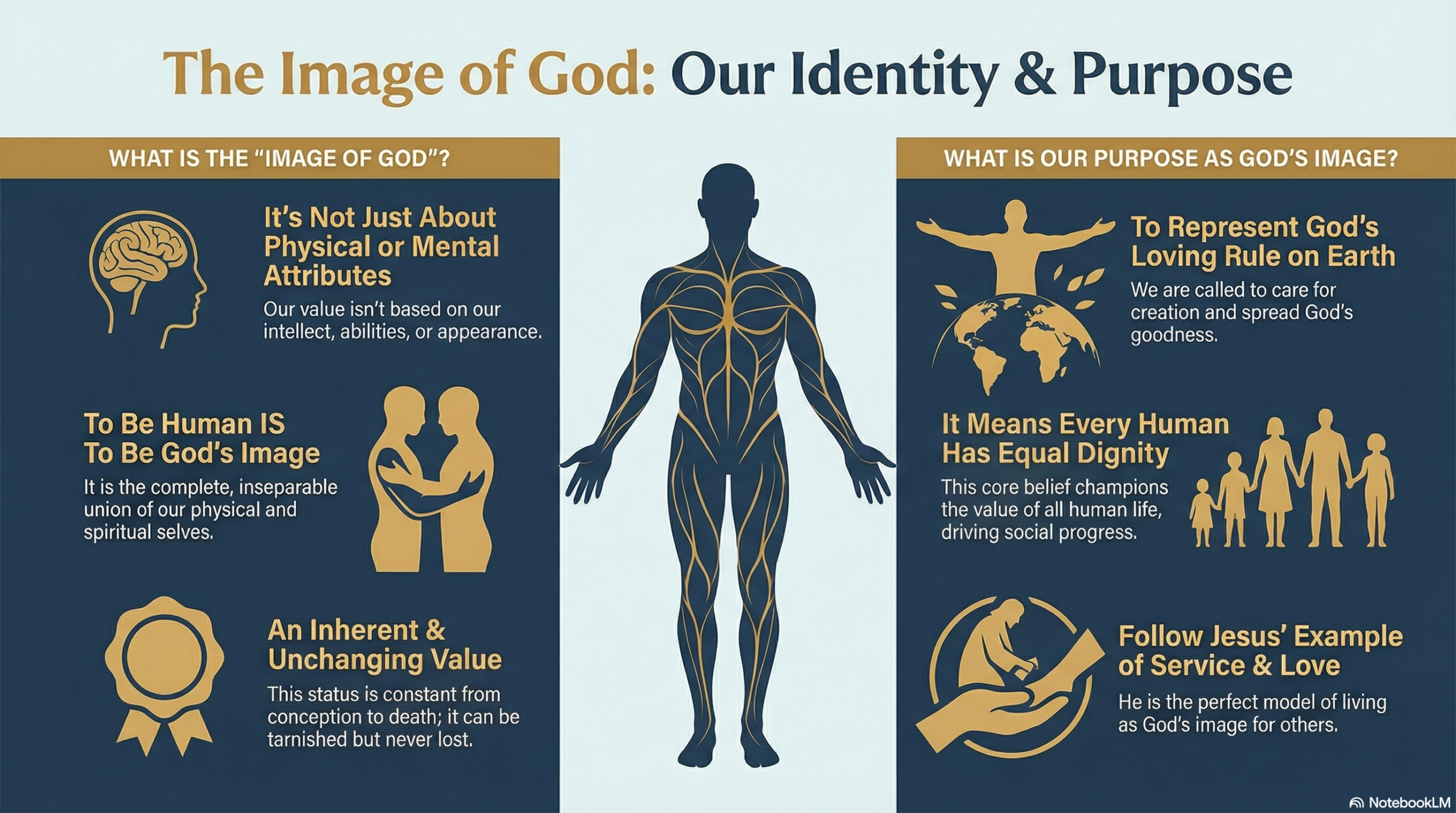
TLDR Summary
In this sermon, Pastor Dustin Woolam explores the theological and practical implications of humanity being created in the image of God. Drawing from Genesis, Colossians, and Hebrews, he defines this concept not as a set of physical or intellectual attributes, but as a calling to communion and stewardship.
The following key themes summarize his message:
- Holistic Humanity: He refutes the "gnostic heresy" that the body is merely a shell for the spirit, asserting instead that God created humans as physical beings and declared them "very good". He emphasizes that we are not fully human without both our material and immaterial parts.
- Inherent Dignity: Pastor Dustin Woolam argues that the image of God provides every human with equal dignity and respect from conception until death. He notes that this belief uniquely transformed the Western world, moving society away from tribal "us vs. them" mentalities to a universal recognition of human value.
- The Mission of Stewardship: He explains that humans were made in God's image for a specific "job": to exercise dominion and spread the peace and rule of "Eden" across the entire planet.
- Jesus as the Perfect Model: He points to Jesus as the "exact representation" of God who shows us the intended plan for humanity—living in constant communion with the Father and serving the broken.
- Restoration through Sanctification: Using the analogy of a tarnished silver fork covered in mud, he explains that while the image of God in humans was marred by the fall, it was never lost. He encourages believers to undergo sanctification, allowing the Lord to "wash off the junk" so they can better reflect Christ.
- Service as Identity: Finally, he emphasizes that true service is a form of stewardship that can only be performed effectively when a person knows their identity in God. He encourages his congregation to simply "do the next right thing" that Jesus would do in their daily interactions.
TRANSCRIPT
Welcome to church. Let's pray.
When I pray, let's just remember Rufus and Brooke's family. They're traveling for a funeral this weekend and there's a ton of sick people. So I'm going to pray for all of these things and then so I encourage you as I pray. It's thinking about this. I used to have a lot of great instruction during prayer time, during all through time. From a previous guy, we always called him Brother Baker, name is Lance Baker. So he'd give us lots of coaching and encouragement on prayer. And some of those people had probably heard that for years. But for me, it was new. And so I'll probably share some of that now on Sundays. But what I would just encourage you is as I pray, either pray about the same things in your own words or just listen to what I say and say, "Yes Lord," "Is that crazy?" or ask questions?
But let's be focused in the moment because it's not just me praying. But it's all of us together joining in prayer to the Lord when we pray from the front. So when Rufus or Ian pray to open the service or when we pray at the end, it's not—I really wrestle when I was a note taker and I was sitting and I had all my notes and they're like, "Okay, we're going to pray to end the service." I'm like, "No, I've got to finish like the last five words." Let's just take a moment and this whole service has set aside to the Lord. But when we pray, let's just dial in and remember who we're talking to, right? So let's pray.
Father, thank You for the body. Thank You that all of us together can come and pray with You. And Lord, I asked this morning that You be with Rufus and Brooke and their family. Lord, as they are navigating this funeral for his sister. Lord, I pray for all the people who are ill, a little bit myself. And all the others that I heard about five, six, eight different people. Lord, I just pray that You would bring healing and peace and strength to our bodies. Lord, I pray for wisdom for all of us in the coming weeks. And I pray that as we come to You now in Your Word that whatever's of You would remain, Lord, that Your Word would rise and that whatever's not from You, Lord, it would just dissipate and be forgotten and not have place. In Jesus name, amen.
All right. So we're still going through a series. I'm probably need to come up with a name for it. But it's essentially our statement of faith, the things we believe, why they're important, why we believe. Last week we talked about the Trinity. This week I want to talk about humanity. And I don't know if I'll go into depth about all of the other things that we often see on statements of faith in today's message, maybe in a future one. But today what I want to talk about is what is the image of God? When the Bible says humans are made in the image of God, what does that mean? And like literally what does it mean? And then what are the implications of being made in the image of God? What is it that being made in the image of God requires from us?
So we'll start out. We're going to read some in Genesis. One thing I do want to share with you before we read too much. So we're going to start in Genesis chapter 1. There has been a very common view. I grew up hearing it. And then as I got older, I started to question it. And then did some study and some research. And it turns out it was common in my life. But it is not the predominant view over the years. Or even in the world at the time that I learned it. However, because people like C.S. Lewis are extremely popular and have a great voice, it became one of the primary things that humans thought.
So you may have heard something like this. We are a spirit. We have a soul. And we live in a body. Anybody heard something like that maybe? Right? In the past, the real part of us is the spiritual part, and our bodies are just going to fade and die and go away and not mean anything. That's a gnostic heresy from the early part of the church. God made humans physical and said we were very good. There's nothing wrong with the human body except for the fall, which Jesus will fix. So our goal is not to escape this earthly shell, to go and live in the true spiritual world. God wanted a human to be physical. Jesus, still, we can read in the Bible and see that Jesus still has a physical body.
So when we talk about humanity, when we talk about being made in the image of God, we aren't all these separate parts. Now I can identify that there's a part I mean that's not physical. One of my favorite little things to noodle on and to think about is that the mind is what the brain does, right? The physical brain doesn't really, for all we can tell, create the mind, but it does. And so there's some intangible piece of us, and that's good and right. But that's not more us than our bodies. We need both. And so we really truly are in a much diminished view of, like last week, we talked about the Trinity, that the Father, the Son, and the Spirit all together are God. In the same way, the part of us that's immaterial and the part of us that's material is what makes us human. We're not human without both. So just get that right out the gate.
There's nothing better, and as much as I like the song, "You didn't want heaven without us, so you brought heaven down". God's plan is for humans to live on earth. God's plan is for humans to live in a perfect, glorified, fixed earth. He made earth for us when we die and we're disembodied in heaven, that's an incomplete state until the end of time, when the resurrection comes. So we'll see that at the end of Revelation and a couple of other places. Why did I say all that? You'll find out.
Genesis chapter 1, we're going to start in verse 26, let's back up. Let's just start in 24. No. It's 26. Then God said, "Let Us make mankind in Our image and Our likeness so that they may rule over the fish in the sea and the birds in the sky over the livestock and all the wild animals and over all the creatures that move along the ground." So God created mankind in His own image, and the image of God He created them; male and female He created them. God blessed them and said to them, "Be fruitful and increase in number, fill the earth and subdue it, rule over the fish in the sea and the birds in the sky and over every living creature that moves on the ground." And then God goes on a little more.
So let's jump up to 5, Genesis 5, we're going to read 1 through 3. This is the written account of Adam's family line. When God created mankind, He made them in the likeness of God. He created them male and female and blessed them and He named them mankind. Your version may say Adam when they were created. When Adam had lived 130 years, he had a son in his own likeness and his own lineage and he named him Seth. All right? And then one more in Genesis and then we're going to back up to 1 and 5. Well, we'll go back and forth and be going to turn just a few pages.
So Genesis chapter 9, this is after the flood, let me catch you up. So God made Adam and Eve, put them in the garden, says, "Don't eat the fruit." They ate the fruit. God sends them out of the garden. After they're out of the garden, Adam and Eve have a couple of sons and one kills the other and then they have a third son, his name is Seth. And then we go down the family line and then we get to Noah. And so when we arrived at Noah, the entire world is wicked and terrible and God says, "Man, I got to fix this." He floods the earth, kills everyone except for Noah and his wife and his three sons and their wives and then now we're caught up.
Genesis chapter 9 says, "Then God blessed Noah and his sons, saying to them, 'Be fruitful and increase in number and fill the earth.' The fear and dread of you will fall on all the beasts of the sky and all the birds of the sky on every creature that moves along the ground and on the fish in the sea and they are given in your hands. Everything that lives and moves about will be food for you. Just as I gave you the green plants, I now give you everything." I'm so hungry. Let's read till five. "But you must not eat meat that has a lifeblood still in it. For your lifeblood, I will surely demand an accounting. I will demand an accounting from every animal, from each human being too. I will demand an accounting for the life of another human being."
So we see a couple of things here in Genesis first. We see that God made man in His image and we see that God gave humans a command. The reason that He put humans in His image was for the command. Like it wasn't like God said, "Here's some humans, they need something to do. Let's give them dominion over the world." What He did was He made them in His image so that they could function in this dominion of the world. Now, it's going to get really easy to get really stupid, really fast. There's a doctrine floating around. It's called little gods doctrine. You may have heard it. That's just not in the Bible. People use the Bible to prove it. We are not little gods and we never will be. There's no sense in which humans will be gods.
However, being made in the image of God is maybe a little more than we thought it was. We want to try to thread the needle right in between "being made in the image of God means we have ten fingers and ten toes" and there's some weird little gods thing out there. I don't want to spend too much time with little gods because I just don't think it's valuable to spend a lot of time there, but if you're curious, we can talk.
So being made in the image of God is something that we've wrestled with a lot in Christian history, even in Jewish history. So for 6,000 years or so, 4,000 years, depending on when you start looking at written things, there's this idea of what does it mean to be in the image of God? A lot of people have taken a lot of different ideas and twists and turns and thoughts. Some people say, "Well, it's because you have a rational mind." So if you have the ability to think, well, then you're like God, but then is someone who's still developing in utero or someone who's become a vegetable or someone with dementia, are they less the image of God if it has to do with thought? Or people will say, "Oh, well, we have two arms and two legs." What if someone has an amputated leg? Are they now less the image of God? That doesn't make sense, either. So is it our eyes, is it our ears, is it anything physical that makes us the image of God? And immediately when we start thinking about taking away some of those attributes, then we would have to say that to not be perfectly holy, healthy—holy with a W and an H—that to take those things away reduces or diminishes the image of God.
So what I will tell you by the end of this, we'll work through it, is that you are not more nor are you less the image of God from the moment of conception than you are when you die. There's no difference in how much the image of God you are. And so how is that true? If we have, at the moment of conception, we have a single-celled organism that immediately begins to multiply and reproduce. It's immediately human. There's never a time that we aren't human. And so being human is the image of God. What is being human if it's not arms and legs and lungs and eyes and ears and noses? And certainly those things are all attributes that humans have. It's not a mind, right? So someone who's mentally incapacitated in a coma, they're not less human.
And there are going to be some implications to this. Let me go ahead and share why this matters so that as we talk through it, you have something to anchor it to. This matters because Christianity amongst all the world uniquely values human life, strictly for the sake that it's human. No other reason is needed. How do I know that? Can I just say that? There's a guy, Tom Holland, historian, not the actor, wrote a book called Dominion. He's not a Christian; well, he wasn't a year and a half ago. Not a Christian when he wrote the book. I pray that he is now; I haven't kept up with him. And this book called Dominion is about Christianity and the change that Christianity brought to the modern world. He started out as a huge fan of the Romans, reading about them, studying about them, all this stuff. And then in all of that, he runs across how Christianity changed everything in the Western world. Capital W Western world, so Europe, the United States and all the things that they impact. It was in tribal situations, even in Roman Greece where they had city states, that's almost tribal. There was a big "us and them". So hey, we're all in Athens, Athenians matter.
We care about us, but those people elsewhere, they're not us. We don't care about them. They don't matter. They don't have value. So for a Roman to crucify someone or for a Roman to enslave someone, they weren't people to them. They were them. They weren't us. And so what Christianity does is it shows up and it breaks into the world and says "no". If you're a human, you matter. Because Jesus died for you. Jesus came for you; every human is equal in dignity and respect because God says they are. And this is from the beginning in Genesis. This isn't something we just made up. It's always been this way. So the implications of the human being made and the image of God are massive. It changes the way we think about issues like abortion. It changes the way we think about issues like slavery. It changes all of these things that we want to address. And so yeah, there's some uncomfortable things in the text. Like, why did some of the things that the Old Testament says about slavery, why do those things get said? What do they look like? And how do they listen? There's hours and hours and hours and hours of stuff that approaches that.
What I can tell you is it from the time God shows up until moving forward, He's moving humans in the direction He wants them to be. He finds them broken. And that's because we broke ourselves. Romans chapter 8 says that all of creation is groaning, waiting for the appearance of the sons of God. So yeah, there's lots of terrible stuff. And there are some guidelines that tell us how to live amongst terrible things as God moves us out of them. And so when we talk about the value of humanity, even when we look at the laws of how they're supposed to treat prisoners of war and how they're supposed to treat servants and slaves and all this other thing, what we see is that God is universally providing dignity to every human inside of the scope of the busted world they live in. And so He moves them systematically through.
And it's the Western world that Tom Holland talks about where he talks about Christianity has this dominion. It's the Western world that begins to end things like slavery. It's the Christian church and the Christian impact on the West that increases medicine, orphanages, all of these other things for everyone, not just for me and mine, but for everyone. And so we see that this is because of the image of God, and when we start thinking about image in the Bible, the word translated image just means "statue". That's weird. That's how our human statues—and then when God says, "Don't make any image of Me," okay God, but why? Let's think about something.
All throughout the Old Testament, when we look at the tabernacle and when we look at the temple, if you go read all that stuff in Exodus and then in other places, all of the imagery is gardens. It's fruit, it's plants, it's trees, it's water, it's all these images. When we see the original place where heaven and earth interact in the Garden of Eden, it's a garden. Then later in the book of Ezekiel, it says that Eden is a garden on a mountain. And so we have all this imagery in the Old Testament of that the place where God lives and the place where humans meet God is this garden-like area.
Then we fast forward to the book of Revelation where we see that there's this water that flows and never stops. And we see all these things with the New Jerusalem and all this greatness and the presence of God. And then what we can see is that God said, "I'm going to make this place where heaven and earth interact." It's Eden. And God puts His image in there; humans, free will, not robots, not statues, but His image. And He says to the humans, "I want you to be fruitful, I want you to multiply, and I want you to spread Eden all over the planet." Because Eden wasn't everywhere on earth. And sometimes, what I forget, because I learned it late in life, later in life, was that God's purpose wasn't for Adam and Eve to live in Eden and just be happy. They didn't break some kind of eternal happiness—I mean they did, but that wasn't the goal.
The goal was that they would be fruitful, they'd multiply, they'd have kids, they'd have more kids and more kids and more kids, and that the beauty and peace and rule of God on earth and Eden, the humans would work with Him to spread that over the planet. And so that's why He says, "Be fruitful and multiply." Well, humans mess up and they get kicked out of the garden. But their job didn't change and we see that with Noah, that the job of humans was still to be fruitful and multiply and go all over the earth. And Noah, being faithful to the Lord, he also is supposed to do this. If we have any questions about that, we can fast forward all the way to Matthew 28. And Jesus says, "Go into all the world and make disciples."
So I say that, all to say this: being made in the image of God is to be human. And it's for the purpose of spreading God's kingdom. It's for the purpose of spreading out His Word and His rule. And that might seem a little weird because, well, isn't God in charge of everything? Yes. He does have complete sovereign authority. He can do whatever He wants. What He chooses to do is work through humans and give us free will. So there are roughly 8 billion people on earth. And of those 8 billion, there's a whole bunch of them that aren't doing what God planned for them to do. And they're not acting the way God planned for them to act. And they're not living the way that God planned for them to live.
Colossians chapter 1, we get some things about Jesus in Colossians and Hebrews. So we're going to read those right quick. Colossians chapter 1—and I realize I haven't exactly said, "A, B, C, what is the image of God?" We'll get there. Colossians chapter 1, verse 15, it says, "The Son is the image of the invisible God, the first born over all creation." And then it says a couple of things here, but I want to go to Hebrews. We'll read a little more in Hebrews. I want to encourage you to go read all of Colossians chapter 1, or all of Colossians. Hebrews chapter 1 verse 1, it says, "In the past God spoke to our ancestors through the prophets at many times and in various ways. But in these last days He has spoken to us by His Son, whom He appointed heir of all things and through whom He made the universe. The Son is the radiance of God's glory and the exact representation of His being, sustaining all things by the power of His Word. After He had provided purifications for sins, He sat down at the right hand of the Majesty in heaven." So He became as much superior to the angels as the name He has inherited is superior to theirs.
There's an interesting parsing that we need to do with Jesus a little bit when we read about Jesus being the image of God. I'm going to make a statement that may feel a little shocking to you, but we're going to work it out in the next two minutes. Jesus is the image of God because Jesus became human, right? Or He became human; He was God and He still is God. He never stopped being God. I want to be really clear about that. But it's the humanity that we see where He shows us the image of God being incorruptible. So Jesus is in this place where He's both God and human. And this is where people get really weird because they're like, "Jesus is the image of God because Jesus is human." That means that one day we can be just like God. No, it doesn't. What Jesus does is He comes to earth and He shows us God's intended plan for humanity. He lives a perfect life, He lives a holy life, He lives a life in communion with the Father. This is what God wants.
So when God starts to say that Adam and Eve are made in His image, what He wants is the communion that Jesus demonstrates. What He wants is for humans to do what Jesus did. Jesus says, "I do what I see the Father doing." Jesus went to the lost. He went to the hurting. He went to the broken; everywhere that Jesus went, He took the kingdom of God with Him. How do we know that? Because He shows up and the demons are like, "Why are You here? It's not time." And so everywhere Jesus went, He's pushing the kingdom forward. He's advancing the kingdom. In fact, early in all of the gospels where it talks about it, it says, "Jesus began to preach the good news of the kingdom"—not the good news of His death and resurrection, which is good news, but the good news that the kingdom of God is at hand.
And so, when we think about the image of God, when we think about what it is that God wants humans to be, the image that we should be bearing or being is the image that says, "This is what God wants us to interact with Him." This is how God wants it to look in the garden. This says He came and He talked with Adam and Eve and there was this purity and there's this kindness and there's this back and forth and this easy communion between God and humans. And then Jesus comes to earth and it's the same. There's this easy communion between Jesus and the Father. And so that the image of God on earth isn't just a reflection of the glory of God. It's something in the task that we have. It's something about being both physical and spiritual at the same time. It's something in all of that, which is why we can say whether you're very first conceived or you're on your deathbed breathing your last breath, everything in between. No matter the condition of your physical body in this broken world, you still represent the communion that God desires to have with all of creation.
And so what we are supposed—and so this goes back to the dominion thing, right? So God gives humans dominion over the earth, why? So that we can be His image to all the earth. So that when we as humans are kind to animals, take care of trees and plants or the fish and all of the other things that Genesis says that God gave us dominion over, when we care for all of those things, it's an image of the care that God has for creation. It's an image of the care that God has for our fellow humans. So when I find a human who's in need or hurting or broken or whatever and I care for that human, then I'm doing it as a member of the human race representing God's love for the human race.
And so that the image of God comes with a job. It's not the job, but it comes with a job. That's why we care for the "least of these". This is why in early, early Christianity—which some people in modern day would think, "How can that be true?" But in early Christianity, it was—Christianity was slighted as a religion for women and children. Because in a society where women and children were property and men were in charge of everything and men were dominant and men were like the only thing that mattered, Christianity said, "No, no, no, no, hold on. We're all equal in value. We're all equal in dignity". And Paul says things in Ephesians like "husbands and wives submit to each other". Peter says husbands and wives submit to each other. So yeah, we do see "wives submit to your husbands". We also see, "Hey, husbands who are in charge of everything and basically the boss of the whole world, I want you to go die for your wife". Absolutely crazy idea at the time, but that was written. But we've lived with it. We've grown with it.
And so for us, it's familiar, but we don't understand how earth-shaking it is for God to come to a human, a father, a husband, and say "your job is to die for your family". Not to go ahead and—why does it say that? It says, "Love your wife, as Christ loved the church and gave Himself for her". And so if this is the way that the image is supposed to be designed and think about in the Garden of Eden, when Eve eats the fruit, Adam eats the fruit and God comes to Eve and He says, "What's happening?" She says, "Well, it was the snake, right?" And so there's the snake and then, "Adam, what happened?" "Eve." "What happened?" "It was the snake." The snake, it's cursed, right? I went backwards. I started in the middle. So God comes to Adam and He says, "Adam, what happened?" He says, "Well, the woman You gave me..." "Eve, what happened?" "Well, it was the snake".
So the snake gets cursed and then there's in between, you know, this is the earliest prophecy of Jesus. God says there will be enmity between the seed of the woman and the snake. What we see is that Adam and Eve together—it wasn't like Eve was off in the next room, saw the fruit of Eden and brought it to Adam. The language, the image there is that Adam and Eve together were at the tree. Eve ate from the tree and then gave it to Adam. So there's a failure in all of the structure that God designed for humans. Eve—God says, "Hey, it's not good for Adam to be alone. He needs a helper." "I'm going to give him Eve," but she didn't really help, did she? Instead, she led him astray. But then we can't hold Eve in guilt alone because Adam was there the whole time and he didn't say stop. He didn't draw the line. He didn't protect it—not because he's in charge of his wife, but because his role is different than hers. And I'm not trying to get into a whole big weird thing about men being in charge of women; I'm not saying that.
What I'm saying is that we can see in the garden the failure of the man and the failure of the woman and that together they broke the image of God in some ways, but not completely. And the way that it was broken is—think of like a silver spoon or something, right, or a fork. A fork is probably better because it's got the little teeth, and it's just completely covered in rock and dirt. And you can kind of make out maybe it's a fork or like when you look—I really like those things where people go down and find old wooden ships and find all the pieces and the parts. So here's a whole bag of Spanish doubloons that looks like a rock to me. It doesn't look like a whole bunch of gold coins; it looks like a rock. But then they start to clean them up and they start to be careful and then they begin to look like coins again. And they begin to look like what they originally were. And this is how Christ finds us, where we are broken and bent and kind of muddy. So we look like maybe we're a fork or maybe it's a rock or maybe who knows. But that is, we come to the Lord and He begins to work on us. It's not that the image was ever lost; it's that it was covered and tarnished.
And so we, as humans, Christian or non-Christian, we are the image of God, but what God wants is for all the tarnishing to be removed, so that we can live the way Jesus lives. So when we say things like—and I'll pray this often, not saying it's because I'm great and wonderful, but I'll encourage you, I picked this up from someone I want to share with you—that when we pray, one of my constant prayers says, "Lord, make me into the image of Jesus," because Jesus was the perfect example of what a human should be. And so Jesus comes to earth and He doesn't regard Himself as better than anyone else, even though He is. He's God, right? He's worthy of worship. And when people worship Him, He lets it happen. He doesn't say, "No, don't worship Me". He lets it happen. And when demons show up and they're like, "Hey, Son of God," or this or that, He doesn't tell them that He's not God. He doesn't have this false humility. Jesus walks in complete understanding of who He is, and this is why His service matters.
In the upper room, when Jesus comes to the apostles, He says to them that He's going to wash their feet. And Peter's like, "No, You can't do this". And Jesus says, "If I don't wash your feet, you don't have any part of Me". That's all really great. The thing—and I'm not saying that sarcastically; it's really great—but the thing that always, always stuck in my heart, is it right before Jesus does that, there's a verse that says, "Knowing who He was, He got up and did this". And so service, for a lot of humans—especially in a world that is self-serving or self-considerate and not others-considerate—service becomes something that makes us "less". But Jesus exemplifies that true service, truly walking in the image of God, can only be done when you know who you are.
And so what I know is that humans are valuable and amazing and wonderful. And if I can say that about humans, then I can say that about me. And you can say that about you. Do you mess up? Is your image of God sometimes tarnished? Yeah, we're not perfect. That's the purpose of sanctification. We're moving into what God has planned for us. But then when I serve someone, the "least of these," if I visit someone in prison or if I feed the homeless or if I take care of someone—even little bitty things. I grew up riding bicycles. Pretty much lived on my bike from the time I can remember to ride it until I started driving probably; that is when I stopped. And I loved riding my bike, but I was always kind of having a tinker with it because I would do silly things. And I would pop the chain off the bike or the tire would become flat or something would get bent or something would break or the handlebars would twist because I crashed my bike. All scars on my body except for two are from bike wrecks; those two that I have are from when I didn't make it over a barbed wire fence. And so, so what? I was a kid, right?
Fast forward all the way to almost 10 years ago. And I'm at work and I go outside of the building and there's a young kid there crying because he can't get his bike to work. His bike chain is all twisted up and tangled up and he's just having the worst day. And so I say to this young kid, "Hey, little brother, let me help you out". In about 30 seconds, all the memories of fixing my own bike chain return and I get him back on the road and he's happy. Don't know his name, don't know where he is today. But the point is that somehow in that moment of fixing that kid's bike, I served him and showed God's love to him, whether I was thinking about it or not. And that's when I was acting like the image of God.
However, so too when I was crashing my bike was I acting like the image of God. God put us on earth to enjoy the earth. And so when I'm out riding my bike, having fun, laughing with my brother, singing goofy songs because it was the 80s and I'd see some cool song and I got to sing this while I ride my bike. And then I crash and I do whatever and I flip and I break and all these things; God made us for these things and it's not bad to be human. It's not wrong to enjoy this earth that we live in, but we also in the midst of all of that enjoyment have to be good stewards. Not just of the earth around us and not just of the things that we have, but of the humans around us and of the people that we interact with. I owe it to everyone—Paul says to the best of your ability, don't owe anyone anything except for to love them. And so I don't want to have to owe someone an apology and I don't want to have to owe someone something. Even though that's the nature of the world we live in, what I want is to think about if I was in the garden and the garden looked like Robinson, Texas. It doesn't, but let's imagine—just imagine it doesn't.
If God said, "Hey Dustin, I want you to be fruitful and multiply," and if He said, "I want you to go and make disciples"—which God said to humans in general and Christians specifically—how do I do that? How do I bear God's image today? When I go to the gas station, do I treat the person behind the counter like a person or do I just treat it like a transaction? When I'm driving on the road, do I drive my own selfish way or do I consider traffic around me? When I'm at work and someone's having a hard time, do I berate and belittle and be hateful to them, or when all these things happen, do I respond in a positive way to the negative? Great. We think about that. We understand that. But when something good happens to someone, do I celebrate? Am I excited for them? Do I rejoice with those who rejoice and mourn with those who mourn? Am I a peacemaker? Am I doing the things that Jesus did on earth?
So what is it to be the image of God on earth? In the most perfect sense, it is to act like Jesus. It's not because—Jesus probably was not pasty white like me; I'm betting cash money that the Son of God had some color in His skin and did not reflect the moon in such a way as to look like a ghost in the dark. When they got scared of Him, it wasn't because He looked like a ghost; it was because He was powerful. So it's not my color, it's not my hair, it's not my fingers, it's not my intellect or my lack of intellect or my ability to breathe or not breathe; it's none of those things. God put us here as His image and we have to be careful not to pervert it.
So in the old times, in some days, people would go to a temple of Zeus and there would be a statue of Zeus. They built a statue of Zeus so that Zeus would come and inhabit the statue and speak to them. And so there's this forcing of the gods to come to the humans. But instead, what God says is—especially if you read 1 Peter—He says, "You're all living stones fitted together". You humans who are Christians are the temple of God, and so that wherever we go, we take the presence of the Lord with us to behave like Him, which is what He wanted for Adam and Eve in the first place. So from the youngest child to the oldest person or us sitting here today, the requirement that God has from us is to love because that's what He did. First He loved us.
The image of God is wrapped up not just in attributes and it requires of us a job; it's somewhere between the two. The image of God is somewhere in between doing the job and who we are physically and spiritually—right in the middle there in that weird gray place that's hard to define is what it is to be the image of God. So for us, the next thing we do when we leave this place, or even before we leave this place, is to do our best to submit to the Holy Spirit and be an untarnished member of the body of first this church and then humans in general—to let God wash off of us the junk so that we look like the coins or the fork or whatever we are and not what the archaeologist found.
And the beauty of that is that our Father—I'll close with this, maybe some encouragement to you. I've watched things where there are experts involved. When we were getting the ultrasound for Calista and the doctor is telling us about kidneys and hearts and whatever, I'm like, "Okay, sure that's your heart, I believe you; how would I know?" He's like, "Oh, there's some fingers and toes." I'm like, "Okay, I can kind of see that". He's like, "That's your heart." "That's a black spot; that's not our heart". Or when you watch these people who are artists doing whatever they're doing. They have all these blobs and they're doing all this stuff and all these weird handprints and then they spin the picture 360 degrees and then turn it on its head and shake it real hard and there's glitter and then like—it's a perfect picture of like a mountain or something and you're like, "How do they do that?"
Or the old song, I think it's called "The Touch of the Master's Hand," where they're trying to sell this fiddle and nobody wants to buy it. It's this old busted-up looking thing, but this master violinist comes up and plays it and now all of a sudden it's worth a lot. The thing is, is whatever you think you look like today, the Lord can see who you really are and who you're supposed to be. And so whatever part of the body you are—ear, nose, knee—you know, Paul talks about we're all members of the body of Christ; Peter says we're living stones fitted together. Maybe we're a little rougher around the edges and maybe we're supposed to be a dinner fork but we've got to get all of the lime and the junk off of us; that's okay, that's okay. You're not less valuable, you're not less important, you're not less God's image on earth.
Just do the next right thing; just do the next thing Jesus would do. And just keep doing the next thing that Jesus would do, and before you realize it, you'll find yourself in the image of Christ. And then you might find yourself at some point in your life saying to your young disciple the way Paul said to Timothy—Paul says to Timothy, "Follow me as I follow Christ". My prayer is that all of us get to that point, where we can look more and more like Jesus, where we can find a young believer and say, "Hey, listen, I've learned some things, let's walk in this path together". Not, "Hey, I'm good, I'm right, I'm righteous," but "I understand that in my years following Jesus I've learned a few things and I can teach you". It's not arrogant; it's honest. It's only arrogant when we forget that our first and primary role is to serve. We serve in our stewardship.
So let's pray. Father, thank You for Your Word and for Your people. Jesus, thank You for Your example; thank You for coming to earth and showing us what it is to be the image of God on earth, to be the exact representation for us to follow as an example. Thank You for great Christians who've gone before us, that we can see a little bit of how to do it. Lord, the people in my life growing up as a Christian, I can look around and say, "Man, I love how they read the Bible," or "I love the way they pray," or "I love the way they show other people the love of God". And so Lord, I pray that You give us great examples. Give us great examples of men and women who follow You faithfully. And Lord, I pray that You would help us to find that balance of not being too arrogant about how great we are, but also not beating ourselves up, but just to be honest about where we are and where we want to go so that we can serve without any extra weight, so that service doesn't diminish us and it doesn't puff us up, but Lord, it's strictly service because it's what You would do, and it's what You would have of us.
So Lord, we give You this day, the rest of this day, and we give You the rest of our weeks and we ask, Lord, that You would give us some clarity about where we are in our sanctification journey. Do we need to give this up or put that up or pick this up or whatever the case is so that we can look more like what it is You made us to be, where we love You and we're grateful for You. In Jesus' name, amen. Are y'all seeing it? No. Okay. We're dismissed. Amen