
IT'S IMPORTANT WHAT YOU BELIEVE | THE WAY OF SALVATION | FROM SINNERS TO SONS

Pastor Dustin Woolam | Recorded January 18, 2026
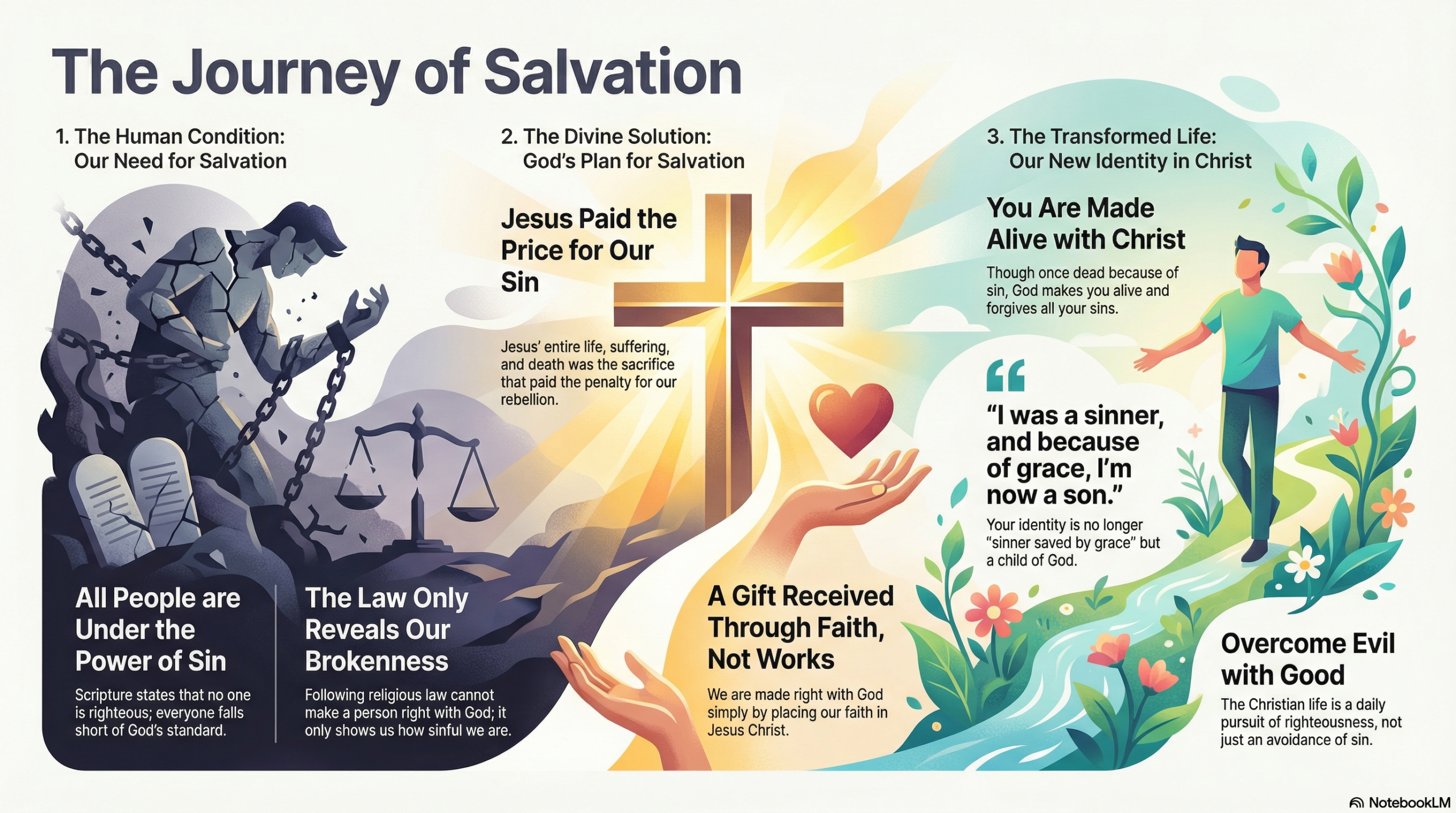
The Way of Salvation Beyond the Cross

TLDR Summary

Salvation is described by Pastor Dustin Woolam as a comprehensive story of redemption that spans from Genesis to Revelation, rather than being limited to a single moment in time. True salvation requires a fundamental change of heart that connects a person to the work of Jesus, moving beyond merely saying words or seeking "fire insurance" to avoid hell.

Key insights from the message include:

  • The Suffering Servant: Drawing from Isaiah 53, the message highlights that Jesus—the Messiah—lived a human life marked by being "despised and rejected," ultimately bearing our sorrows and being "pierced for our rebellion" to bring us wholeness.
  • Theological Frameworks: The work of Christ is explained through theories like Recapitulation, where Jesus lived the perfect life Adam and Eve should have lived, and Christus Victor, emphasizing that Jesus conquered all through His resurrection.
  • Law vs. Faith: The message explains that no human is righteous and that the Law exists to show us our sinfulness rather than to make us right with God, We are made right solely through faith in Jesus Christ, which acts as the fulfillment of the Law.
  • A New Identity: Pastor Dustin Woolam rejects the notion that a Christian is a "beggar," arguing instead that a believer becomes a living child of God with a completely changed nature.
  • The Pursuit of Righteousness: The Christian walk is an ongoing process of purging the old nature and pursuing the "next right thing" to become more like Jesus.

Ultimately, the goal of this journey is to recognize that through grace, a believer is no longer defined by their sin, but has been transformed from a sinner to a son.

TRANSCRIPT

So I started my Christian walk with a children's Bible, and I don't have it anymore, but I distinctly remember it, and we attended a church that had the exact same kind of Bible. And as I was looking through this one a little bit this morning, I had this realization, oh, by the way, we're gonna be in Isaiah 53. I had a realization that maybe there's some things in children's Bibles that will be good for us to not get away from. And then as I was thinking about it, I was thinking there's actually some things in children's Bibles that would be good for us to grow past, right? Like, not that we ever abandoned them, but if some of the some of the stuff here is a great reminder, but hopefully, you know, these little like there's a picture of a kid on a roller coaster, right? It says you want to be here. It speaks to them, and so we want to be childlike, but we don't want to be childish, anyway, for what that's worth. That's all free. Those are my rambling thoughts.

This morning, we've been talking about what we believe matters. So we talked about the Trinity, the mystery of the Trinity, that we worship one God in three persons, and we one God in Trinity, Trinity in unity. And we talked about what it is to be made into the image of God or to be the image of God. So we have these kinds of conversations. And now that we have a couple of really key pieces, we're going to move to something that probably feels really familiar to us, that is maybe a lot bigger than many of us have considered. So this week, I want to talk about salvation. I think we know a lot about why God saved us. I think plenty of us could look at our life and understand that we need it as Savior. But I think that sometimes one of the things that we miss is how God saved us. Well, Jesus died on the cross from resurrected from the dead, right? That's true, but that's not the entire story, right? So the promise of the Messiah, the promise of Jesus, like so we call him Jesus Christ, or Christ Jesus in the New Testament, that just means Jesus the Messiah. And so the promise of the Messiah is all the way in Genesis. And it moves all the way through until everything is completed in revelation. So while the crucifixion and resurrection absolutely vital, there's more to the story of our salvation than that moment in time. And I try to be weird, just hang on, we're not going to be silly here. But it is also, I was thinking a lot, a guy named Scott Adams, he died in the last week, if you don't know Scott Adams, maybe you know that Cartoon Dilbert, anybody heard of Dilbert, he was the author, writer. He in his closing letter, like he knew he was dying, he was dying of cancer, he knew he was dying. And his final letter, he says, all of my Christian friends have wanted me to get saved. So I'm writing this letter that I accept Jesus as my Lord and Savior. And then I hope that when I meet him, when I die, he'll be gracious to me. And a lot of people are like, isn't this awesome? Scott Adams is saved.

But I remember my grandfather, my dad's dad, he, dying, knew he was dying, was very intentional and spoke with everyone he could and everyone who would talk to him. And I was serving as a youth pastor in Lubbock at the time. I wasn't thinking much about it. I had a bunch of like shirts with snarky sayings because that's still kind of who I am. But I had a shirt that said a product of intelligent design, right? That we're not from nothing but that we come from the Lord. And I went to go see my (grand)father who was a confirmed atheist and believer in evolution. And I didn't really think much of it. I just went to see him. And before I left, we  knew it would be the last time I would see him. We went in the back room because he was tired and he wanted to lay down. We had a big long conversation. And part of that conversation, he says to me, "Dustin, I see your shirt" and I say, "Granddad, we don't have to talk about all this right now. We've talked about all these kinds of things. I was like, you've talked to my father, who's your son, who loves you. Granddad, I just want to be with you. Like, I just want to make the most of this moment." He said, "No, no, listen to me". He said, "Dustin, I believe", he says, "people tell me that if I say the words before I die, I'll go to heaven." And he says, "But I don't think that it matters unless you mean it." And then he said to me, and I have no idea what decision he ultimately made, and I'm perfectly at peace with that. But then he says to me, "Dustin, I don't know what will happen between now and when I die. But I want you to know that if I can say the words and mean them, I will." And so there's something to salvation, that even my grandfather who said he was not a Christian understood, that salvation is not saying the words, "I accept Jesus." Salvation is a change in your heart that connects to the things that Jesus did. And so we're going to talk a little bit about what Jesus did today. We're going to talk a little bit about our condition before Christ. We're going to talk about the transition from who we are before Christ to who we are in Christ. And then we're going to end up at, what does it mean now that I'm a Christian? Because one of my least favorite, this is seed for the end of the message. One of my least favorite things that I hear, and this is from some famous preachers in the past, they say that a Christian is one beggar showing another beggar where to find bread. And the thing that I would say to you is that if you're a Christian, you are not a beggar. Right? So we're going to talk about why I say that. So there's a little preview. We're going to take a journey.

So as I have 53, this chapter is about what is commonly called the suffering servant. When this was written, the Jewish nation said this is us. We're the ones who are suffering. It's probably true. One of the things about Old Testament prophecy that's really neat is it has what's called double fulfillment, that there's a literal fulfillment for the people that it's written to in the moment. And it also points to a future event. This is very common in the Old Testament, and we see this being fulfilled in the New Testament. So while Isaiah 53, the Jewish people said this is us, and it was accurate, it's also a very clear pointer to Christ. In fact, I've said this before, but if you haven't heard this, it's very common to call Isaiah the fifth gospel because of the clear teachings of the life of Jesus found in the book of Isaiah. So Isaiah 53 starts with who has believed our message, to whom has the Lord revealed his powerful arm. My servant grew up in the Lord's presence like a tender green shoot, like a root in dry ground. There was nothing beautiful or majestic about his appearance, nothing to attract us to him. He was despised and rejected a man of sorrows, acquainted with deepest grief. We turned our backs on him and looked the other way. He was despised and we did not care. So we're going to keep going, but I want you to think about just these first few verses and think about Jesus. Now we're looking backwards. So we see Jesus, the victorious Messiah on the cross who made the devil look stupid, and what we sometimes don't think about, unless we're intentional, is, hey, Joseph's not your daddy to the eight-year-old, right? To the little boy who grew up, maybe not looking that much like his siblings because he looked like his mother. And we don't think about that even, and then why do we know this? Because later in life, Jesus is preaching and he's talking about people not being the sons of Abraham and the Pharisees and the other people say, we know who our fathers are. They're pointing to him that his whole birth is a joke because they don't believe in the virgin birth or that the Holy Spirit came upon Mary and then she found herself pregnant. And so Jesus is starting out despised and rejected and looked down on. And he's a carpenter, so he's a laborer, but he ends up not being that. As the oldest son, it was his job to take, whether Joseph was his father or not, it would have been his job to take Joseph's place and to take care of his mother and his siblings and to be the man of the house, and he doesn't do that. He goes to become a preacher because he had another job from his father in heaven. And so all the humans who see him day-to-day, he's breaking old rules even from a very young age and even from an early time in his life. And so there's nothing to attract you to this child who's essentially fatherless. He says, yet it was our weaknesses that he carried. It was our sorrows that weighed him down, and we thought his troubles were a punishment from God, a punishment for his own sins, but he was pierced for our rebellion, crushed for our sin. He was beaten so we could be whole. All of us, like sheep, have strayed away. We have left God's paths to follow our own, yet the Lord laid on him the sins of a soul. So we're already talking about Jesus paying the price, and he hasn't died yet. In this story, he's still living. He says he carried us. He carried our sorrows. We thought that his troubles were a punishment from God. It says he was pierced for our rebellion. He was crushed for our sins. He was beaten so that we could be whole and he was whipped so that we can be healed. The entire life, death, and resurrection of Jesus from his conception to his resurrection to his return is part of the plan of God's salvation for us. Not just the day that he died on the cross and three days later when he rose from the dead and then days later when he ascended into heaven. So Jesus didn't just come for a moment in time, but he came to bear all of our sins and struggles.

We'll keep reading at verse seven in a second. There's something, I don't really like this terminology, but it's the most common one. And so if you've heard this, it'll be familiar to you. But there's something in theology that's called atonement theory. And what that means is that this is people talking about, this is the way that we believe that Jesus purchased our atonement. And there are a lot of different things that people have believed over the years. And I think when we make a mistake, the mistake that we make is that we don't understand that part of each of them is true. And so the oldest and maybe most common, well one of the oldest, there are a couple that are about the same age, is what's called recapitulation. And so the idea is that Jesus came and lived the life that Adam and Eve should have lived. He came and lived a perfect life. He struggled through this world. He lived and so he lived as a human should live. And then he did that in our place and for us. He basically kind of remade humanity. It's kind of what that talks about. That's a real layman's term, their books that are thicker than the length of my arm that go into a lot more detail. But what we see in Isaiah is where that idea comes from. We see Jesus come to earth and he lives as a human. And as a human living here on earth, all of our sorrows are laid upon Jesus. Not just at the cross, but in his life and all that he does, the weight of who we are as humans is laid on him.

And so let's back up to six. It says, all of us like sheep have strayed away. We've left God's paths to follow our own, yet the Lord laid on him, Jesus, the sins of us all. So he was opposed and treated harshly, yet he never said a word. He was led like a lamb to the slaughter. And as a sheep is silent before his years, he did not open his mouth. Pay attention to this unjustly condemned, he was led away. We're going to talk about justice a little bit later. So remember, he's unjustly condemned, he's led away. No one cared that he died without descendants, that his life was cut short in midstream. But he was struck down for the rebellion of my people. He had done no wrong and had never deceived anyone. But he was buried like a criminal. He was put in a rich man's grave, Joseph of Arimathea. So we see now the picture of Jesus' death that when he says no one, right? Like no one cared that he was cut down. He's a blasphemer, obviously, you know, his apostles and people like that would care. But we see that he gets crushed, he gets buried, he gets put in a rich man's grave. And then there's this odd thing that sometimes is difficult for us. Isaiah 53, 10, it says, "But it was the Lord's good plan to crush him and cause him grief." How could that be true? Isn't God love me and have a wonderful plan for my life? Why was it God's good plan to crush Jesus? Why was it God's good plan to cause grief to Jesus? In Jesus being God himself, when his life is made and offering for sin, he will have many descendants and he will enjoy a long life. And the Lord's good plan will prosper in his hands. So we see that the crushing and the grief was the path to the good plan. And sometimes in our lives there are things that Jesus shows us of this little side note to salvation. There are things in our lives that were like, "God, why aren't you being good to me?" And the reason that we don't see the goodness of God because we see crushing, we see breaking, we see stuff, is because there's things in our life that have to be purged out of our hearts. And there are things in our lives that have to go away. There are things that for whatever reason we won't release or can't release or they're stuck. I think of it this way a lot. If someone were to break a bone, say they're out somewhere and their bone breaks and they can't make it to a hospital, when they finally arrive to the hospital, sometimes that bone has to be rebroken to be set properly. And so there are things in our life that when we're like, "Why is this hard?" Well, it's because somewhere in the past it didn't get set properly. I think of one thing that's really popular in today's society as people talk about like, "Well, oh, this is a response I'm giving because of the trauma that I've experienced." And because I've experienced this trauma, so somebody has a situation where they're in a relationship, the person they're in a relationship, it betrays them, cheats them, steals from them, all the other stuff, abuses them, all these things. These are all valid things that you would have a strong response to the next time you meet someone, right? But something has to give in that next relationship, all of this stuff that you learned how to survive. You don't need those survival tools in this next situation that you're in. Could be a job, could be a romantic relationship, could be a hundred other things, right? But they're these things in us. And sometimes the only way those things disappear is that they get broken out of our life, right? Like when someone's a sculptor, they're carving an image out of the rock. So when Jesus comes and saves us, part of that salvation is that he's carving away the things that we've picked up that we don't need. And so the crushing, the bruising, the breaking is on the way to the good plan. And so in Jesus' life we see the death, and in our life we see where places in us have to die.

Verse 11, "When he sees all that is accomplished by his anguish, he will be satisfied." And because of his experience, my righteous servant will make it possible for many to be counted righteous, for he will bear all their sins. I will give him the honors of a victorious soldier because he exposed himself to death and he was counted among the rebels. He bore the sins of many and interceded for rebels. So we see Jesus is victorious. There's another atonement theory, which is one that I really like. Well there are two more. One of them is called penal substitutionary atonement. So like in the penal system or someone's being penalized. And so Jesus dies in our place and receives the punishment that we should have received. We see hints of that here. We'll see more of it later. And then the other one that I really like, there are four main ones. The fourth one's ransom theory. I don't really like it. I'll tell you what it is briefly. I don't think you can make a good case for it scripturally, but I understand how people do. But the other one that I'm a big fan of is called Christus Victor, which is just Christus victorious. So Jesus came and died in our place. He recapitulated the human life. He lived for us. He lived in our place. He did all the things that we couldn't do properly. He did. And those things paid for all of our failures along the way to the cross where he died and gave the ultimate death that we deserved. He took and resurrected. But his resurrection is important because in that resurrection he conquered everything. And so Jesus won. He was victorious. Christus Victor, Christ the victor. So we see in three different ways that Christ has made a way for us to be with the Father. The fourth one that I'm not a fan of is called ransom theory. Basically Jesus had to pay a price to the devil, which makes zero sense. In my mind, again, I know how people get there, but it's just, it doesn't work for me. So we're not going to talk about it.

Romans chapter three. So we're going to, we've seen what Jesus did in his life, real high level. I know there's a lot more depth we could go in. We could talk a lot more. One thing I will say is let's not get too worked up into all the little minutia where it says he was wounded for our iniquities and all that. We don't have to pray, God, because of your wounds. Please forgive my iniquities. We don't have to get into all that. We can end up being really weird. So Romans chapter three, we're going to start in verse nine. Paul says, well then, I will say what I always say about Romans, the context of any single verse in the book of Romans is the entire book of the book of Romans. So I know that we're kind of getting a hot start right in the middle, but Romans 3:9, he says, well then, should we conclude that Jews are better than others? No, not at all. For we have already shown that all people, whether Jews or Gentiles, are under the power of sin. As the Scriptures say, no one is righteous, not even one. No one is truly wise, no one is seeking God, all have turned away, all have become useless. No one does good, not a single one. Their talk is foul like the stench from an open grave. Their tongues are filled with lies, snake venom drips from their lips. Their mouths are full of cursing and bitterness. They rush to commit murder, destruction and misery always follow them. They don't know where to find peace, they have no fear of God at all. Then, verse 19, obviously the law applies to those to whom it was given for its purpose is to keep people from having excuses and to show that the entire world is guilty before God. For no one can ever be made right with God by doing what the law commands. The law simply shows us how sinful we are. There is no human, we're going to read a little bit about what Jesus did for us and how that changes our situation, but every human is guilty of breaking the law. You get to a certain age like all of these things begin to happen in our lives and all this stuff starts to happen. The thing that really sticks out to me is that Paul says, "The law won't make you right. The law shows you that you're wrong. The law shows you that you're far from God." Even in the Old Testament, we can see where people were following the law because the way God wanted them to live, but it never actually made them righteous, and that the sacrifices that they made before going into the temple to see God or to worship God or to the high priest would do his thing on the day of Atonement, these sacrifices were so that they could be in God's presence, but it did not make them righteous nor did it make them holy. In fact, it says, way later, and gosh, I should have looked this up, I think it's a malachy, but one of the things that it tells us is God says, "I don't want all these sacrifices, what I want is a contrite heart." He says, "I want you to do justice, love, mercy, and walk humbly with God." God says, "If I wanted an animal from you," he says, "If I wanted an animal, why would I ask you because I own all the cattle on all the hills?" And so then the question becomes, "Well, why did God give us the law?" God gave us the law so that we could know that we were far from Him. Galatians chapter 3 Paul says that the law is a tutor to bring us to Christ, but he says that we can't remain schoolchildren nor can we remain captives, but instead we must become children of God if we're going to truly be free. Looking at Exodus chapter 20 where we see the 10 commandments and it says, "Don't lie, don't commit adultery, don't covet." When it says all these things that we're not supposed to do, that's good and right. We should follow those rules, but being perfect in those rules does not make us righteous. So when we come to Jesus and say, "But I'm a good person, you can't be made righteous by your own works anyway." The law shows us how broken we are, and so Scott Adams, who I hope that he truly said the words and meant them, "It's not enough to just say the words." It's not enough to just say, "Oh yeah, well of course Jesus is God." Even Richard Dawkins now, the famous atheist says that culturally he's a Christian because the teachings of Christianity are better for society, even though he has no belief in God at all. There are a lot of people sitting in church all over the world this morning that are exactly like that. They have no relationship with the Lord, they have no understanding of what it is that Christ has done for them. They go to church because if they don't, their mom will like not feed them or turn off the Wi-Fi or something like that, right? Or their dad will be disappointed and it'll be the whole like I'm not mad, I'm disappointed things that the fathers sometimes do to their children. Sometimes.

Anyway, but let's look now at Jesus because there's good news, right? We're not stuck being lawbreakers. Verse 21, "But now God has shown us a way to be made right with him without keeping the requirements of the law, as was promised in the writings of Moses and the prophets long ago. We are made right with God by placing our faith in Jesus Christ." And this is true for everyone who believes, no matter who we are. So, hey, guess what? No one's righteous, nobody. But if you place your faith in Jesus, we'll talk a little bit about what that means, place your faith in Jesus, then you can be made right with God. Verse 23, "For everyone who has sinned, for everyone has sinned, we all fall short of God's glorious standard." Yet God with undeserved kindness declares that we are righteous. So, God declares we're righteous. He did this through Christ Jesus when He freed us from the penalty of our sins. For God presented Jesus as the sacrifice for sin. People are made right with God when they believe that Jesus sacrificed His life shedding His blood. This sacrifice shows that God was being fair, so this back to that justice, when He held back and did not punish those who sinned in times past. For He was looking ahead and including them and what He would do in this present time. God did not demonstrate His righteousness for He Himself is fair and just and He declares sinners to be right in His sight when they believe in Jesus. Can we boast then that we've done anything to be accepted by God? No, because our acquittal is not based on obeying the law and is based on faith. So, we're made right with God through faith and not by obeying the law. After all, this God, the God of the Jews only, isn't He also the God of the Gentiles? Of course He is. There's only one God and He makes people right with Himself only by faith, whether they are Jews or Gentiles. Well, then if we emphasize faith, does this mean that we can forget about the law? Of course not. In fact, only when we have faith, do we truly fulfill the law?

So, Paul tells us that the way that we become Christians is to put our faith in Jesus. Now, faith is more than making a statement. No harm, no foul, love, Billy Graham, love what he did. One of the things that became common is that Billy Graham would say, come down here and make a decision for Jesus. People would prayer prayer and they would become Christians, right? This is the thing that we would see and then they would go off. How many of those people, I've met a lot of people who were saved in a Billy Graham crusade, love Jesus, faithful followers of Christ. How many of those people left changed and how many of those people left just feeling better, right? And I don't have anything against coming forward and making a public declaration and praying with someone, but the Bible doesn't say that we become Christians because we say a prayer, it says we become Christians because we have faith in Jesus. And faith in Jesus necessarily comes with something. James says that he shows, James chapter 2, he says he shows his faith in God by what he does. And so if someone is a Christian, their life will be different, might be incremental, might be a little bit at a time, might be a little here, a little here, a little here, a little here. My dad was far from Jesus when he became a Christian. I have friends that as I was growing up, they were far from Jesus when they became Christian. And they were no more or less a Christian. The moment they committed their life to Jesus, then I am right now after almost 40 years of following Jesus. I'm not more or less a Christian than those people because being a Christian isn't based on anything that I do. Being a Christian is based on everything that Jesus has done. And so if I put my faith wholeheartedly in Christ, I can't be a better Christian or more of a Christian. I'm in or I'm out. Now, if I'm in, my life will change. As I pursue the Lord, I will hate the things that he hates. As I read the Bible, I will despise the things the Bible tells me or sin. Let's imagine that I'm an adult and my whole life is lying. I don't know anything different. I lie when the truth is better. Let's imagine that's true about me, right? For just a moment. I become a Christian. All I know is that I'm a sinner in I need Jesus. Nobody's told me about lying. I don't know lying's wrong. I'm just living my life. And then I read the Bible and I see in the book of Exodus and I see in the Gospels and I see in Paul, Peter and John's writings and I see in the book of Revelation that God hates lying. And Revelation 21:8 even says, "Liars go to hell." Now, all of a sudden, I have to do something with that. I have learned new information as a Christian. What am I going to do? Am I going to ignore what the Lord says? Am I going to let my heart become hard to his teachings? Or am I going to do what God asked me to do? And I will say that just as Jesus lived, a struggle in his life and our griefs were heaped upon him. Paul says in Colossians that we fill up the sufferings of Christ, we have to change. We can't say, "I will ask God and He'll forgive me." Something you intend to be forgiven of later. This says, "I will just do it and ask for forgiveness later." If you know that it's wrong, then you should check the condition of your heart and really start to ask, "Did I mean it when I said that I wanted to put my faith in Jesus or did I just want fire insurance because I didn't want to go to hell?" Or, "Did I mean it when I said I want to be a Christian? Do I want to change my life? Do I want to turn the path? Do I want to make another step?" Because when we think about the fact that Jesus came and died and rose from the dead and we wrap up all of our salvation in those few moments, we could think, "Man, that's terrible. I'm really glad he did that." But Jesus lived 33 years on earth as a human, and every moment of that life was for us. It didn't just cost God a bad day. It cost God everything to come and be with us. And so putting our faith in Jesus is more than, "Well, I'll just act right or I'll go to church on Sunday or I'm going to ask the Lord for forgiveness." Now, Christians still sin, right?

Let's talk about something else. So let's go to Colossians chapter 2. Because I would contend, you know, Paul says that we were this way, but now I can't say Gentiles, eat pork chops in my head and talk. Galatians, Ephesians, Philippians, Colossians, Gentiles, eat pork chops. If you're trying to remember order the New Testament. So Colossians chapter 2 verse 12, let's look at now where we are. It says, "For you were buried with Christ when you were baptized, and with him you were raised to new life because you trusted the mighty power of God who raised Christ from the dead." So he's attaching baptism to our confession of faith, not to salvation. So he says, look, this baptism is a picture of your being raised to life, but the being raised to life isn't based on water baptism, it's when you placed your trust in God. So verse 13 says, "You were dead because of your sins, and because your sinful nature was not yet, not yet, cut away." Then God made you alive with Christ for he forgave all our sins. He canceled the record of the charges against us and took it away by nailing it to the cross. In this way, he disarmed the spiritual rulers and authorities, he shamed them publicly by his victory over them on the cross. And then it goes on.

So here's the thing, he says, "You were dead, but your made alive. When someone places their faith in Jesus and becomes a Christian, there's a change in the nature of who they are. This is why as a Christian I cannot be a sinner leading someone to Jesus. I cannot be a beggar leading other beggars to bread. Now I still might sin and I still might beg, but what I'm supposed to be is a living child of God who's got a new life. And so sometimes, just like we talked last week, about being made into the image of God and being changed, sometimes I'm still like that tarnished, busted, gross fork that somebody found deep in the ocean in the ship and they have to restore. So sometimes I live more like that than I should, but my identity is not that I sinned today, or yesterday, or the last three days, or that I don't know how to get out of this pressing difficult situation I'm in. I'm living a life day after day that I know is opposed to the Lord. What I should be doing is understanding, let me say it this way. Scott, who came a couple weeks ago, he does a great job discipling people, and one of the things I love about the way that he does it, is he says I'm not mad at you, I'm mad for you, because in Christ you're better than this. And so what he says is not so much stop doing what you're doing, but rather what he's saying to people is you were made for more and you should do what God made you for. And so the thing, the weight that we carry, the guilt that we carry, what God says is leave that alone, I have something better.

So the gospel drives us to Christ, the gospel says come to me, come and be my child. How many of us, right? There's new babies, right? In the back, in Curtison, Cheyenne have a new baby, and how many of us his parents, good parents, God knows there's terrible ones. What good parent would just be furious and lose their mind because their child tried to tie their shoes and made a knot, right? Who would do this? It doesn't make any sense. And so figuratively speaking, they're sin in our life, that basically we've tied knots in our shoes and we can't really walk, because not only did we tie a knot in one shoe, we've tied a knot in both shoes together. And so we're stumbling around in the dark in a room that we should have never been in, because we're children of the king, and we get afraid and we hide, and we do like Adam and Eve where when God says where are you, or like look, we hid because we knew that we had sinned, but instead Jesus coming, his life on the earth, his life, death, resurrection, ascension, his return, all of that says, hey, you're my child, I'm going to teach you how to do that, right? So while it's true that someone who's been a Christian for 70 years and someone who's been a Christian for 70 minutes are both equally Christian, the hope of every Christian is that at the end of 70 years of walking with Christ, we'd be more like him and less like we were when we came to him. And it's God's work that does that in our lives day over day over day. Somebody wants us to preach or they say will I ever stop sinning? And he says to them, no, you'll sin less, but you'll hate it more. And so there are things in our lives that, and then here's the Christian walk and I'm going to read one more thing in Matthew. Here's the Christian walk, actually, I'll say the Matthew thing for another time. We have this thing where we're back and forth with God, back and forth with God, and the Christian walk starts out with, oh my gosh, I came to Jesus and I lied or cheated or I still, or I committed adultery or I'm living a life that I shouldn't live. And we have all of this rushing in on us and in our zeal, we start pulling all these things away and some of some of the stuff's easy to give away. So I'm just hard to give away. Some of it we didn't even know we had until the Lord pulled the thread and he's like, yeah, we don't need this. And you're like, how much of that is in me? And God just keeps pulling and pulling and pulling and we're like, God, how much work can you take? And then we get to a point in our Christian life where we're like, I'm doing really good. I'm not doing any bad stuff. And then we're reminded what Paul says in the book of Romans, he says, if you know to do good and you're not doing it, that's it. So it's not just enough to not do bad things. We also have to do what's righteous, which is where I love my friend Scott's message, you're made for more than this. Do right things. And frankly, if we pursue righteousness by default, we'll stop doing bad things. Romans 12, 21 says, don't be overcome with evil, but overcome evil with good. And so if we will commit to pursuing the righteous life that Jesus paid for us to have, then we don't really have to worry about a whole bunch of other stuff. It's the whole thing. I'm sure you've all heard of this. The best way to teach someone to find a counterfeit is to just teach them what the real one looks like. So I don't teach somebody what a thousand different fake hundred-dollar bills look like. I just show them what a real hundred-dollar bill looks like. And then if they memorize that, anything that's a variance is immediately obvious. And so we look in the scriptures, we read about Jesus, we see who Jesus was, we learn about Paul, John, Peter, and the other people who follow Jesus. We look in the Old Testament at Abraham. It says Abraham was righteous, considered righteous, because he put his faith in Jesus. And then we look at our own lives and say, where in my life can I put my faith and hope and trust in Jesus and do the next right thing? Where can I do the next thing God wants me to do? And if I spend all of my energy being God's kid, then I don't have any energy to be a rebel anymore. I don't have any energy left to sin. And so now it's not that I stay away from sin because, oh, that's bad, I shouldn't touch it. I'm not saying that's bad. If that's your motivation, if that's working for you, okay, but that's not the motivation. The motivation isn't that I don't want to do that. The motivation is I want to do this instead.

And so this final picture, when I was a kid in church, they used to give this example of, man, you're going to get as close to the edge as you can, and you're just seeing if you could look over, or you're getting to the fence. And you're like, if I sit on the fence, am I in the yard, am I out of the yard, all this stuff? When the truth is that man, the yard might be gigantic, but the thing that we really want, the presence of God, the life with God that we really want is right in the middle. And if you will pursue God, you'll be in the middle of the yard, and you'll never have to worry about the edges, right? So day in, day out, the next moment, the next breath, the next morning. You woke up today. You forgot to pray? Great. Pray tomorrow morning. You went to bed. You forgot to read your Bible. It's too much for you to get up and do it right now, because you're falling asleep. You took some meds, and they're knocking you out. Read it tomorrow. There will always, always, always be a place in our lives to pursue righteousness until we die. Where's the condition of your heart? What is the direction that your heart is facing? Jesus came to earth, and the direction of his life was always pointing to the cross for our own salvation. And for our life, he lived for us. And what he asked in return is that we then live our lives pointing towards him.

So all of that said, let's bundle it up. What we believe about salvation matters, because if we understand that Jesus lived and died for us, and that we were sinners, but now we're not, because of what he paid, then it changes the way we live our whole life. It changes everything about how we live our life, because now instead of being a sinner saved by grace, I was a sinner, and because of grace, I'm now a son.

Let's pray. Father, thank you. Thank you for coming to us. If you'd not come to us, we would never have found you. If you'd not come to see us, we would never know who you were. You're so different from anything we could imagine that you're beyond us. And so in this time, Lord, we want to be grateful. Father, I pray for those here who are thinking, I wonder if I meant it when I said I had faith in Jesus, or did I just want fire insurance, or for people who are maybe like, I'm a good person, and I go to church. Lord, I pray you stir up their heart that they'd see that that's not enough, that we have to put our faith in you for all that we need, because we're helpless without you. There's nothing in us that can save us, in Lord, that once you save us, for all of us who have truly put our faith in you, Lord. I pray that you would help us to take the next right step. Let us love the next person we see. Let us pray as we should. Let us read as we should. Let us have a heart of tender compassion as we should. Let us stand for righteousness and truth as we should. Lord, let us do all the things that Jesus exemplified for us. Let us do the thing that the Messiah who lived a whole life in our place. Lord, let us look to him and be like him. Give us a strength and the wisdom to do it. Jesus, you said the Holy Spirit would come and teach us, and so Holy Spirit, I just pray that you would come and teach us now, and in all the days to come, so that we could follow you and be good and faithful in Jesus' name. Amen.


Tags


You may also like

Leave a Reply

Your email address will not be published. Required fields are marked

{"email":"Email address invalid","url":"Website address invalid","required":"Required field missing"}