
IT'S IMPORTANT WHAT YOU BELIEVE | Biblical Giving | Time Talent Treasure

Pastor Dustin Woolam | Recorded February 8, 2026
Time Talent Treasures Biblical Giving One Way Community Church OWCC It Matters What You Believe

TLDR Summary

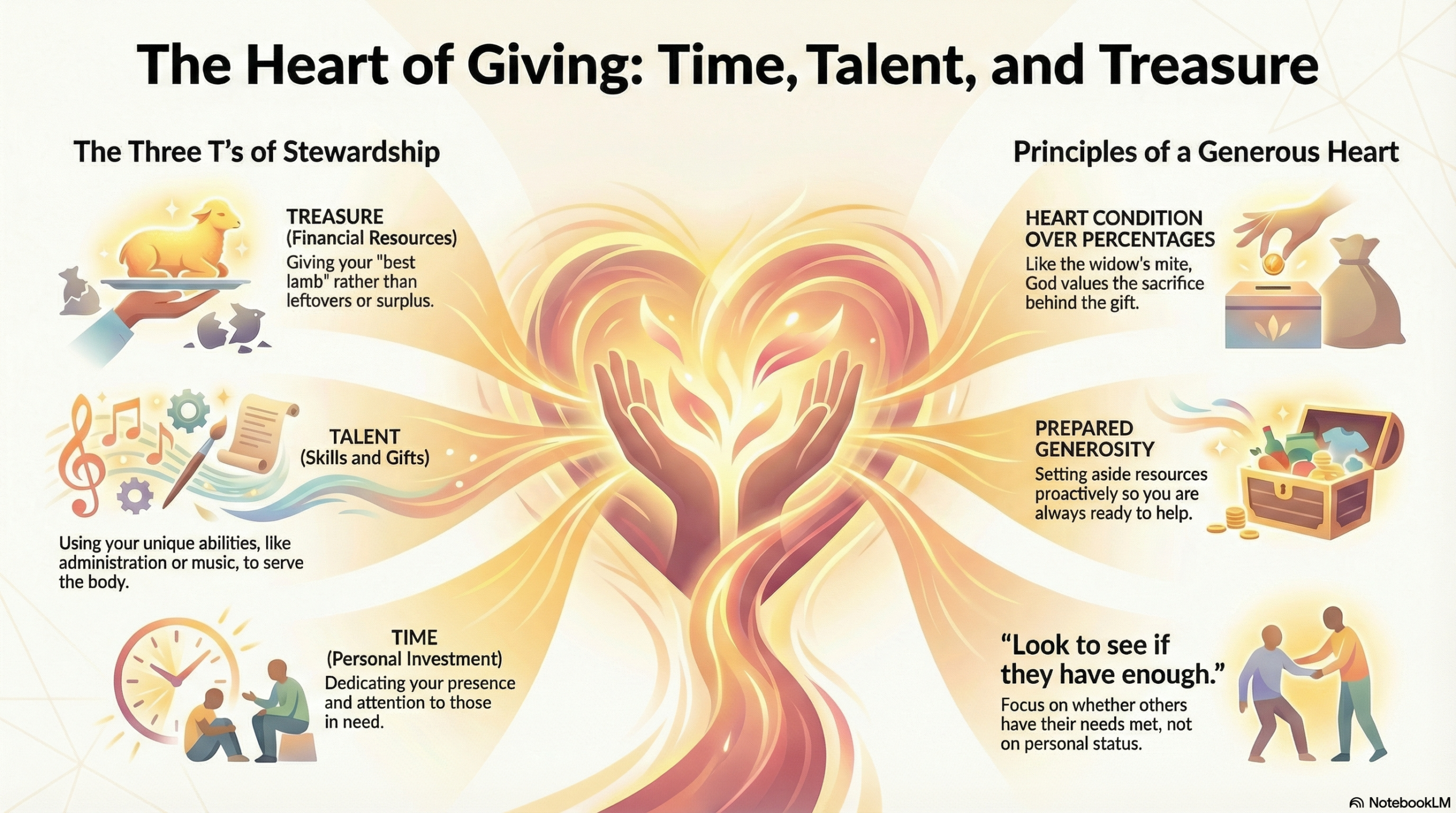
Core Theme: The sermon focuses on the concept of biblical giving, encompassing Time, Talent, and Treasure. Pastor Dustin Woolam argues that giving is not merely about money or funding the church, but about a heart condition that offers God one’s "best" rather than just leftovers.

Key Takeaways

  • Rejection of Transactional Giving: Pastor Dustin critiques the "Word of Faith" idea that God is obligated to pay you back financially if you give (e.g., give $10 to get $100). He calls this "nonsensical" and clarifies that while blessing is connected to generosity, it is not a financial obligation on God's part.
  • Context of Malachi: He explains that the famous tithing passage in Malachi 3 is not a guilt trip for fundraising, but a call for the people to return to God's ways. The tithe was intended to support the temple so it could care for widows and orphans.
  • Quality Over Quantity: Using the story of the Widow’s Mite (Luke 21), Pastor Woolam emphasizes that God values the sacrifice and condition of the heart over the amount given. The widow gave her "best" (everything she had), whereas the rich only gave from their surplus.
  • The 10% Standard: He suggests a minimum of 10% (the tithe) is a good biblical goal, referencing Abraham giving a tenth to Melchizedek before the Law existed. However, he notes this can take many forms, such as buying groceries for a needy neighbor if that is where the need is.
  • Holistic Generosity: Pastor Dustin challenges the congregation to evaluate which "lever" they are pulling—Time, Talent, or Treasure. He warns against giving money just to avoid giving time, or serving with talent just to hoard money.
  • "Nobility Obliges": He concludes with the concept that as "children of the King," Christians are spiritually "nobility" and therefore obligated to care for those with less.

TRANSCRIPT (word for word)

Good morning. Welcome to church. So I have a little preface here. I'm going to say something and I expect all of us to be like, but it's not going to be that, right? But you're going to feel that probably. Today we're talking about giving. That's the moment. Yeah, there you go. Let's pray and we'll get started.

Father, thank you for today. Thank you for the gift of your word. Thank you for the gift of your body. Father, I pray that you would come and join us in this moment. Holy Spirit, come and teach us that all the things that are of you remain and anything that's not of you, Lord, just let it be gone. Let it not be a distraction and let it not go with us from this place. We give you this time in our hearts and our minds. Lord, teach us in Jesus' name, amen.

I was thinking a lot about, you know, because we're in this series of like, what we believe matters. And what we believe about giving matters. And I'm sure all of us have a different thought about giving. So there's this sense of, oh, the church just wants my money. Or why does that pastor need a jet? Yeah, listen, I don't need a jet, by the way. In case you were concerned, don't need that. Well, want maybe, don't need. But I don't need the church to pay for it.

So there's all this, like, put your hand on the TV and pray, and God will give you money stuff, right, from the past. The interesting thing is that when the Bible was written, some of those people didn't even have a currency at all. They were giving grain to the temple so that people could eat throughout the year. And they were giving animals. And so I was thinking about how giving has been changed by our modern concepts. So I just want to look at the Bible and say, listen, there's a lot about giving that's just wrong in our minds, if we grew up in church, or if we saw something.

I don't think anyone really has a problem supporting a musician by buying their music, right? If you like their music, you're happy to buy it. You're happy to buy it ticket. The problem is that we've somehow turned that same idea into church. And we shouldn't have to buy a ticket or support the pastor in his next new book or whatever. And there's just a lot of that in the world. And, frankly, a lot of where this comes from is from a group of people that, like, broadly called word of faith. And they say things like... So if you haven't heard this, I'll catch you up and tell you why I'm saying this. They say things like, God owes you money if you give. That's ridiculous. That's just a nonsensical statement. I'm going to explain why I say that.

So, honest to goodness, heard a pastor say, if you give God $10, he's obligated to give you $100, because you're prepaying your tithe on that $100. That's a very common thing amongst a lot of people in the church. And so, when non-believers are like, all they want is my money, you kind of can't fault them for thinking that way, right? But when we're talking about giving, I want us to remember the three t's, time, talent, and treasure. So what do we give to God? We give God our time. We give God our talent. And we give God our treasure. And notice I said, treasure not money, because you don't have to have money to have treasure. Jesus says, store up your treasures in heaven, where moth and rust and all this stuff can't destroy.

Now, all of that said, it's not bad to have money. It's not wrong to be wealthy. I have no problem with someone having $0 or a lot of dollars. In fact, my brother, who I love dearly, makes this fun comment. He and I were driving, and my brother had some, you know, credit card debt, school debt, whatever debt he had some debt. We're riding in the car that he's paying for. And we're driving past someone begging for money on the side of the road. And he's like the audacity of that person to ask me for money when they have more than I do, because at least they're as zero. I'm at negative dollars. And I thought, you know, I get it. And I'm not saying that's the right idea. But it just shows how much we just don't really see money the way God sees money. And we don't see treasure the way God sees treasure. And we don't see time the way God sees time or in talent the way God sees talent.

And so when we're talking about giving today, what we believe matters. And yeah, I'm going to talk about money. It's part of it. But don't, when I say give, just get in your head that this is a fundraising service. It's not. But we are going to talk about something. So the first thing I want to do is kind of talk about the elephant in the room. We're going to go to Malachi chapter three. You've probably heard this before a ton Malachi is the last book in the New Testament before Matthew, by the way. I heard someone once say that he was the only Italian prophet because his name is Malachi. Probably not true. But a lot of times what will happen is someone will read Malachi chapter three. I'm a certain verse six. And they'll read this as a almost like a guilt or like an encouragement or whatever. But as I say about everything in the Bible, the context of a verse is the book that it's in. So we'll read this and then we'll have some context around it.

So Malachi chapter three verse six, I am the Lord. I do not change. That is why you descendants of Jacob are not already destroyed. Now that verse belongs to some context from chapter one. We'll get there. Ever since the days of your ancestors, you have scorned my decrees and failed to obey them also from chapter one. Now return to me and I will return to you, says the Lord of Heaven's armies. We're creeping in the chapters two and three there with that context. But you ask, how can we return when we have never gone away? Should people cheat God? Yet you have cheated me. But you ask, what do you mean? When did we ever cheat you? You have cheated me of times and offerings due to me. So offerings would have been like the animal sacrifices as well as just their 10% tithe.

You are under a curse for your whole nation has been cheating me. Bring all the tithes into the storehouse so there will be enough food in my temple. If you do, says the Lord of Heaven's armies, I will open the windows of heaven for you. I will pour out a blessing so great you won't have enough. You won't have enough room to take it in. Try it. Put me to the test. Your crops will be abundant and I will guard them from insects and disease. Your grapes will not fall from the vine before their ripe says the Lord of Heaven's armies. Then all nations will call you blessed for your land will be such a delight since the Lord of Heaven's armies.

All right. So people will read that and then say everybody give your money. Give your money and God will bless you. The context of Malachi, Malachi opens up like this. God says, "I love you." And people are like, "Well, what do you mean you love us?" And he's like, "Well, I destroyed you saw and I didn't destroy you." And that's the opening salvo from God. I didn't destroy you. I destroyed someone else who, by the way, was doing the same things the Jews were doing. But he didn't destroy them and when we get to chapter 3, he says, "I don't change. I didn't destroy you because I promised your ancestors that I would not." So he says, "Listen, I'm already taking care of you by not destroying you. I'm showing you love, by not destroying you." He says, "But if you'll interact with me in the ways that I've said, then you'll see blessing."

And the things that God had told the Jewish people to do when He says, "Bring the tithes into the storehouse." And when He says to bring offerings and chapters 1 and 2, part of the problem is they'd say, "Oh, well, we're going to bring God a really nice lamb for an offering." And then they would bring a lamb that was blind or lame or beat up. And so what God is trying to tell the Jewish people is not so much that there's a whole other verse in the Bible where God says, "If I was hungry, would I even ask you? I only cattle on a thousand hills. I don't need anything from you." But this is about you interacting with me in the way that I said, and so much of the Jewish law is about the Jewish people understanding the greatness of God. It's built into the law. And so you can't come to God dirty and wretched and broken. And if you are, then something has to die to make you fit for God's presence. And that's what those sacrifices were about when He says your offerings are bad.

And so in Malachi, what God is talking about when He says, "Test me and see if I won't bless you." His chiding of the people, his correction of the people, is because they're not doing the things that make them fit for God's presence. Now, in the New Testament, we have Jesus who's done that for us. So we're in a little bit different scenario, but Jesus still tells us to obey. We'll get to the New Testament a little bit. But the point of Malachi is not so that someone could stand up here and say, "Bring your tithing into the church so that God will bless you." That's right in the middle of a book where God is saying, "You people are so far from me and not doing anything that I want you to do, that if you want my blessing, you have to come back to what I said."

And part of what they were missing was the tithe because God is intimately interested in carrying for widows and orphans and those who have no resources. And the reason that people would give to the church or to the temple was so that the temple could do that. It was so that the Levites could have a living and so that people who needed help could get it. And so it's not about give money to the church so you could be blessed by God giving you all these blessings, but He's saying, "Come in line with my teachings and my ways." And that following me, part of that's your money. And so if you've heard Malachi used to say, "Hey, give your money to God so you'll be blessed," it's really not the whole picture. In fact, it's an exceptionally small portion of that picture.

So hold on to that because we're going to talk about tithing near the end and why even though it's part of the Old Testament law, we're still going to do it. But first, before we talk about tithing, let's look at what Jesus says. We're going to go to Luke chapter 6. Jesus says some interesting things in discernment on them out. One of the things he says is, "You've heard don't murder, but I say don't hate. You've heard don't commit adultery, but I say don't lust." And I'm giving you really high versions, or high level versions of these things. But what Jesus is saying is that really what God once from us is not just an adherence to the law, but a wholehearted living for the way that Christ would have us to live.

And so in Luke chapter 6, we're going to read verse 38. Jesus says, and I just want to get really clear, actually, by the way, there is a blessing connected to being generous, right? But there's not a sense of obligation of if I tith God's obligated. So I don't want to miss the point that there are blessings attached to being generous and to giving. I don't want to just skip past that, but we're not there yet. In case I've said too much in a way that makes you think that God doesn't bless giving, I don't want to say that. Especially because Jesus says in Luke 6, 38, "Give, and you will receive, your gift will return to you in full. Press down, shaken together, to make room for more, running over, and poured into your lap. The amount you give will determine the amount you give back."

So there's tons of songs about this. I grew up, give, and I'll come back to you, press down, shaken together, running over. There's a whole thing. When Jesus is talking about this, he's describing the way you might buy something in the market. Because you didn't just go buy a bag of flour, or a bag of sugar, or a bag of rice. Instead, what would happen is you would have a container, or even an apron, and you would pour it in, and then you would shake it and let everything settle, and you press it down, and make room for more. You would do that repeatedly, and so what Jesus is saying is when you give, this is how it will come back to you. But I think that one of the things that we miss, when we look at this passage, as Jesus says, "Hey, when you give, your gift will return to you, and this is how your gift returns." Full measure, and you put this sentence at the end, the way you give is the way that you'll receive. The measure you use is the measure you will receive.

So there's this sense of, "How am I giving?" Let's look at the next part. We're going to stick in Luke, but we're going to go verse 21, and we're going to talk about, now we have some giving concepts that when God is correcting the people in Malachi, it's because of where their hearts are in relation to the Lord. When Jesus talks about giving and blessing and return, he's talking about how we give. Like the measure that we give, but here in Luke 21, we're going to start in verse 1. We're going to look at the widow's offering. So Jesus was in the temple. He watched her rich people dropping their gifts in the collection box. Then a poor widow came by and dropped in two small coins. You might hear it called the widow's might in some other versions. Jesus says, "I tell you the truth." This poor widow has given more than all of the rest. For they have given a tiny part of their surplus, but she, poor as she is, has given everything that she has.

So the widow gives the last of what she has. She gives not, like imagine, if I have, like just $100 in my pocket, it's extra, it's just my extra money, it's my surplus, and I give $20. That's not nothing, right? I gave $20. But now let's imagine someone who has no money. In fact, they barely have enough to eat, but they find a way to give two pennies to the church. That person has given more. And so it's a percentages thing, right? And it's not just a percentages thing because God's not after like, well, if you give 50 percent, you're more holy than if you give 10 percent. If you give 10 percent, you're more holy than if you give 1 percent. But it's a condition of the heart, right?

This woman had nothing and still gave. And so it's a sense of the condition of, like in Malachi where God says, you're bringing me lame and busted and blinded animals. But they could have done more. They could have given better, and they didn't. But this way, well, there's a bunch of different points of view. So I'm going to give you mine. My wife and I differ in this area. If there was a toaster and somebody needed a toaster and we had a toaster, I would just give them arse, or I would buy them a new one. And if I gave them arse, I wouldn't replace it because I don't ever toast anything. And it wouldn't occur to me to buy another toaster. But I would give it, whereas Jamie's not this way anymore. First God married, Jamie's like, well, let's give them our old toaster and go buy a new one. She is 100 percent not that person. If you get a toaster from Jamie, it's a new one in a box these days.

But there's this sense of how did we grow up? How did we think? How did we interact with money as we were coming to the moment that we're in now, right? The Bible finds us where we are. And I'm not saying that it's wrong to give somebody something to use them. I'm not saying that at all. But did you give away something old so that you could get yourself something new? Well, all you did was find a different way to not throw it in the trash. Like, did you really give, right? Or, and I'm not saying you can't have new things. And I'm not saying you can't donate old things because they're still good enough. I'm not saying that you can't. But what the Lord is asking us to do is something a little bit higher. He's asking us to not just give our leftovers, but he's asking us to give our best.

So when the widow gives her two pennies, she's not giving leftovers. She's giving her best. And when the people who give out of their surplus, great, the surplus is valuable. Jesus didn't say that their giving was bad. He just said it wasn't the same as when she gave her best. So the widow, so Jesus tells us that we're given and receiving in the measure that we give and receive. And then he points to the widows an example of what it is to give your best.

So some practical things, 1 Corinthians 16, Paul, on a couple of occasions, talks about giving. He writes this whole letter to this church about how he never takes any money from them. That when he shows up, he works as a tent maker and he provides for himself or another church sins provision for him. When he's in jail, he talks about people sending him food and things to care for his bodily needs or even friends. So Paul says a lot of things about giving. He's very familiar with receiving. He's also, in a couple of occasions, been given the job of gathering up a whole bunch of stuff to deliver to a church in need. So Paul interacts a lot with money.

Chapter 16 of 1 Corinthians, starting in verse 1, he says, now regarding your question about the money being collected for God's people in Jerusalem, you should follow the same procedure I gave to the churches in Galatia. On the first day of each week, you should each put aside a portion of the money you have earned. Don't wait until I get there and then try to take it all at once. When I come, I will write letters of recommendation for the messengers you choose to deliver your gift to Jerusalem. And if it seems appropriate for me to go along, they can travel with me.

So Paul gives this practical idea about giving. We want to give our best. We want to do like how the widow did and just say, "Hey, Lord." And then we'll talk about this a little bit. But we don't want to give from a sense of compulsion, like, "Man, if I don't give, God's going to curse me." Also, I want to talk about where we give. So Paul is talking to this group of Christians in Corinth. They're gathering money for the church in Jerusalem because they need money in Jerusalem. It's very poor church. One of the things that happened when they became Christians. You know, we read the book of Acts and it says they had all things in common. They're selling land. They're helping people. Well, here's why a lot of that happened. Not all of it, but a lot of it. As soon as they became Christian, they were completely ostracized from all of their community and their support. They essentially became vagabonds.

And so the Christians had to build a whole new community where they had to depend on each other. And they didn't have any money or resources. So they had the description in Acts is not a description of like this perfect utopia of everybody being socialist or communist or not capitalist or whatever the case might be. It's also not in favor of capitalism. What it is saying is the people in the book of Acts began to look like a typical family from the first century. That's how families looked. That's how families interacted. That's how families behaved. And the Christians from all over the face of everywhere began to act like a family with each other. They began to take care of each other. They began to look after each other.

That behavior was already happening all over the entire planet. It's just new for the Christians because they didn't have that support system anymore. Some of them had traveled and decided to stay. They didn't go home. Some of them couldn't go home. And so what the book of Acts is telling us is part of us giving to each other. Part of us caring for each other is showing the world that we're family and that we care about what's going on. So if somebody needs some help with their vehicle or somebody needs some help with something. And so when we give Paul says put a little to the side so it's not a big pressure.

In the church, just anybody who wants to know, this is what we do. Everything that is given to the church, 10% of that goes into a completely separate account and it's for benevolence, right? Because we want to prepare to give, not have to take up an offering if something happens. Now, not a post that's taken up an offering, if somebody needs some medical procedure or if something's happening in their home or not a post that's coming and saying, hey everybody, there's a need, please give. But what we want to do is be wise and gather that money ahead of time so that we're not always having to come and have some emergency. The rest of the money in the church goes to running the church, the building, the lights, the hopefully saving for the future, wherever we're going to go in that.

But the other, there are lots of options. We're going to talk about the tithe. Before I talk about the tithe, I want to set up this picture. So tithe just means 10%. Strong believer, Christians should tithe. We'll talk about why. But here's what I want to tell you. Your tithe, ideally you hear some people say, I don't want to say ideally. You'll hear some people say, hey you should give 10% to your church where you worship. 10% of your income should go there and it should be before taxes, after taxes, there's all this argument. I'm not going to give you the right answer on that. What I'm going to do is hopefully share with you wisdom from the scripture for you to make your own decision. About your own money, I'm not going to dictate to you how to spend your money or how to gift to God. What I'm going to say is that Jesus teaches us that we should give with our whole heart, that we should give our best gift, not a bad gift, not a blind lamb.

And I'm going to talk to you about why I think it should be 10% and then I'll give you a couple of ideas about what that might look like. So let's go to Genesis chapter 14. The tithe is established in the law and when God is speaking in Malachi, he's talking about the tithe because those people live under the law. One of the things that happens in the New Testament is we ask the question, well why should I tithe? We don't live under the law. The laws written for the Jewish people, Jesus came and we have a new law and we don't have to live under the law anymore. Yeah, right. But Abraham lived before the law. In fact, when Abraham dies, it says that Abraham was righteous and it was credited as living according to the law because he was righteous. We read that in the book of Genesis and also in the book of Romans.

So, Abraham, before he's Abraham, by the way, before he's gone into covenant with the Lord. Let me catch up. So Abraham has a lot, his family member, his nephew and their shepherds are all fighting with each other and Abraham says, hey, or Abraham at the time says, lot, pick you a spot. Wherever you go, I'll go the opposite way. We just got to separate out these people because there's so much fighting. Lot takes a look at the land and he's like, well, that's the good land. I'm going to go over there. He travels off down into the valley and he sets up. He ends up moving into Sodom and Gomorrah. That's how lot ends up in Sodom and Gomorrah. Abraham, on the other hand, goes off the opposite direction.

The Lord blesses him and he has this whole thing with the Lord. Sodom and Gomorrah and the five cities there are five cities. We commonly call them Sodom and Gomorrah, but there are five cities in the valley there. Get attacked and lot gets carried off. Oh, no, he's been kidnapped. And so Abraham, Abraham at the time, gathers up his guys and he goes to save his family and all the other people. So he goes, he saves everybody and he's on his way back and he meets a guy named Melchizedek. Melchizedek is the king of Salem, so it's pretty commonly believed that Jerusalem had this king who was Melchizedek, who was also a priest.

So whatever was happening before the Jews were there, that's pretty common speculation. We're going to start in Genesis chapter 14, we're going to start in verse 17, after Abram returned from his victory over Keter Lemur and all his allies, the king of Sodom went out to meet him in the valley of Shiva. That is the king's valley and Melchizedek, the king of Salem and a priest of God most high brought Abram some bread and wine. Melchizedek blessed Abram with his blessing, blessed to be Abram by God most high creator of heaven and earth. And blessed to be God most high who has defeated your enemies for you. Then Abram gave Melchizedek a tenth of all the goods he had recovered.

The king of Sodom said to Abram, "Give back my people who were captured, but you may keep for yourself all the goods that you have recovered." Abram replied to the king of Sodom, "I solemnly swear to the Lord God most high creator of heaven and earth that I will not take so much as a single thread or sandal thong from what belongs to you. Otherwise, you might say, "I am the one who made Abram rich. I will accept only what my young warriors have already eaten and I request that you give a fair share of the goods to my allies, anner and ash call and memory."

So it seems like a little, maybe even almost kind of a neat God-blessed Abram, but the reason that we tie this is the same reason that we Sabbath both existed before the law. God shows us the Sabbath and Genesis at creation and Abram shows us the tithe before the law, when he's blessed. So the reason that we want to give our best first and foremost, whatever our best is, in this moment where God finds us, maybe you're in like a whole bunch of debt, maybe you have $70,000, $90,000 in debt, and you're just buried under those payments. Do not feel the weight of God wants your money and how are you going to take care of things.

However, that doesn't mean just don't give, find a way to give to the Lord. There was a guy who was a huge inspiration to me and still is to this day. His name was Eric. Still is Eric, by the way. Not my father-in-law, another man. And this guy was just completely gone on drugs and he becomes a Christian and Eric was such a neat guy because he could barely put sentences together, barely at all. In fact, when you would talk to him, he would say, "Lord, how do you say that?" And then he would say something that you knew was the Lord helping him to speak. He lived his whole life depending on God.

He has two examples of trusting the Lord when it comes to money and to things that have meant the world to me in my growing. The first example was he painted his house this really odd color of blue. He painted his house that color because he believed that God was going to give him a vehicle the same color. And he's like, "God told me he's going to give me a car of this color. I'm painting my house that color as a reminder to me that God is going to provide." Well, when he did that he kind of had enough money to paint his house and not much else. He got a really good job. He even got like a, excuse me, a work vehicle that he could drive and he decided to buy a vehicle.

Two weeks later that vehicle broke down. It was almost the color of his house but not quite. And so even though he continued to make more and more money, he would not buy a vehicle because he wanted to trust in the promise of the Lord. I'm not saying that you should all go paint your house. Listen, I'm just telling you about Eric's life and his walk with the Lord. So he does this. He won't buy a vehicle. In fact, the broken down car he left in front of his house as a second reminder of a promise from the Lord. Years go by. He's got plenty of money and then he gets a car of the color of the house. It's like when they remade the tea bird, right? That color blue is the same color as his house. There were no cars that color until that car came out. And he ended up with that car and I thought, "Man, he could have bought five cars over in the meantime but he walked everywhere or got rides or whatever."

The next story that he tells was from a time when he didn't have that much money. He had $20. That's all he had and this was in the 90s. So that was a lot more than it is now but it was still not much because he had no food in his house at all, like no food. And he wasn't going to get paid till Friday and it was a Sunday and he tells the story that he believed God was asking him to put that $20 and offering plate. And he wrestles with it. He's like, "Lord, I don't have any food." And then he tells himself, "This isn't what the Lord says to him but he tells himself." He's like, "I can't eat for a week on $20 anyway. I might as well just give it to God." And all week people invited him over for dinner and send him home with leftovers. He had more than he would have possibly been able to buy.

And so both of those stories, I'm not saying that we should mimic him exactly. I'm not saying empty your bank account and put it in the offering plate. But what I'm saying is when the Lord talks to us about giving, let's be open to doing something that might be a little bit of a press for us. Let's be open to doing something that's maybe outside of how we might normally choose to give. Maybe it's giving in a place. And then within the scope of that, like Paul says, "Let's be prepared to give." So I think the best goal from the Scriptures, what we can see, we're going to tile this up. Our goal should be to give a minimum of 10% because it's the example from Genesis. God later puts it into a law for his people. So I think aiming for 10% of our physical treasure is a good idea.

How do we do that? Well, maybe if we give 10% to the church, that's an okay way to do that. But what if, man, my neighbor, she never has any money. He never has any money. They're always out of money. So every week, I'm going to buy them groceries. Maybe that's your 10%, like the church really doesn't need your money, but you need to give somewhere, right? And you need to give for the Lord. Like God will make sure that the church has whatever it needs. I am not worried. I mean, there was a pastor who said something to me once, they like, stuck in my soul the way peanut butter won't come off a spoon, right? We were in a city where every Dave Ramsey had just exploded. Everybody loved Dave Ramsey, and I have my job. Can I just tell you I was sick of people walking in and saying, "Oh, work for a church. Can I get a discount?" I was like, "No. In fact, stop asking. I'm sick of churches asking for free things."

And so this one guy in this church, in this community, he says, "I never ask for a discount." And he's a pastor. He says, "I'm a minister that gospel and God can make sure that I can pay full price." I mean, discounts are bad. No. But he was being counter-cultural in the city that we were in, right? In a city where churches looked bad all the time because they were looking for a handout when they had all this money, he was saying, "Look, I'm not going to be that way. I'm not going to be that person." And here's the thing about giving Eric trusted in the Lord and he gave everything he had. This other person trusted in the Lord and didn't ask for a discount. Even though it might have been wise or prudent to do so, he was being counter-cultural.

And so in our giving, it's not just about giving 10 percent, but it's about living that moment with the Lord. It's about living that moment, giving our best, not bringing a broken lamb or not forgetting to give to the church in the case of Malachi. They had to give to the temple so the poor could be taken care of. If you can give to the poor and take care of the poor, then do that. But do it for the Lord and unto the Lord. Maybe you have some money you set aside. Maybe you put money aside. Someone in this building, I won't write on them because I don't know if they want to know. Share it with me. They put money to the side so they have money to give later when it comes time to have that. But do it for the Lord and give your best. So when we talk about giving, man, I'm not worried about it. This whole thing is the Lord's. If he wants to go get one of his cows off of a thousand hills and do something with that, that's his business. The only reason that I would say please continue to give to the church is because it's the lights.

And it's the technology that Jamie's using right now with the kids and it's the ability to give to people who ask and it's the reason we have a place and we can do the things that we do. So yeah, the church needs some help and some support. But more important than all of that is that wherever you give that you do it for Jesus, you do it for the blessing of Jesus. And Jesus says in one place, he says when I was poor, you fed me when I was in jail, you visited me. And they said, Lord, when did we do these things? And he said when you did it for the least, you did it for me.

And so as we are in the world giving money, sure, I've spent a lot of time on money. Let's just switch gears a little bit. You can take everything I said about money and make it time and talent as well. Like there's not, it's easier to think about like $10 is 10% of a hundred or $20 is 10% of 200. So that's easy. But like what would it look like if if giving is more than money, what does it look like if I want to tie my talent? What does that look like? What does it look like if I want to tie my time, right? And you could go through and say, well, six minutes of every hour, 24 hours and you can do all the math. Some people have done that. I'm not asking us to be legalistic about the 10%. I'm asking us to give our best whatever that is, right? And so, man, I'm buried, right? I'm that person with $100,000 in debt. I don't know where my next meal is coming from. But I know how to change a tire and somebody needs help with their tire changed.

Or I know how to fix someone's computer or I know how to hold a baby or I know there's so much that we can do where we have a lifestyle of giving. And it doesn't have to be finances. A lot of times that's practical. Somebody needs food, you give them a gift card to Walmart and they go buy groceries, right? Practical sins to giving that we want to be aware of. But when we find ourselves unable to give financially, or even when we're able to give more than we could imagine financially, we don't want to separate from giving our hearts and our lives and our skills to the Lord. And this is partly why so we're all one body. I've said this. We all have gifts and talents that all of us need. Part of that is because God has deposited gifts into each of us that all of us need.

And so if God's giving you the gift of being friendly or if God's giving you the gift of like administration or if God's giving you the gift of music or the gift of like cleaning carpets or whatever the gift is. Let's use that gift for the people of God and for the lost to point them to God. And so last this is it. If you don't hear anything else, the purpose of giving is not so that I can get. The Lord has promised blessing if I will give to him and I'm sure God give me whatever you have. I'm not going to argue with you if you want to bless me. But I don't want to focus on the return. I want to focus on and I really love God. And if I'm going to love God well, then I have to love people. And one of the best ways to love people is to be generous towards them. Give to them with a full heart, whatever you can give.

And so yeah, giving matters. It makes us not selfish when we focus on giving. If I'm there's a comedian, he quoted this and he heard it from somewhere else. He says that he told his daughter that when you're looking in someone else's bowl, you never look to see how much they have or if they have more than you, what you're looking for is to see if they have enough. And so when we start looking around, let us be outward focused in the way that we're looking at people. I don't need to measure up to that person. I need to make sure that person has what they need. I don't need the nice new car. I don't need the house. I don't need. If you want those things, buy those things. God bless you. He said he would bless you. If you have those things, then enjoy those things.

But in all of that, how do we give to the neighbor or to the person on the street or how do we be wise with our money? Those are the questions that we want to ask. And so my encouragement to you would be to take an honest evaluation of your life, your time, your talent, your treasure. How are you spending it? Are you giving money because you don't want to give time or talent? Are you telling yourself, oh, well, I gave $3,000 this week so I don't have to give my time or my talent. Is that your best offering? Or is your talent a better offering than your money? Or are you giving your time and talent because you want to hold on to everything else? Are you giving your time and your money because your talent is for you?

Because we have these three levers that we pull, are we giving the one we're comfortable with, and how might the Lord press you to move the others? That's the question I want to ask us all. Am I selfishly being at a home by myself where I'm happy when what the world needs is me? And instead, I was like, yeah, because James tells us when you walk by and you see someone, you say, be warm, be fed, you've done nothing for them. I want to solve in whatever place we are, whatever gifts we have, whether they be financial or otherwise. How do we give? How do we be a people who are generous and full-hearted in our generosity?

I said I was done, but I have one last thing. There's an old term, and I'm not going to try to say the French, I'm just going to translate it, but it says nobility obliges, right? And the sense is that if you're in the nobility, then it's your obligation to take care of the people under you. So a king is required to take care of his people, and then all the way down, Duke's lords, I don't know the structure, but all the way down, everyone who has someone under them is obligated to the people below them to care for them. I just want to submit to you that we're all children of the king, and if we're all heirs with Jesus, then we're obligated to share with those who are not. We're obligated by God, because he's given so much to us already.

Let's pray. Father, thank you for helping us to understand that you're not after us for our things or in search of our hearts. So Lord, I pray that you would help us to give our full heart to you, that as we evaluate our time, as we evaluate our talent, as we evaluate our treasure, that we don't just give the easy thing. That's fine, we should do that, but the Lord on top of that, we should give the thing that costs us a little bit, we should give the best that we have. So Lord, I ask you to help us to look for that thing, and to listen, the same way Eric listened, I'm not saying we should paint our houses or give the last of our cash, Lord, but help us to listen for the thing you are saying to give, and Lord, help us to be wise to put that in good soil, or we don't want to throw your resources down a drain that's wasteful, help us to be wise and where we give and where we donate, help us to listen well.

Lord, I pray for your blessing and your abundance on those who give, or you said you would give it, so Lord, help us to receive that well and to not feel guilty. Lord, if you've given us blessing, then help us to enjoy that blessing, but then to also share it with others. When we give you our hearts and our lives, we ask you to go with us this week, we ask you to teach us in Jesus' name. Amen.


Tags

Doctrine, Giving


You may also like

Leave a Reply

Your email address will not be published. Required fields are marked

{"email":"Email address invalid","url":"Website address invalid","required":"Required field missing"}