
No Greater Love | Agape Love | Guest Speaker: Rufus Wallace, Elder

Guest Speaker: Rufus Wallace, Elder | Recorded February 22, 2026
No Greater Love Agape Love OWCC One Way Community Church

TLDR Summary

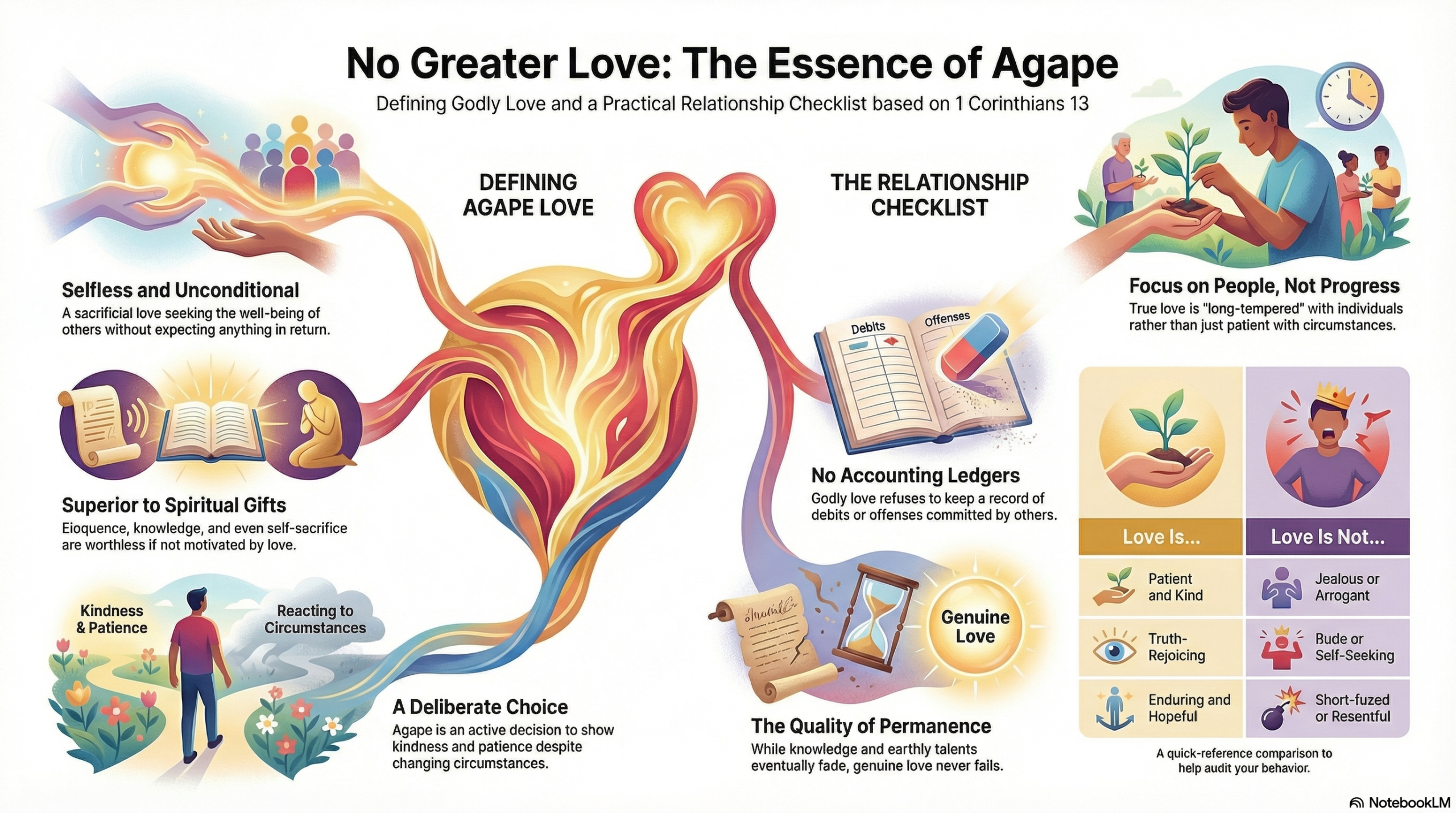
The Nature of Godly Love: Rufus Wallace focuses his message on "agape" or godly love, which he defines as a selfless, unconditional, and sacrificial choice that expects nothing in return. Drawing from 1 Corinthians 13, he explains that this type of love is essential for making families, relationships, and churches run smoothly, especially in times of conflict or division.

The Checklist of Love: Rufus encourages listeners to use the Apostle Paul's description of love as a personal checklist for their own relationships. He highlights the following key characteristics:

  • What love is: It is patient with people and actively demonstrates kindness, much like God showed us kindness by sending Christ. It also bears, believes, hopes, and endures all things, always holding out the possibility for others to change.
  • What love is not: Love is not jealous, arrogant, or boastful. It is not rude (unbecoming), easily provoked into a temper, or focused on seeking its own rights ahead of others.
  • Forgiveness and Truth: True love does not keep a record of wrongs or track the offenses of others. It refuses to take pleasure in the misfortune of enemies, choosing instead to rejoice in frank truth rather than empty flattery.

The Permanence of Love: Rufus concludes by emphasizing that "love never fails". He points to Jesus's death on the cross as the ultimate example of this unfailing, enduring love, noting that Jesus took the punishment we deserved so that His love could be poured into us.

TRANSCRIPT (word for word)

We have different types of love. We have love for a longtime friend, love for a spouse, love for a child or grandchild, and love for something that you hold dear. Then we have godly love. Jesus has poured His love into us, and we can pour that love into others. Jesus offers us life from His love.

Let's pray. Heavenly Father, we come to You right now and thank You for everything. I pray, Lord, that we can speak about Your love, about godly love, and about the way we should do things. We thank You for watching over this service. In Jesus' name, amen.

I listen to several sermons every week, and I have some pastors that I really follow and like. The message I’ve put together is probably a combination of three or four pastors, including our own pastor, Dustin. That is where I get all of this in my study.

Jonathan Swift, the author of Gulliver's Travels, said that "we have just enough religion to make us hate one another, and not enough religion to make us love one another." That was true in the Church of Corinth. They were a growing church, but they were filled with strife and division. What was the answer to that conflict, which was threatening their witness for Christ? Paul wrote an entire chapter about this subject of love in the midst of division in the Corinthian Church. Love is what makes any friendship, relationship, or family work, and it is required to make any church run smoothly. We are going to talk about the quality of love this morning.

Let's look at 1 Corinthians chapter 13. When Paul talks about love, he isn't talking about a desire-based kind of love; he is talking about agape love. What is agape love? It is a selfless, unconditional, sacrificial love. It is often considered the highest form of love, characterized by deep care and a desire for the well-being of others without expecting anything in return. Prominent examples are God's love for humanity and humanity's love for God. It is a deliberate choice. It means acting with kindness, patience, and service in changing circumstances. Practicing agape love can heal relationships and lead to deeper, more meaningful connections.

Let’s read 1 Corinthians 13: "If I speak with the tongues of men and of angels, but do not have love, I have become a noisy gong or a clanging cymbal. If I have the gift of prophecy, and know all mysteries and all knowledge; and if I have all faith, so as to remove mountains, but do not have love, I am nothing. And if I give all my possessions to feed the poor, and if I surrender my body to be burned, but do not have love, it profits me nothing. Love is patient, love is kind and is not jealous; love does not brag and is not arrogant, does not act unbecomingly; it does not seek its own, is not provoked, does not take into account a wrong suffered, does not rejoice in unrighteousness, but rejoices with the truth; bears all things, believes all things, hopes all things, endures all things. Love never fails. But if there are gifts of prophecy, they will be done away; if there are tongues, they will cease; if there is knowledge, it will be done away. For we know in part and we prophesy in part; but when the perfect comes, the partial will be done away. When I was a child, I used to speak like a child, think like a child, reason like a child; when I became a man, I did away with childish things. For now we see in a mirror dimly, but then face to face; now I know in part, but then I will know fully just as I also have been fully known. But now faith, hope, love, abide these three; but the greatest of these is love.".

Paul is talking about the excellence of love. He says that love is superior to speaking well, to spiritual gifts, and even to self-sacrifice. Beginning in verse four, Paul talks about the characteristics of love. We can use this as a checklist to ask if this is true about ourselves and our relationships. If you are single and thinking about dating or getting married, you can use this checklist to ask if the other person possesses the characteristics of love.

Love is patient. This refers to people, not circumstances. Are you long-tempered? Do you have a long fuse rather than a short one?. When it comes to people, I know that I need to look hard at myself and do better in those areas. Love is also kind. Love is always doing something for others, especially people who wrong us. God did something kind for us. Titus says He demonstrated kindness toward us in sending Christ to die for us. Even though we were sinners deserving God's judgment, He gave us what was needed instead of giving us what we deserved. Kindness means doing something useful for those who wrong you.

Paul also lists the negative characteristics of love. Love is not jealous. A lot of people have the wrong understanding of the word jealous, equating it solely with possessiveness. If you love someone, certain actions and emotions are exclusively reserved for that relationship. Jealousy is not always a bad term; God is a jealous God, and there are emotions He wants reserved for Him alone. However, the word jealous here means to envy—to desire what someone else has, or to covet. It means wishing you had what somebody else has, or wishing they didn't have it. Jealousy was the root of the very first murder when Cain killed his brother Abel because Abel had a closer relationship with God. Jealousy is the opposite of agape love. Real love rejoices over what other people have instead of resenting it.

Love does not brag. It does not behave like a windbag. We all know people who are constantly bragging about their accomplishments, who they know, or name-dropping. There is nothing wrong with accomplishments when expressing your qualifications or encouraging others, but love avoids constant bragging. When Muhammad Ali was the heavyweight champion of the world, he sat down in a first-class seat on an airplane. The flight attendant told him to buckle his seatbelt, and he growled, "Superman don't need no seatbelt.". The flight attendant replied, "Well, Superman don't need no airplane, either.". That is what it is like to be a windbag. The Corinthians were constantly bragging about their spiritual heritage and mentors.

Closely related to bragging is arrogance. Love is not arrogant, or "puffed up.". William Carey, a missionary to India who translated the Bible into 34 different languages, came from being a shoe cobbler. At a nice dinner, a snobbish host tried to humiliate him by asking, "I hear, Mr. Carey, that you were a shoemaker.". Carey replied, "Oh no, you heard that wrong. I was not a shoemaker. I never had that gift. I was only a shoe cobbler." He wasn't about to inflate his own resume to impress other people. The cure for arrogance is found in 1 Corinthians 4:6-7. When you realize that everything you have—your strength, your breath of life—is a gift from God, you lose the right to boast as if you achieved it entirely on your own.

Love does not act unbecomingly. This means love is not rude or overly severe. This doesn't mean we don't stand for truth, but we must speak the truth in love. Many people have been turned off to Christianity not because of the gospel, but because of the offensive behavior of other Christians.

Love does not seek its own rights. Nothing causes more friction in a family, friendship, or church than when people put their own rights above the rights of others. As James 4:1 points out, the source of quarrels and conflicts is often our own desires waging war within us.

Love is not provoked. It does not fly into a temper. While there is a place for righteous anger—like when Paul was angry about false teachers, or when Jesus cleansed the temple out of jealous anger for God's holiness—most of the time our anger is not righteous. We get angry because our rights are violated, a friend forgets a birthday, or a church vote doesn't go our way. Genuine love is not easily provoked or short-fused.

Love does not keep a record of wrongs. Keeping ledgers is essential for business, but if you are keeping a list of offenses people have committed against you, you will have a hard time maintaining harmony in relationships. True love treats other people the way God treats us. As Romans 4:8 says, "Blessed is the man whose sin the Lord will not take into account.". If you are a Christian, the ledger of offenses you have committed against God has been erased by the blood of Jesus.

Love does not rejoice in unrighteousness. We should never take pleasure in the misfortune of other people, especially our enemies. If someone cheats you and later files for bankruptcy, or if an ex-spouse's new marriage fails, it might be tempting to feel satisfaction. But Proverbs 17:5 warns that he who rejoices in calamity will not go unpunished. Instead, love rejoices in the truth. Flattery is a form of hatred because you are more interested in getting something out of the person than in their actual well-being. People ultimately appreciate frankness more than flattery, and true love will share the truth even when it hurts.

Love bears all things. This means shielding another person from the consequences of their actions. If you truly love someone who wrongs you, something inside you wants to protect them, and that must be the love of God working in you.

Love believes all things. This doesn't mean trading your good sense to believe everything you are told. It simply means giving the other person the benefit of the doubt and believing the best about them instead of the worst.

Love hopes all things, refusing to believe that a person's failure is final. While discipline or dismissal is sometimes necessary in business or church, in personal relationships, love always holds out the possibility for change. We give people an opportunity to change and never pronounce final judgment upon someone; only God can do that.

Love endures all things. Instead of returning evil for evil, you endure hurts and offenses and continue to love like Jesus, who hung on the cross and said, "Father, forgive them, for they know not what they do.".

Finally, Paul speaks of the permanence of love: love never fails. Two thousand years ago, Jesus climbed Mount Calvary and allowed Himself to be placed on a cross, taking the punishment that you and I deserve. As Isaiah prophesied, He was pierced for our transgressions and bruised for our iniquities. The Lord has laid upon Him the iniquity of us all. Jesus covered everything, and that is a love that will never fail. True conviction is a sign that the heart is in a good place and sensitive to the Holy Spirit. Jesus poured His love into us, and we can pour that love into others because He offered us life from His love.

Let's pray. Heavenly Father, I thank You for Your Word and Your instruction on how we should do things in the Spirit. We are so thankful that the Holy Spirit is here to guide and direct us. Lord, I ask that You would be with everyone here, keep them safe, and help them ponder what agape love truly means. We thank You for everything. In Jesus' name, amen.


Tags


You may also like

Leave a Reply

Your email address will not be published. Required fields are marked

{"email":"Email address invalid","url":"Website address invalid","required":"Required field missing"}