
IT'S IMPORTANT WHAT YOU BELIEVE | Can You Trust the Bible

Pastor Dustin Woolam | Recorded March 1, 2026
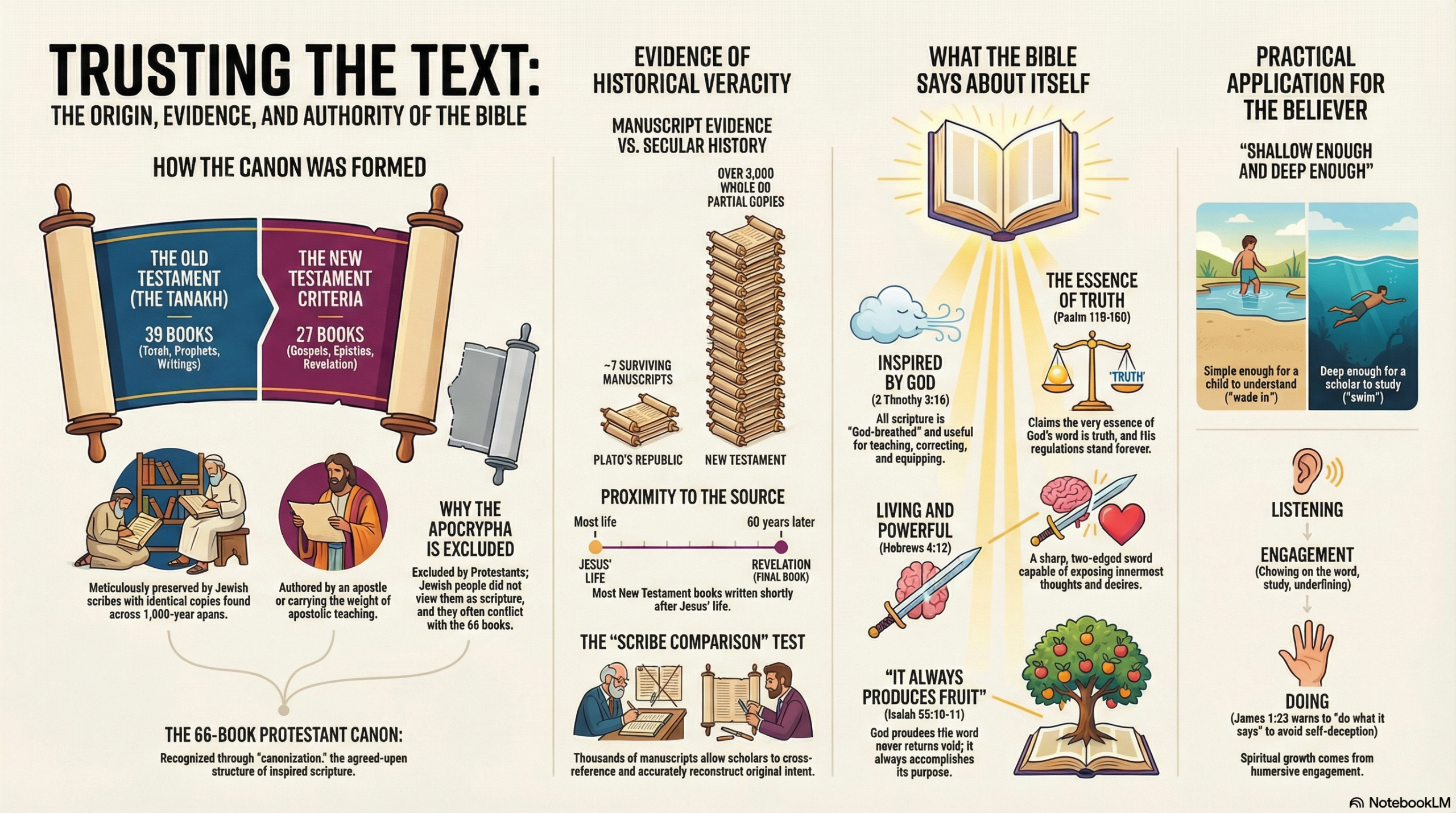
Can We Trust the Bible Historical Evidence Infographic OWCC One Way Community Church Robinson Texas

TLDR Summary

Pastor Dustin Woolam's sermon regarding the origins, reliability, and authority of the Bible:

  • How We Got the Bible: Pastor Dustin Woolam explains that the Protestant Bible consists of 66 canonized books. The 39 Old Testament books were adopted from the Jewish scriptures, which were meticulously preserved over thousands of years without variation. The 27 New Testament books were recognized by the early church based on whether they were written by or aligned directly with the teachings of Jesus's apostles.
  • Unmatched Historical Reliability: The New Testament is supported by roughly 3,000 whole or partial manuscript copies that were written shortly after the life of Jesus. This provides far more historical accuracy and textual evidence than any other ancient document, including the writings of Plato or Homer.
  • Ultimate Authority: Because the scriptures have been miraculously and faithfully passed down from God, Pastor Dustin emphasizes that believers must submit to their authority. When the Bible presents counter-cultural teachings or challenges personal preferences, Christians must adapt their own lives to agree with the scriptures rather than arguing against them.
  • The Bible's Claims About Itself: The scriptures boldly declare that they are inspired by the Holy Spirit, fundamentally true, clear enough for the simple to understand, incredibly powerful and effective, and more precious than millions in gold and silver.
  • Practical Application: Pastor Dustin Woolam challenges his listeners to immerse themselves in God's Word, whether by studying it deeply or simply listening to audio versions in their daily routines, just as he recently did with the book of Job. He reminds the congregation that they are called to obey these scriptures, love their neighbors, and organically share the wisdom of the Bible with others.

TRANSCRIPT (word for word)

Welcome to church. Let's pray. There are a couple of families in the church who have experienced losses and tragedies this week. Let's pray for them, and if there's someone you know who needs prayer, lift up their name. The Lord knows who they are. Father, thank you for your constant care and attention, even when it seems like you're absent during difficult times. I pray for these two families who have experienced tragedy and loss, that your blessing, care, and concern would be overwhelmingly known to them. As we spend time in your word today, we ask the Holy Spirit to come and teach us, just as Jesus promised. We trust you and thank you, Amen.

We are in a series about what we believe matters, and this week, I want to talk about what we believe about the scriptures. Before we get deep into the Bible, let's discuss how we got it. Christianity is entirely unique in the way we received our Bible. The Bible we have today consists of 66 canonized books in the Protestant tradition. The word "canon" simply means the agreed-upon structure or recognized collection of authoritative texts.

Let's start with the Old Testament. The 39 books in our Old Testament were the Jewish Bible, which they called the Tanakh. This included the Torah, the Writings, the History, and the Prophets. The Jews recognized these writings—by people like Moses, Isaiah, David, and Solomon—as the Word of God and meticulously protected them. Jewish scribes were such careful record-keepers that we have writings separated by a thousand years that are virtually identical, with no variation. We can have immense confidence that the Jewish scriptures are faithful to their original writings. This is the scripture that Jesus and the Apostle Paul referred to when they spoke of the scriptures.

You might wonder why Protestants do not include the Apocrypha, which is found in Catholic Bibles. We didn't remove these books; rather, the Jewish people never considered them scripture. They viewed them as valuable historical books, but not as God's Word. Furthermore, the Apocrypha conflicts with the teachings of the other 66 books—introducing concepts like praying or offering money for the dead—and is never quoted by the apostles in the New Testament.

The New Testament's 27 books appeared in their final, canonized form around 390 AD. However, we have found fragments showing that 22 of these 27 books were already recognized as scripture as early as 170 AD. The early church didn't simply invent a list centuries later; they recognized the books that carried authority. To be recognized as scripture, a book had to be written by an apostle or closely match apostolic teaching. For instance, Matthew and John were apostles, while Mark recorded Peter's account of the gospel. Luke was a careful historian who interviewed eyewitnesses. While we don't know exactly who wrote Hebrews, its theology perfectly aligns with the rest of the Bible. Other popular books of the time, like the Didache or The Shepherd of Hermas, were widely read for practical Christian living but were correctly excluded from the canon because they were not divinely inspired scripture.

The historical reliability of the New Testament is unmatched. The latest book, Revelation, was written in the 90s AD, roughly 60 years after Jesus died. We currently have around 3,000 whole or partial manuscript copies written shortly after the life of Jesus. Compare this to ancient works like Plato's Republic or Homer's Iliad, which only have a handful of surviving manuscripts copied centuries after the authors' deaths. There is no other historical document on the planet with the textual veracity of the New Testament. Even if minor copying errors occurred among scribes, comparing thousands of manuscripts allows us to easily find the accurate representation of what was originally said.

Why does it matter that we can trust the scriptures? It matters because when the Bible tells us something we don't like—such as the command to love our enemies—we cannot simply throw it away. Because we have a faithful, miraculously preserved representation of God's Word, we know that when it challenges us; we are the ones who need to change. When the Bible presents something counter-cultural, we have a choice: do we agree with culture, or do we agree with scripture? If we don't have confidence that the scriptures came from the Lord, we could just make decisions based on how we feel today, but the Bible doesn't give us that option. Whether or not I fully understand a passage is a separate issue from whether I will trust and obey it as authoritative.

Based on how the Bible came to us, let's look at what it claims about itself. First, it claims to be inspired by God. Second Peter 1:20-21 states that no prophecy came from human initiative, but prophets were moved by the Holy Spirit. Second Timothy 3:16 says that all scripture is inspired by God and is useful for teaching, correcting, and preparing us for every good work. Inspiration means God used the unique personalities of the authors—just as a musician plays the same song differently on a kazoo versus a keyboard. God worked together with authors like Paul, Moses, and David so that their distinct voices shine through, while still communicating His exact truth.

Second, it claims to be true. In John 17:17, Jesus prays to the Father, "Make them holy by your truth; teach them your word, which is truth." Psalm 119:160 and Proverbs 30:5 echo this, stating that every word of God proves true. The Bible affirms its own correctness to guide us safely, much like a parent warns a toddler.

Third, it claims to be authoritative. In Matthew 28:19-20, the Great Commission, Jesus commands us to make disciples and teach them to obey all the commands He has given. James 1:22 reminds us not to just listen to God's word, but to do what it says.

Fourth, it is clear and accessible. There's a saying that the Bible is shallow enough for a toddler to wade in, but deep enough for an elephant to swim. Psalm 119:130 says the teaching of God's word gives light, so even the simple can understand. In Deuteronomy 6, God commands His people to commit wholeheartedly to His commands and teach them clearly to their children.

Fifth, it is effective. Hebrews 4:12 describes the Word of God as alive, powerful, and sharper than a two-edged sword. Isaiah 55:10-11 compares God's word to rain and snow that water the earth and produce fruit, promising that His word will accomplish all He wants it to.

Finally, it is precious. Psalm 119:72 says, "Your instructions are more valuable to me than millions in gold and silver." Romans 15:4 adds that the scriptures were written to teach us and give us hope and encouragement.

The Bible is an ancient book, yet it perfectly applies to our modern, technological world. When it was originally written, it was penned in the common language of the people—"gutter Greek"—so regular people could understand it. The message has always been accessible.

I challenge you to dedicate your life to the scriptures. You don't have to be a scholar to be transformed; simple Christians living simple lives change the world. Sometimes the simplest approach is the most effective, like just listening to the Bible. Recently, I spent a Saturday morning simply listening to the entire book of Job. Instead of picking apart every verse, I absorbed it as one big package, floating in the deep waters of the text. In the story, Job's friends criticize him, but eventually, God speaks to Job from a whirlwind, reminding him of His profound greatness and sovereignty. Job repents, makes things right with the Lord, and ends up more blessed at the end than at the beginning. Listening to the book from beginning to end makes it fit together so well.

Whether you read deeply, listen to it during your daily routine, or simply share its ancient wisdom organically with a coworker, immerse yourself in the Word. We have a true and faithful representation of God's Word, and it's our responsibility to learn it and let it change us.

Let's pray. Lord God, thank you for giving us your Word and making yourself known to us. Help us to take advantage of the opportunities to dive into your Word, whether we are just getting our feet wet or diving deep. Protect us from our own misconceptions and let the Holy Spirit teach us. Help us to read the Bible this week and come to know you better. In Jesus' name, Amen.


Tags

bible, Doctrine


You may also like

Leave a Reply

Your email address will not be published. Required fields are marked

{"email":"Email address invalid","url":"Website address invalid","required":"Required field missing"}