
IT'S IMPORTANT WHAT YOU BELIEVE | The God Who Speaks

Pastor Dustin Woolam | Recorded February 15, 2026
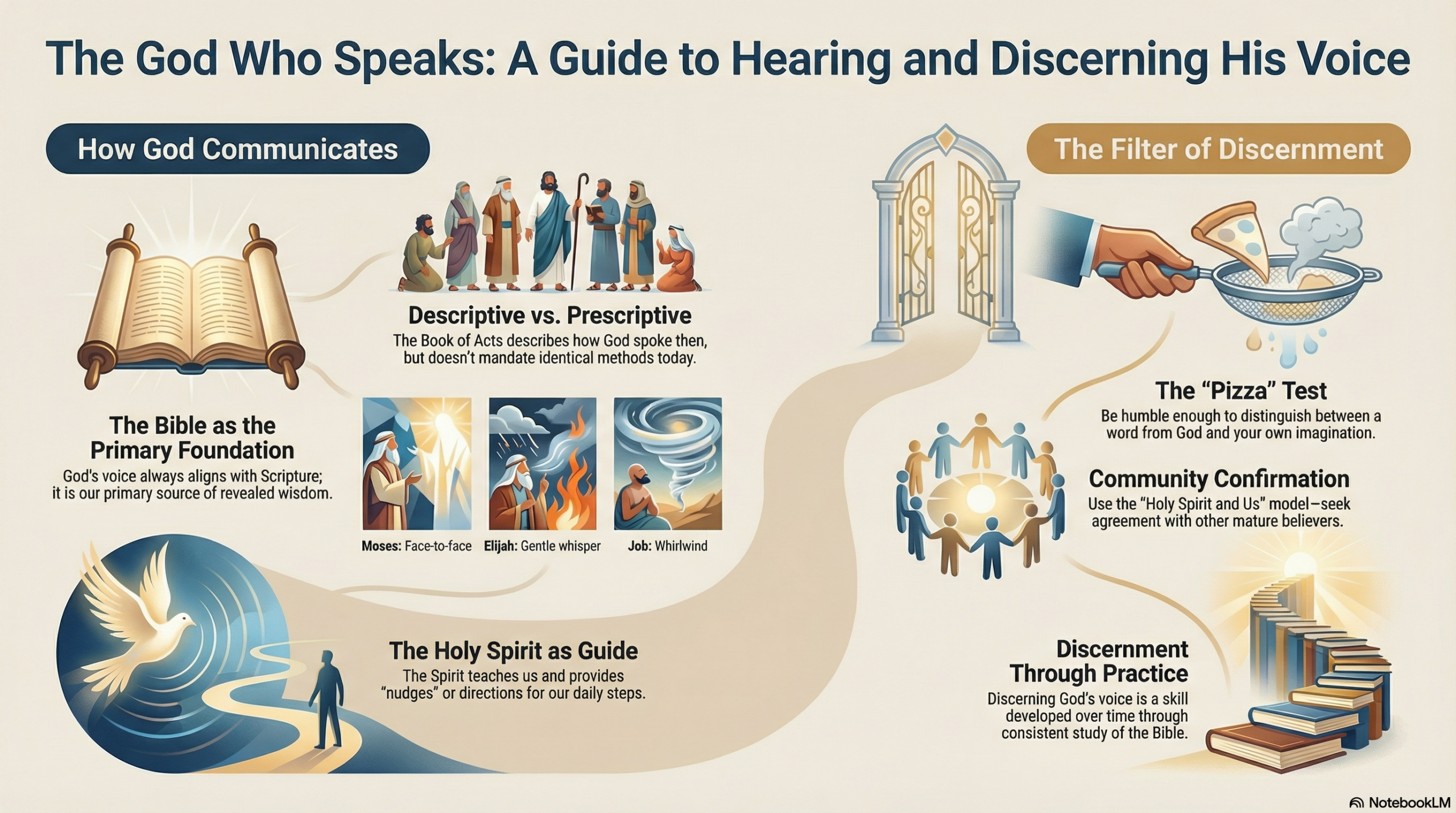
The God Who Speaks Infographic OWCC One Way Community Church Dustin Woolam

TLDR Summary

n this sermon, Pastor Dustin Woolam explores the Christian belief that God actively communicates with His people, emphasizing that while God speaks in various ways, His voice is best discerned through a deep understanding of Scripture. Pastor Dustin cautions against blindly accepting claims of "God told me," urging believers to judge prophecies and distinguish between God’s voice, their own thoughts (joking about "pizza"), or deceptive influences.

Key Takeaways:

Biblical Foundation: Pastor Dustin cites Hebrews 1 and John 16 to establish that while God formerly spoke through prophets, He now speaks through Jesus and the Holy Spirit, who guides believers into truth.

Diverse Methods of Communication: Using examples from the Old Testament (Elijah’s whisper, Moses face-to-face) and the New Testament (Philip’s specific directions, Paul’s dramatic vision), Pastor illustrates that God's methods vary from dramatic signs to gentle nudges.

Descriptive vs. Prescriptive: Pastor Dustin argues that the book of Acts is "descriptive, not prescriptive," meaning it describes how God has spoken but does not dictate a rigid formula for how He must speak today.

The Primacy of Scripture: The central key to hearing God is knowing the Bible. Pastor Dustin asserts God will never contradict Scripture, using the example of a woman seeking a divorce for unbiblical reasons to show that revealed Scripture trumps subjective feelings.

Practical Discernment: He encourages "practicing" hearing from God by stepping out in faith—like Jonathan and his armor bearer—while remaining humble and testing impressions against the Bible and community counsel.

TRANSCRIPT (word for word)

Opening Prayer

Welcome to church, everybody. It’s good to see you. Let's pray for Haley. The Bible says that when two or three people agree, or when people come together and pray, something happens. Somehow, the Lord is there in a way that He is not when it is just us. He is there when we pray alone, but there is something about community that is really important to the Lord.

So, as I pray, I want you to not think about anything else. Put whatever might be happening in your life—health issues, work, family, car trouble—on hold for a couple of minutes. Let's just focus on the Lord and see what He might do.

Father, we come before You knowing that You care so much more than we possibly could. That is easy to say and hard to believe, but we pray for Haley. We pray that You would deliver her home safely and that things would begin to change even now. Your Word says You send Your angels as ministering spirits. You know exactly what is happening. I pray You speak to those who need to know. Maybe they feel an impression, maybe they hear an audible voice, or maybe somebody finds a phone. I don't know how You want to do it; You always surprise me with how You work. Holy Spirit, move in this moment and in this situation, that Haley would come home safe. In Jesus' name, Amen.

The God Who Speaks

We are in our series "What We Believe Matters," and this week I want to talk about the belief that God speaks. There are a lot of different ways people talk about this. If you have been around church for very long—or if you have been on TikTok—you have probably heard a Christian say, "God told me." They might say, "God told me you are supposed to be my wife," or "God told me to get this job," or "God told me to turn left instead of right."

Someone less comfortable with that language might say, "I had an impression from the Lord," or "I was reading my Bible and this thought came to mind." There are many ways we describe how the Lord speaks to us. One thing I’ve been aware of lately is that the Bible finds us right where we are. When we come to Jesus, we probably don't look much like Him. But over time, the Bible, God, and the Holy Spirit shape us into the image of Christ. Part of the way God does that is by speaking to us.

How God Speaks: New Testament Foundations

Let’s look at John chapter 16. Jesus is in the Upper Room with His disciples for His last Passover. He gives them final instructions, saying in verse 12: "There is so much more I want to tell you, but you can't bear it now. When the Spirit of truth comes, He will guide you into all truth. He will not speak on His own but will tell you what He has heard."

We see this established further in Hebrews chapter 1: "Long ago God spoke many times and in many ways to our ancestors through the prophets. And now in these final days, He has spoken to us through His Son." So, the New Testament establishes that God speaks through Jesus and that He sends the Holy Spirit to speak to us.

Discernment: God or "Pizza"?

Now, let's look at the Old Testament. But first, a caution. If you follow Christian news, you might know about a guy who claimed to prophesy but was really just cold-reading people’s social media. He was lying. It is easy to become skeptical and think that anytime someone says "God spoke," they are playing a trick.

My wife, Jamie, told me a story about three women approaching her at the grocery store to pray for her. She said yes, but they looked surprised. I grew up in a Pentecostal church where we expected people to have a "word from the Lord" in every service. But because there was so much focus on it, there was also room for nonsense. It makes you lose trust.

If someone at the store asked to pray for me, I would want to know something about them first. What if they are praying to a different god? I’m not interested in the blessing of a demon. When we talk about the Lord speaking, I don't want the wheels to fall off. 1 Thessalonians says that if a prophet speaks, we should judge it. Just because someone says, "Thus says the Lord," doesn't mean it is the Lord. It could mean they had pizza last night, had a weird dream, and now they have a "vision" for you. That’s not God; that’s pizza.

I have a friend, and when we share things, if I’m not sure, I’ll say, "I don't know if this is Jesus or pizza, but this is what I think." We need that discernment.

The Filter of Scripture

Proverbs 3:5-6 says, "Trust in the Lord with all your heart; do not depend on your own understanding. Seek his will in all you do, and he will show you which path to take."

But notice the verses before that: "Store my commands in your heart." If you want to trust the Lord to guide you, step one is to stay in the Scriptures. If you want to know what God sounds like, read the Bible.

I heard a pastor tell a story about a woman who wanted him to pray for her divorce because she "wasn't happy." The pastor asked if her husband was unfaithful or abusive. She said no, she just wasn't happy. The pastor replied, "God is not telling you to divorce that man. That is not what the Bible teaches. I don't have to pray for God's will because I know what the Bible says."

If you come to me asking for wisdom, I will first check if there is already revealed wisdom in Scripture. If you ask, "Should I be a pastor or a pimp?" the answer is obvious. The Lord has already spoken on that.

Old Testament Examples: From Thunder to Whispers

God speaks in diverse ways. In Isaiah 30, He promises that "Your own ears will hear him. Right behind you a voice will say, 'This is the way you should go, whether to the right or to the left.'"

In 1 Kings 19, Elijah is on the run after a major victory against the prophets of Baal. He is hiding in a cave. God passes by, but He isn't in the windstorm, the earthquake, or the fire. God speaks to Elijah in a "gentle whisper."

Contrast that with Job 38. Job’s friends have been arguing with him, and then the Lord answers Job "from the whirlwind," questioning Job’s understanding of the universe. In Genesis 3, God walks in the garden and calls out to Adam and Eve. In Exodus 33, God speaks to Moses "face to face, as one speaks to a friend." In Genesis 18, God visits Abraham and includes him in His plans regarding Sodom and Gomorrah.

In the Old Testament, God interacts with specific people in specific ways. But Hebrews tells us that now, God speaks to us through His Son and the Holy Spirit.

New Testament: Descriptive vs. Prescriptive

Let's look at the Book of Acts. A helpful rule for Acts is that it is often descriptive, not prescriptive. It describes what happened, but it doesn't necessarily prescribe a rigid formula we must follow. They didn't have printed Bibles or the internet; God meets us where we are.

In Acts 8, an angel tells Philip to go south to a desert road. Philip obeys. Then the Holy Spirit tells him to walk alongside a specific carriage. Philip obeys again and ends up sharing the Gospel with an Ethiopian eunuch. God didn't give Philip the whole plan upfront. He just said, "Take a walk." Sometimes we don't need step three; we just need to obey step one.

In Acts 9, Saul (Paul) is on his way to kill Christians when Jesus appears in a blinding light. Meanwhile, God speaks to Ananias in a vision, telling him exactly where to find Saul. Ananias argues because Saul is dangerous, but God says, "Go, for Saul is my chosen instrument... and I will show him how much he must suffer for my name's sake."

In Acts 10, Cornelius gets very specific instructions from an angel to send for Peter. Peter, meanwhile, has a vision of a sheet with animals, teaching him not to call unclean what God has called clean. This prepares Peter to go to the Gentiles.

In Acts 15, the church leaders gather to decide what to do about Gentile believers. Their conclusion is fascinating: "For it seemed good to the Holy Spirit and to us." They made a decision in community, sensing the Holy Spirit’s guidance.

Finally, in Acts 21, Paul is warned by prophets not to go to Jerusalem because he will be bound. They were accurate about the suffering but wrong about the direction. Paul knew he was compelled by the Spirit to go, despite the suffering. We see that even legitimate prophecy requires correct interpretation.

Practical Application: Learning to Listen

God is always speaking. But He isn't speaking through your horoscope, tarot cards, or tea leaves. He is speaking by His Spirit.

Sometimes His guidance doesn't make sense immediately. It might be a nudge at the grocery store to walk down a specific aisle. You might wonder, "Is that God?" It’s okay to test it. If it’s not sin, go take the walk. It might just cost you two minutes.

We are learning a new language. When you start, you might get it wrong. That is okay. I don't recommend you practice by giving people "words from the Lord"—that can be dangerous. Instead, practice hearing for yourself.

My favorite example is Jonathan and his armor-bearer in 1 Samuel 14. Jonathan says, "Let’s go over to the Philistine outpost. Maybe the Lord will work for us." He didn't have a burning bush; he just stepped out in faith. He set a test: "If they say come up, we go up. If they say wait, we leave." He just went to see what the Lord said.

Conclusion

We need to be humble and teachable. The vital key to hearing from God isn't just prayer or worship ambiance; it is knowing the Bible. God will never contradict Scripture. If you are immersed in the Bible, you will recognize His voice because you know His character.

If you feel like you have a word for someone else, deliver it with humility. Say, "I was praying and I feel like this might be from the Lord, but please test it."

God doesn't always agree with what you want. If the "voice of God" always aligns with your desires and comfort, it probably isn't God; you are likely just talking to yourself.

Let's commit to learning the Bible so we can discern His voice. Let's pray.

Closing Prayer

Father, thank You for speaking to us. Your Word is always clear, but we don't always hear or interpret it clearly. Help us to listen well. We are confident that You are speaking. Help us to practice discerning Your voice so that in the sea of opinions, the voice of truth rings loud.

Lord, I pray for healing for the people in this room. Be the Great Physician. Whether You choose to heal miraculously in a moment or guide us through a path of recovery, we trust You. We need to hear You to know which path to follow. Help us to be faithful. In Jesus' name, Amen.


Tags

Doctrine


You may also like

Leave a Reply

Your email address will not be published. Required fields are marked

{"email":"Email address invalid","url":"Website address invalid","required":"Required field missing"}