
JESUS IN THE STORM | FAITH, FEAR, AND THE GOD WHO CARES
Pastor Dustin Woolam | Recorded December 28, 2025
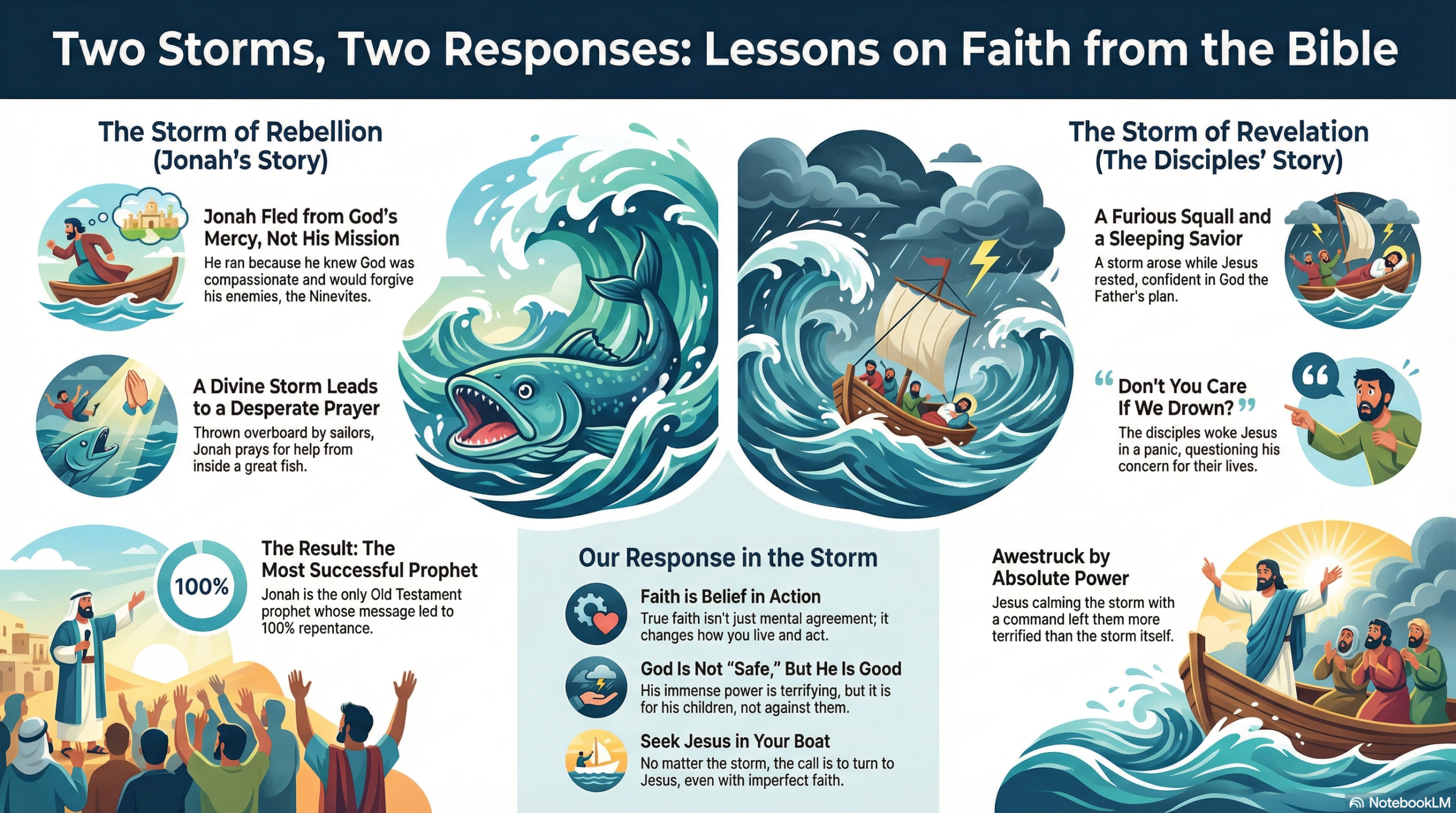
TLDR Summary
This sermon from Pastor Dustin Woolam focuses on the biblical definition of faith, which is described not merely as belief, but as belief bracketed to action. Using the examples of Sarah and Jonah, he illustrates that while individuals may struggle with doubt or rebellion, God values their ultimate obedience and action.
A central theme in the message is the comparison of storms, specifically those encountered by Jonah and the disciples of Jesus. In both narratives, the characters are forced to confront a divine power that they do not fully understand, such as Jesus’ absolute authority in commanding the wind and waves to be still. Pastor Dustin notes that while God’s power is "not safe," He is fundamentally good and compassionate, even toward those whom society might deem undeserving.
The sermon concludes with a call for personal reflection as the year 2025 ends, encouraging listeners to:
- Avoid a calloused heart and instead seek a relationship with the Father.
- Live lives that positively influence the conversations of others.
- Trust in the peace of Jesus, who remains "in the boat" with His followers regardless of the storms they face.
TRANSCRIPT
Welcome to church. Let's pray real quick.
Father, thank you for today. Thank you for the gift of your word and for the gift of your body. Lord, I pray and blessing on all those who have come and all those who are unable to come. And Lord, for those who wanted to come, but just didn't win the battle with the bed today. Lord, I pray that you would just wherever they are, that you would speak to them, Lord, that they would feel a sense of longing for you. Lord, not a sense of guilt that they've done wrong. Lord, a little bit of guilt might be all right, but Lord, that that would not overtake them. But Lord, more than anything, that they would feel a sense that you want to be with them and to meet them and that your body is a place that you do that. Lord, for those who, for some other reason, couldn't be here, whether illness or grief, or all the things that take our soul and make it difficult to be around. Lord, I just pray you're healing in their life. Lord, for those who have been having lingering sicknesses or I just pray you're healing that you would overwhelm them with your goodness. And Lord, that they would see your goodness in the land of the living. Lord, we ask for all these things and for your blessing on your word. Lord, that we would hear from you and that whatever's of us would not remain, whatever's not from you would not remain. In Jesus' name, amen.
When I was a kid, in Sunday school, we'd have the story of Jonah and the whale. Also, can I just say, okay, that I am to be here? Everyone else was great, but I missed this. All right, let's go. Jonah and the whale, and so I would go to Sunday school and listen to, here's Jonah, God says, go to Nineveh, he's like, actually, how about Tarshis? There's a storm, he ends up in the water, a big whale eats him, he goes to the coast and gets spit on the sea. And then that's kind of where the story always ended for me in Sunday school. I didn't know that there was a chapter two and a chapter four to that book. In fact, most of chapter three didn't even really get taught in Sunday school. And I didn't realize that those other chapters existed until later in high school, there was this big to do about whether or not it was a fish or a whale, because, well, how could Jonah live in a fish? How could Jonah live in the whale? The ancient Jews didn't even know what whales were and there's all this back and forth and everyone's really worried about whether or not it was a whale or a fish. And now all these years later, sure, it was probably a fish. What did they know about underwater mammals in ancient Judaism? They probably said fish and God used the word fish because it's what they knew. But let's just be realistic if it was a fish or a whale. The story doesn't change, right?
So when we want to be clear about what Scripture says and we want to be clear about what God's up to. And so if your version says, "Well, OK," if your version says fish, OK, biblically language, it's probably just based on the Hebrew language. The correct translation is probably fish, but I'm not going to fight about it. Now, that said, here's something that did happen. Jonah fought with God, but not in a way that's immediately obvious. The thing that I love about Jonah and the whale, if I read Jonah and the whale and don't read—see, I have saying, well, because that's why I grew up. We're going to be in chapter 2 of Jonah, if you want to turn there or go there on your phone. If you don't know about chapter 4, then it's hard to know why Jonah didn't go to Nineveh. If you know a little bit about history, Nineveh was the capital of the country that hated the Jews and treated them terribly. They would kill people and hang them off the walls just to make all this terrible stuff. So imagine—and all that kind of is like, OK, imagine God comes to you right here in this church in Robinson Texas, where praying. And God says, I want you to go to Nigeria where they're killing Christians by the hundreds of thousands. And I want you to go preach to the Muslims there who are killing the Christians. And I want you to tell them if they don't change their life then I'm going to kill them. And I'm just going to crush them and destroy them and their animals and everything else. So you go tell them to repent. And you have some idea of what God was asking Jonah to do. And for me, well, of course Jonah doesn't want to go there. Right? Jonah doesn't want to go tell these people because that's like big scary. That's not regular scary.
But if we read chapter 4 and this is not up here, Jonah finally goes to Nineveh in 3. And he preaches, and the king of Nineveh says, nope, guys, we have to repent. We can't deal with this. So Jonah in chapter 4 verse 1 says—well, let's read the book of Jonah, not with Jonah. The person says, but to Jonah, this seemed very wrong and he became angry. What seemed wrong? The fact that God forgave and relented from destroying Nineveh. And then this is what it says. This is the reason Jonah went to Tarshis. Isn't this what I said, Lord, when I was still at home, that this is what I tried to forestall by fleeing to Tarshis? I knew that you are a gracious and compassionate God, slow to anger and abounding in love, a God who relents from sending calamity. Now Lord, take away my life for it is better to die than to live. But the Lord replied, is it right for you to be angry? And so Jonah didn't want to go to Nineveh because he knew that God was good. And he wanted the people and Nineveh to die. He wanted God to curse them and destroy them. And so he's like, no, I'm not going. I'm going to go the exact opposite way.
So I'm going to catch you up a little bit in chapter 1 and then we're going to read chapter 2 and then we're going to turn to Mark. So in chapter 1, Jonah gets on a boat and he runs away. And a big storm comes and all the sailors are like, if somebody here has messed up. Somebody here has really upset the gods. We've got to figure out what's happening. So they're throwing lots, they're doing all this stuff. They fall onto Jonah and they say, Jonah, tell us what you did. And Jonah's like, yeah, I'm running from God. And they're like, well, what do we do? Because your God's clearly powerful enough to come get you. What do we do? And Jonah says, well, just throw me overboard. And they're like, no way we're doing that. Look how mad your God is. Now, if we kill you, it'll be worse for us. So they keep trying to save the ship and Jonah's like, seriously, guys, you got to toss me off. So they throw him in the water and then immediately the storm calms.
So we have this prayer from Jonah starting in chapter 2 of Jonah. I'm going to read the whole chapter. It's not long. Jonah, chapter 2, verse 1, from inside the fish, Jonah prayed to the Lord, his God, he said, in my distress, I call to the Lord, and he answered me. From the deep in the realm of the dead, I called for help, and you listened to my cry. You hurled me into the depths, into the very heart of the seas, and the currents swirled about me, all your waves and breakers swept over me. I said, I have been banished from your sight, yet I will look again toward your holy temple. The engulfing waters threatened me. The deep surrounded me, seaweed, was wrapped around my head to the roots of the mountains. I sank down the earth beneath, barred me in forever. But you, Lord, my God, brought my life up from the pit. When my life was ebbing away, I remembered the Lord and my prayer rose to your temple, to you, to your temple. Those who cling to worthless idols turn away from God's love for them. But I, with shouts of grateful praise, will sacrifice to you. What I have vowed, I will make good. I will say salvation comes from the Lord, and the Lord commanded the fish, and evominate Jonah onto the dry land.
So I have Jonah. Here's the interesting thing about Jonah. He is the only Old Testament prophet whose message was completely received and responded to. No other prophet in the Old Testament had to success rate that Jonah had. Jonah is also the only Old Testament prophet that went to Gentiles and not to Jews. And so there's something kind of happening with Jonah. And so what do we think about? I had a conversation with Jayme this week about Sarah, Abraham, and Sarah. And one of the things that's fascinating to me about Sarah is that in the New Testament, she's credited as being a person of great faith. When we think about—and this is going to take us into mark, chapter four. I think 35 is where we're starting. When we think about faith, let me say growing up in church, the way that I was taught faith was it was strictly belief. What do you believe? What do you believe to be true? But as I got older, and as I began to explore the Bible, belief in God is good. It is faith, though, is never just belief. It's always belief bracketed to action. So do I believe enough to do something about it? Not just do I believe God is in heaven, that's great. James, chapter two, which I quote often, the demons believe and tremble when it comes to God. But they're still demons. They're not Christian. So believing isn't enough. It's the first step, but we have to believe to the point that we act in some way. Now, that doesn't mean that you don't go to heaven based on your actions. You can't do anything to earn salvation. Jesus did it all. But we show our faith with our works.
So Sarah, in the Old Testament, if you read the Old Testament, you're like, Sarah, what are you doing? You're giving your slave to your husband, to have a child, and then when the messengers come, three messengers come right before Sodom and Gomorrah is destroyed. And this is something I never noticed, though somebody pointed it out. These three messengers come. Abraham says, hey, go get that animal. We're going to cook a big meal. We're going to have a feast. And he tells Sarah, he's like, get some bread. Well, the whole thing goes by, and there's this big feast. And he brings the meat, but you know what's not there? The bread. Sarah didn't make the bread. She didn't do what she was supposed to do for these visitors from God. And then when the visitors from God say, hey, this time next year, Sarah is going to bear a child. Well, she do, she laughs. Not enjoy, but kind of that sarcastic sort of laugh. And we know that because he says, why did your wife laugh? And so there's all this stuff going on with Sarah. But you know what happens? In the New Testament, Hebrews tells us that Sarah was a woman of great faith. And why? Because ultimately, whatever it was that she wrestled within her hearts, laughing, not making the bread, giving a servant instead of trusting God, all these things, when it all hit the road, she did what God said. She had a child. She raised Isaac. And she did the things that she was supposed to do.
Jonah ends up being a successful prophet after what? After running away from God. And then he turns his heart to the Lord. And he does what the Lord says. Jonah didn't want to go to Nineveh. But I guess being in a fish for a couple of days probably gets the point across. And he goes to Nineveh. And he preaches. And he's mad because he knew that God would be good. But we don't see God chastised Job as a man of little faith. What we see is God chastised Job because he says, shouldn't I care? You don't care and I do. And isn't it right that I care for all these people and all these animals? And that's how the book ends. Isn't it right? God's telling Jonah, isn't it right that I care? And we see Sarah who's obedient and is credit to her as faith. And so she believes and she acts. And Abraham believes and he acts. And Jonah remembers to act in all these different people and all these stories, people taking action on their faith.
So in Mark chapter four, Jesus has been preaching a little bit. The disciples are hanging out with him. They're learning from him. Mark chapter four verse 35 says that day. So Jesus has done a bunch of parables and teaching. That day when evening came, he, Jesus, said to his disciples, let us go over to the other side. Leaving the crowd behind, they took him along just as he was in the boat. There were also other boats with him. A furious squall came up and the waves broke over the boat so that it was nearly swamped. Jesus was in the stern sleeping on a cushion. The disciples woke him and said to him, teacher. And then what did they say, don't you care if we drown? He got up, Jesus got up, he rebuked the wind and said to the waves, why it be still? Then the wind died down and it was completely calm. And he said to his disciples, why are you so afraid? Do you still have no faith? They were terrified and asked each other, who is this? Even the wind and the waves obey him.
Two things. I really like themes that stretch across the scripture. And so in this case, there's two themes. There's the storm in both of the stories. The boats are in danger of being lost. The people selling the ship are afraid, right? All of these things are the same. Now, the disciples knew they could go directly to Jesus. He's asleep. But these guys are casting lots, trying to figure out what's going on. So in both cases, there's this real, and then once they cast lots, they find out it's Jonah. Tell us about your God, Jonah, they get the story. So in both cases, they have the person they're supposed to speak to to figure out what's happening. In the one story, Jonah says, I've rebelled. Toss me in the water. It's going to be all right. And in the other story, Jesus stops the storm. So Jonah goes in the water. The storm stops because God relents. Jesus exercises his power over the storm. And calms the storm. If you—we didn't read this, but in the story of Jonah, those men all begin to worship the Lord, the God of heaven, that Jonah worships. And in the New Testament, while we just read, the disciples are terrified after the storm stops. Which is kind of weird, right? Wouldn't you be scared before and call them after? In both stories, Jonah in the belly of the fish, the sailors on the ship, the disciples in the boat with Jesus, all of these groups have one thing in common. They came face to face with the power. They didn't understand, right?
And so for the Jews, they're in the middle of the storm. These guys are fishermen. They understand how storms work. They're bailing water out of the boat. They're trying to hold it together. They're terrified. They even go to Jesus and say, aren't you worried? They were going to drown. And when Jesus chastises them for not having faith, there's this sense where Jesus says, hey, we're going to the other side. And Jesus tells them what's going to happen. And they forgot what he said. And so he stands up and he calms the wind in the waves. And it's not until he does that that he talks to them. He resolves the storm and then has a communication. In the same, Jonah is in the well and he gets spit out and goes and does the thing. And so what happens in all of our lives, some of us have storms because of rebellion. Some of us have storms because the rain falls on the just and the unjust, and that's how it is. Sometimes it just rains. And there's nothing to it except for the fact that there's rain. That's the way the earth works. That's the way God made the earth, the weather cycles. And so I'm not saying God's out in control, but I'm saying that sometimes this is a really helpful saying.
We're going to take a little side road. It's really common for us to think that things are happening to us, right? Somebody comes into our job and they're crazy. And I can't believe they would treat me that way. And maybe they did talk to you some kind of way, or maybe we're driving and somebody is not going at the red light. It turns green and for all of half a second, they don't go and we get really mad and we slam the horn. And we think they're doing that to us. But one of the things that happens in life is that sometimes things just happen and they affect us. And we have to decide how we're going to respond because they didn't really happen to us. They happened and now we have to choose how to respond. And so that's what's happening in the first and second boats. Both of these groups of sailors are choosing how to respond to something they don't understand. And in the first story, in the story of Jonah, this is something God's actively doing. He's brought a storm because Jonah's been rebellious because Jonah has to go to Nineveh because God loves Nineveh. And so Jonah responds and says, look, this is how you do it. You have to give me in the water and everything's going to be OK.
And then the other one, they go to Jesus. They know, like, they've seen him feed thousands of people. They've seen him raise the dead. They've seen him do all this stuff. So they go to him. And then this is the thing that blows my mind. You have a group of guys in a boat with a miracle worker, right? Some of them, maybe they know he's God, you know, because they're still learning, right? Or maybe they've accepted it or maybe they're wrestling with it, but they know that Jesus can do miracles. And so I'm sure that some of those people who went to Jesus and said, don't you care. They're looking for Jesus to just grab a bucket and help them get water out of the boat. They see Jesus the human. Jesus, we need your help. Need you to hold this rope so I can do sailor stuff, right? Like, you're a strong guy. You're a carpenter. Put your hands on this and hold it for me. And then there were other people on the boat, probably people who were less familiar with sailing who were like, man, we could really use a miracle right now. And I don't know what Jesus is up to. But this all seems real bad because the guy's that knows what's up, they're terrified. So they start all of them for their own reasons, for their own—they're all in the same situation. And they're all having different feelings. And you know, if you've got 12 people, you've got 13 opinions, right? And so all these people are going to Jesus and saying, don't you care.
But Jesus gives one answer for all of their concerns. He acts. He stops the storm. So Peter, who understood, maybe Peter, James and John, who were all fishermen, who were like, we're going to die. This boat's going to go into water. This is it. They go to Jesus, maybe just for some practical help, because hey, we can save us. We're OK. We just need you, Jesus, to be another pair of hands. And then you've got guys like Judas Iscariot or Matthew, like, think about this. I'm a tax collector. Matthew's hanging out in the front of the boat. He's like, there's nothing my knowledge of money can do for us right now. I'm no hope. But Jesus, man, if you could do anything, it would be great, right? And so Matthew went to Jesus, clueless and desperate. So some of us, when we go to God, we go in our own power, in our own skill, in our own understanding. We've walked with Jesus for years, for decades. We get it. And we say, Jesus, I know you're real busy holding the whole universe together by the word of your power. Take a little nap in the boat. You've earned it, I'm sure. But we're dying here. So if you could hold this rope, I'll take care of the rest.
And some of us, we get some kind of diagnosis. We don't know anything about. Like, I'll be honest, I don't know a lot about medicine. So people are like, you have a 50-letter long word. And you need these three prescriptions that if I put all the letters together, spell a novel, you need to go take this. And I'm like, well, Jesus, the expert's kind of seem to know what they're talking about. But I feel a lot better if you just fixed it. And so we all come to Jesus in our own way. But just like Jonah and the Old Testament, who was rebellious, maybe that's us. Maybe we're hanging out with Jesus and we're just scared. Or maybe we're in one of the other boats following along. They're all in the storm, too. But they're nowhere near Jesus. But they're in the same storm. And when Jesus calms the storm, he calms the storm for everyone. And so who knows that the fear of the disciples didn't turn into the salvation of some little kid who went on to do whatever? Or some grandmother who loved their child well, or some father who made it home to his wife and their marriage was repaired, because someone was faithful to call unto the name of Jesus. We don't know, and we'll never know.
And so then there's this place that scares them. And here's what's interesting about the fact that they were terrified after the storm stopped. It's one thing to make more bread. It's one thing to turn water into wine. Those are amazing miracles. Don't get me wrong. It's another thing to take a human who was alive and died and bring them back to life. But what Jesus did, that no one could do, and was one of the ultimate forms of power expressed by any God in that time period, was control the weather. And not only did he control the weather, he did it right now. It wasn't like we went out, like, and did a whole bunch of mumbo jumbo on a hilltop and tried to get some fire, and then the rains came three weeks later. Jesus stood up and said, stop it. And Jesus demonstrated his absolute authority over everything in their minds when he stopped the winds and the waves. Imagine, think about this. A couple years ago, we had, like, right after COVID, we had snovid, y'all remember that? Like, it was everything, it was icy, and it wasn't safe to drive, and we couldn't go anywhere. My house has the roads, like, maybe it's very small rise, but somebody came around the corner and was trying to drive, and just couldn't get up too much ice, so they had to back out and go another way. Imagine all that snow, all that ice, and all the everything, and Jesus is like, no, and it all just goes away. And it's summertime. This is the power that Jesus demonstrated when he stopped the storm.
And one of the things that happens in our life, we can be Gentiles in the storm with Jonah. We can be Jonah and rebellion in the storm. We can be the disciples at varying degrees of understanding, but all the followers of Jesus in the storm. Or there's Jesus, who's our example, who was confident in what he was doing. The Bible tells us that Jesus did what he saw the Father doing, and so Jesus says, let's get into boat and go. And so Jesus had no concern about reaching the other side of the water, not because he could control the wind and waves, but because his Father told him to go. Right? Now, it turns out that Jesus got there by stopping the storm, and he teaches us a lesson, and God knew what he was doing. He knew that this thing was going to have a little storm, and God knew that he was going to stop the storm, and all this knowledge is true, but we can be like Sarah, and it's okay. God, that's crazy talk. Like, I don't know how honest y'all have been with God, but the year that I found out that my dad had cancer, I was really honest with God, and it probably wasn't good for me, let's be real. There's sometimes where you're yelling and screaming and mad at God, and God's response is, why are you mad? I've been thinking about Scott Sermon last week, and some things Joe said, and even Tyler and my mom over at that, I'm super grateful for all of them sharing, but one of the things that Scott talked about last week when he talked about love is that God's up to something that we don't see, and we need to trust him. And so sometimes things are really great, sometimes things are really terrible, and sometimes things are just normal and grindy, and that's almost worse sometimes, because isn't there any release from the drudgery? I'm stuck. And the whole time we forget that Jesus is right here with us. The whole time we could be taking our cues from Jesus, and maybe they all were resting, right? Like, hey, you're on sale, duty, you're on whatever, we're going across in the storm, whips up.
But when the storms in our lives come, whatever they are, man my marriage is tough, work is tough, family is tough, my life is falling apart. 2025 has been really good for some of us, frankly, and it's been really terrible for others. Even the last couple of months or the last couple of weeks have been horrible for some of us. But the invitation of God is in His words to Jonah. Isn't it right that I care? It just makes sense that God would care. And so what did God do? God sent Jonah, somebody he knew didn't want to go, but you know what Jonah knew about God? That he was loving, compassionate, kind, and merciful, and Jonah knew the nature and the character of God may be better than the 12th. But Jonah's knowledge of God caused him to rebel. And the disciples' knowledge of God, such as it was, caused them to seek Him. Now wanna be like the disciples, even if I'm wrong, even if it's Jesus could you wake up and hold the rope? I'd rather be chasing Jesus. So that I could learn something about Him. And if what I'd learn about Jesus scares me a little bit, good, good. You like listen, you ever watch those videos with the lion tamers, like people who like live with lions, raise lions, play with lions, they'll be standing there in the video talking to a lion, it'll come and tackle them. And the lions don't use their claws, right? This dude is about half a inch away from being dead. If that claw comes out, he's finished. Sometimes we are like those lion tamers. And we forget that the person that we have great relationship with is deadly, right? We forget the power of the Almighty.
I've shared this before, but I'll share it again. In the story of Narnia, three of the kids, not Edmund, 'cause he's off with a white witch being stupid. Three of the kids end up with the beavers. And they're hanging out with Mr. and Mrs. Beaver and Mr. Beaver's telling the kids all about Aslan. Here's Aslan, he's doing this, he's doing that. He's coming around when he shows up, the white witch is gonna be scared, she's gonna freak out. And he's like, she'll be lucky if she can even stand up. And Lucy, the youngest of the four siblings, young girl, she says, 'Oh, he sounds very dangerous.' Is he safe? And Mr. Beaver's like, 'Haven't you been listening?' No, he's not safe, he's a lion. He's not safe at all. But he's good, right? He's good. So when we read the story of Nineveh, what we see is a God who's not safe at all in his level of power, right? But because he's so good and so loving and so kind, we have no reason to fear. We have no reason to be afraid because his lack of safety is for his enemies, not for his children.
And so, I'll tell you a story, kind of end up here. When I was a young man and even in high school, and gosh, probably further back, I was angry all the time. There was never time that I wasn't angry. That was just my default. Today, we are waking up angry, not like Jesus. Jesus woke up and just calmed storms. Me, I woke up and was looking for one. It was storm time, right? And in my first year of marriage in our first apartment, Jayme was in the closet. We had this walk-in closet in our apartment. Kind of have the size of our bedroom, not because the closet was big because the bedroom was small. And we're fighting about something. Who even knows what? In our first year of marriage, we'd never had roommates or anything. She went from her parents' house. And I had had some roommates and some other stuff, but then we're living together and we argued over silly stuff. Like, did you guys know that there are some families who refrigerate Tabasco like the sauce and their families who don't? So I asked Jayme to buy Tabasco and I opened the fridge and it wasn't there because I came from the family that Tabasco was in the fridge. And I was furious that she had forgotten to get Tabasco. It had happened directly to me. She had failed me because of whatever, right? In my head, that was my default. Just all the anger in me. That's how I always went. I can't believe my wife would do this to me. This is crazy. Why would she do this? We're newly married. Does she care? La, la, la, la. And like, I just hit this cycle of just angry. And that's just how I was all the time. Turns out Tabasco can. And to this day in my house, 25 years later, be in the cabinet and not in the refrigerator. I did, though, on that first bottle right, keep refrigerated and sharpie. But after that, I gave it up.
So, but I was angry all the time. I was never not angry. 20 something years later, I learned that that's because I was depressed, right? I didn't understand why I was angry all the time. But God in His goodness gave me some ways to deal with my anger and to work through my anger, without knowing what was going on in my life. But at one of these times, when I was mad about, frankly, probably something stupid. And that's why I've chosen to forget it. I'm really furious. Jayme's in the closet. I'm standing in the bedroom. And she says to me, 'Dustin, you have to stop looking at me. I'm afraid'. And it freaked me out. And I didn't know what to do. And so I just left really kind of just shocked that like I love this person and I've scared her. Fast forward, my son is two. And Kalista's five. We're at a new house in Lubbock. And I'm really mad about something. Probably again, something stupid. The kids are in trouble. And I'm yelling, again, not my best moment. But I tell the kids, I have the blah, blah, blah. Mad dad noises and send them to their room. And Jayme looks at me. I wasn't mad at her. And she said, 'I just realized that I don't have to be afraid of you when you're angry. Because our kids aren't afraid of you'. And then she had had some things in her own life that my anger had caused her fear. And I had some things in my life where I needed to stop being angry, but both of us needed to adjust, right? She, in seeing my kids interact with me, learned that I was safe when I was angry. Out of control, misbehaving. No excuses for my behavior. But I wasn't going to do anything dangerous. Then, fast forward years later. And now, if I'm trying to be really serious, I say, 'Jayme, sweetheart, I love you. I need you to imagine that I'm yelling'. This is how serious I am in this moment. I'm yelling. And I just have a regular conversation. And she understands. But gosh, that never happens. And it's, again, usually because of something that I care about that doesn't really matter.
Because Jayme's perfect and wonderful. And you can all tell her I said that, and it's recorded. Here's the thing. There are people that, when they look at God, they take their cues from how we respond. And we need these interactions. We need to be confronted with the power of the Almighty. We need to be in the storm and see it stop. We need to be at Lazarus grave with Jesus, watching Him raise the dead. And we need to be at the cross wondering, what, earth are you doing, God? Why are you on a cross? You could call all these angels. What are you doing? And then for Jesus to say, this is right. And even to say to John, hey, this is your mom now. And all these other things that we watch, Jesus, and He's an enigma to us. But we run into the power of God constantly. And so we become familiar. God loves us. He's kind. He's gentle. Like the lion tamer, we can play with the lion, and interact with the lion, and enjoy his presence, and his warmth, and his fuzzy mane, and look how great he is. But that's not going to be a hyena, because like lions love to kill hyenas in those cool videos. If you don't mind a little bit of animal violence, give him a watch. Intua de Mela is amazing.
But there's a whole boat full of sailors who are trying to stay alive. And there are a bunch of other boats who are just following along, because whatever Jesus is doing in that guy's life is real interesting, or that girl's life is real interesting. And so they come into contact, because imagine being on one of those other boats. You're sailing along. You're trying real hard not to die. Oh my gosh, what's the storm going to do? Can I trust the sailors I hired to bring me across? Or even worse, you're getting a boat with your uncle who's drunk, just being cool, like, yeah, let's go see Jesus. And who even knows what your boat situation is like? And all of a sudden, everything stops, and it's calm. What did they talk about at dinner? To our lives and our interactions with Jesus, change what people talk about at dinner. Did they change what we do every day? Because I can promise you that for the rest of their lives, that when the storm came, the first thing they did was pray, right? Even though sailors back in Jonah's day, if their storm came up, they're probably like, hey, God, I have an in-earth from that new Jonah that we threw off the boat. We don't have another Jonah to toss, but it'd be super cool if you stopped the storm.
The Bible says God makes a terrain on the just and the unjust. But we, the just, even if we're like Sarah and for like Jonah, for fighting God as he moves us towards his good purpose, I want to end like Sarah, a person of great faith, because the things I believe changed the way that I lived. And so as we review 2025 and we look forward to 2026, I'm not a New Year's resolution kind of person. I never have been, but I think it's good to mark times and seasons. And in this last Sunday of 2025, as we reflect on what's happened good, bad, or otherwise, I want us to think and be honest about how have we been responding to Jesus? And how could we respond better? Am I in another boat? Am I lost? Am I far from the Lord? But I know His name. Am I in Nineveh waiting for the Word of the Lord to come and tell me to be different? Am I Jonah? Am I mad because God's good to bad people? Am I a disciple who knows about fishing who wants Jesus to hold a rope? Am I a disciple who knows about money freaked out because I'm out of my element? Or am I like Jesus, taking my cues from the Father resting in the stern?
I can tell you that I want to be at peace. There's a great sermon. The guy uses this passage from Mark and he talks about all the different things that happen in our life. And in this moment, all these people say, 'Jesus, how can you be so calm?' And Jesus responds to this, 'I just woke up like this'. And that he had woken up being God and being calm and being confident. A lot of times you go to bed with the stresses and the pains and the hurts of the world. And there's nothing we can do about that sometimes. But my prayer for each and all of us is that we wake up and calm this in peace just as Jesus did in the middle of the storm. And that His peace would be a peace that we have, a peace that envelops our lives, that whatever is happening, the creator of the universe, the God of the heavens and the earth, the one with the power to say, 'Stop it,' is right with us. We're still in the boat, we're still in the water, but we're better for having Jesus with us.
It's better to be in a boat with Jesus than in a fish with your prayers. Now Jonah says, 'I called out to the Lord and He answered me. So even if you find yourself in the fish today, call out to the Lord and He will answer you'. Jonah was not afraid to call out to the Lord in his distress because he knew the Lord was gracious and compassionate and kind and loving so that even Jonah in his wrongdoing and rebellion knew that he could come to the Father. That's what I want all of us to know. I want to wake up in peace and security with the Lord, but if I wake up and I don't feel that way, then I want to know with confidence that I can go to the Lord and have relationship with Him again, that it doesn't have to be far. And I don't want you all to think, you know, I talked about it's good to believe, but you've got to do works. You cannot, in any way, shape or form, earn your way into heaven. But you absolutely, if you believe in God with a saving kind of faith, then you will change the way you behave. You will change the way that you live. Otherwise you should ask yourself if you believe, frankly. If your life doesn't look like the life of the saints in the Bible, and it doesn't look like people who are following Jesus closely, ask yourself if you really believe. I'm not saying you don't, but if you have no remorse for your constant sin, do you believe are you cold, is your heart calloused, don't go into 2026 with a calloused heart.
If I could make a storm and calm a storm so that you could all see this, great. But I want us to think about it. Where are we? Who are we? What do we want? And this last thought, I'll pray, something I already said, are we living our life that changes the way that people talk for better around the dinner table? If people in the world today knew how I lived my life, like if all of the United States saw your life in the last week, when they say good things about Jesus or bad things about you, or even worse bad things about Jesus. So my encouragement to us all going into 2026, let's just be the disciples on the boat and seek the Lord. Whatever we find ourselves in.
Let's pray. Let's pray that we love you. We thank you for your just amazing power, that you can overcome any situation, any obstacle, anything in our life. But Lord, more than that, or we're grateful that you have that power, but more than that, we're grateful that you're loving and good and kind. Even to those who we don't think deserve it, Lord, you're kindness to the people that we don't believe deserve it, show us that we can be confident in your kindness toward us. So Lord, I pray that all of us here would have a sense of your kindness and be confident in that kindness. And Lord, that beyond that, we would live lives where people would speak well of you. That Lord, we wouldn't be worried about our own reputation, but we would be concerned about your reputation. Lord, I love you. I love these people. I pray you're blessing on them, you're peace, Lord, that they would know your goodness today. And in the weeks to come, Lord, we give you all the rest of this day and all the rest of the days that we have in Jesus' name. Amen.