
IT MATTERS WHAT YOU BELIEVE | Jesus is the Healer | Divine Healing

Pastor Dustin Woolam | Recorded March 8, 2026
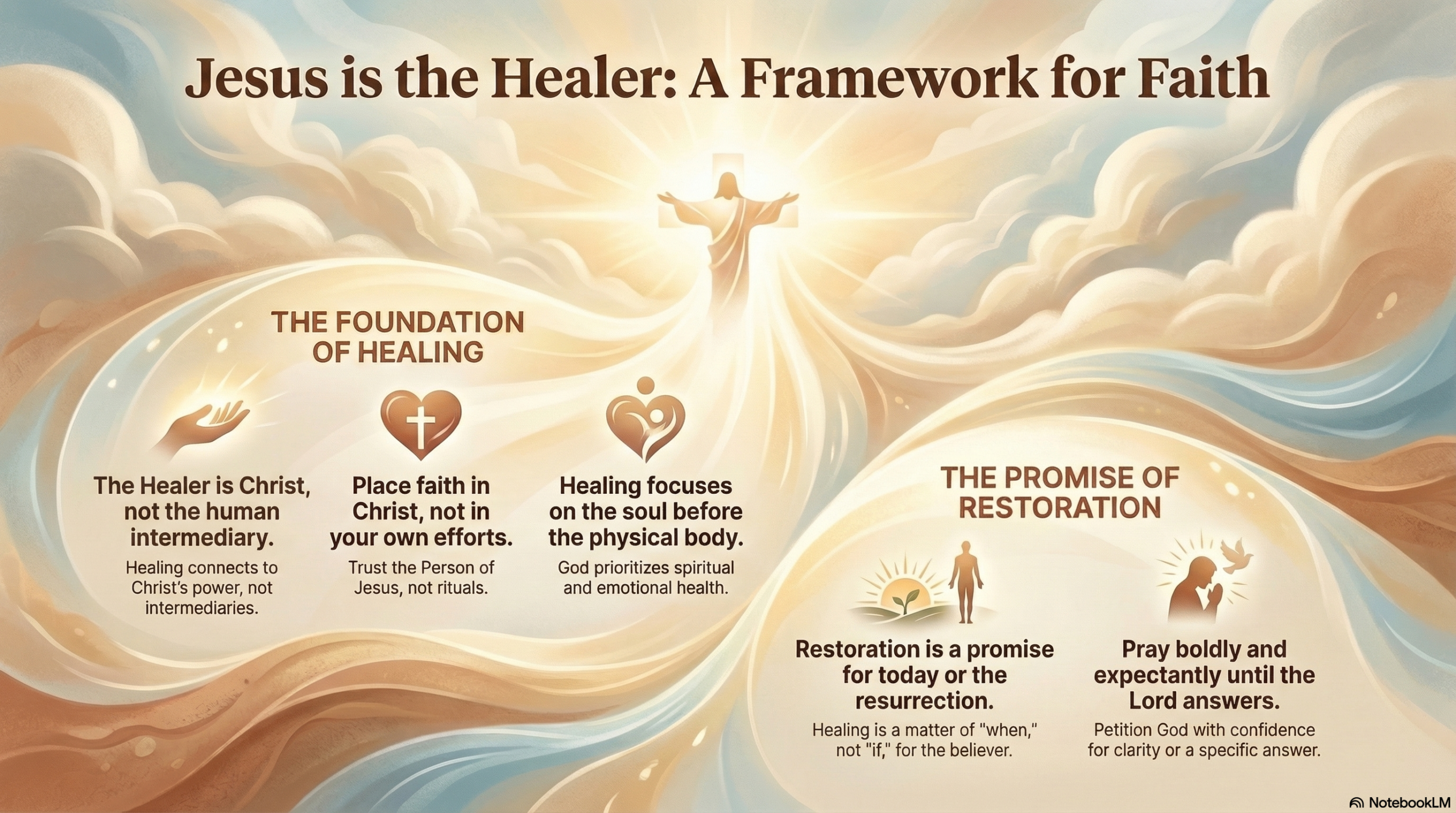
Jesus is the Healer Infographic Healing

TLDR Summary

In this week's message, Pastor Dustin Woolam begins a heartfelt and grounded conversation on the topic of divine healing. Prompted by a recent wave of illness in the congregation, he unpacks biblical stories to strip away the misconceptions surrounding how and why God heals, setting the stage for a practical prayer focus next week.

Main Biblical Theme: Jesus is the Healer
The core theme of the message is that all healing is directly connected to the person of Jesus Christ. Drawing on narratives like Naaman the leper (2 Kings 5) and the woman with the issue of blood (Mark 5), Pastor Dustin emphasizes that faith must be placed firmly in Jesus Himself, rather than in specific formulas, relics, or human effort. He reminds us that healing is not a magic trick, and we do not need to jump through herculean hoops to earn God's attention.

Primary Problem & Pain Point: The Spiritual Damage of "Magic" Healing Formulas
Pastor Dustin Woolam directly addresses the deep pain and spiritual damage caused when well-meaning Christians treat healing like a transaction or a spell. He points out that expecting God to act precisely how we dictate, or believing that a lack of physical healing means a lack of faith, can crush people. Sharing vulnerably about his own father's death from cancer, Pastor Dustin illustrates that demanding physical healing on our terms misses the bigger picture: God is actively shepherding us and is ultimately far more concerned with the sanctification of our eternal souls than the temporary state of our physical bodies.


Ultimate Message of Hope & Action: Healing is a Matter of "When," Not "If"
The ultimate message of hope Pastor Dustin leaves with the congregation is that physical healing is a guaranteed promise for every believer—it is simply a question of when. While some will experience miraculous healing in this present life, all believers will be completely healed at the final resurrection, where we will receive glorified bodies.

Pastor Dustin encourages the congregation to continue asking God for healing boldly and expectantly, trusting in His goodness until He explicitly says otherwise. In preparation for Part 2 next week, the church is invited to come with a spirit of expectation to simply and earnestly pray for the sick among the church family—without the pressure of "weird" or "kooky" performative rituals.

TRANSCRIPT

All right, we're going to have the kids in with us today. I promise not to be as exciting as my wife, but I'm going to do my best. Let's pray. There are a ton of people out sick right now, and others who have had medical emergencies. The irony that I'm preaching on healing today is not lost on me. Let's just pray.

Father, thank you for meeting with us. Thank you for putting us in a time and place where we can know you, where I don't have to scream but can use a microphone. Lord, I thank you for all the little things we never think to thank you for—a beautiful day, a nice week, or even the wind that reminds us of the other good days. Father, it's all by your hand, your power, and your providence. I want to be mindful and grateful for all things, big and small. As we gather around your Word today, please teach us. Let the things that are from you remain, and remove anything that is not. Remove any distractions in the name of Jesus. We trust you and give you this time. Amen.

Healing is an interesting concept in the Bible for many reasons. Let's start by reading 1 Peter 2 to get us established. Starting in verse 21: "For God called you to do good, even if it means suffering, just as Christ suffered for you. He is your example, and you must follow in his steps. He never sinned, nor ever deceived anyone. He did not retaliate when he was insulted, nor threatened revenge when he suffered. He left his case in the hands of God, who always judges fairly. He personally carried our sins in his body on the cross, so that we can be dead to sin and live for what is right. By his wounds, you are healed." That’s a quote from Isaiah. "Once you were like sheep who wandered away, but now you have returned to your Shepherd, the Guardian of your souls."

Now, let’s look at Luke 4. Jesus is in Nazareth, his boyhood home. He goes to the synagogue on the Sabbath, as was his habit, and stands up to read. He unrolls the scroll of Isaiah and reads: "The Spirit of the Lord is upon me, for he has anointed me to bring good news to the poor. He has sent me to proclaim that captives will be released, that the blind will see, that the oppressed will be set free, and that the time of the Lord’s favor has come." Jesus then tells them this scripture is about him.

When we talk about healing, the absolute first thing I want to say is this: whatever happens with healing is directly connected to Jesus. It’s not connected to the person praying for you or any other supplementary things. Ultimately, Jesus is the healer.

Today, I want to talk about what healing looks like and what we can and should expect. Let's go to 2 Kings 5. This is one of my favorite stories in the Bible. The king of Aram had great admiration for Naaman, the commander of his army, because the Lord had given Aram great victories through him. Though Naaman was a mighty warrior, he suffered from leprosy. Notice that Naaman is not a believer, but God is already up to something in his life.

Through a series of events orchestrated by God’s providence, Naaman goes to Israel to be healed. He arrives at the house of Elisha the prophet with great wealth and a letter from his king. But Elisha doesn't even come outside. He just sends a messenger to tell Naaman, "Go and wash yourself seven times in the Jordan River. Then your skin will be restored, and you will be healed."

Naaman becomes angry and stalks away. He says, "I thought he would certainly come out to meet me! I expected him to wave his hand over the leprosy, call on the name of the Lord his God, and heal me."

This brings up an important point. Often, when we pray for healing, we have an anticipation of exactly what God should do and how He should do it. Naaman wanted someone to perform magic—to wave a hand, say the right words, and fix the problem. It’s common to hear Christians talk about healing as if it were magic, like waving a wand. I absolutely believe the Lord heals, but we often approach it incorrectly with our own rigid expectations.

Naaman’s officers reason with him: "Sir, if the prophet had told you to do something very difficult, would you have done it? So you should certainly obey him when he simply says, 'Go and wash and be cured.'" Sometimes we feel the need to jump through hoops to get God's attention. We think we have to perform herculean tasks to prove our faith. But healing belongs to Jesus, not to our own efforts.

So Naaman dips in the Jordan seven times, and his skin is fully healed. He returns to Elisha and declares, "Now I know that there is no God in all the world except in Israel." He commits his whole life to the Lord. God used Naaman’s physical suffering to ultimately capture his heart.

Let's look at Mark 5. Jesus is approached by Jairus, a synagogue leader, begging him to heal his dying daughter. As Jesus goes with him, a woman in the crowd who had suffered from constant bleeding for twelve years reaches out and touches his robe. She thought, "If I can just touch his robe, I will be healed." Immediately, she is healed.

Jesus stops and asks who touched him. When the frightened woman comes forward, Jesus says, "Daughter, your faith has made you well. Go in peace. Your suffering is over."

Here is where we sometimes get off track. We hear "faith" and start thinking of it like the Force from Star Wars—if we just believe hard enough or tap into it deeply enough, God will do something. But her faith wasn’t in some mystical power; her faith was so firmly planted in Jesus that she believed even His robe would heal her.

If we aren't careful, we turn this into a formula. We think we need a famous preacher to lay hands on us, or we put our faith in "having enough faith." But we all have access to the Father. He doesn't listen to one of us better than another. Jesus said, "Your faith has made you well," because her faith was rightly placed in Christ, not in the robe itself.

While Jesus is still speaking, messengers arrive to tell Jairus his daughter is dead. But Jesus overhears and says, "Don't be afraid. Just have faith." He goes to the house, tells the mourners she is only sleeping, takes her by the hand, and says, "Talitha cumi," which means, "Little girl, get up." And she does.

Again, in healing circles, we sometimes get weird about this. We read that Jesus used a specific foreign phrase, or that He called death "sleep," and we turn those details into a spell. We think we have to say the exact same words in the exact same way. While God honors our earnestness, we cannot make magic out of just a few phrases in the Bible.

In Mark 7, people bring a deaf man with a speech impediment to Jesus in the region of the Decapolis. Jesus takes him away from the crowd, puts His fingers into the man's ears, spits on His own fingers, touches the man's tongue, and says, "Ephphatha," which means, "Be opened." Instantly, the man is healed.

I've seen charismatic circles where people try to mimic this by putting their fingers in someone’s ears, but funnily enough, nobody is brave enough to spit on their fingers and touch someone's tongue!

We do this all the time. As a kid, I read about Naaman and actually tried dipping myself in a swimming pool seven times to cure a sunburn. It didn't work. Later, when I needed glasses, I read the story of Jesus putting mud on a blind man’s eyes. I prayed elaborate prayers trying to connect the fact that humans are made of earth to God shaping my eyes like mud balls. I was looking for a formula. But Jesus simply says, "Have faith." We get caught up in the trappings and miss the Healer.

In Acts 3, Peter and John meet a lame beggar at the temple gate. Peter says, "I don't have any silver or gold for you. But I'll give you what I have. In the name of Jesus Christ the Nazarene, get up and walk!" He takes the man by the hand, helps him up, and instantly his feet and ankles are healed.

I've seen well-meaning people read this and do a disservice to healing. They'll go to a sickbed, shout, "In the name of Jesus Christ, rise and walk!" and literally jerk someone out of bed. People, in their desire to follow God, have sometimes abused other humans. I want us to be cautious. I don't want our confidence in what we think we know to damage someone's soul when their physical body isn't healed in that moment.

I know this pain personally. I actually left church and spent a year drinking heavily because I got so tired of hearing Christians tell me God was going to heal my dad of cancer. God didn't heal him. Thankfully, the Lord is faithful and kind, and He brought me back. I still absolutely believe in healing. I’ve been in a room and watched a man regain sight in his blind eye during a sermon. But I am very careful about the abuses that can happen when praying for the sick.

In Acts 20, we see God raise Eutychus from the dead through Paul, showing that miraculous healing wasn't limited to Jesus' earthly ministry. But we must understand why God heals.

Recently, I was talking with my good friend Scott Ruby, and I asked him what he believes about healing. He said something eye-opening: "I don't think God ever does a physical healing unless there's a spiritual or emotional healing attached."

God is ultimately more concerned with our souls and our hearts than He is with our bodies. Because in Revelation 21, the resurrection is when God fixes everything for everyone. There is nothing that the resurrection won't fix. My dad died of cancer, but when he is raised in his bodily form at the end of the age, his new body will not have cancer. When God heals our physical bodies now, it’s a taste of the future breaking into the present.

When my dad was dying, I remember sitting in a chair watching him. A few months prior, I had heard the Lord tell me very clearly that He was not going to heal my dad, but that I was to walk with him until he died. So, as I watched his body fail, I became very aware that the Lord had not abandoned him. God was actively shepherding his soul, preparing him for heaven. If God is interested in sanctifying a saint in his final moments, He is interested in sanctifying us in every moment of our lives, whether we are healthy or sick. Rather than being angry at God for not waving a magic wand, remember that God is far more concerned that you know Him than whether or not your physical body is perfectly healthy right now.

Some of us will be healed in this present life. Others will die, go to heaven, and see our healing at the resurrection. I don't know why God makes the choices He makes, but I know He says, "Trust in me."

A few months ago, when I was unexpectedly unwell, the Lord specifically pressed on me to pray with my wife every night for my healing. We prayed that God would heal my body and make me wise about my health—which ultimately led me to go to the doctor and get the help I needed. The point isn't that you must pray with your spouse for exactly five minutes every night. The point is to listen to what the Lord is asking you to do and to place your trust entirely in Him, not in the mechanics of your prayers.

If you take nothing else away today, please hear these two things:

First, God has promised physical healing for us. It is a matter of when, not if. We will either see it now or at the resurrection. Because Jesus paid for our healing, we are going to boldly pray that God will do a miracle right now. Until God explicitly says "no," I am going to pray like the answer is "yes."

Second, God is more concerned about your soul than your body. Your future glorified body is already secured, but your soul is in your keeping right now.

Next week, we will talk about practical ways to pray for the sick. We aren't going to be weird or kooky. We are simply going to come expecting God to be good, and we are going to pray for each other as a church family.

Let's pray.

Father, thank you for coming and paying for our healing. I pray we would see it in the here and now. I boldly ask for healing for everyone in this room and those who are out sick today. Make us truly whole. We don't ask just to see a spectacle; we ask simply because we are your kids and we need your help. We ask this in the name of Jesus. Amen.


Tags


You may also like

Leave a Reply

Your email address will not be published. Required fields are marked

{"email":"Email address invalid","url":"Website address invalid","required":"Required field missing"}