
IT MATTERS HOW YOU LIVE | Faith in the Dark Seasons of Doubt

Get the Study Guide for This Week's Message

Pastor Dustin Woolam 
The Heart of the Message Summary

In this transitional moment between studying what we believe and how we live, Pastor Dustin Woolam delivers a foundational reminder that right believing must always anchor right action. Drawing heavily on our approach to Scripture, he warns against the danger of "overdeveloped strengths"—where a genuine desire for holiness or biblical truth becomes legalistic, rigid, or entirely uncoupled from grace and contextual understanding. We are called to hold the sacred tensions of the Bible without flattening them into modern self-help or religious legalism. True transformation requires us to abandon the exhausting cultural and religious narrative that God demands us to burn out or perform for Him. Instead, we must pause, seek biblical clarity, and allow God's word to properly realign our hearts so that we can walk faithfully in grace.

TRANSCRIPT

Opening Prayer and Transition

Let's pray and then we'll get started.

Father, thank you for the gift of your body. Thank you for the gift of your word, and thank you, Lord, that we can come and meet with you and gather with you. We don't have to be worried or afraid that something terrible will happen to us because of the nation that we live in. Sometimes I think that that might make us more sincere Christians, but also I don't want to look a gift horse in the mouth, and I just want to be grateful to you. So Lord, I pray that as we're here, you'll come and meet with us, Lord, and that we'll meet with you. May the things of you remain, and may the things that are not of you fade away. In Jesus' name, amen.

We're transitioning in between two series. We've just done What We Believe Matters, and we're going to go into How We Live Matters. In those types of series, I am a big fan of a quote. The first place I heard it—I don't know if he's the originator, but the first place I can remember hearing it—is from a guy named Joseph Prince. He says, "Right believing leads to right action." So, if we believe the right things, and not just acknowledge that they're true, but if we really believe them and absorb them, then we'll do the right thing.

Open Q&A: Addressing Spiritual Warfare and Scriptural Origins

But in this little window of time in between, I'll be honest with you, I really struggled with talking to the Lord about what we were going to talk about today. I want to be a little bit vulnerable. I do have something to share today, but I also have this sense from the Lord that it's probably a great time to say, "Man, what questions do y'all have?" Like, what do you want to know about God, about the Bible, or about Jesus? Most of my time spent outside of this place sharing the Word of God when I interact with people is answering questions about Jesus or the Bible. I know it's short notice. If you're like me, you might think, "I have so many questions, but I can't think of any right now." So we're just going to give it a couple of seconds. It might be a question you have, or a question someone in your life has asked you where you gave an answer but you're wondering if you gave the right answer or if there is something else you can say. If nobody has any questions, we're going to jump right into the scriptures, but I just want to make room for that real quick. Also, I am super comfortable with silence, so we'll wait for just a moment. Nobody feel like you have to have anything, but I'm comfortable to wait.

Yes?

A congregation member asked: The question or the statement is that there was a conversation where someone had said that prior to humans being created, the devil and the demons got cast down onto the earth, and the angels and demons were fighting on the earth, and there is no memory of seeing that in the Bible.

I will agree with you; you are correct that this is not in the scriptures. The concept of the origin of the devil and a third of the angels being led against—let's see. Oh man, if I get it wrong, it'll be all right. The origin of that specific concept actually doesn't come from scripture, but there is a scripture that kind of points to the devil leading a third of the angels away. I'm not going to find it quickly, but there is a scripture in Revelation where it talks about a vision of a woman in heaven giving birth, and a dragon is waiting for the birth of this child, and the dragon's tail sweeps a third of the stars from the heavens. Then there's a scripture in Luke, somewhere between chapters 9 and 11, I think, where Jesus has sent out his disciples to teach, witness, and do miracles. They all return, and when they return, Jesus says, "I saw Satan fall from heaven like lightning."

These two passages together are where people like Dante and other old writers have said, "Well, there was a war in heaven, and the demons got cast down to earth, and there was this big ruckus." There's actually nothing in scripture that supports that. From a scriptural perspective, what we see for the origin of demons or the origin of Satan involves a couple of different dynamics. We see in the garden there is a talking snake. Interestingly enough, in Ezekiel, Jeremiah, and Isaiah, there are these throne guardians that we hear called Seraphim or Cherubim. They are snakes with wings. So they basically look like dragons, if we were going to describe it—that's not exactly what they look like, but they are—and so this snake character in the book of Genesis is a spiritual creature who is misbehaving. At some point, maybe even still today, the Bible is not explicitly clear, so I don't have a rigid opinion.

Spiritual beings had free will, and God gave them jobs, but they rebelled against those jobs. We see this in Psalm 82, and I think it's Psalm 89, maybe Psalm 84, where God says, "Didn't I give you guys jobs, but you rebelled, and so now you'll die like men?" All through the Old Testament, we see this original rebel show up who is a serpent, and then serpents become bad guys all the way through. This is true to the point that in 1 Samuel 17, where David and Goliath occurs and Goliath is wearing all this bronze armor, the text uses all the same root letters used for the word "serpent" in Genesis. Everywhere you look, Goliath, who is representing the enemies of God and the false gods, is clothed in this serpentine type of armor.

The whole concept of the Old Testament is this war of God against the rebellion of the original rebel. Later in Genesis 6, there's another rebellion where it says the sons of God had children with the daughters of men. So there is some kind of supernatural rebellion there. We see there are some rebellions and there are some conflicts in the scripture between God and spiritual darkness, but nothing that would indicate that God threw the devil and some angels out of heaven and that there was an ancient war on earth. There's nothing in the scripture that would support that.

Hopefully, that's as clear as mud. Does that answer kind of what you're thinking? Anything else? Anybody? There are no wrong questions. That was a great question, by the way. Thank you. We'll give it like 30 more seconds, and then we'll jump in, or if you have questions later.

Guarding Against Overdeveloped Strengths and Legalism

All right, let's go to Luke chapter one. We're going to talk about Jesus and John the Baptist today. One of the things that I think about a lot is how every generation seems to have what we call a zeitgeist, right? It means the spirit of the age. That just means the way that people are acting in a given time period, a given generation. Depending on the generation you're in, you're going to see other generations differently. For example, a common thing would be that Millennials see themselves as empathetic and caring, while someone in my generation, Gen X, might look at Millennials as soft. Both of them are probably wrong because people are people, and you can't just lump a whole bunch of people all together.

One thing that does seem to be true throughout the ages is that while the Bible doesn't change, what people do with the Bible changes. There is a spoken word piece by a guy who writes poetry and puts it to music; his name is Glenn Scrivener, and the title of the piece is I Gave My Life to Jesus. He talks about being my age in the '90s especially, but a little bit on both sides of that decade, when there were a lot of interesting things that God was doing around revival and moves of the Spirit. Of course, God had some work that He was doing, but there were also a whole bunch of people who were just out there doing nonsense and not staying grounded in God's word. Then there were people who meant really well.

I once had a job where, when we would do performance reviews for people, we evaluated what we called "overdeveloped strengths." If someone had a genuine strength, but it was overdeveloped or taking too much control, it actually functioned like a weakness. In Christianity, it's a strength to want to be holy. It's a strength to want to live a righteous life. However, if you're so focused on holiness and righteousness that you forget all the other structural truths about mercy and grace, then you become like the Pharisees and you become legalistic.

There are things in our life like that. Another strength of the Christian faith is saying, "I love what the Bible says. The Bible is my authority for life. I'm going to believe exactly what the Bible says and exactly what the Bible teaches." An overdeveloped strength, however, would be to take the Bible too literally. Now, that sounds a little scary to people who love the Bible, so let me explain that. If I flip into my Bible and it says "Judas went out and hung himself," and then I flip a couple of pages and read where it says "Go and do likewise," and I go do that, that is an overdeveloped, misplaced application of the Bible's instruction. I have to take the Bible as it's given.

The Bible is 100% true. There's no problem with the Scriptures. When the Scripture disagrees with me, then I have to first make sure that I understand it properly, and then second, apply it properly so that I truly comprehend what's going on. Here's the problem: when we swing away from that, we risk another big pitfall over on the other side. Because we want to read the Bible properly, if we don't take it seriously, then we don't follow it at all. We just make it say what we want it to say.

We have got to really find the tension where the Bible is true in all that it teaches, all that it affirms, and all that it says, standing as our absolute authority for life. At the same time, we must understand that the Psalms are poetry and that Proverbs is wisdom. We need to understand that some of the ways the Scripture is written are designed specifically to get our attention. When it says "The Lord is my shepherd and I shall not want," that doesn't mean that God stops being God. I could read that very literally and just think, "Well, God's a shepherd, that's great," but it doesn't mean He stops being God; both are true at the same time. A lot of reading the Bible well is holding the tension of things that appear difficult.

When we have these overdeveloped strengths, we get really zealous about something. One of the things that was true when I was young was this sense of, "I've got to work for Jesus," which is a great passion to have. But then it turns into this dynamic that Glenn Scrivener talks about. In his writing, he highlights his own misunderstanding—and really my generation's misunderstanding—of God. A lot of us grew up with this persistent idea that God wants us to burn out for Him. We think, "I've got to blaze bright and burn out," or we read scriptures and think, "Man, I've got to give everything I have to Jesus." Some of those statements come from a really good place, but it was the dynamic.

Walking in Grace and Holding Spiritual Tensions

And so one of the things that happens is that as we begin to pursue the Lord, as we begin to look in the scriptures, as we begin to try to figure out what it is that God's up to, and as we go into our next thing about living rightly, I want us to remember—and I've said this more than once—is that the Bible, God, finds us where we are today. God finds us in the moment that we're in, and we're going to have people who are going to be zealous for Christ and they're going to make mistakes, and that's okay. And we're going to have people that we want to have the same amount of zeal as us, but they've been through the zeal cycle and they've come to a slower pace of just humbly walking with the Lord. It's important that as we all grow and are learning to walk with Christ, that we're constantly calling each other to places of holiness, we're constantly calling each other to places of right living, but that we're not constantly beating each other for missing the mark, right?

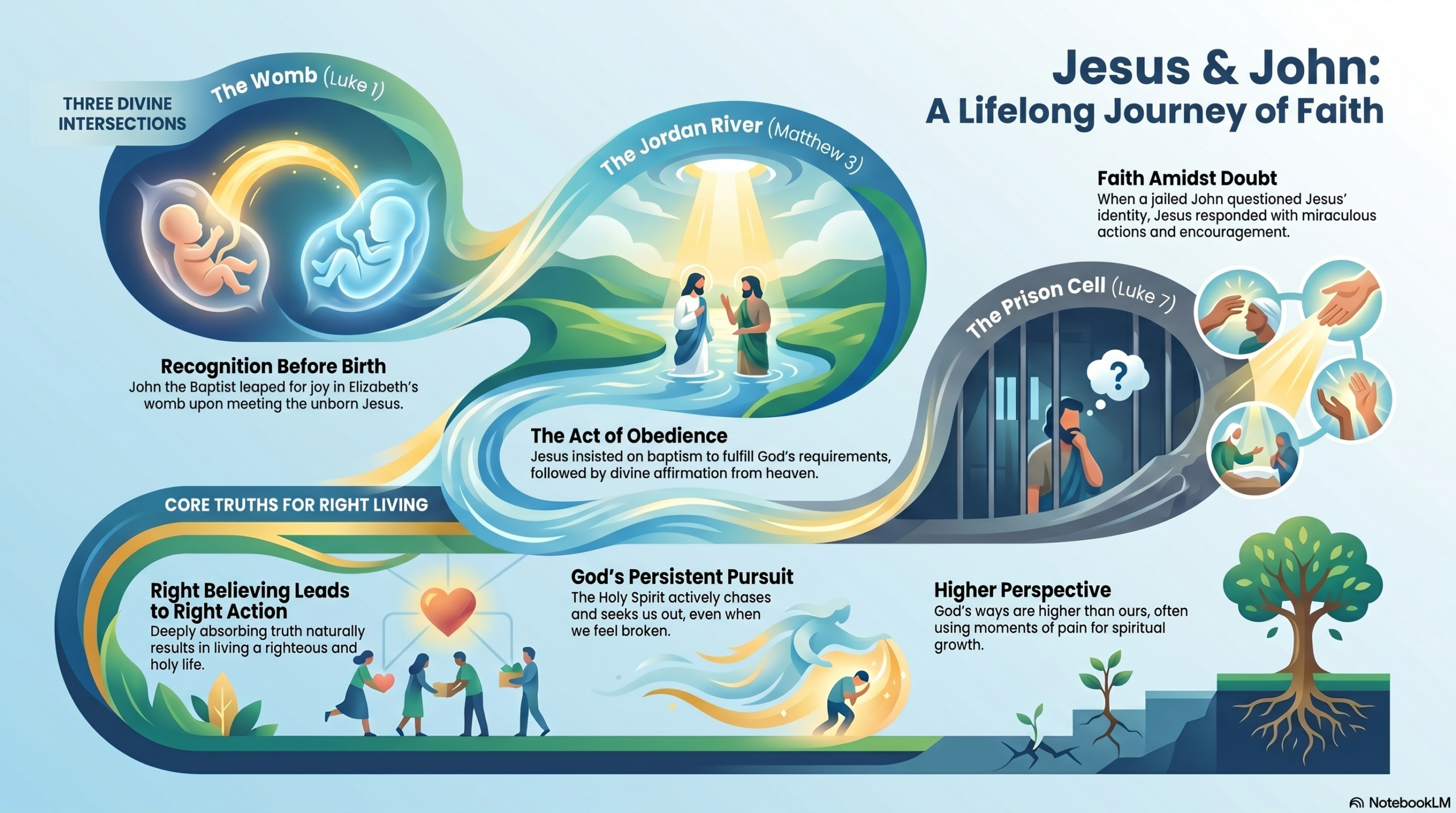
So, what does all this have to do with John the Baptist? I'm glad you asked. There are three moments that John the Baptist and Jesus intersect in the scriptures. There's a fourth one that happens in heaven or prior to birth, but there are three main moments where they intersect in their dynamic.

The Dynamic of John the Baptist and Jesus

The first one is John the Baptist's birth announcement. In Luke chapter one, we see Zacharias, who's a priest, and he is going into the holy place to burn incense. An angel appears to him and says, "Hey, your wife is going to have a child. You're going to name him John, and he's going to be great in the sight of the Lord. He's going to turn many of the children of Israel back to their God. He'll go before Him in the spirit and power of Elijah to turn the hearts of fathers back to their children, and the disobedient to the attitude of the righteous, so as to make ready a people prepared for the Lord."

So right off the bat, John's dynamic is to get people ready for Jesus. He is the guy who goes out into the wilderness and starts preaching. What is his message? Repent, for the kingdom of heaven is at hand. He's dunking people in water, and he's calling people out. He is intense. He's wearing camel hair, eating locusts and wild honey, and he's calling the religious leaders a brood of vipers. He's saying, "Who warned you to flee from the wrath to come?" He is a hellfire and brimstone preacher, completely detached from culture, living in the woods, and just yelling at everybody about their sins.

Then Jesus shows up. This is the second intersection. Jesus comes to be baptized by John. John looks at Him and says, "Behold, the Lamb of God who takes away the sin of the world!" John recognizes exactly who Jesus is. He dunks Jesus in the water, the heavens open up, the Holy Spirit descends like a dove, and the Father says, "This is my beloved Son, in whom I am well pleased."

Disillusionment in the Prison Cell

But then something changes. John keeps preaching his intense message, and eventually, he gets arrested because he tells King Herod that it's unlawful for him to have his brother's wife. So John is sitting in a prison cell. He's in the dark, he's lonely, and things aren't going the way he thought they would. He thought Jesus was going to bring the axe to the root of the trees, burn up the chaff with unquenchable fire, and overthrow the corrupt leadership right then and there. But instead, Jesus is going to parties, eating with tax collectors and sinners, healing people, and talking about grace and mercy.

So John sends his disciples to Jesus. This is the third intersection, found in Luke chapter seven. John's disciples come to Jesus and ask, "Are you the Expected One, or do we look for someone else?" Think about that. The guy who saw the dove descend, who heard the voice from heaven, and who declared "Behold the Lamb of God" is now sitting in a prison cell doubting. He's asking, "Did I get it wrong? Are you really the guy?"

Jesus doesn't get mad at John. He doesn't say, "Go tell John he's being crazy and needs to stop acting that way." Instead, in that very hour, Jesus cures many people of diseases and afflictions and evil spirits, and He grants sight to many who were blind. Then He tells John's disciples, "Go and report to John what you have seen and heard: the blind receive sight, the lame walk, the lepers are cleansed, and the deaf hear, the dead are raised, the poor have the gospel preached to them. Blessed is he who does not take offense at Me."

Jesus meets John in his need, in his pain, and in his discouragement. He reminds John of the true nature of the kingdom. It's not just about immediate political overthrow or instantaneous judgment; it's about restoration, healing, and the good news being preached to the broken.

Closing Prayer

Lord, help us to look around us and see when you meet with us. Lord, help us to be content with the answers. And Lord, if we can't be content with the answers, then at least help us to be content with your presence and your character. Help us to walk faithfully in the grace you've given us, holding truth without becoming harsh, and chasing righteousness without losing our love for people. In Jesus' name, amen.


Tags


You may also like

Leave a Reply

Your email address will not be published. Required fields are marked

{"email":"Email address invalid","url":"Website address invalid","required":"Required field missing"}