
Is Faith All It Takes to Get to Heaven? | It Matters How You Live

Get the Study Guide for This Week's Message

Pastor Dustin Woolam 
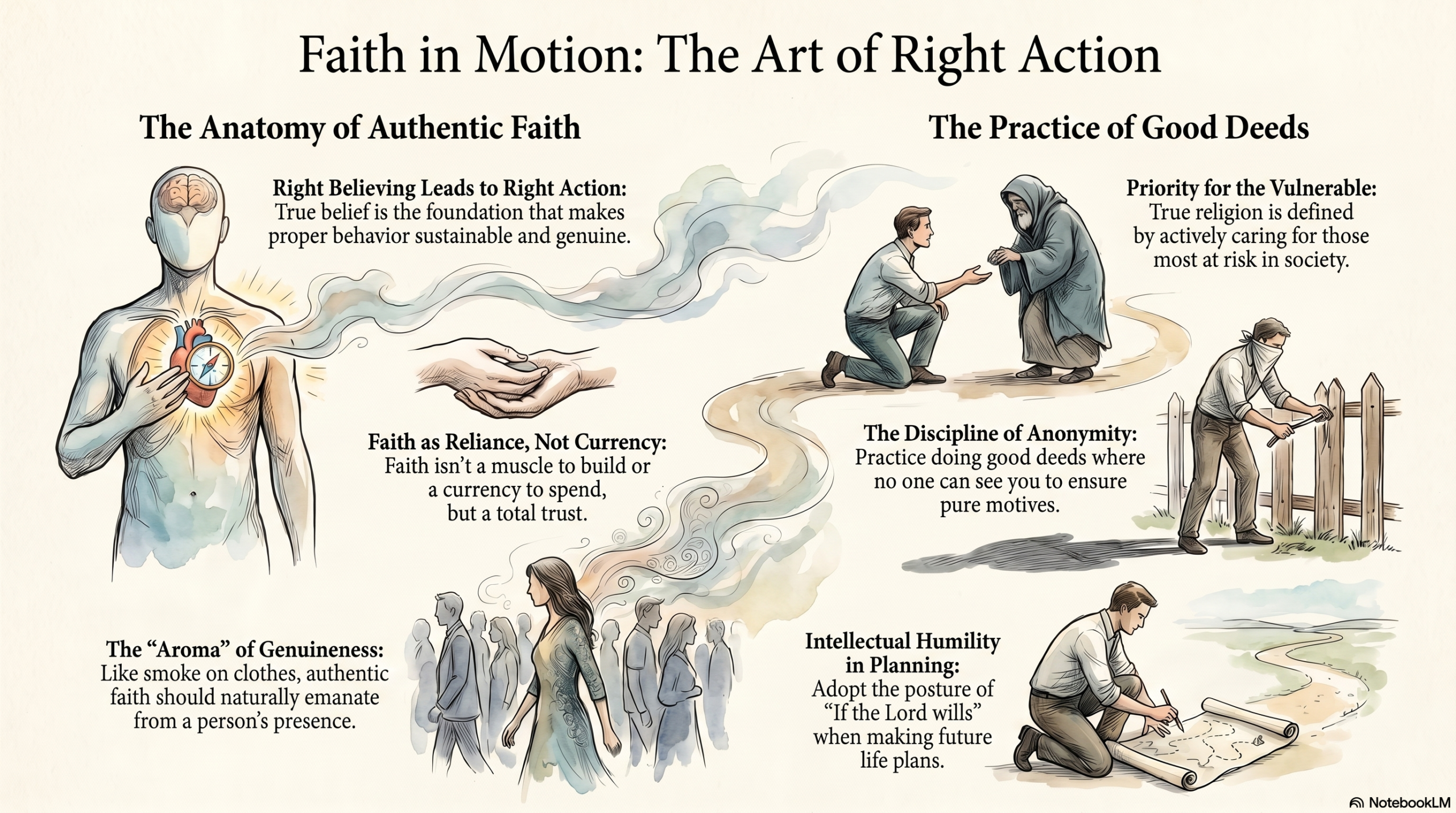
Infographic Faith and Works OWCC Robinson Texas One Way Community Church Pastor Dustin Woolam

The Heart of the Message Summary

In this message, Pastor Dustin Woolam establishes that right believing must always lead to right action. True Christian faith is not merely a collection of intellectual agreements or passive attendance where we just let the ambient smoke of the church rub off on us; rather, genuine faith transforms our hearts so that we actively emanate the aroma of Jesus Christ. Turning to James chapter two, Pastor Dustin challenges the church to understand that while salvation is entirely a gift of grace—beautifully illustrated by the thief on the cross—a living, authentic faith naturally produces good deeds. The primary call to action is to stop waiting for a mystical sign or a special feeling before doing good. Instead, believers are called to look around, notice the immediate needs of people, and proactively love them through tangible, daily actions.

TRANSCRIPT

Welcome to Church

Morning again, and welcome to church. Let me say this: I realized I was talking to my daughter on the way to church in the truck, and I was talking her ear off. But I realized there is something that I say, and Jamie says it too, and maybe you have noticed it or maybe you haven't. It is like when you buy a car—when I bought my truck, I suddenly realized how many Nissans there were on the road. They are just everywhere. Or if you notice a red car, you start seeing red cars everywhere, whatever the case might be.

So I am going to point something out that might ruin your life because you will see it all the time, or you might have already noticed it. One of the things that I say—and it is not for any reason other than probably because of the way I was raised—is "Welcome to church." And I mean that. I remember being in church, and you go to a lot of places where people say, "Make yourself at home, make yourself at home." But we had a pastor, Lance Baker, who would say, "Don't make yourself at home; make yourself at church, because you are going to act some kind of way at home that we don't want you to act at church."

Then I realized there is a guy named Jentezen Franklin, and he might be the last really well-known Pentecostal—truly Pentecostal, not charismatic, Spirit-filled, some version of continuing in the gifts—who is still around and hasn't had a scandal of some kind. I realized while listening to him, because I follow him on different social media, that he constantly says, "Welcome to church." I was like, "Wait a second, this is a Pentecostal thing." So every Sunday, your dose of Pentecostalism is "Welcome to church."

How We Live Matters

I thought about it, and I want to share it with you. Before I pray, today's sermon will be half introduction and half groundwork for a new series about how the way we live matters, or how how we live matters. As a reminder, right believing leads to right action. If I believe rightly about something, then I will follow the action that I should follow. Now, I do not have to follow the action; I could believe all the right things and not do any of the right things. You can believe but not do. But it is hard to do the right things if you do not believe the right things.

We have just spent a long time talking about our beliefs and what the Bible teaches about the core beliefs of Christianity. So now the question is—because we do not want to just gather information—what do I do with that information? How do I live with that information? What does that information change in my life and in my heart?

Let us pray. Father, thanks for today. Thank you for the gift of your body. Thank you for your people. It is not a small thing to be in the body, Lord. It is just as important for us to be with Christians as it is for us to be with you, because somehow, you have created humans for community. Yes, you save us, but you save us for each other. Lord, I pray that as we celebrate Christianity together, and more specifically, as we celebrate worshiping you together, we would not forget that we are not just individuals, but we are members of each other, just as communion and so many things in the Scriptures remind us. I am grateful for your body and I am grateful for your Word. I pray that if things remain, only things from you would remain. May the things that are not from you—whether they are from our own hearts, our own minds, social media, the devil, or whatever else—none of those things would remain. In Jesus' name, amen.

The Marks of Belonging

All right, let us go to James chapter two. There are certain things that happen among different groups that let you know someone belongs to that group. Some groups have secret handshakes. If you see a bunch of guys on a football field smacking each other on their rear, they are probably on the same team, hopefully. We see things like a group of young girls together all wearing the same clothing, so there are all these outward signs of how people show they are together. When my brother was in the Air Force, he could look at someone and tell if they were in the Army or in the Marines by the way they were dressed. To someone who is not a soldier or a Marine, like myself, I cannot immediately tell the difference just by looking at the camouflage, but there are things that happen inside of groups so that the people inside know they belong together.

If you see someone who is in a relationship with someone else, like a husband and a wife, there is a way that Jamie and I stand together that I do not stand with anyone else. If some other dude tried to stand with my wife the way I stand with my wife, we might fight; there is probably going to be a problem. When we think about that, and how it is the most natural thing in the world to us, how much do we think about that when it comes to Christianity? How much do we think about that when I say I am a Christian or a member of a specific church like One Way Community Church? What does that mean? What does that look like? What does that sound like?

For example, if you were Catholic, you might carry a rosary, or if you were part of the Coptic Church, when they pray they use what are called Coptic knots. In a modern-day, Protestant, charismatic, non-denominational world, a lot of what makes the church look like the church begins to fade and to dissipate. How does anyone know that I belong to a church when I am just out in the wild, when I am at work?

I am ninety-nine percent sure it was Ian who made this comment to me: he was talking about the aroma of Christ. He said there are people who are in the church, and it is like the smoke gets on them. When they leave, they still kind of smell like Jesus, but it is not coming off of them; it is just around them. There is a difference when someone is truly emanating that aroma. There is a genuineness that comes with it. As we look at how we live, it is not just a list of do's and don'ts. That comes with it, but it is more than that. If I follow Jesus, how do people know? How do people know that I love Jesus? It is not because I am perfect, because the reason I need Jesus is because I am not perfect. It is not my perfection and it is not my effort, but there are some things that I am going to have to do.

Faith and Actions in James 2

When we look at James, I like the book of James. I liked it a lot when I was young, and then I grew up and realized that James wasn't being as much of a hard case as I had hoped he was being. Then I got older and I was like, "Wait, no, yeah, he is." So I love James as a book, and I love the things that he says because James really draws a line in the sand. The whole Bible does this, but James especially will draw a line in the sand and say—if I were to say it in modern English—"If you are not going to serve Jesus, then just don't serve Jesus. You can leave and go do something else."

So we will start in James chapter two, verse 14. James says, "What good is it, dear brothers and sisters, if you say you have faith, but don't show it by your actions? Can that kind of faith save anybody? Suppose you see a brother or sister who has no food or clothing and you say, 'Goodbye and have a good day. Stay warm and eat well,' but then you don't give that person any food or clothing. What good does that do?"

You see, faith by itself isn't enough. Now, some people are going to say, "But wait, Paul says..." Hold on, we are going to get there. Unless it produces good deeds, it is dead and useless.

Now, someone may argue, "Some people have faith and others have good deeds." But I say, how can you show me your faith if you don't have good deeds? I will show you my faith by my good deeds. You say you have faith for you believe that there is one God. Good for you! Even the demons believe this, and they tremble in terror. How foolish! Can't you see that faith without good deeds is useless? We will keep reading here in a little bit, but let us unpack that.

Grace, Faith, and True Transformation

There will be some people who read this—and I have had these conversations with people—and think there is a group of Christians who say that we should not read the books of Paul. They argue that Paul has changed the writings of the Bible and that the writings of Paul, which make up about 13 of the 27 New Testament books, give or take, should be questioned. There is some debate about whether Paul or some of his followers wrote some of the books attributed to him, but none of that matters. For sure, 13 of them are attributed to Paul. The ones that aren't were at least written by someone who was trained by him, maybe one generation down. There are people who will say that these books need to be removed from the New Testament because they take away the importance of doing works to earn our faith.

Let me just not bury the lead: those people are incorrect. That is not a true statement. I understand why they say it, but here is what happens: they read something like James, and they say, "Oh, well, if I don't do good deeds, I'm not saved." But that is not what James is teaching. That is not what James is saying.

When Paul says, "By grace through faith we've been saved," and that it is not of our works so that no one can boast, Paul didn't lie. When Jesus comes, he does everything for us. When we read the Gospels, he says, "My yoke is easy, my burden is light." Jesus comes and does all of the work. There is nothing I can do to be saved.

What James is saying is that the faith we have in Jesus isn't really faith in Jesus if our lives don't change. You can say, "Man, I believe in Jesus," and James says, "Great, so do the demons." We see that all through the Gospels. We see demons show up and say, "What do you want from us, Son of the Most High? Why are you here?" They tremble and they are afraid, but they are still demons. They are not somehow going to heaven just because they know who Jesus is.

What James says is, if you have that kind of faith, so what? It doesn't do anything for you. The kind of faith that is valuable is the kind of faith that changes the way that we live.

He specifically talks a lot about good deeds. He doesn't say, "Do you have enough faith in Jesus to not murder someone?" He doesn't say, "Do you have enough faith in Jesus to not cheat on your wife?" He doesn't say, "Do you have enough faith in Jesus to not lie," or mention all the other things that we might see, asking if you have enough faith to keep from doing bad things just to say you are doing what you are supposed to do. What he says is, do you have enough faith in Jesus so that when you see someone in need, you do something about it? Do you have enough faith in Jesus so that you are doing good deeds? It is your good deeds that will show that you have a kind of faith that matters.

Relational Reliance vs. Spiritual Muscles

Faith is interesting. I have breakfast with a friend almost every week—we miss once in a while—and we were talking about faith and faithfulness this week. Hebrews is right before James, and if we go to Hebrews chapter 11—you don't have to turn there, but you can if you want; I am only going to read a verse or two—we read the heading "Great Examples of Faith." We think, "Great, I'm going to read all about faith." Verse one says, "Faith is the confidence that what we hope for will actually happen. It gives us assurance about things that we cannot see."

Somebody will take that verse, and they will tell us that faith is basically like the Force. They imply that if I believe hard enough, if I have enough faith, and if I build up my faith, then God will do whatever it is that I am hoping for. We treat faith almost like a currency. If it is not like a currency, we treat it like a muscle. We think that if we go to the gym every day and build up our muscles, we can pick up 200 pounds, and if we keep going, we can pick up 300 pounds, then 400 pounds, and if we keep going and take some steroids, we can pick up 1,000 pounds. That is how we treat faith.

But if we read Hebrews in context, that is not what the writer is talking about. You could take that one verse out, read it all by itself, and talk about faith—which is what I was talking about last week when I said we have this overdeveloped strength where we say, "I'm just going to believe what the Bible says"—but we will take a verse and misuse it if we are not careful. What we need to do is take that verse within the scope of all of Hebrews. What is the writer telling us? It is an important verse, and it means what it says, but it doesn't落 necessarily say what we think it says.

I was reading something this morning written by a guy whose job for decades was to look at media like movies or video games to make sure they were realistic. One of the things he pointed out is that when you watch an old movie and see all these torches down the hall in an old castle, that is entirely unrealistic because a torch is expensive and only burns for about an hour. He talks about how people might think of a little glass vial or this or that, but these are all modern applications applied to old things.

If we are not careful, we look at the Bible and take one verse out of context. We look at it within the scope of this room, this city, or this country, and we start applying the Bible to things that we shouldn't apply it to.

When we look at faith from Hebrews, especially if you continue to read chapter 11 and skip past just focusing on verses one or two, you see a whole bunch of people whose trust was completely in the Lord. It wasn't that they built up a muscle thinking, "If I believe hard enough, God will make it rain," but rather their trust, their confidence, and their reliance was upon the Lord. A lot of times when we read about faith—because of so many years of how it has been taught in the West, in the United States, in Texas, the Bible Belt, or in various churches—we have turned faith into a work that we perform. We think, "If I believe hard enough, then God will."

The Man on the Middle Cross

I was showing Curtis one of my all-time favorite videos by Alistair Begg. Alistair Begg has a famous illustration that I have shared before, but it is worth saying again. He shares a scenario where the thief on the cross gets to heaven. He says, "I have to find that guy and see how that worked out for him." The thief gets to heaven, he is standing there, and the angel asks, "Hey, why are you here?" The thief says, "I don't know." The angel responds, "What do you mean you don't know?" The thief says, "I really just don't know why I'm here." The angel asks, "Well, do you believe in the doctrine of justification by faith?" The thief answers, "I don't know what that is. I don't understand."

The angel says, "Hold on," and goes to get the supervisor angel. They come back, and both angels are talking to the thief on the cross, asking, "Do you believe in the doctrine of Scripture? Do you believe in this? Do you believe in that?" Finally, the guy says, "Listen, all I know is that the man on the middle cross said I could come."

That is salvation: Jesus does all the work. Right before he tells that story, Alistair Begg says that if someone asks you the old question, "If you were to stand before God and he asked, 'Why should I let you into heaven?' what reason would you give?" Think for a second—I will give you about 10 or 15 seconds. Imagine you are standing in front of God, and He says, "Why should I let you into heaven?" What would you answer?

The only answer that works cannot be, "Because I did this," "Because I did that," "Because I believed in Jesus," "I was baptized," "I went to church," or "I did good things." All you can do—the only correct answer—is to say, "Because he did something for me, because Jesus bought my place here, and he died in my place."

When we look at faith, it cannot be a work that saves me. In the Bible, faith is distinct. Have you ever heard that there are at least three different words for love used in the Bible? There are four Greek words in total, but three of them show up in Scripture. We have agape, which means "I love you unconditionally for all things." I am going to butcher these because I don't speak Greek, but then there is phileo, which is like brotherly love or brotherly affection, and there is eros, which is romantic love. All of these words get translated simply as "love" in English. In English, we might say, "Man, the Greeks have four different words for love," because the other one is storge, though that doesn't really matter for this purpose. We would say the Greeks have four words for love, but the Greeks would look at us and say, "No, you have one word for four completely different emotions." Because I love my wife, and I love pizza—well, I don't actually love pizza, but you get the idea. I am using the same word, but those are not the same thing.

Even little kids notice this. How many times in elementary school—maybe people still say this—do you say, "Oh, I love pizza," and some little kid says, "Well, then why don't you marry it?" Thanks, that is exactly what I needed today: this sass from you.

True Religion in 2026

When we look at faith, and when James says faith without works is dead, he is separating faith from works. He says that we show we have faith through our actions. Going back to the question: how does anyone know that I am a Christian? They know I am a Christian because they see the good deeds that I do because of the faith that I have. If I trust in Jesus and trust all the things that are in this Bible, then I am going to do good works.

Then we ask the question, "Well, what sort of good works should I do?" James says that true and undefiled religion is to take care of widows and orphans. When James wrote that, widows and orphans were the most vulnerable people in society. There was no Social Security. The whole society was built on the reality that if you didn't have a husband or a father to take care of you, then you were in a lot of trouble.

There was a heavy weight to this. When we think of the idea of Father Abraham, it wasn't just because of all the people who descended from him, but because of the care he had for his community. To be a father is a weighty thing, especially in that time period. What James is saying is that if you really love God, you are going to take care of the most vulnerable people in your community; you are going to take care of widows and orphans. That is why for millennia, we have seen that Christians will do exactly that, because we understand from Scripture that this is what needs to happen.

Now, that looks different throughout the years. It could be that for me as a human right now in 2026, to take care of an orphan might mean I adopt that orphan and they become my child. Or I may go work at an orphanage and take care of kids, like the Methodist Children's Home or something similar. It could be that there are a whole bunch of kids whose parents have failed them, who are now in the criminal justice system, and they might just need someone to go and be a good role model to them. Or it could be, as Jesus says in the Gospels, that even if you give someone a cup of cold water, the blessing will not be taken from you.

My goal is not to stand here and tell each of us, "If you don't do X, then you don't get Y," or "If you don't go and do exactly this, then you can't go to heaven." What I want to say unconditionally and without question is that if you love Jesus, it will change the way that you live. If your faith and confidence are in Jesus, it will change the way that you live, and you will do good deeds.

The Strenuous Life of Faith

There is a website that I like and have followed for years called The Art of Manliness. Every so often, he runs a program you can pay to join, which is essentially like Boy Scouts for adult men. It sounds goofy, but it is really cool. He has another branch of it called The Strenuous Life, built on the idea that life should be hard because hardship is good for you. Life is hard, so there is this challenge of living a strenuous life.

One of the things you have to do within the first 90 days of joining one of these groups is a daily good deed, and no one can see you do it. If someone catches you doing this good deed, it doesn't count. You don't get credit for it if someone sees you do it, so you have to go do another one. You have to keep doing good deeds until you can accomplish one without being caught. The purpose of that exercise is to learn to live a life where I am doing good for the people around me, whether anyone knows it or not. I happen to know the guy who organizes all of this is a Christian, so I suspect there are Christian ideas behind it.

I wonder what would happen if all of us just decided to do good deeds because we love Jesus, because he is good to us, and because he came and saved me when I was far away and there was no reason to save me. Paul says in Romans—or is it Corinthians—that Jesus died for us when we were still his enemies. I think about that because you don't have to look very far into the land of social media to see who your enemies are, but Jesus died for those people. He died for me when I was his enemy, and he died for them while they are his enemies. What if we, as a people, took James seriously and said, "My faith should produce good deeds. My love for Jesus should cause me to treat others well?"

The thing I love about this is that James doesn't care how you feel. He doesn't say anywhere in the passages we read that it matters how I feel about the person I am doing good deeds for. He just says, "Do good deeds."

Humility, Planning, and Friendship with the World

Let us look a little bit further into chapter four, starting in verse four. James writes: "You adulterers! Don't you realize that friendship with the world makes you an enemy of God? I say it again: if you want to be a friend of the world, you make yourself an enemy of God. What do you think the Scriptures mean when they say that the spirit God has placed within us is filled with envy? But he gives us even more grace to stand against such evil desires. As the Scriptures say, 'God opposes the proud but favors the humble.' So humble yourselves before God. Resist the devil, and he will flee from you. Come close to God, and God will come close to you. Wash your hands, you sinners; purify your hearts, for your loyalty is divided between God and the world. Let there be tears for what you have done. Let there be sorrow and deep grief. Let there be sadness instead of laughter, and gloom instead of joy. Humble yourselves before the Lord, and he will lift you up in honor. Don't speak evil against each other, dear brothers and sisters. If you criticize and judge each other, then you are criticizing and judging God's law. But your job is to obey the law, not to judge whether it applies to you. God alone, who gave the law, is the Judge. He alone has the power to save or destroy. So what right do you have to judge your neighbor? Look here, you who say, 'Today or tomorrow we are going to a certain town, and we'll stay there a year. We will do business there and make a profit.' How do you know what your life will be like tomorrow? Your life is like the morning fog—it is here a little while, then it's gone. What you ought to say is, 'If the Lord wants us to, we will live and do this or that.' Otherwise, you are boasting about your own plans, and all such boasting is evil. Remember, it is sin to know what you ought to do, and then not do it."

James takes faith and good deeds one step further here by talking about the condition of our hearts. He talks about being humble before the Lord. He describes a humility that manifests in the way we talk about each other, a humility in how we plan our lives, and a humility that anchors everything we do, recognizing that we are supposed to do what God says. If I follow God, I am going to follow Him fully. I am not just going to believe the way the demons believe; I am going to believe the way God wants me to believe, and I am going to do good works.

There is another layer on top of that: am I going to be humble in all that I do? I am not saying don't make plans for your future; James doesn't say that. What he says is that when we make plans, we should say, "If it's the Lord's will, this is what is going to happen." For instance, "I'm going to go buy this house if it's in the Lord's good plan." It might feel weird to say that, but that is okay. There are lots of examples in the Scriptures where people say, "I'm going to do this and see how God responds." Gideon puts out a fleece before the Lord to see how God responds. Jonathan and his armor-bearer go out and talk to the Philistines to see how God responds. There is all kinds of context we can look at where we see that God responds in different ways to us, but there is a baseline humility in that posture. There is a humility where we say, "I'm going to go before the Lord and see what He has to say, and I'm going to do whatever that thing is." I am going to make a plan, and I am going to let the Lord guide and direct me within that plan.

A lot of times we pray and say, "Lord, I'll do good deeds if you'll just show me what good deed to do. I'll follow you. I'll go to this school, I'll take that job, or I'll fill in the blank, but Lord, you just have to tell me." Standing in that place is not a bad thing, but as we think about what it would look like if we did good deeds, what if we didn't wait for the Lord to tell us to do something that is obviously good? What if we just saw a need and did something about it simply because we love Jesus? That's it. No other reason is required. I don't need another reason to do a good deed; that love is all I need.

Basic Skills vs. Basic Care

All of the things that I believe about the Trinity, communion, baptism, the perspicuity of Scripture, and all these other things are really good to know. But if I just keep that information to myself in a library, it is not valuable. As we start looking throughout the coming weeks at how what we believe changes our lives, let us start with the basics. James says that if you know to do right and you don't do it, then it is sin. So, I know that it is good to do right.

Now, how I do right is a question that we will explore in the coming weeks. How do I know if I am giving the right thing to the right person in the right amount, or whatever the case might be? If somebody on the street asks me for fifty dollars and I give it to them, how do I know they are going to spend it well? What do I do, and how do I make that decision? We will talk about those kinds of things and look at some of the nuance involved. But today, what I want to establish is just the basic commitment to do good deeds, the commitment to love someone well, and the commitment to say, "I'm going to hold this door," "I'm going to shake this hand," "I'm going to buy somebody dinner," or "I'm going to help someone save face who looks embarrassed." Or even something more extreme: if I see somebody getting beat up, I am going to go help stop the fight—though hopefully that is not happening around here. But we don't know.

If you struggle with doing good deeds, I want you to ask yourself this question: "Am I struggling with good deeds because I am not skilled at doing them and I just don't know how?" That is okay. That is a fine place to be. Or are you struggling with good deeds because you simply do not care about people? That is a problem. It is a massive problem if you are struggling to do good deeds because you don't care. It is perfectly okay if you are simply learning how to do good deeds because you don't know how. Find where you are, and then just say, "I'm going to do a good deed."

Now, whether or not you want to practice doing good deeds where no one catches you, there is also something to be said about the fact that when people see you repeatedly doing good deeds, loving others, and being kind, they are eventually going to look at you and ask, "What's different about that person? They are behaving in a way that I don't expect." It points them directly to Jesus.

I would like for all of us, myself first and foremost, to live in such a way that when someone finds out we are a Christian, they are not surprised. Instead, they should say, "Oh, well, of course you are."

I have a friend whom I have been trying to lead to Jesus for about 12 years. He repeatedly tells me and Baylor, "Hey, you guys are some of the good ones." He doesn't really understand Christianity yet, in spite of all our efforts, and he still holds some wrong ideas. But the world absolutely knows the difference between someone who truly loves Jesus and someone who doesn't. There is a lost guy out there right now who doesn't really feel the need to believe in Jesus because of all the Christians who are doing it the wrong way, and I don't want to be one of them.

In the book of Acts, when the apostles get in trouble for preaching about Jesus, they are brought before the Sanhedrin—the Jewish leaders. The leaders look at them and think, "Oh, man, these guys are not smart. They are not educated. But it's really obvious they have been with Jesus." That is exactly what I want in my life. I want someone to look at me and say, "Man, it's obvious that guy has been with Jesus, because who else could produce this in him?" James says people see that reality explicitly through our good works and our good deeds.

Closing Prayer

Let us pray. Father, thank you for not just saving us, but for setting us on a road to work with you, to work beside you, and to bring people to you. It is easy to think about how you want us to do that, but it is not always easy for us to execute. I suppose it is simple: we do good deeds, and we love people—simple statements.

Lord, I pray for the parts of us that are hard, the parts of us that haven't considered this, that you would teach us. For the parts of us that do not want to do good deeds, I pray that you would change that and give us a soft heart. For the parts of us that don't know how to do good deeds—where we want to, but we just don't know how—Holy Spirit, I pray you would whisper in our ears. The book of Isaiah says we will hear a voice in our ears saying, "This is the way, walk in it." I pray we hear that voice clearly.

Show us how to do good deeds, and show us which good deeds to do. We ask this not for merit badges, and not so that we can accumulate "good boy points," but simply because we love you and because our faith in you is genuine. Our faith in you produces this lifestyle. We love you, Lord. In Jesus' name, amen.


Tags


You may also like

Leave a Reply

Your email address will not be published. Required fields are marked

{"email":"Email address invalid","url":"Website address invalid","required":"Required field missing"}