
Is Faith All It Takes to Get to Heaven? | It Matters How You Live

Get the Study Guide for This Week's Message

Pastor Dustin Woolam 
Pride and Humility One Way Community Church OWCC Robinson Texas Pastor Dustin Woolam

The Heart of the Message Summary

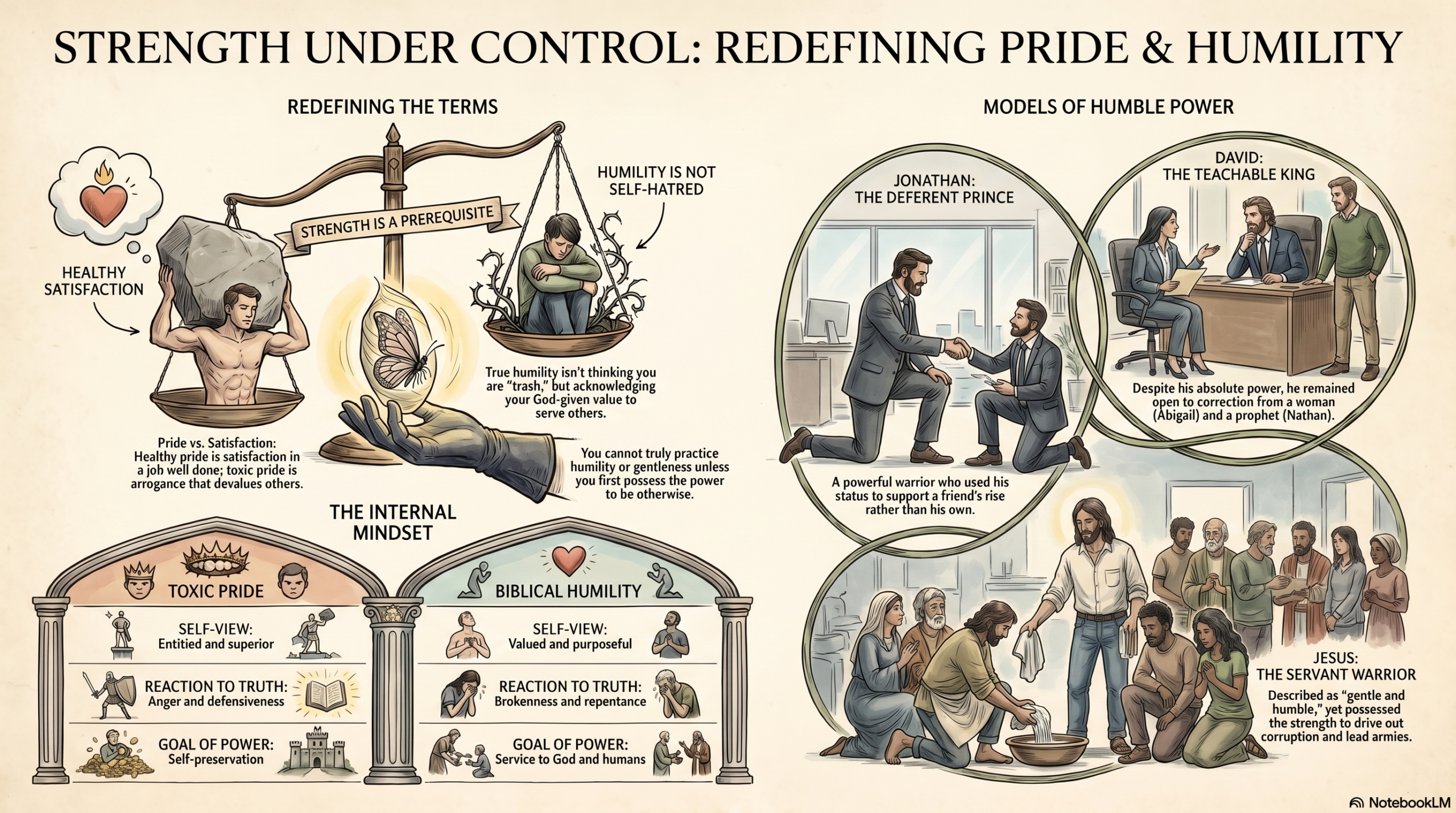
In this week's message, Pastor Dustin Woolam confronts the deep-seated human struggle with ego and control, challenging us to redefine our understanding of pride and humility. True humility is not a call to powerlessness, weakness, or artificial poverty; rather, it is the intentional restraint of power aligned fully under God’s sovereignty. By tracking the lives of Jonathan, David, and ultimately Jesus, we see that defensive pride sets us up for a fall, while a teachable, repentant posture positions us to experience God's redemption. Pastor Dustin calls the congregation to stop fleeing the difficult weights of life and instead develop a submissive heart that values others. Spiritual transformation occurs when we stop using our strengths to diminish those around us and instead submit our lives entirely to Christ, finding true rest for our souls.

TRANSCRIPT

The Purpose of Pressure in Fatherhood

Let's pray. Father, thank you for today. Thank you for the gift of your mercy and your love, the gift of your word, and for your body. I want to pray that you would be with those who are out sick today, Lord, and that you bring them healing and strength to their bodies. Father, I pray for all the different things that are going on right now in our community and in our world. Father, please be with us. I thank you for all that you do. In Jesus' name, amen.

All right, so we are in this series about how we live matters. Before I jump into that, I just want to talk a little bit because it's Father's Day. I think the thing that I want to say that's really important is that there is this odd thing that happens in the life of a guy. Ladies, maybe you already know this, or maybe I'm telling secrets. They are not really secrets; men are simple creatures on the outside. On the inside, we want to be simple, but we often find that it is difficult.

One of the things that is interesting and challenging is that there is all this external pressure. If that pressure is missing from young men, they fail. They need that pressure. They need that motion and drive, or they fail. A lot of times, what we don't realize is that this pressure is the good thing that men provide for their sons—this weight, this pressure. Sometimes as sons, we wonder why dad is being hard on us.

I can think of my own son asking why I was nicer to his sister than he is to me. I don't know if he said this directly to me, or to his wife, or to my wife who then told me, but I had a realization through that question many years ago. I realized that I am raising two different people. In today's modern world and today's society, we have said that men and women are not different, but we are vastly different. We need different things.

A lot of times, when we look at the men in our lives who are trying to be fathers and grandfathers, we miss the backstory of the men in their lives. I can remember the men in my life, my father among them, telling me, "Son, you have to. You don't have a choice." I remember sitting in his living room in Midland, telling him about my troubles, and him telling me that the only way out is through. That weight and what it did—the weight that my father put on me to be a man—made me the man I needed to be so that I could be a father.

Sometimes when the men in our lives are broken or messed up, it is because nobody told us that the weight was good and that we need it. The constant desire to escape and flee is bad for you as a man. That is something that fathers give to their sons.

The flip side of that coin, which is exactly the same, is the thing that fathers give to their daughters: a place to be safe, a place to watch, guard, and protect. There will never come a time in my life, even if I am laying in bed, cannot walk, and am 105 years old, that I won't feel the need to protect my daughter. That will never go away, and that also is good. Now, she may or may not need my protection, but that is not the point. The point is that I will never stop feeling that need, and that is a good thing.

Society would tell us otherwise. The amount of women we hear say, "I don't need a man," and then ask for help opening a jar is very high. I say that as a joke, and it's kind of funny, but I think what has happened, especially in my generation and during my time growing up, is that we have heard a lot about toxic masculinity. The real problem is that we actually have an absence of masculinity. We have a bunch of adult boys who are failing because they did not have fathers. That doesn't mean every man who fails lacked a father; some guys are just foolish all on their own. Some guys have everything handed to them and receive all the right things they need, yet they still choose to fail. That's life.

The things I want to say in all of that are twofold. First, guys, if it is hard, that is good. You should lean into that struggle because it will make you better. Secondly, women, please stop saving your sons from difficult things. They need that struggle. It is like a butterfly trying to come out of its cocoon; if you help it, it will die. It needs the struggle. As a father to a son I am proud of, and as someone watching a lot of young men, it is okay if it's hard. I am not saying let them die, but there is a baseline they need to hit.

There is a documentary called Jiro Dreams of Sushi about an elderly sushi master in Japan who runs a three-Michelin-star restaurant. His second son has a restaurant that only has two Michelin stars because he does not care quite as much as his father does. His oldest son still works for him because of traditional Japanese culture, meaning the older son will take over the father's restaurant, but since the father is not retiring, he stays on to work. When his second son reached a certain age, his dad told him, "Son, it's time for you to go, and you can't come home. You have to make it work." The son went out and succeeded.

When I first heard that, I thought it was tough. I don't know if I would ever tell my child they can't come home, but the message he conveyed was that you have to make it. If you are a young man, a young father, or an older guy who has never heard it: you have to lean into that weight. You have to stand up under it. That is where you find manhood, and that is where you find fatherhood. Women are wonderful, and I don't think women are bad in any way, shape, or form, but it is Father's Day, so let's talk about why how we live matters.

Defining True Humility vs. Arrogance

I want to talk today about something adjacent to this. I don't know if men struggle with this more than women, but it manifests in obvious ways. This isn't just for men; my examples lean that way because they are clear, but I want to talk about pride and humility. It is really easy to look at a guy and think he is arrogant or proud. Women struggle with pride too; it is not unique to guys.

I want to look at the difference in how we use the words for pride. There is pride month, which is complete chaos, so I am not talking about that. It is dismal that society would be proud of sin. Setting that aside, that is not my topic today. What I am talking about is what it means when the Bible says, "Do not be proud."

The word pride can function like the word love. You can love your wife, your husband, or your kids, but you can also love pizza, your vehicle, or your job. We use the word love for a lot of things where it fits, but other words exist too. I can say I love pizza, but I can also say I really enjoy the way it tastes. If you choose a human in your life and say you enjoy the way they taste, you might be a cannibal, and that's a problem. Let's not eat humans. If you like the way your vehicle tastes, there is a problem.

We have different words we can use, and pride works the same way. We universally tell people not to be proud, but we haven't taken the time to define it. There is certainly a pride that amounts to arrogance, but there is also a pride that simply means being proud of your kids, a good job you performed, or an accomplishment. It is okay if it stops there. The problem arises in how we express that pride or what we believe about ourselves because of it.

If I accomplish something really hard, do something for the first time after working on it for years, or achieve a goal, I feel proud. Maybe I lifted more weight, became a great marksman, graduated from college, or beat a level on a video game. We feel a sense of pride in that accomplishment, and that is fine. Do we let that pride change how we see other people? Do we let that sense of joy distort things? Then there is the pride that asserts, "I am better than you," regardless of the justification.

In my life, and I suspect in the lives of many other Christians based on conversations over the decades, we have been so explicitly against pride that we have created a group of people who don't realize it is okay to be who God made us to be. That is where humility comes in.

Many years ago, I followed a fitness influencer on YouTube named Christian Guzman. On his gym wall, he had a big sign that said, "Proud, but not satisfied." It didn't mean he was proud and arrogant; it meant he was proud of the accomplishments he had made.

As we look at the scriptures on pride, we are actually looking at humility. It is easier to chase the target we want than to simply reject the thing we don't want. In some cases, it is right to reject things, but it is much easier to avoid pride and arrogance if I focus my attention on pursuing humility and understanding what it looks like. Right up front, let's recognize the difference between arrogance and simply being happy about an achievement, even though we use the word pride for both. Let's filter that out as we turn to scripture.

Wisdom, Wealth, and the Heart

Let's start in Proverbs chapter 16, verse 16:

"How much better to get wisdom than gold and good judgment than silver!"

I want to make a distinction here regarding the book of Proverbs. When we read passages like this, the author is not saying gold and silver are bad. He is only saying that wisdom and good judgment are better than those things. In fact, the very fact that gold and silver are good things is why he can use them as a valid comparison.

Verse 17 through 21 continues:

"The path of the virtuous leads away from evil. Whoever follows that path is safe. Pride goes before destruction and haughtiness before a fall. It is better to live humbly with the poor than to share plunder with the proud. Those who listen to instruction will prosper. Those who trust the Lord will be joyful. The wise are known for understanding, and pleasant words are persuasive."

A lot of times, we associate humility with poverty and wealth with arrogance. This happens because of a misunderstanding of passages like this. We see a comparison and a contrast, but it is important to think about what the Bible is actually saying versus what it is not saying. It says that it is better to be wise, to seek good counsel, to be curious, and to listen than it is to be wealthy. Then it says it is better to be humble and poor than to lack those righteous traits while holding wealth. It is not saying that the humble will always be poor, nor is it saying that wealthy people are inherently terrible. It is a strict comparison.

I want to move that misconception off the table because somehow, in a lot of people's minds, being poor is viewed as inherently better than being rich, as if it automatically makes us better people. It is true that it might be easier to see the failures of rich people because they have the financial means to execute those failures, but Proverbs says something else that I love: "Don't let me be so rich that I forget my need for God, and let me not be so poor that I begin to steal and sin in my poverty."

What I want from the Lord is just enough—whatever that number is for me—to lift faithfully for Him. For some people, that means millions of dollars, and for some people, it means a couple of pennies. I want to be exactly where the Lord puts me when it comes to wealth so that I do not become proud.

Some people can actually become proud in their poverty. They boast about how poor they are and how much they love Jesus because of it. We see this in the Gospels where the Pharisee prays, highlighting all the things he does for the Lord, boasting about his righteousness, his piety, and his religious works. When scripture states that pride goes before destruction and haughtiness before a fall, let's not mix that up with whether or not we have wealth. It is strictly about pride and haughtiness.

Jonathan: Strength Under Constraint

With that understanding of pride established, let's look at David and Jonathan. I love the way the Bible gives us comparisons, contrasts, and examples through different people's lives. For years, if you have been in church or have heard Christian teaching, everybody points to David to show how great he is, telling us we should all be just like David. Well-meaning teachers have inadvertently set up a complicated example.

David as a man is a wonderful example of someone whose whole heart is given to God, and he is a great example of what God will do through someone who gives Him their heart. Past that, his personal lifestyle is not always a great example. He was a terrible father, he was really not great at being a king, though he was a wonderful warrior, and I love that he was zealous for the Lord. He had some great redeeming traits, but when we look at his personal life, he had multiple wives, committed adultery, had his best friend murdered, and his kids were a total train wreck. His son Solomon, who succeeded him, failed in even more spectacular ways than he did. It is actually the people around David—like Abigail, Nathan, and Jonathan—who help him along the way in his weakest areas.

In 1 Samuel chapter 14, we see the story of Jonathan displaying incredible capability. Jonathan is out with his armor-bearer and develops a great strategic plan to fight the Philistines. He suggests going out to see what the Lord is doing. Just these two men cross over. Verse 11 states:

"When the Philistines saw them coming, they shouted, 'Look! The Hebrews are crawling out of their holes!' Then the men from the outpost shouted down to Jonathan, 'Come up here and we'll teach you a lesson!' 'Come on, climb up right behind me,' Jonathan said to his armor-bearer, 'for the Lord will help us defeat them.' So they climbed up using both hands and feet, and the Philistines fell before Jonathan, and his armor-bearer killed those who came behind them. They killed some twenty men in all, and their bodies were scattered over about half an acre. Suddenly, panic broke out in the Philistine army, both in the camp and in the field, including the outposts and raiding parties. And just then, an earthquake struck, and everyone was terrified."

Jonathan says, "Let's go, the Lord will help us," and then we see the Lord's supernatural help arrive. Everyone panics, an earthquake strikes, and King Saul's lookouts notice the chaos. The Israelites join the fight and win an amazing victory. Jonathan experiences massive personal success.

Compare this to what happens later in chapters 20 and 23. Saul decides he wants to kill David out of intense jealousy. When David killed Goliath, the people sang that Saul had killed his thousands, but David had killed his ten thousands. Saul realized David was gaining more favor, so he resolved to eliminate him. Jonathan and David had become close friends, so David fled to find Jonathan and asked, "What have I done? What is my crime? How have I offended your father so that he is determined to kill me?"

Jonathan protested, "That's not true! You're not going to die. My father always tells me everything he's going to do, even the little things. I know he wouldn't hide something like this from me." David took an oath and explained, "Your father knows perfectly well about our friendship, so he said to himself, 'I won't tell Jonathan, why should I hurt him?' But I swear to you that I am only one step away from death." Jonathan responded, "Tell me what I can do to help you."

They set up a warning signal using arrows. Saul holds a festival, David is missing, and Saul becomes furious, confirming his murderous intent. Jonathan gives David the warning signal, they embrace, and David runs for his life. Jonathan directly protects David's life against his own father's agenda.

In 1 Samuel chapter 23, verse 13, David and his men, now numbering about 600, leave Keilah and roam the countryside. Saul hunts David day after day, but God does not let Saul find him. The text notes:

"Jonathan went to find David and encouraged him to stay strong in his faith. 'Don't be afraid,' Jonathan reassured him. 'My father will never find you. You are going to be king of Israel, and I will be next to you, as my father Saul is well aware.' So the two of them renewed their solemn pact before the Lord, and Jonathan returned home while David stayed at Horesh."

Why do we read these stories of Jonathan succeeding in battle and behaving in kingly ways? Jonathan was the next in line for the throne. When Saul died, Jonathan would naturally become king unless God chose otherwise. Jonathan was doing the exact kingly duties that Saul should have been doing. When Saul became king, he flunked his early opportunities to fight properly, but a couple of chapters later, Jonathan steps up and acts like a king, establishing his fitness as a successor. Yet, when he learns that God has chosen David to be king instead, Jonathan says, "I will be on your side."

His high level of personal accomplishment did not produce a sense of entitlement. He refused to wrestle against what God was doing. We see a highly capable, powerful warrior express deep humility. He essentially says, "I will stay in the position I am assigned; I am happy for my friend and brother who will succeed." We never see Jonathan complaining or pushing for his own platform. He only asks David to show kindness to his family later on. Jonathan is never depicted as feeling that his circumstances are unjust; he simply performs at the highest level exactly where God places him.

This is what true humility looks like. Humility did not mean Jonathan became an impoverished beggar living in a gutter; he remained a prince in the palace, but he maintained a correct understanding of what God was doing.

David: Remaining Teachable and Repentant

In 1 Samuel chapter 25, we find the story of a wealthy man named Nabal. David and his men were out in the wilderness protecting Nabal's herds and flocks from danger, acting like a protective wall around them. When it came time for a feast, David sent messengers to ask Nabal for a small share of food since they had looked after his property. Nabal insulted David, ran him down verbally, and refused to assist him. When the messengers reported this, David became furious and ordered, "Everyone strap on your swords, we are going to eliminate this guy and every male associated with him."

Nabal's wise wife, Abigail, heard about the impending disaster. She rushed to meet David with an abundance of provisions and intervened, telling David to ignore her foolish husband. She successfully calmed David down. In this interaction, we see David being taught humility. David wasn't factually wrong to be angry; he had genuinely protected Nabal's livelihood. He was acting like the warrior God made him to be, but he let his wounded ego drive him too far. He wanted to mass-murder a household over an insult. It was David’s pride that demanded blood.

To avoid destructive pride, we must remain teachable. There will be times when we want to react out of arrogance because our ego says, "You can't treat me that way." In David's culture, there was zero societal reason for him to listen to Abigail. She was a woman from an outside family, and an explicit warrior-leader like David held all the power. Yet, the Bible highlights the value of her voice, and David practices humility by actively listening to her correction. Truth can come from unexpected sources, and a primary way to cultivate humility is to remain continuously teachable.

The final element regarding David occurs in 2 Samuel chapter 12. To contextualize it, let's look at his situation with Bathsheba, which means daughter of Sheba. Throughout most of the text, she is formally referred to as the wife of Uriah. Uriah was one of David's elite warriors, part of a small group of mighty men who performed legendary exploits. He was one of David's closest companions from the early days of hiding in caves.

While the army was out in the field fighting battles where David should have been leading them, David stayed behind in the city. Walking on his roof, he saw Bathsheba bathing, summoned her to the palace, and she became pregnant. She sent word of the pregnancy to him. David tried to cover up his sin by calling Uriah back from the battlefront, instructing him to go home and spend time with his wife so everyone would assume the child was his.

Instead, Uriah showed integrity, stating, "The ark and the armies of Israel are staying in tents in the open fields; how could I go home to eat, drink, and sleep with my wife?" In saying this, Uriah inadvertently convicted David for abandoning the field.

Realizing his cover-up failed, David wrote a letter to his military commander, Joab, and had Uriah carry his own death warrant back to the front lines. David ordered Joab to place Uriah in the fiercest part of the battle and then withdraw so that he would be struck down and killed. Uriah died, Bathsheba mourned, and David married her. She gave birth to the child, but the child became terminally ill.

While David was living in the hidden arrogance of his covered-up sin, Nathan the prophet confronted him. Nathan told David a story about a wealthy man with massive flocks who lived near a poor man who owned only one pet lamb. The poor man raised this lamb inside his house; it played with his children and was treated like family. When a traveler visited the rich man, instead of slaughtering one of his own numerous animals, the rich man took the poor man's single lamb and prepared it for his guest. David flew into a rage and declared, "The man who did this deserves to die! We must enforce justice!" Nathan looked at him and said, "David, you are that man. You are the one who took the poor man's lamb."

David was completely broken, and he rent his heart. There are times when we march along in the arrogance of hidden sin, assuming we have escaped the consequences. God brought heavy penalties upon David's household, but the reason God could continuously redeem David’s life is that David's response to being exposed was not defensive anger. His response was genuine sorrow, brokenness, and deep repentance. When the Bible instructs you to humble yourself before the Lord, this is exactly what it means. It looks like saying, "God, I am sorry. I messed up. I do not want to be this way anymore. I repent."

We have Jonathan, who possessed a legitimate title and every cultural reason to be proud, yet chose to be humble and recognize that serving was not beneath him. We have David, who remained teachable under the correction of Abigail when society said he didn't have to listen, and who humbled himself before the Lord when Nathan exposed his sin.

Jesus: The Humble Warrior

Let's look at Jesus, because humility does not mean being a pushover. Jesus says in Matthew chapter 11, verse 29:

"Take my yoke upon you. Let me teach you, because I am humble and gentle at heart, and you will find rest for your souls. For my yoke is easy to bear, and the burden I give you is light."

Jesus explicitly describes Himself as humble and gentle. This is the same Jesus about whom Matthew chapter 12 quotes a prophecy from the Father:

"Look at my servant, whom I have chosen. He is my beloved, who pleases me. I will put my spirit on him, and he will proclaim justice to the nations. He will not fight or shout or raise his voice in public. He will not crush the weakest reed or put out a flickering candle. Finally, he will cause justice to be victorious, and his name will be the hope of all the world."

We see this gentle description, yet in Matthew chapter 21, Jesus enters Jerusalem as a king. Verse 12 states:

"Jesus entered the temple and began to drive out all the people buying and selling animals for sacrifice. He knocked over the tables of the money changers and the chairs of those selling doves, and he said to them, 'The scriptures declare my temple will be called a house of prayer, but you have turned it into a den of thieves.'"

Immediately afterward, the blind and the lame came to Him in the temple, and He healed them. Jesus carries a profound gentleness for the broken, but He completely clears out corruption and foolishness with authority.

In Revelation chapter 19, verse 11, we see another picture of Jesus at the end of the age:

"Then I saw heaven open, and a white horse was standing there. Its rider was named Faithful and True, for he judges fairly and wages a righteous war. His eyes were like flames of fire, and on his head were many crowns. A name was written on him that no one understood except himself, and he wore a robe dipped in blood, and his title was the Word of God. The armies of heaven, dressed in the finest of pure white linen, followed him on white horses. From his mouth came a sharp sword to strike down the nations. He will rule them with a rod of iron. He will release the fierce wrath of God, the Almighty, like juice flowing from a winepress. And on his robe at his thigh was written his title: King of all kings and Lord of all lords.

Then I saw an angel standing in the sun, shouting to the vultures flying high in the sky, 'Come, gather for the great banquet God has prepared. Come and eat the flesh of kings, generals, and strong warriors, of horses and their riders, and of all humanity, both free and slave, small and great.' Then I saw the beast and the kings of the world and their armies gathered together to fight against the one sitting on the horse and his army. And the beast was captured, and with him the false prophet who did mighty miracles on behalf of the beast—miracles that deceived all who accepted the mark of the beast and worshipped his statue. Both the beast and his false prophet were thrown alive into the fiery lake of burning sulfur. Their entire army was killed by the sharp sword that came from the mouth of the one riding the white horse, and the vultures all gorged themselves on the dead bodies."

Value and the Pursuit of Humility

There is no sense in which being humble means being powerless. Jesus describes Himself as humble, kind, merciful, and a good shepherd who finds lost sheep, but we also see Jesus the supreme warrior who conquers. True humility can only occur when you possess the actual capacity to choose otherwise. If you do not have the power to choose anything other than a submissive posture, you aren't demonstrating humility; you are simply experiencing a lack of options.

It is the same with kindness. If you are entirely weak, you cannot show true, voluntary kindness or deference because you lack the strength to enforce a different outcome. The virtues of kindness, humility, and gentleness require that you hold the power to act otherwise but choose restraint. Physically and verbally, we often possess the strength to tear people apart, cut them down, or boast about how we are better than them. Jesus could have done that repeatedly with the Pharisees or the poor, but instead, He brought answers, truth, and grace.

In Philippians chapter 2, verse 3, Paul writes:

"Don't be selfish; don't try to impress others. Be humble, thinking of others as better than yourselves. Don't look out only for your own interests, but take an interest in others, too."

A primary step in humility is realizing that you are not the center of the universe, but you must hold that in balance with the fact that you are not garbage either. You are not less than. If I consider someone better than myself, I do not do that by developing a self-loathing mindset or pretending I am completely incompetent.

If I go to the gym to lift weights with my daughter, the fact that I am physically stronger than her is just a reality. That baseline strength doesn't make me a superior human being to her. I practice humility by not boasting about it, not constantly challenging her to match me, and not making proud statements to show off.

On the flip side, I don't walk around pretending she is physically stronger than me either, because that would be a lie. True humility acknowledges the accurate reality of a situation, and then chooses to treat the other person as holding immense value. I choose to treat them the way God treats them—as His son or daughter, lifting them up and honoring them. When we consider others better than ourselves, we actively push away selfishness and pride, and we embrace true kingdom humility.

Micah chapter 6, starting in verse 6, asks:

"What can we bring to the Lord? What kind of offerings should we give him? Should we bow before God with offerings of yearling calves? Should we offer him thousands of rams and ten thousand rivers of olive oil? Should we sacrifice our firstborn children to pay for our sins? No, O people, the Lord has told you what is good, and this is what he requires of you, To do what is right, to love mercy, and to walk humbly with your God."

The prophet is laying out a profound truth here that cuts through all of our religious busywork. He is asking if God wants thousands of rams or ten thousand rivers of olive oil. He even asks if we should sacrifice our firstborn children to pay for our sins. The answer is a resounding no. God does not want your external performance; He wants your heart posture. He is not looking for grand, dramatic gestures designed to show everyone how pious you are while your ego remains completely intact and unbowed on the inside.

When we look at our lives, our families, our workplaces, and our marriages, the daily question we have to face is incredibly simple: Are we walking in defensive pride, or are we walking in the restrained power of kingdom humility?

True humility means stepping fully into the reality of exactly who God made you to be, holding nothing back, but keeping your strength completely submitted to His divine will. Let us stop trying to constantly prove ourselves to the world. Let us stop running away from the structural weights and pressures that God uses to make us mature. It is time to bow our knees to the King of Kings, because that is the only place where we will ever find true, lasting rest for our souls.

Let's pray. Father, thank you for your word today. We ask that you would cultivate a clean, humble, and teachable heart within us. Break our defensive pride, Lord, and fill us with your grace so that we can serve those around us well. In Jesus' name, amen.


Tags


You may also like

Leave a Reply

Your email address will not be published. Required fields are marked

{"email":"Email address invalid","url":"Website address invalid","required":"Required field missing"}