
IT MATTERS WHAT YOU BELIEVE | Is Spiritual Warfare Real?

Get the Study Guide for This Week's Message

Pastor Dustin Woolam 
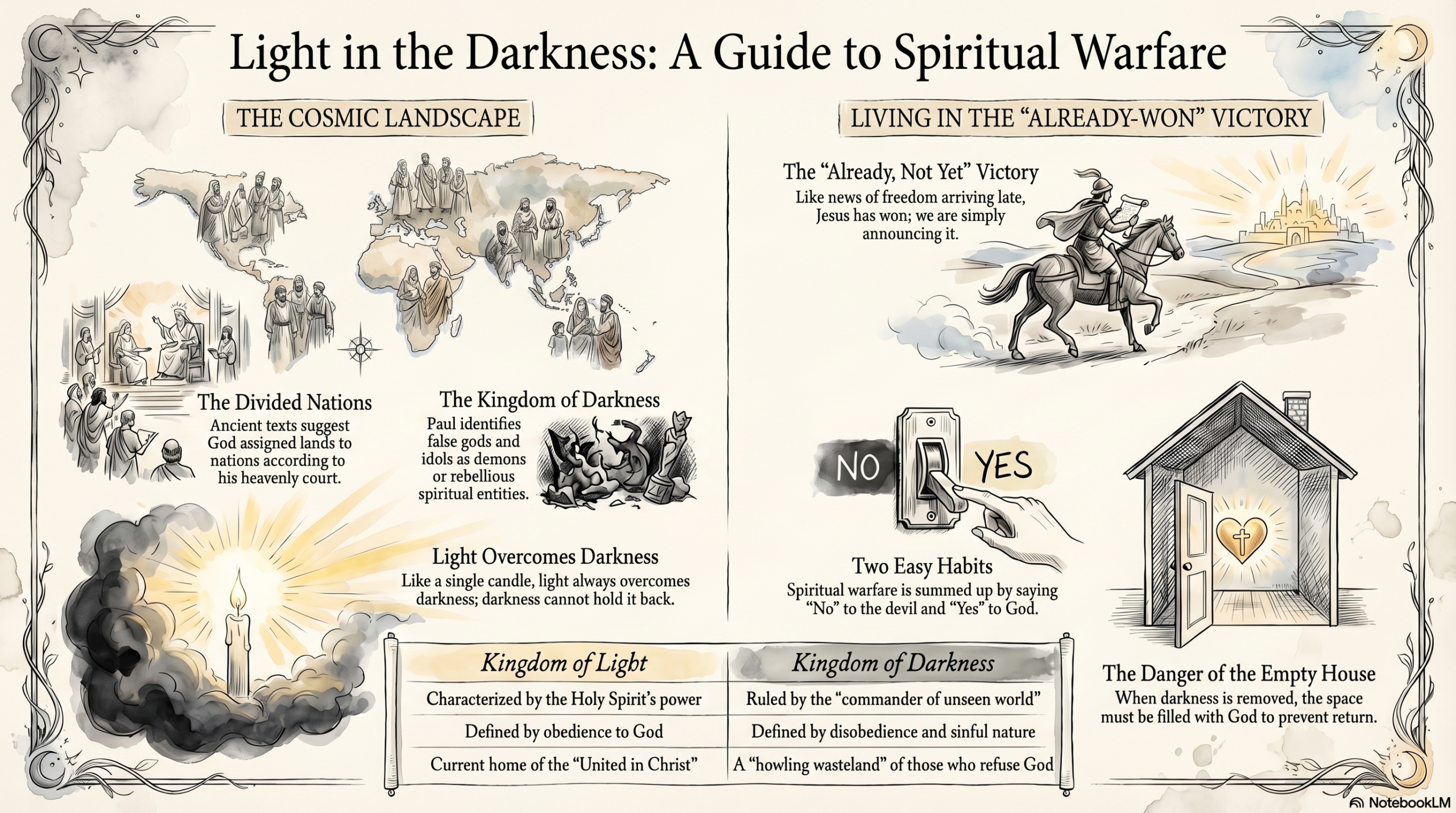
The Heart of the Message Summary

In this message, Pastor Dustin Woolam reclaims the narrative of spiritual warfare from fear-based sensationalism, grounding it in the absolute sovereignty of Christ. The core spiritual truth is that the Kingdom of Light has already invaded the darkness, and because Jesus is the "Stronger Man" who has disarmed the enemy, believers operate from a position of seated victory, not a desperate struggle for it.

The primary call to action is for the church to stop viewing the enemy as a rival power and start recognizing him as a defeated squatter. We are called to "make no place" for the enemy by choosing a life of active allegiance to God. This transformation is crystallized in the daily decision to say "no" to the devil and "yes" to Jesus—a commitment publicly declared through the act of baptism. The message shifts our focus from the strength of the darkness to the inevitability of the Light..

TRANSCRIPT

Introduction and Prayer

Before I get started, I just have one announcement. Let me think—one announcement. Now, I’m going to preface this announcement by saying I haven't talked to anybody about this yet, so it's still a little bit in the works and details will be coming.

We're in a series—you'll remember the series we're in—about how "what we believe matters." We've talked about a lot of different things recently. We had a small sub-series within that about healing: what the Bible teaches about healing and what we believe about healing. In the midst of that, one of the things we discovered is that there are places in the New Testament where we see Jesus cast a demon out of someone, and that person is then healed. For example, there was a young boy who was deaf and mute—not "dumb" as in lacking intelligence, but as in he couldn't speak—and Jesus cast a demon out of him, and then he was healed.

Because of that, I mentioned that we probably should talk about what is often called "spiritual warfare." For some people, that term is immediately going to make you feel freaked out, and for others, you're going to be upset that I don't say more. But we're going to start that series today. One of the things that I've come to believe strongly in my life—and this might sound wild, but I'm okay with that because any new idea can sound that way—is that there's a very real spiritual warfare aspect to baptism and what baptism means. I've been trying to think about when to spend time on that. We won't do it today, but stay tuned; we'll get there.

The Spiritual Significance of Baptism

Since we're talking about that and what we believe, there's going to be a segment in this whole series about baptism anyway. Last week was Easter, and during Easter, I am always excited to celebrate the resurrection of Christ, but then I immediately remember that it's not just His death and resurrection, but also His ascension that matters. Ascension Sunday is roughly 40 days after the resurrection. It doesn't always fall exactly 40 days after Resurrection Sunday, but May 17th, I believe, is the correct date.

I want to have a service where we do baptisms on that day. So, if you've never been baptized, or if you want to be baptized again, or if you have any other questions about baptism, let's talk. Now, that being said, if the doctor hasn't released me to lift more than 10 pounds by then, I'm going to need some people to help. We'll get there; you might have to dip yourself in the water, or we'll have Joe or one of these strapping young knights help with the dipping.

The important thing about that is—and we're going to have a whole baptism lesson at some point—in the early church, there was a "good, better, best" approach to baptism. Their "best" view was that you would be baptized in what was called "living water," which just meant water that's moving, like a stream or a river. The next best thing would be a lake or something that isn't stagnant; the Dead Sea would not be ideal. Third, which is still good, is a swimming pool or in someone's house in a bathtub.

Here's the announcement: I personally think it would be really cool to have church at the park and then just baptize someone in the water. I haven't talked to anybody about the logistics of that yet, so it may not happen, but I think it would be cool. What I don't want to do is start here and then move, because I think it would be good for all of us together to witness these things as a group. So we might make a day of it. We might baptize here in a trough—though "trough" is probably not the right word. Jesus was born in a manger, so maybe baptism in a trough is okay.

Regardless, it's coming soon. Sometime between now and then I'll talk about baptism, but I would encourage you—my wife has been baptized a couple of times. I got baptized at seven and I've never had the desire to do it again, but it's okay if you want to be. It's okay if you're saying you want to make an adult decision or rededicate your life. There's nothing in Scripture that says baptism is strictly a "one and done." Just have that in the back of your head and think about what you want to do.

The Gift of the Word

In the meantime, I have adopted my daughter's old children's Bible. Genesis sometimes falls out, and there are some things in here I would not have highlighted, but that's okay. I've come to really love this Bible. I realized I have an entire shelf of Bibles at my house that I don't really use that often. So, if anybody wants one, I'm probably going to bring them next week or the week after, depending on my memory. I'm just going to put them in a box or on a table. If you want them during service, great, or take them home. God be with you. They're not "extra special" because they were mine; they're special because it's the Word of God. I might have written in them, or I might have just had them on the shelf because I thought it would be cool to have. It’s always interesting the things you find that you enjoy, like a children’s Bible.

A Prayer for Illumination

Let's pray. Father, thank You for today. Thank You for the gift of Your Word and the gift of Your body. I pray that You would teach us and that our hearts and minds would be open to understand the things You want us to know. May the things that are of You rest in our hearts, and may anything that is of our own selves or any other place be removed. Help us to listen with a mind and a spirit that's open to You, Holy Spirit, and that You would be our teacher just as Jesus promised in the book of John. We give You this time in Jesus' name. Amen.

The Invasion of Light

Alright. Spiritual warfare will probably take us two weeks. It starts here: Jesus shows up. Let's go to Matthew chapter 4. We're going to come back to Matthew 4 later, so you might want to keep your finger there. We'll probably come back near the end.

I'll be honest—I don't know that "spiritual warfare" is my favorite term because it comes loaded with a bunch of baggage, especially in the modern United States where we've been at war since before my children were born. What does "war" even mean? What war meant during the Civil War was very different from what it means today; they didn't have drones and aircraft carriers then. However, what is absolutely true is that there is God's kingdom, and then there are every other faction that oppose Him—often called the Kingdom of Darkness—because Jesus says, "If you're not with me, you're against me."

In Matthew 4, starting in verse 12, it says: "When Jesus heard that John had been arrested, he left Judea and returned to Galilee. He went first to Nazareth and then left there and moved to Capernaum beside the Sea of Galilee in the region of Zebulun and Naphtali. This fulfilled what God said through the prophet Isaiah: 'In the land of Zebulun and Naphtali, beside the sea, beyond the Jordan River, in Galilee where so many Gentiles live, the people who sat in darkness have seen a great light. And for those who lived in the land where death cast its shadow, a light has shined.'"

From then on, Jesus began to preach: "Repent of your sins and turn to God, for the Kingdom of Heaven is near." This is the good news—the Kingdom is near. All those who were in darkness saw a great light, which is Jesus. Jesus introduces His kingdom and tells people to repent and turn to God. Those are two different things. You can be sorry for your sin and not come to God, or you can come to God and not be sorry for your sin. I think if you really come to God, you will eventually be sorry for your sins in short order, but both things have to occur.

Territorial Boundaries and the Heavenly Court

That's the setup. Now, let's go to Deuteronomy chapter 32. Depending on your version of the Bible, you're going to see something different here. Verse 8 says: "When the Most High assigned lands to the nations, when he divided up the human race, he established the boundaries of the peoples according to the number in his heavenly court."

Some older versions say "according to the sons of Israel," but the Hebrew and modern, up-to-date translations say "his heavenly court." This is very specifically not the 12 tribes; the context makes that clear. There was a time when God assigned the lands to the nations—Egyptians here, Babylonians there—and assigned their boundaries.

Remember when we talked about Naaman? He was the leper from Syria who got healed. When he left, he asked to take some dirt with him. The reason he did that was because in that time period, there was a strong belief that different gods—little "g," not the Most High—had different territories and different places where they worked. In modern terms, these ancient people would have believed there was a "god" over the city of Dallas and a "god" over the city of Abilene. These are all lowercase "g" gods—not rivals or competitors to the Most High. Don't let the word "god" mislead you into thinking they believed something weird.

So, God assigned these boundaries according to the number in His heavenly court, but He kept Israel as His own possession. He found them in a howling wasteland, guarded them as the apple of His eye, and carried them on His wings. The Lord alone guided them; they followed no foreign gods. But verse 15 says: "Israel soon became fat and unruly... they abandoned the God that made them... they stirred up his jealousy by worshiping foreign gods... they offered sacrifices to demons, which are not God." They offered to "new gods" they hadn't known before. Because of this, the Lord said He would abandon them and "provoke their anger through the foolish Gentiles." This is why Jesus ends up in Galilee, in Capernaum—a mixed place where Gentiles were. He went to a place where God could begin that work of provoking His people through the Gentiles.

The Cup of the Lord and the Cup of Demons

Now let's go to 1 Corinthians 10. Paul is talking about whether or not to eat meat offered to idols. In verse 19, he asks: "Am I saying that food offered to idols has some significance, or that idols are real gods? No, not at all. I am saying that these sacrifices are offered to demons, not to God. And I don't want you to participate with demons." He warns that you cannot drink from the cup of the Lord and the cup of demons, or eat at the Lord's table and the table of demons.

The Nature of Darkness vs. Light

Jesus shows up in Matthew and preaches that the Kingdom of Light has come to invade the darkness. There's an interesting thing about darkness: you can't "turn it on." I can't flip a switch and turn on darkness; it's just what is there when light is absent. But any amount of light will overcome darkness. If this room were pitch black and I lit a single candle, the darkness could not hold that light back. While the metaphor has limits regarding proximity and brightness, the reality remains: light always overcomes darkness.

Deuteronomy 32 shows us that God gave people over to these false gods, which Paul tells us are demons. What is a demon and where do they come from? High level: if you've heard the story that demons are a third of the angels that the devil led in rebellion against God, that's not actually in the Bible. That’s just not where they came from. The closest you get is in Revelation, where a story about the birth of the Messiah mentions a dragon whose tail swipes a third of the stars with it. Instead, in Deuteronomy 32 and several Psalms, we see that there are spiritual beings that exist and were assigned roles. It’s okay to come to the Scripture and think of the angels as the "white hats" or "good guys," and the demons as the "black hats" or "bad guys." You don’t have to overthink it more than that.

Authority Over the Enemy

In Luke 10, Jesus sends out 72 disciples. When they come back, they are amazed, saying, "Lord, even the demons obey us when we use your name!" Jesus responds, "I saw Satan fall from heaven like lightning! Look, I have given you authority over all the power of the enemy... nothing will injure you." He tells them not to rejoice just because spirits obey them, but because their names are registered in heaven. The important thing is that you belong to God.

In Luke 11, Jesus casts a demon out of a man who couldn't speak. Some people accused Him of getting His power from Satan. Jesus pointed out how illogical that was: "Any kingdom divided by civil war is doomed... if Satan is divided and fighting against himself, how can his kingdom survive?" He explains that if He casts out demons by the "finger of God," then the Kingdom of God has arrived.

He gives this illustration: "When a strong man like Satan is fully armed and guards his palace, his possessions are safe—until someone even stronger attacks and overpowers him." Jesus is that "someone stronger" who has overpowered him and stripped him of his weapons.

Filling the House

Jesus also warns that when an evil spirit leaves, it might come back with seven other spirits more evil than itself if the "house" is empty. This is why simply being "cleaned up" isn't enough; the house must be filled with God. A woman in the crowd shouts a blessing to Jesus' mother, and He replies: "Even more blessed are all who hear the word of God and put it into practice."

The Already but Not Yet Victory

In Ephesians 2, Paul reminds us that we were once dead in our sins, following the "commander of the powers in the unseen world." But God is rich in mercy. He raised us from the dead along with Christ and seated us with Him in the heavenly realms. Note the tense: "raised" and "seated" are past tense. Because we are united with Christ, we are already seated with Him in heavenly places.

Theologians love the phrase "already but not yet." Jesus has already won, and we are already seated with Him, but we are not yet seeing the full reality. It's like at the end of a war. There's a story from World War II about a Japanese soldier on an island who didn't know the war was over and kept fighting for decades. The victory was won, but he was still acting as if the war was ongoing.

If you are in Christ, there is zero reason to fear demons or Satan, because they are subject to His name. But does that mean we don't have responsibility? If you kick out the "strong man," you must make sure the house is occupied by God. We are told to "make no place for the enemy" and to "resist the devil."

The Strategy of Resistance

Back to Matthew 4. After Jesus was baptized, He was led into the wilderness to be tempted. The devil tried to use Scripture against Him, but Jesus rejected the temptation because He knew the full context of Scripture. The devil even tried to offer Jesus a shortcut to ruling the nations—the same nations from Deuteronomy 32—if Jesus would just worship him. Jesus said: "Get out of here, Satan! For the scriptures say, 'You must worship the Lord your God and serve only him.'"

Final Exhortation: No to the Devil, Yes to God

If you don’t take anything else with you, take this: there is a Kingdom of Light, and if you are a Christian, you are in it. We must resist the enemy. We don't have to look at sensationalized things or charlatans online. The truth is that He has overcome and He has placed us with Him. Spiritual warfare is simply saying "no" to the devil and "yes" to God.

Lord, help us to make sure we are saying "yes" to You. In all the weirdness we see around us and online, with nonsensical documentaries that Lord, I'm pretty sure aren't real—many of these people have come out as charlatans—let us not look at the false and deny the truth. The truth is that You have overcome already and that You have put us with You already. So, in that position with You, we say no to the devil. We say yes to You. We give You our whole hearts and our whole lives. May we walk in the light as You are in the light. In Jesus' name, Amen.


Tags


You may also like

Baptism Service May 16, 2026

Baptism Service May 16, 2026
Leave a Reply

Your email address will not be published. Required fields are marked

{"email":"Email address invalid","url":"Website address invalid","required":"Required field missing"}