
When Church Feels Like a Routine | How to Rediscover Jesus

Get the Study Guide for This Week's Message

Pastor Dustin Woolam
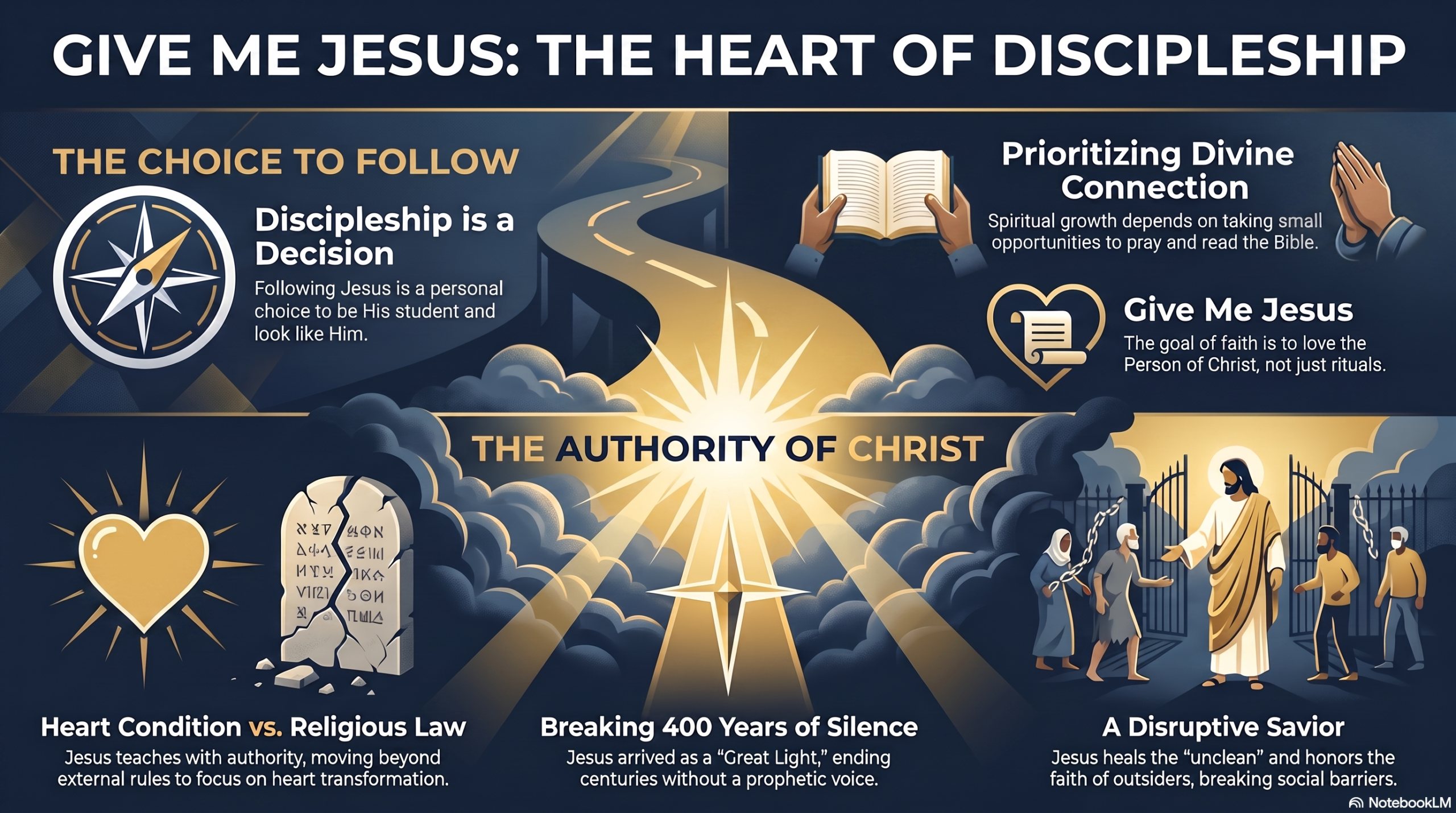
Give Me Jesus Discipleship Infographic

The Heart of the Message Summary

In this opening message of the "Give Me Jesus" series, Pastor Dustin Woolam calls the church back to the heart of discipleship: a personal, daily choice to pursue Jesus Himself rather than religious routine, spiritual benefits, or mere moral self-improvement. Drawing from Matthew 4, 7, and 8, the sermon illustrates how Jesus entered a world shaped by 400 years of divine silence, bringing light to darkness, teaching with unmatched divine authority, and actively restoring what was broken. From touching the leper to praising the unexpected faith of a Roman centurion, Jesus continuously disrupts human expectations. True spiritual transformation happens not when we simply perform Christian duties, but when we surrender to His authority and invite Him to disrupt our lives, reshape our hearts, and draw us into a deeper love for who He is.

TRANSCRIPT (word for word)

Welcome and Prayer

Welcome to church. It is good to see you all. We have three or four families traveling, and we have some people sick, so let us pray for them and let us get started.

Father, thank You for today. Thank You for the gift of Your Word. Thank You for the gift of the body. I pray for those of us who are not here for various reasons, that You watch them, keep them, bless them, and look over them. Lord, I pray that everything in this meeting that is of You would remain, and anything that is not of You would just fade. Father, we give You our whole hearts and our whole lives. In Jesus' name, amen.

Reflections on a Life in the Church

It is interesting looking at some of the songs from today because Rufus and I do not talk about these things, but today we are starting a new series. The title of this series is simply "Give Me Jesus."

I have been thinking, praying, and talking to the Lord a lot, specifically about what is next as we finished our previous series and our little mini-series. I started thinking about the church, the people in the church, us, and everything. I was thinking about the way things were when I was a seven-year-old kid in the Baptist church—five, six, seven, I do not know where we were going when I was five, but I remember being seven at this Baptist church. Later, my mom and dad started looking for another church, and we found a place to go. My dad drove a dump truck; he worked for a construction company and heard about this school. So we moved to Midland and ended up in a charismatic church. Then we went to a Pentecostal church, then back to the charismatic church, and then to a Foursquare church, which is like the first Pentecostal denomination—there is some argument over whether it was them or the Assemblies of God. As I was reflecting on those things, I was thinking about the different elements at each of those churches and my journey all the way up to now.

Duty vs. Desire in Church Attendance

My adult life is probably less interesting to me because it was in some ways less formative. But as I was thinking about this, I was reflecting on all the times in my life where I was really excited to go to church and happy to be there, versus the times in my life where I went to church simply because it was the "Christian thing" to do. I went to church because Hebrews says do not forsake the assembling of the saints, and I was going to do what God says, so I went to church. Both of those are good. It is good to go when you want to, and it is good to go when you do not want to because it is good for you to go to church.

So I was thinking about what was present in the moments I was really excited to go. I was reflecting on that and thinking about discipleship, praying, "Lord, what is happening here?"

Discipleship is a Personal Choice

For the last six to eight months, I have been praying and talking to the Lord a lot about discipleship. I talk with a coworker a lot, and he says, "You cannot disciple someone, because disciple is a noun and you cannot noun a person." I replied, "Well, you can be demonized, and demon is a noun, so why cannot you disciple someone?" I am still shaking all of that out. He makes a really great point, and I do not want to misrepresent him in any way.

The thing I wrestle through in all those conversations is that really, being a disciple is a choice. If I am going to follow Jesus and be His student, I am the one who makes that decision. Someone can teach me, mentor me, and guide me—and we call that discipling somebody—but ultimately, it is my choice whether or not I want to look like Jesus. It is my choice whether or not I want to read the Bible. It is my choice whether or not I want to praise God.

We talk about not having time, but whether or not we have time is usually a choice. It is very rare that we do not have some control over our time. There is a story about a guy who was a prisoner. To punish him, the guards sent him out to what was basically a septic tank. He had to march around in it and stomp down human waste and trash. I cannot even imagine how disgusting that must have been. But he took that time, realizing that while he was out there, the guards stayed away from him because of the smell. He used that time to sing and pray out loud to God. Whether or not we have time is often an issue of whether we take the opportunities in front of us. Do I want to wake up five minutes earlier or stay up five minutes later to read a couple of verses? Five minutes might be all you have, but the Lord will honor what you give Him and multiply it.

Returning to the Person of Jesus

I was thinking about the sense of dedication I have had throughout different times in my life. In some groups I was in, we would go to a Bible study that started at eight or nine in the evening because that was when everyone could show up, and we would meet until midnight in the middle of the week when we all had work or school the next day. We did that not just to hang out with friends, but because all of us together were interested in Jesus. There were times we would go to church at 9:30 in the morning and not leave until three in the afternoon. What made that different? No matter how good the music was—which, in that case, honestly was not that great—or how good the speaker was, why did I stay until three? Part of it was because I was riding with my parents and had no choice, but I would have stayed anyway because Jesus was there.

Time after time, I look at the moments where I was really excited about church, and it was because I was really excited about Jesus in those moments of my life. All the things we have gone through in the last couple of years—placing the groundwork, changing our church name, all of it—have been good, vital, and led by the Lord. But if we are not careful, we will just do the activities and forget the Person who is the reason we are here.

So I just want to take a moment and say, "Give me Jesus." We are going to spend time throughout the Gospels—looking in Exodus, looking in Revelation—and we are just going to look at Jesus.

Looking at Jesus in the Four Gospels

What does it look like if my heart is turned fully to the Lord? The last two weeks we looked at the Beatitudes and noted that if we want to be like Jesus and do whatever it takes to look like Him, this is how we will interact with people. So how do we say, "Give me Jesus"? What does that look like?

We know that if we say it and do not mean it, if we say it and take no action, if nothing changes other than using our breath to speak three words, it does not matter. I can say "Give me Jesus" or "Help me Jesus," and it will not change my life if I do not act on it. It has become popular today to say, "Live as though God is real" or "Live as though Christianity is true." Even famous atheists like Richard Dawkins say cultural Christianity is ideal, but it is not enough if we remove it from Christ.

My plan, unless the Lord changes it, is to go through all four Gospels and look at Jesus—not only His teaching, but Him interacting with people, interacting with the Father, and His actions, like sneaking away to pray or fast. If I say "Give me Jesus," I do not just want His teaching to make me a better person, and I do not just want the things He gives me. Jesus provides healing, peace, encouragement, and direction in my life—I want those things, but I do not want anything separate from Him. I want to get as clear a picture of Jesus as possible.

I love the miniseries "Jesus of Nazareth." It was my first live-action introduction to Jesus in media as a kid. I watch it up to the crucifixion about three times a year, then skip to the resurrection. There is something about how that film portrays Jesus. Whenever He appears, He is completely different from everyone else. In six hours of film, the actor playing Jesus blinks only two or three times because the director wanted His gaze to be distinct. Every time I watch it, I come away loving Jesus a little bit more. The same is true of "St. John in Exile" starring Dean Jones. At the end of the series, I want all of us to love Jesus a whole lot more and reflect on who He is to us and to the world.

Four Hundred Years of Silence

We will start in Matthew chapter 4. From the time of the previous prophet until John the Baptist, God had been silent in the sense that there was no prophet and no direct voice from the Lord. He had given them the Torah, the Tanakh, and all the Jewish writings, but God had been quiet for 400 years.

I cannot fathom what 400 years of silence feels like. I did some research to see what happened 400 years ago, in 1626. Business was as usual: there were wars, an influenza epidemic in Asia, and someone bought Manhattan Island from Native Americans. People were moving around, getting sick, buying land, and arguing about religion—the King of England was crowned, and his wife refused to attend because it was not a Catholic ceremony.

When Jesus appeared, I wonder if the Jewish people felt similarly. They looked back over 400 years where life went on—people got sick, wars happened, technology shifted—and they just waited for the Lord to speak. For us, Jesus has been present with us through the Holy Spirit over the last 400 years, but for them, the overarching reality was that God was silent. Their entire national history—from Abraham to the last prophet—was followed by total silence for 400 years. Then John the Baptist appears and announces, "The Messiah is coming." How do you even process that? Unless a prophet appears, you do not expect God to speak; you just go to the priest, hope everything is okay, and try your best not to end up back in Babylon. Then a prophet shows up saying, "Repent, for the kingdom of heaven is at hand," and everyone is overwhelmed.

Light Shining in the Darkness

In Matthew chapter 4, after His temptations, Jesus begins His public ministry. Verse 12 says: "When Jesus had heard that John had been arrested, he left Judea and returned to Galilee. He went first to Nazareth and then left there and moved to Capernaum beside the Sea of Galilee in the region of Zebulun and Naphtali. This fulfilled what God had said through the prophet Isaiah: In the land of Zebulun and of Naphtali, beside the sea, beyond the Jordan River, Galilee, where so many Gentiles live, the people who sat in darkness have seen a great light. And for those who lived in the land where death cast its shadow, a light has shined. From then on Jesus began to preach, Repent of your sins and turn to God, for the kingdom of heaven is near."

It is remarkable that scripture describes the start of Jesus' preaching as light arriving in darkness. Imagine if there were no sunlight for 400 years, and suddenly the sun broke through the clouds. You would not have to rely on candles or streetlights anymore. Jesus comes as that light, proclaiming repentance because the kingdom of heaven is near.

He calls His disciples, and verse 23 continues: "Jesus traveled throughout the region of Galilee, teaching in the synagogues and announcing the good news about the kingdom. And he healed every kind of disease and illness. News about him spread as far as Syria, and people soon began bringing him all who were sick. Whatever their sickness or disease, or if they were demon possessed or epileptic or paralyzed, he healed them all. Large crowds followed him wherever he went—people from Galilee, the Ten Towns, Jerusalem, Judea, and from east of the Jordan River." People came from everywhere because when light shines in deep darkness, people travel to see it.

Teaching with True Authority

Following the Sermon on the Mount, Matthew 7:28–29 states: "When Jesus had finished saying these things, the crowds were amazed at his teaching, for he taught with real authority, quite unlike their teachers of religious law."

I have thought about that phrase a lot. I know many people who are confidently wrong and speak as if they have authority, so what made Jesus different from the Pharisees, Sadducees, and scribes? In Matthew 5 through 7, Jesus repeatedly says, "You have heard it said... but I say to you." He takes the external rules of the Law—such as "do not murder" or "do not commit adultery"—and directs them straight to the condition of the heart: do not nurse anger, do not lust. It is not enough to perform outward compliance; our hearts must be transformed. God promised in the Old Testament to replace our heart of stone with a heart of flesh.

Jesus spoke with the inherent authority of the Son of God. When we ask for Jesus, we are asking Him to come and disrupt our status quo. For those who have walked with Him for a long time, He may not need to dismantle everything, but He will refine foundations and touch up areas of our lives. Until we are made perfect, we continually require the Lord's holy disruption.

Touching the Unclean

Matthew 8:1–4 records: "Large crowds followed Jesus as he came down the mountainside. Suddenly a man with leprosy approached him and knelt before him. 'Lord,' the man said, 'if you are willing, you can heal me and make me clean.'"

Under Jewish law, a person with leprosy was required to remain isolated from the community. Yet this man approaches Jesus, acknowledging two distinct needs: physical healing and ceremonial cleansing. To be unclean meant being barred from the temple and community fellowship. He asks Jesus to both fix his broken body and restore his spiritual standing.

"Jesus reached out and touched him. 'I am willing,' he said. 'Be healed!' And instantly the leprosy disappeared. Then Jesus said to him, 'Don't tell anyone about this. Instead, go to the priest and let him examine you. Take along the offering required in the law of Moses for those who have been healed of leprosy. This will be a public testimony that you have been cleansed.'"

According to the law, touching something unclean made the clean person unclean. But when Jesus touches the leper, uncleanness does not transfer to Jesus; instead, His purity and power transform the leper, making him clean. Jesus then instructs him to present himself to the priests as a public testimony of his spiritual and physical restoration.

The Faith of the Roman Centurion

Matthew 8:5–13 tells of another powerful encounter: "When Jesus returned to Capernaum, a Roman officer came and pleaded with him, 'Lord, my young servant lies in bed paralyzed and in terrible pain.' Jesus said, 'I will come and heal him.'"

Entering a Gentile's home was culturally forbidden for a Jewish teacher, yet Jesus immediately agrees to go. This reflects Isaiah's prophecy that the Light would reach the Gentiles. The officer responds: "Lord, I am not worthy to have you come into my home. Just say the word from where you are, and my servant will be healed. I know this because I am under the authority of my superior officers, and I have authority over my soldiers. I only need to say Go, and they go, or Come, and they come. And if I say to my slaves, Do this, they do it."

"When Jesus heard this, he was amazed. Turning to those who were following him, he said, 'I tell you the truth, I haven't seen faith like this in all Israel! And I tell you this, that many Gentiles will come from all over the world—from east and west—to sit down with Abraham, Isaac, and Jacob at the feast in the kingdom of heaven... Then Jesus said to the Roman officer, 'Go back home. Because you believed, it has happened.' And the young servant was healed that same hour."

Only twice in the New Testament does Jesus marvel at someone's great faith, and both individuals were Gentiles. This officer, despite holding military power, humbled himself, addressed Jesus as Lord, and recognized His absolute spiritual authority over sickness and distance. Like Naaman the Syrian in 2 Kings 5, who recognized that there was no God in all the earth except in Israel, this Roman centurion surrendered to the supreme lordship of Christ.

Growing into the Mind of Christ

When Jesus enters a situation, everything changes. In raising my children, my wife Jamie and I observed four distinct phases of parental authority. In Phase 1 (early childhood), it was absolute instruction: "Do what I say, when I say, how I say." That authority established safety so that when a child ran toward a street, a single command brought an instant halt. Phase 2 allowed conversation after obedience was rendered. Phase 3 permitted discussion before carrying out instructions. Phase 4 involved trusting them with responsibilities without micromanaging the details, because they had internalized the values of our home.

While human parenting is not an exact match for the Christian walk, when we first come to Jesus, obedience begins with direct, strict adherence to His Word. As we grow in intimacy and maturity, we require fewer detailed reminders because His desires become the desires of our heart. Psalm 32 notes that God guides us with His eye—we become so attuned to His character that we walk in His ways instinctively.

Following Jesus Like a Faithful Companion

It reminds me of my great-grandfather, my dad's mom's dad. His name was Richard Lewis. Incidentally, that is how my dad got his name. Lewis was his last name, and he was an old rancher. He had an old ranch dog, and my dad would tell me the story that when Granddaddy Lewis, my great-granddaddy, would walk into the house from the field, he would just make a simple motion with his arm. He did not call, and he did not whistle. He just waved his arm, and the dog would come sprinting next to him and go right into the house.

What would it look like if we followed Jesus like that? What if my eye was always fixed on Jesus? The Bible tells us that Jesus only did what He saw the Father doing. It does not say that the Lord had to give Him a massive amount of direction. He said what He heard the Father speak, and He did what He saw the Father do. Jesus' attention on earth as a human—and likely throughout eternity—is oriented completely toward the Father.

Growing Into Instinctive Obedience

What does my life look like when Jesus comes in? Yes, I have to learn discipline, self-control, and all the guidelines we are called to follow. But what happens when I start to realize that I do not constantly need Jesus to issue severe corrections because I learn to choose what is right from the start? I do not need a special command to remind me to be kind to the poor; I can simply do it, knowing that it honors Him.

There is a passage we will study where Jesus explains that when we visit those in prison or care for the needy, we are serving Him directly. When the people ask, "Lord, when did we see You in prison or care for You?" Jesus answers that whenever you give even a cup of cold water to the least of these, you have done it unto Him.

Never the Same Again

When I think about the phrase "Give Me Jesus" and consider what it truly looks like for Christ to enter a person's life, I am reminded of a scene from the film Jesus of Nazareth. Matthew and Peter have a wonderful, subtle interaction in that movie. Jesus is sitting in Peter's house when Matthew shows up at the door. Peter begins shouting for him to leave, and Jesus very calmly observes, "You do not seem to be welcome here."

Later, after Jesus calls Matthew and they cross the Sea of Galilee, they are getting ready to sleep for the night. Peter is talking out loud to anyone listening, saying, "I will just follow Jesus around for a little while. I told my wife the fishing is bad anyway." Matthew looks at him and says, "Do not kid yourself, man. You will never be a fisherman again."

Because Jesus entered Peter's life, everything changed. What is it in our lives—or in our past—that we will never be again because of Jesus? When Jesus called Peter, John, and the others in Matthew 4, He told them, "Come, follow Me, and I will make you fishers of men."

Equipping for the Kingdom

I do not know all the unique gifts that the Lord has placed in each of us. Evangelist Reinhard Bonnke used to compare spiritual gifts to a tool belt. My dad was a maintenance worker, so he wore a heavy tool belt containing a hammer, tape measure, tape, nails, and screwdrivers—everything he might need for a quick repair on the job. Bonnke explained that as we walk out into the world each day, we strap on our spiritual tool belt, not knowing which tool the Holy Spirit might choose to use through us in a given moment. We might meet someone who needs a specific word, encouragement, or act of service.

Regardless of what tools we currently carry or what new skills the Lord develops in us over time, my ultimate desire is that we keep our eyes fixed on Jesus and ask, "How can I be like Him?" How do I extend love to those who are hurting, broken, or considered unclean? How do I love those who are far outside our religious community, much like the Roman centurion was? And how do I ensure that when I speak, I speak with the true authority of the Lord, rather than like the scribes and Pharisees who spoke endlessly about a God they did not intimately know?

Following Jesus Wholeheartedly

That is the focus of this series and our journey together: learning to look like Jesus. We need to continuously consider what next step Jesus is asking of us. There might be something in my life—a habit, media choice, or personal preference—that God asks me to set aside. It might not be inherently sinful for someone else, but Jesus may ask me to lay it down simply to test my willingness to surrender to Him.

While certain actions are clearly defined as sin in Scripture, there are also personal sacrifices God may ask of you that He does not require of others. As we strive to walk like Jesus, we must remain sensitive to His personal promptings in our lives, knowing that our sole responsibility is to obey Him. As the classic hymn says, "Though none go with me, still I will follow."

When we navigate this walk together and grow to resemble Christ, our passion for Him naturally deepens. We naturally cultivate a desire for whatever we consistently pursue and consume. If we train our hearts to seek Jesus in both prosperous and challenging seasons, our appetite for Him will continually grow, and He will consistently enrich our lives.

Closing Prayer

Let us pray.

Father, thank You so much for sending Your Son. There is nothing in our lives that we need more than Him. I pray that as we enter into this season of actively seeking You, learning to follow Your promptings, and discovering who You are, You would cultivate in us a humble and gentle heart like Jesus.

I pray, Lord, that You would guard us against the enemy. Stand against the schemes of the adversary on our behalf as we learn these new paths, and hold back his influence while we practice walking in Your ways. Father, I pray for peace, freedom, health, and spiritual wholeness over every member of our congregation, whether they are present today or far away. We love You, and we are deeply grateful for Your grace. In Jesus' name, Amen.


Tags


You may also like

Leave a Reply

Your email address will not be published. Required fields are marked

{"email":"Email address invalid","url":"Website address invalid","required":"Required field missing"}