
Dustin Woolam | Pastor & Lead Elder
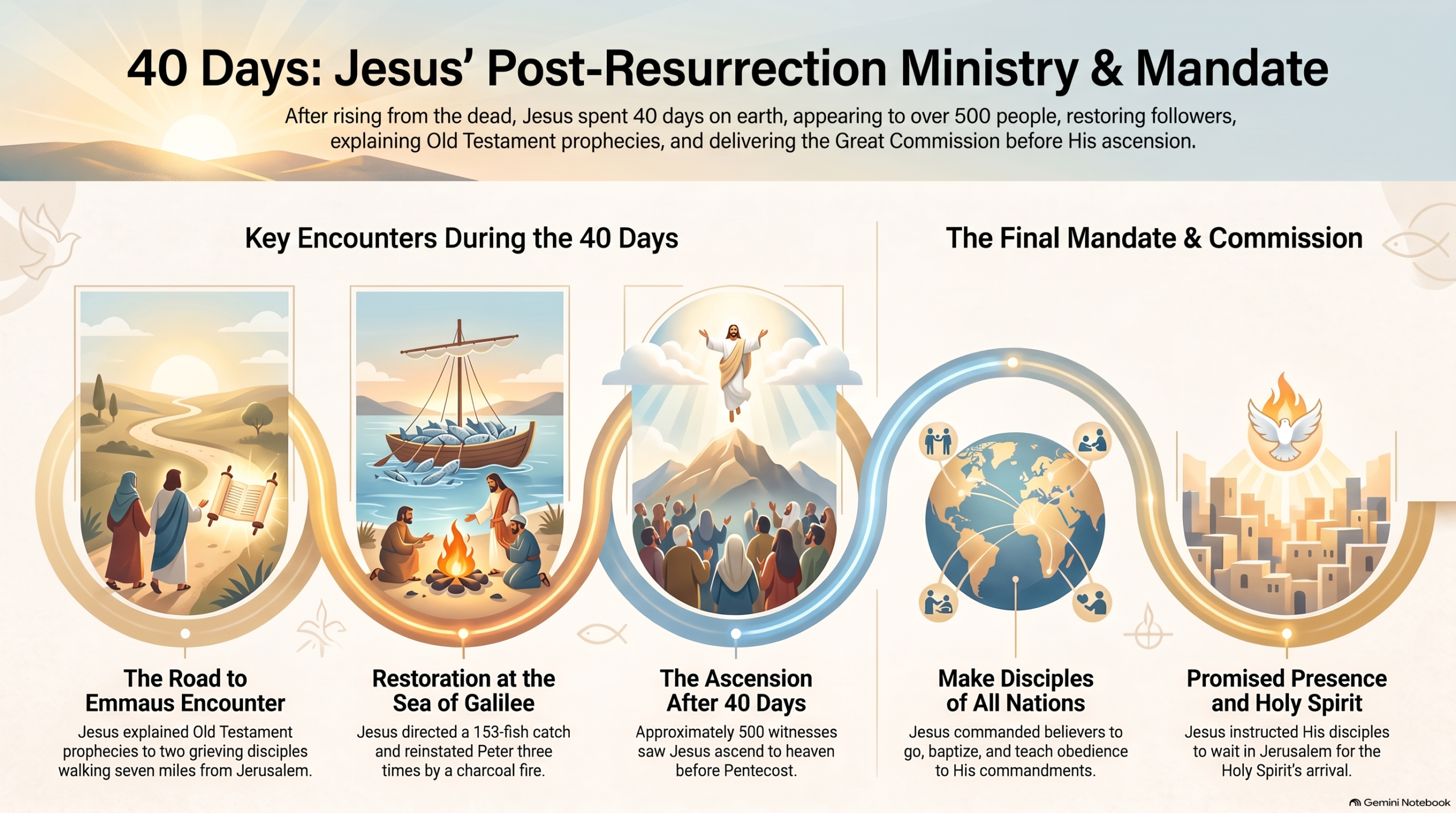
The Heart of the Message Summary
At its heart, this message is a personal invitation to realize that no matter where we find ourselves—whether we are wrestling with confusion on our own road to Emmaus or nursing the shame of failure by a charcoal fire—Jesus consistently pursues us to meet us right in the middle of our lives. The forty days between His resurrection and ascension prove that our stumbles and heartbreaks never disqualify us from His grace; instead, the risen Christ lovingly restores us, opens our eyes through His Word, and sets our hearts on fire with fresh purpose. Through His ascension and the promised gift of the Holy Spirit living within us as His temple, we are never left to walk alone or rely on our own devices. Ultimately, it is a reminder that we need Jesus every single day to transform our lives, heal our doubts, and empower us to follow Him with open hearts.
TRANSCRIPT
Introduction & Opening Prayer
Good morning. Hello. There I am. All right. I'm going to church, everybody. Depending on how on topic I stay, this is probably our last message in the Give Me Jesus series, but I don't want it to be the last of our hearts that we say that. I want Jesus every day. I want Him to have more of me every day.
So let's pray and get started: Father, we're grateful to You for all that You've given us, all You've done for us. You didn't even have to make us, but You wanted to—wanting us in Your life, which still kind of blows my mind. Because I mean, if I have problems with humans and I'm not perfect, I don't know how You tolerate us, but I'm grateful that You do. Lord, I pray You come and visit us. Holy Spirit, come and teach us just as Jesus said You would. Pray that things that are of You, God, would remain and the things that are not of You would fade. We give You this time, we give You our attention. Lord, bring us wisdom. In Jesus' name, Amen.
The 40 Days After the Resurrection & Ancient Burial Practices
So, Jesus—we talked about His death last week. Today, I want to talk about the resurrection and kind of the things that happened. It's not always immediately obvious. Sometimes if you read a quick story or synopsis in a life of Jesus, or if you're watching some media, one of the things that I feel like most media gets wrong is that from the time Jesus rose from the dead until the time He ascended to heaven, there were 40 days. He didn't, like, raise from the dead on Sunday and then punch out on Monday. There were 40 days, and the Bible tells us that He interacted with a bunch of people. So we'll talk about some of those interactions today.
Let me give you a quick timeline and a little bit of burial practice. In the early centuries—1, 2, 3, 10, 30, up to 70 AD, whatever, and ongoing, and even back in the past prior to that—the burial practice was something like this in a lot of places: They would take someone who had died and they would clean the body and put herbs and all kinds of stuff on it. They would even wrap it, and then they would take it and lay it like on a slab in a tomb and leave the body there until it had fully decayed. Once that had happened, they would take the bones of that person and put them in an ossuary, which is a bone box. So we see lots of this kind of stuff. You could be put into a family tomb and lay there while people came to see you. That was the reason for the herbs—because in the Middle East, it's hot over there, and when people died, they began to smell bad. We even see that in the story of Lazarus, right? Day four had come, and when Jesus said, 'Hey, let's go see Lazarus, let's move the rock,' they're like, 'Jesus, the body surely is smelling bad by now.' Of course, they didn't know Jesus was going to raise Lazarus from the dead.
When Joseph of Arimathea and Nicodemus take Jesus—He dies on the day before the Sabbath. The Jewish Sabbath is on what we call Saturday, and the way Jewish days work (and this even comes from way back in Genesis, where it says 'evening and morning' for those days)—for example, the Sabbath starts what we would call Friday night at sundown and ends Saturday at sundown. So we have this window of time. Jesus dies before sundown on Friday. We know this because the Bible tells us that they're trying to beat the Sabbath, that they didn't want Him on the cross during the Sabbath, and that they wanted to get Him into the tomb prior to the Sabbath.
We also know, and we'll read some of this today, that He raises from the dead the day after the Sabbath. Because it says when the Sabbath had ended, the women—Mary and Mary and Joanna and some other people—all go to the tomb to prepare His body for burial. So Joseph and Nicodemus do what they can for Jesus before the Sabbath, but they're both members of the Sanhedrin, right? They're big, important guys. The Sabbath matters to them. So they do everything they can for Jesus to get Him as ready as they can, and then they leave. They put a stone block over the door. The Sanhedrin hires some guards to go and guard it because they want to make sure—Jesus had claimed that He would raise from the dead, so they want to make sure that nobody comes and steals the body. But if a body steals itself, what are you gonna do, right? Jesus rose from the dead and that was that.
So the women come the next morning. Jesus then does some appearances to some people. Peter and John go to see the tomb; it's empty. Jesus shows up and He sees 10 of the 12. Judas has gone out and killed himself by this time—or will shortly kill himself. It's a little unclear when that happened, but we know it was before the ascension, and Thomas is not there. So Jesus shows up and He talks to the other 10. He's gonna tell them some stuff, and then He comes back and talks to Thomas.
One of the things that Jesus says, which is not always immediately obvious, is that He tells the apostles, 'I want you to leave Jerusalem and go to Galilee. I want you to be in Galilee.' And then that's when we see the story, which we'll read today in the last parts of John, that Jesus is at the shore where they're fishing. I always wondered, like, how are they fishing in Jerusalem? Well, Jesus told them to go to Galilee!
We also will read today in Luke about two people who—Jesus shows up and He's walking with them, and they don't recognize Him. I remember when I was in youth group, one of these people was unnamed, and one of these people, his name is Cleopas (or Cleopas, however you say it—it sounds the same, but it's different in my head anyway). But the other guy, my youth pastor named 'Tyrone,' and so it will forever be Cleopas and Tyrone in the Bible, even though it's not! So thanks, Pastor Kurt, appreciate you for that endearing thing.
So Jesus is talking to these guys, and Jesus is talking to His apostles, and they go fishing, and there's all this little stuff that happens. So the timeline, big picture, goes something like this: Jesus dies on Friday, spends Saturday in the tomb, rises from the dead on Sunday, and then for 40 days sees a lot of people. Roughly 500 people, we know from the book of 1 Corinthians—about 500 people see Jesus ascend into heaven. At His ascension, they're in Bethany when this happens according to the Bible, and Jesus says, 'Hey, go to Jerusalem and wait for the Holy Spirit. He's coming. I'm going to send Him to you just like I said that I would.' So they go, and at Pentecost, the Holy Spirit comes and then everything changes. Not that Jesus didn't change everything, but that's the point—God tends to change everything when He shows up! So Jesus shows up, everything changes. The Holy Spirit comes, everything changes. And the whole point of Give Me Jesus is that I want Jesus to come into my life and for everything to change.
Jesus Appears at the Sea of Galilee (John 21)
So let's start in John chapter 21, verse 1: "Later Jesus appeared again to the disciples beside the Sea of Galilee. This is how it happened. Several of the disciples were there—Simon Peter, Thomas (nicknamed the Twin), Nathanael from Cana in Galilee, the sons of Zebedee, and two other disciples." The sons of Zebedee are James and John. "Peter said, 'I'm going fishing.' 'We'll come too,' they all said. So they went out in the boat, but they caught nothing all night."
"At dawn, Jesus was standing on the beach, but the disciples couldn't see who He was. He called out, 'Fellows, have you caught any fish?' 'No,' they replied. Then He said, 'Throw out your net on the right-hand side of the boat and you'll get some.' So they did, and they couldn't haul in the net because there were so many fish in it." Now remember, this is how Jesus met Peter—same kind of story.
Then the disciple Jesus loved said to Peter, "It's the Lord!" The disciple Jesus loved is John, the author of this. He says, "It's the Lord!" And when Simon Peter heard that it was the Lord, he put on his tunic (for he had stripped for work), jumped into the water, and headed to the shore. So we see Peter again in the water with Jesus. He's fishing with Jesus, he's in the water on his way to Jesus. There's this thing in Peter—he's so eager to see Jesus that he doesn't care about all the fish. Everything that used to matter to him, everything that governed his life doesn't matter. And he goes to Jesus.
The others stayed with the boat and pulled the loaded net to the shore, for they were only about a hundred yards from the shore. When they got there, they found breakfast waiting for them: fish cooking over a charcoal fire and some bread. (I'm gonna come back to that charcoal!) "Bring some of the fish you've just caught," Jesus said. So Simon Peter went aboard and dragged the net to the shore, and there were 153 large fish, and yet the net hadn't torn. "Now come and have some breakfast," Jesus said. None of the disciples dared to ask Him, 'Who are You?' They knew it was the Lord. Then Jesus served them the bread and the fish. This was the third time Jesus had appeared to the disciples since He had been raised from the dead.
The Charcoal Fire & The Restoration of Peter
Okay, so before we read verse 15, let me set some context for you. There are interesting things about words in the Bible. God does a lot of things on purpose, even things that we don't know about until much later. Remember it says that Jesus was cooking breakfast on a charcoal fire. Now, this is somewhat commonly known in some circles of the church and completely unknown in other circles. So at the risk of telling you something you've already heard, I'm gonna say it anyway: This particular charcoal fire only shows up twice in the entire Bible. These Greek words are not used anywhere else.
The only other time that we see this fire is when Peter's warming himself at the fire in denying Jesus. So there's this fire. Peter used to be a fisherman, he's walked on water, and now he's returned to a fire made of the same source of fuel as where he denied Jesus. So Jesus has almost in a way called Peter again, and the Bible shows us that Jesus is almost walking through Peter's life with him again: 'Hey, Peter, throw your net on the other side, you'll get some fish.' Peter comes through the water to Jesus as he's done in the past, and Jesus is at a coal fire—the same place where Peter denied Jesus.
And so Jesus says to him in verse 15, after breakfast, Jesus asked Simon Peter, "Simon, son of John, do you love Me more than these?" It's interesting, too—He's calling him Simon and not Peter. Because Peter was the name Jesus gave him when he said, 'You're right, now I call you Peter, and on this rock I'll build My church.' (There's some argument whether or not Peter's the rock or the rock they're standing next to—that's not really the point, but it's not a mistake that He's calling him Simon at this point.)
So He says, "Simon, son of John, do you love Me more than these?" And the 'these' is probably the fish, right? Because Peter's waiting for Jesus and decides to go fish. "Yes, Lord," Peter replied, "You know that I love You." "Then feed My lambs," Jesus told him. Jesus repeated the question: "Simon, son of John, do you love Me?" "Yes, Lord," said Peter, "You know I love You." "Then take care of My sheep," Jesus said. A third time He asked him, "Simon, son of John, do you love Me?" And Peter was hurt that Jesus had asked the question a third time. He said, "Lord, You know everything. You know that I love You." Jesus said, "Then feed My sheep."
It's true that Peter denies Jesus three times, and Jesus asks him three times, "Do you love Me?" So there's something like when Jesus puts the mud on the blind guy's eyes, and when Jesus puts His fingers in the ear of the guy, and when He touches the tongue of the other guy—when Jesus does all of this stuff, He's doing something in the physical that has a supernatural response. So there's this back and forth with Peter three times at the same kind of fire where Peter denies Jesus.
And the only thing Jesus wants is for Peter to care for people: "Do you love Me, Peter? Well, feed My lambs, feed My sheep, take care of My sheep. That's what I need you to do, Peter. I don't need you to have never denied Me. I don't need you to be perfect. I don't need everything to be right. I need you to care for the people who are important to Me." That was God's call on Peter's life. There's some call in our life that God has given to us, and we don't have to be perfect—we just have to obey.
So Peter has this back and forth with Jesus. He's crying, but the interesting thing too is He specifically says, "Peter, son of John." But John means that God is gracious! So even in his name: 'Hey, Simon, son of the gracious God, do you love Me?' And so Peter's heart is breaking. He's like, "Lord, You know that I love You."
I don't know what it was like for blue-collar workers 2,000 years ago, but I think that if a bunch of blue-collar oilfield guys were sitting around a fire with Jesus, and Jesus tells one of them who's kind of the leader and kind of the roughest, toughest, no-nonsense guy: 'Hey, man, do you love Me?' He's like, 'I'm trying to be a man right now, Jesus. I got my boys right here.' We don't get any sense of that tension, and maybe that didn't exist in the first century, I'm not 100% sure. But I can imagine it today where if Jesus says, 'Do you love Me?', a guy has to put everything aside and say, 'Yes, Jesus, I love You.'
And they all loved Jesus. I think the thing that's beautiful there is it's not just the beauty for the good that Jesus did for Peter, but everyone else got to see that. So just as Peter denied Jesus in front of a bunch of people who didn't care anything about Jesus, all the people who love Him see him restored. So it's something for them too, because they're like, 'For Peter, that guy—he denied Jesus. I didn't deny Jesus. Look how good I am, right?' And Nathanael's like just minding his own business—Jesus told me I was this—and Bartholomew or whoever else was there, right? James, John—like, 'Well, we're the sons of thunder and Peter's the denier.' But not in front of everybody anymore, right? They can see something.
And the thing about that is that watching Jesus restore Peter after He died for everything Peter had done, there's this path that becomes obvious. So that when we look into our own selves—as Jesus says in the Sermon on the Mount in the book of Matthew, as we begin to look at the speck or the log in our own eye—we look to Peter and say, 'Oh, I can make it back. He denied the Master verbally in front of a bunch of people after doing miracles, after walking on water, after all the stuff that he did. After all that happened, he denied Jesus. And if I deny Him with my actions, or with my life, or with my words, or by not behaving, there's still a path back for me.' And so Jesus shows us in Peter the way back.
The Road to Emmaus & Burning Hearts (Luke 24)
In Luke, this is where we find old Cleopas. (If you're familiar, there's a program called the Walk to Emmaus—this is where it comes from!) So in Luke chapter 24, verse 13: Jesus has risen from the dead. It's Sunday, the day after the Sabbath—that same day, that same Sunday. So this is day one, Jesus has risen from the dead.
Verse 13: "That same day two of Jesus' followers were walking to the village of Emmaus, seven miles from Jerusalem." I don't think it's a mistake that it's seven, right? These numbers show up. "Seven miles from Jerusalem, as they walked along, they were talking about everything that had happened. As they talked and discussed these things, Jesus Himself suddenly came up and began walking with them, but God kept them from recognizing Him." So at some point, these people would have known Jesus, right? If they're being kept from recognizing Him! And He asked them, "What are you discussing so intently as you walk along?"
They stopped short, sadness written across their faces. Then one of them, Cleopas, replied, "You must be the only person in Jerusalem who hasn't heard about all the things that have happened these last few days." "What things?" Jesus asked. "The things that happened to Jesus, the man from Nazareth," they said. "He was a prophet who did powerful miracles, and He was a mighty teacher in the eyes of God and all the people. But our leading priests and other religious leaders handed Him over to be condemned to death, and they crucified Him. We had hoped He was the Messiah who had come to rescue Israel. That all happened three days ago. Then some women from our group of followers were at His tomb early this morning and they came back with an amazing report. They said His body was missing and they had seen angels who told them Jesus is alive! Some of our men ran out there to see, and sure enough His body was gone, just as the women had said."
Jesus said to them, "You foolish people! You find it so hard to believe all that the prophets wrote in the Scriptures. Wasn't it clearly predicted that the Messiah would have to suffer all these things before entering His glory?" Then Jesus took them through the writings of Moses and all the prophets, the Old Testament, explaining from all the Scriptures the things concerning Himself.
By this time they were nearing Emmaus and the end of their journey. Jesus acted as if He were going on, but they begged Him, "Stay the night with us, since it is getting late." So He went home with them. And as they sat down to eat, He took the bread and blessed it. Then He broke it and gave it to them. Suddenly their eyes were opened and they recognized Him, and at that moment He disappeared! And they said to each other, "Didn't our hearts burn within us as He talked to us on the road and explained the Scriptures to us?" And within the hour they were on their way back to Jerusalem. There they found the eleven disciples and the others who had gathered with them, who said, "The Lord has really risen! He appeared to Peter!"
Two guys—not apostles, not big, fancy, special people—just sad on their way home. Can't believe it: 'We thought Jesus was the Messiah. We thought He was the one. We had all this hope in Jesus. I guess we were foolish. I guess we were wrong, or maybe the bad guys won, right? Maybe I wasn't foolish, maybe Jesus was the Messiah, but the bad guys won.' And so they're talking amongst themselves trying to figure it out, talking about how they felt. How many times have you verbally said, 'I don't even know how to feel, I'm just gonna talk about it until I decide how I feel'?
And then they're walking on the road and Jesus shows up: "Hey guys, what's happening? What are you all talking about?" "How do you not know, Jesus?" The silly thing is, of course He knew! Of course, that's why He was there! And so He talks to them and says, "Hey man, haven't you read the Bible? Have you never read what God said?" And it says He walked them through it. It's interesting to me that the whole time they're walking, they're just talking with Jesus. Just them and Jesus, back and forth. Or maybe just Jesus downloading information to them—and being good Jewish boys, they probably knew a lot of the Scriptures, they just didn't understand them.
And then Jesus is just gonna walk on by, kind of like He did when He came walking on the water where it says, "Jesus was getting ready to walk by the boat." And they're like, "Wait a second, that's a ghost!" And then, "Oh my gosh, what are we gonna do?" And then it turns out that it's Jesus. I wouldn't wanna make a whole big rule for every time something happens, but I think that there are times in our lives where we're in the middle of all we're doing—we're trying to save our lives in a boat thinking, "Man, there's a storm, we have real problems going on," or we're walking and we're in the depths of despair, and Jesus is walking by. And there's an opportunity to interact with Him.
When Jesus came up, He said, "Hey, what are you guys talking about?" They could have been in their own emotions and not talked to Jesus, like, "Hey man, if you don't know, I can't tell you." But they took the time to listen, and they sat, and Jesus prayed and broke the bread. And it's in the breaking of the bread, after He's described all of this stuff from Isaiah and Jeremiah and the books of Moses and all of these other places—all these things that point to Jesus being the Messiah who dies and rises from the dead—they're hearing all this and they say, "Didn't our hearts burn within us?"
Now, sometimes we get a burning heart and it's because we ate too much pizza last night, right? But there's something about the truth that when Jesus speaks into our lives, it's going to pull and tug on the places in our spirit that need it. It's not always just going to be this simple like, "Okay, well, I know the truth." You can get a ton of the truth—James chapter 2 says that the demons believe all the right things about God and they tremble, but they're not going to heaven. They're not going to spend time with God.
So there's something that's happening with these guys—it's not just "let me tell you all this truth." It's like where Philip comes up to the Ethiopian eunuch and says, "Hey, do you understand what you're reading?" And he tells him all about what's happening to Jesus through the book of Isaiah, and the eunuch's like, "Well, let me get baptized then!" And then the eunuch gets baptized and Philip teleports somewhere else! What Jesus is doing here—one of the many things that's happening—is showing us that Jesus will come and enter our life and interact with us along the way to somewhere else, maybe even with bad news in our hearts.
These people were crushed and depressed and sad, and rightly so. If all of my hope was in someone who was taken from me in a tragic way—not only was Jesus killed, He was put on display and murdered in a horrible way with everything that looks like the full extent of the power of the law that He was a criminal. And now Jesus gives these guys hope through the Word of God. Jesus gives Peter hope through restoration.
The Great Commission & Living as Disciples (Matthew 28)
Let's read from Matthew. Jesus gives some instruction. There's some lies that we see—the Pharisees bribe some guards at the tomb. So there are these guards who were supposed to be at the tomb, and there's a stone. But then the stone flies out of the way, and the guards are like, 'Oh my gosh, what am I going to do?' And they run away. It says the Pharisees paid the guards to lie that some people had come and stolen the body. So the guards accepted the bribe and the story spread. The Bible even says that people were still believing that Jesus' body was stolen and did not actually rise from the dead.
But verse 16 says: "Then the eleven disciples left for Galilee, going to the mountain where Jesus had told them to go. But when they saw Him, they worshipped Him, but some of them doubted." They're seeing the risen Christ and they're doubting—probably not Him as much as their own eyes! Like, "Am I seeing what it is that I think that I'm seeing?" Jesus came and told His disciples: "I have been given all authority in heaven and on earth. Therefore go and make disciples of all nations, baptizing them in the name of the Father, the Son, and the Holy Spirit. Teach these new disciples to obey all the commandments I've given you. And be sure of this: I am with you always, even to the end of the age."
The last thing that Jesus tells His disciples in the book of Matthew is to make new disciples and teach them to obey. A lot of times you can see people struggle with, 'How come Christians are always telling me how to live?' Well, Jesus told us to tell people how to live! I'm doing what Jesus told me to do. Jesus says, 'Don't do this,' Jesus says, 'Don't do that.' Jesus says, 'You should behave this way, you should behave that way. You should be kind and loving and just and merciful, and you should not be involved in all this other stuff.' Growing up, all my friends would say, 'Who's that preacher man to tell me what to do?' He's just trying to obey Jesus the best that he can! Maybe he does it well, maybe he does it poorly, but it's what Jesus told us to do.
I want to put some context with this: I'm not necessarily the Holy Spirit, right? Just a guy! The Holy Spirit may tell me to say something, He may tell me to go and do something. I remember being at youth camp, 16 years old probably. There were a couple or three guys who were troublemakers—somebody sent them, they didn't want to be there. Young guys, my age or younger. Who even knows why they were there? But there were just the three of them, they didn't have a church group, and they were in my dorm. They were just kids, kind of little thuggy kids—'Oh look, I said cuss words, like edgy,' you know how people are!
But I distinctly remember during one of the services having the sense that I need to go talk to one of the three—not all of them, just one of the three. And go and talk to him and just tell him, 'Man, look, Jesus loves you and He's glad you're here.' That's it, that was the whole thing. I have no idea what happened with that person or what came of that. Maybe nothing, maybe everything, who knows? That guy could be the next Billy Graham, he could be the next Reinhard Bonnke, or maybe he died later that week after giving his heart to Jesus. I don't know anything about him. But what I know is that when we feel like the Holy Spirit is telling us to do something and it's not simple, just do it. Give it a shot, see what it is. Maybe it's just your good idea because you read the Bible, or maybe it was the Holy Spirit.
What we want to do is make sure that we're still following the directions of the Lord. In Galatians, it says when we restore someone, we do it in a spirit of gentleness. And in Matthew, it says that when we correct someone, we first take account of ourselves. So I can't go out and do a whole bunch of sinful stuff and live in open sin, and then run around and tell people how all their lives are wrong. God is not for that! So it's not the Christian's job to just be the fun police. But it is the Christian's job to tell the truth: repent, the Kingdom of Heaven is at hand, there's a better way to live.
There are lots of things Paul tells us in the book of Romans that you're allowed to do. He says, 'I can do anything I want, but not everything that I do is profitable.' And so Paul says, 'Because grace abounds, should I sin some more? No!' And he says that like five times in the book of Romans. And so Jesus, when He's telling us to obey the things that were taught, it's not just stay away from bad things, but move towards good things.
The Ascension & The Promise of the Holy Spirit (Acts 1 & 2)
In the interest of finishing the series today, let's go to the book of Acts. In the resurrection of Jesus, we see Jesus spending 40 days tightening things up, encouraging people, reliving parts of their life, and all these things. But in the book of Acts in chapter 1, we see Jesus ascending to heaven. There are two questions I want to ask: One, why does the resurrection matter? And two, why does the ascension matter?
We often say, 'Jesus came and died for you.' Okay, Jesus died for my sins, I was guilty, Jesus died. In my opinion, we don't always do a good job of saying Jesus rose from the dead for you, or Jesus ascended into heaven for you. We don't often say these things! But Paul tells us in 1 Corinthians 15 that if Jesus didn't rise from the dead, we are without hope, because He's the firstfruits of the resurrection from the dead. And if Jesus didn't ascend to heaven—well, then Hebrews is wrong, and He's not sitting at the right hand of the Father, and He's not constantly interceding for us! So both are vital to the Christian life. Jesus' life, death, resurrection, and ascension are all of equal value.
Acts chapter 1, verse 1: "In my first book, I told you, Theophilus"—this is the book of Luke, Luke is the author of Acts—"about everything Jesus began to do and teach until the day He was taken up to heaven, after giving His chosen apostles further instructions through the Holy Spirit. During the 40 days after His crucifixion, He appeared to the apostles from time to time, and He proved to them in many ways that He was actually alive. And He talked to them about the Kingdom of God."
"Once, when He was eating with them, He commanded them: \"Do not leave Jerusalem until the Father sends you the gift He promised. As I told you before, John baptized with water, but in just a few days you will be baptized with the Holy Spirit.\"" What does that even mean? I imagine if you haven't ever read the Bible, or if you're a good Jewish boy who memorized the Old Testament (and the women who were potentially there, right?), you remember John the Baptist saying, 'I baptize you with water, but there's One coming after me who will baptize you with the Holy Spirit and with fire.' And so Jesus says, 'Hey, wait in Jerusalem until you're baptized with the Holy Spirit.' If it was me, I would have been like, 'Well, what about the fire of Jesus? What about that?' So there's this question of how much understanding they had.
Verse 6: "So when the apostles were with Jesus, they kept asking Him, \"Lord, has the time come for You to free Israel and restore our kingdom?\"" They still expect Jesus to be King David! He replied: "The Father alone has the authority to set those dates and times, and they are not for you to know." So, "Hey, listen, you don't get to know when this happens, but here's what you get: You will receive power when the Holy Spirit comes on you, and you will be My witnesses, telling people about Me everywhere—in Jerusalem, throughout Judea, in Samaria, and to the ends of the earth."
After saying this, He was taken up into a cloud while they were watching, and they could no longer see Him. As they strained to see Him rising into heaven, two white-robed men suddenly stood among them. "Men of Galilee," they said, "why are you standing here staring into heaven? Jesus has been taken from you into heaven, but someday He will return from heaven in the same way you saw Him go!"
And that's why the ascension matters—because Jesus is coming again! We know that He's coming again because we know that He went, and if He can go, He can come. When we read the end of the book of Revelation, it says that Jesus comes riding a white horse, His robes are dipped in blood, and He has 'King of kings and Lord of lords' written on His thigh. He returns and He makes everything right. And the last verses of the Bible say, 'Even so, come quickly, Lord.' That's where Maranatha comes from—that's what that means: 'Come quickly' or 'Come.'
So Jesus ascends into heaven, but Jesus says in the book of John, 'I won't leave you as orphans; I'll send you the Holy Spirit.' So yeah, give me Jesus—I need Jesus! But Jesus says the promise of the Father is the Holy Spirit. The Holy Spirit comes and He dwells with us, He lives with us, and He lives inside of us. This is why we don't need a temple made by human hands anymore, because God has made a temple for Himself out of living stones, as Peter says. We are living stones fitted together as a dwelling place for the Lord. Does God live in each of us individually? Absolutely! But more than that, He lives in all of us collectively, because we, the people of God, have become the temple of God.
So Jesus, in His ascension, sends the Holy Spirit who lives in all believers. And then later in the book of Acts, everything changes! The Holy Spirit comes, and Peter goes out and says, 'Hey, all you people who killed Jesus, repent!' And 3,000 people come to Jesus! All of this wild stuff begins to happen. When you read the book of Acts, now it's not just that Jesus is doing miracles—it's that all of His people are doing things! It wasn't just the apostles; it was also some of the deacons and other people. We see Stephen doing miracles, Philip doing miracles, Philip has daughters who are prophetesses.
There's a theological phrase called the democratization of the Spirit of God. In the Old Testament, the Spirit of God was on a priest or a prophet. But after Jesus, when the Holy Spirit comes on everyone, there is no need for a priest class or a prophet class—we all can go to the Lord directly. Because when Jesus ascended, Hebrews tells us He is at the right hand of the Father making intercession. As Hebrews 4 says, we can go boldly to the Lord!
Man, I absolutely need more Jesus! When I'm walking to Emmaus and I don't understand all the things that God has done—when I can't understand what Jesus just did and it's confusing to me—or when I fail and fall far away, I need Jesus to come and give me a fish and fire and restore me! And if everything is going great, I still need the instructions: 'Go and make disciples, teach them to obey the things that I've told you.' Next week we'll start another series. I'm not exactly sure where we're going to end up, but man, I don't want to forget that I need Jesus. I don't want to look at anything else in my life and feel like I'm okay on my own. I want to know that I am okay in the Lord.
Closing Prayer
Let's pray: Father, thank You for the gift of Your Son. Jesus, we're grateful to You that You came and You suffered—now it's at the end of it—but that You rose from the dead and You made Yourself known. You didn't leave people guessing. We ask You, Lord, to be with us and to watch over us, and that more than that, that our hearts would turn to You so that we would choose to be with You. And we wouldn't just have to be left to our own devices every time You chase us, but God, that we would actively be chasing You as well.
I pray that You would help us to have our eyes open so that when You're on the shore calling to us, or when You're walking with us on the road, Lord, that we see You and that we can follow You. I just ask that You would come. Of course, Ephesians says that all believers are sealed and baptized in the Holy Spirit, but I just pray You come and fill us and baptize us again, Lord, that we could walk with You, that we could be a dwelling place for You, God, and that You would be pleased with the place that You dwell. In Jesus' name, Amen.