
Dustin Woolam | Pastor & Lead Elder
The Heart of the Message Summary
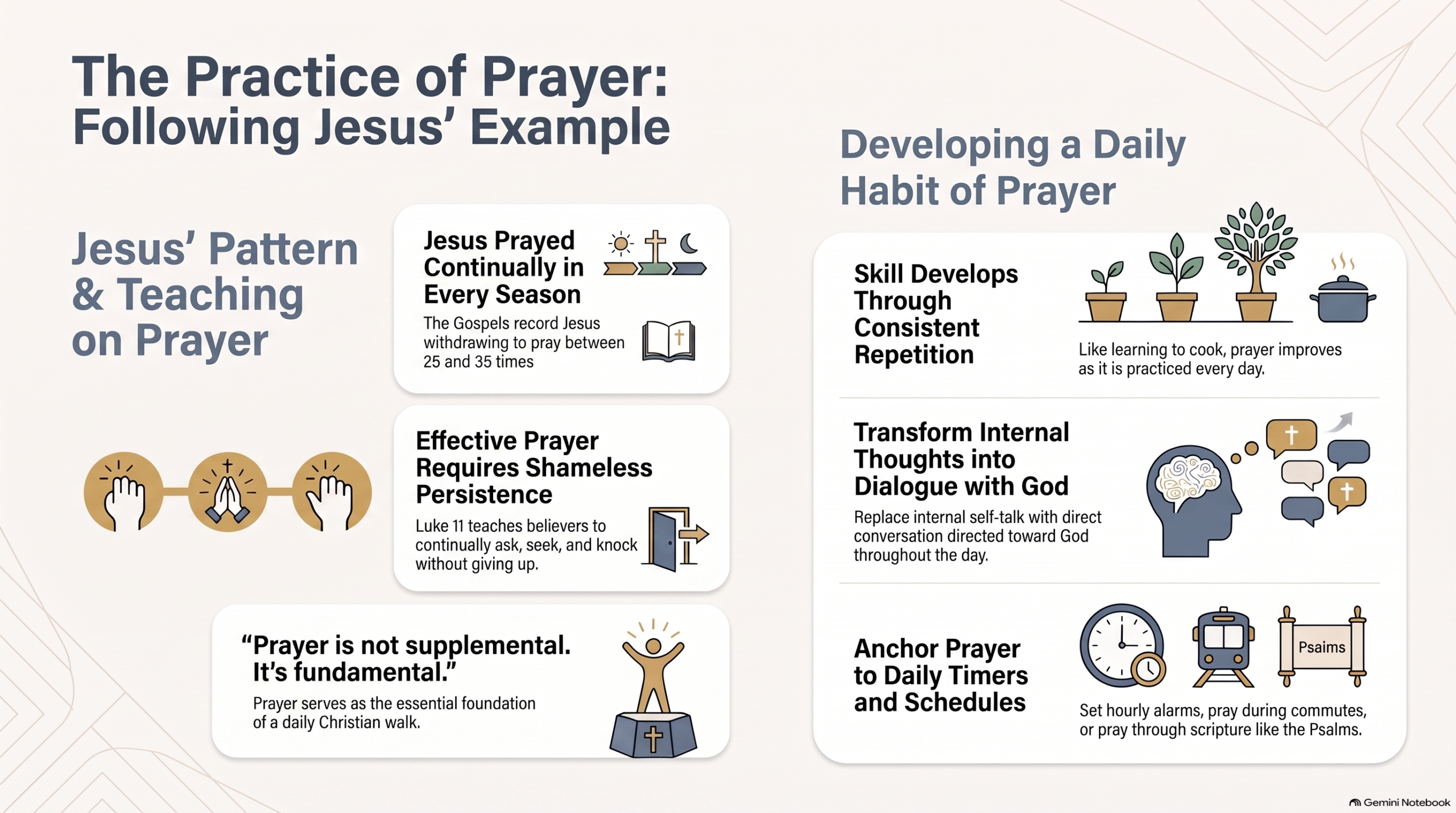
Prayer isn't just an optional addition to our lives—it's foundational. Looking at the Gospel accounts of Jesus' daily habits, Pastor Dustin Woolam reveals how prayer is meant to be a continuous, daily rhythm rather than a quick fix in times of need. Learn how to move from internal monologue into ongoing dialogue with God, develop daily "spiritual reps," and lean into the power of persistent prayer.
TRANSCRIPT (word for word)
Opening Prayer
Father, thanks for today. Thanks for the gift of Your body. Thank You for the gift of Your word. Lord, we
ask You to come and be with us. Speak to us and teach us. Jesus told us in the book of John that the Holy
Spirit would come and be our Counselor and our Teacher. And so, Holy Spirit, we ask You to come and
teach us.
Pray to help us turn our attention to You, that we give our whole hearts over to this moment so that we
could learn from You. We ask You that whatever is of You would remain, and whatever is not of
You—whether it be from us or from the enemy—those things would fade and would not gain purchase.
Similar to the parable where it says, 'You sow good seed,' and then the enemy comes in and sows bad
seed behind, we pray that there would be no bad seed. We love You, in Jesus' name, amen.
Introduction: The Habit of Prayer
All right, we're going to land in Luke 11. We want to talk about—you know, we're in our series, nearing
the end of our series, 'Give Me Jesus.' The part of the series we're in might take on a new picture. I've
been thinking about this topic for a couple of weeks, completely out of my mind for all the thinking I do.
I was completely unaware of some things on the calendar that I write down. I let Jamie tell me what's
happening, and if it's not on my calendar, the odds of me remembering are pretty near zero. So the fact
that prayer is coming up this Wednesday has nothing to do with the topic of prayer that we're going to
talk about today—at least not in my mind, but perhaps in the Lord's mind. He knows what He's doing;
He knows my weakness and fills in the blanks.
As we look at the things that Jesus does and think about the way Jesus lives, there are lots of things we
could look at, and we have looked at. But one of the things that Jesus does commonly—and they're
almost like filler sentences or throwaway sentences in the Bible that we know aren't throwaway, but
because we're human when we read things, we see a verse here and a verse there where it says, 'Jesus
went to pray. Jesus went to pray. It was Jesus' habit to pray.' Depending on how you choose to count,
there are somewhere between 25 and 35 of these sentences and phrases in the Gospels. The reason it
depends on how you count is because in the Garden of Gethsemane, Jesus goes to pray, comes back,
goes to pray, comes back, and goes to pray again. Is that three events, or is that one event with Jesus
praying? That is why there is fluctuation depending upon how you count. So I want to look at that today.
Biblical Examples of Jesus Praying
Before we get too deeply into Luke 11, it's easier than flipping pages—I've taken some screenshots here
of different scriptures that talk about Jesus praying. In Luke chapter 6, right before Jesus chooses the
twelve apostles, verse 12 says, 'One day soon afterward, Jesus went up to the mountain to pray, and He
prayed to God all night. At daybreak, He called together all of His disciples and chose twelve of them to
be apostles.'
In Matthew chapter 14, after Jesus had fed the five thousand and sent everyone home, verse 23 says,
'After sending them home, Jesus went up into the hills by Himself to pray. Night fell while He was there
alone.'
In Mark chapter 1, verse 35, it says, 'And in the morning, rising up a great while before day, He went out
and departed into a solitary place, and there prayed.' And then Luke chapter 5, verse 16 tells us, 'But
Jesus often withdrew to the wilderness for prayer.' We also see in Matthew chapter 4, right after Jesus
is baptized, He goes into the wilderness where He fasts and prays before the devil comes and tempts
Him.
So what we can see—and this is just a small selection—is that Jesus prays until it becomes nighttime. I
don't know how many of us could make it all through the night in prayer without falling asleep; it
probably had to be something really important for me to stay awake and talk to the Lord about it, if I'm
being honest. And then Jesus wakes up early. So whether you're a morning person or a night person,
Jesus gives all of us examples of when and how to pray. It says He would often withdraw into a
wilderness to pray. In another Gospel account, when He and all the disciples had been busy, He takes
them with Him to separate themselves, rest, and pray.
What Distinguishes Prayer from Superstition?
Sometimes when we think about prayer, it's kind of a unique word. You don't say 'pray' that much in
English except when praying to God, although if you read Old English, 'I pray thee' means asking for
something or wanting something. So prayer occupies this spot, at least in language and perhaps in our
minds and hearts, as a spiritual practice. But does it even matter if we pray? I would contend that it
does. But what is the difference between praying and just hoping something good happens? What is the
difference between praying and saying, 'Don't say that, knock on wood'? What makes prayer different
from superstition? I want to talk about that.
Before I do, I got to thinking: How would you even know if you were good at praying? If I wanted to
know if a guy was good at talking to women, I could observe him and see how many times he gets slaps
versus smiles, and determine his success. Or if I wanted to determine whether a salesperson is good at
talking to clients, the volume of sales would tell me if he was successful. But how do I know if I'm good
at praying? Because I could be really great at praying, but God might say no. So getting a 'yes' doesn't
necessarily prove I'm good at it.
Practice, Repetition, and Spiritual Reps
Here is what I know about anything we do in life: the more we do it, the better we get. That's true about
things we should be doing and things we don't want to do. I was thinking about Bruce Lee, the famous
martial artist and philosopher. In an interview, he famously said he was not worried about the man who
practiced 10,000 kicks one time, but rather the person who practiced one kick 10,000 times. It was the
repetition of the same movement over and over that Bruce Lee credited for mastery.
The other thing I was thinking about was cooking. My wife, Jamie, was out of town this weekend. I like
to cook, so I'm cooking more because I'm trying to eat healthier and avoid boxed foods or eating out as
much. I went to the store to buy something different from my usual purchases. I used to be a butcher,
so I know how to cut meat into steaks. But I had never cooked a roast in my life. It turns out I'm good at
it, but I had to look up a lot of things online: how long to cook it, at what temperature, what ingredients
to include, and what to substitute for starchy carbs since I didn't want potatoes.
Lots of people have different ideas online, but no matter how well you do on your first attempt, it could
just be beginner's luck. If I went to Gordon Ramsay, he would tell me that I'm awful at cooking because
he's a master chef. I could buy his cookbook and follow his instructions, but I wouldn't get the same
results because I don't possess the subtle knowledge he has accumulated over a lifetime in culinary arts.
He cuts faster, knows at a glance which cut of meat or produce is superior, and executes techniques
effortlessly. If I don't get his results, it's not Ramsay's fault or mine—I simply don't have the reps. I don't
have the practice.
For many Christians, when we start to pray, we look at Jesus' instructions, try them, and say, 'Well, this
didn't do anything for me.' But that is no different than learning to cook, learning a martial art, or
learning to drive. I am a safe driver, but I'm not going to get into a Formula 1 car and race because I have
no experience at that level.
Learning to Pray Without Ceasing
As we look at prayer, let's acknowledge that compared to Jesus, none of us pray as much as He did. Early
in my Christian walk, I read in the Bible where it says to 'pray without ceasing.' That sounded like an
impossible task. But in an effort to accomplish it, I realized that I talked to myself a lot. Some people
have an internal monologue; I have an internal dialogue where I talk back and forth to myself. I realized
that rather than talking to myself, I could just talk to God. What is the difference between talking to
myself and getting a bad answer, versus talking to God and getting a good answer? I'm far better off
talking to God.
I remember being in fifth or sixth grade, walking down the hallway, and thinking, 'I should just talk to
God instead of myself.' Now, when I wake up in the morning, by the time I'm up and moving, I find
myself falling into the rhythm of prayer. I fall into the rhythm of talking to God on my drive home or
wherever I'm heading. How did I develop that practice? Fifth grade was a long time ago. A lot of
Christianity is simply doing a little bit every day until it becomes a habit. Whatever humans devote their
time, attention, and focus to, they get better at.
Consider the 'Red Car Theory.' If I asked you how many red cars you saw on your drive to church, you
probably couldn't tell me. But if I offered you $50 for every red car you counted, you would count every single red, maroon, or reddish-orange car, trying to figure out what qualifies. If we gave our time and attention to prayer because we recognized its immediate value, we would pray much more consistently.
Teach Us to Pray: Luke 11 and the Lord's Prayer
In Luke chapter 11, we see Jesus' habit of prayer, and He gives us teaching on it. If we are new to prayer
or lack established habits, we might feel like someone holding a cookbook from a Michelin-star chef,
wondering why our initial results don't match.
Before reading Luke 11, consider Mark 9, where the disciples tried to cast out a demon and failed.
Afterwards, they asked Jesus why they couldn't do it, and Jesus explained, 'This kind can come out by
nothing but prayer.' Jesus didn't pause to pray at that exact moment; rather, it was His lifetime and
lifestyle of prayer that enabled that authority.
In Luke chapter 11, verse 1: 'Now it came to pass, as He was praying in a certain place, when He ceased,
that one of His disciples said to Him, "Lord, teach us to pray, as John also taught his disciples."' Notice
that they saw Him praying. If we are going to be effective in prayer, we cannot worry about who sees us
praying. It needs to be an integral part of who we are, without turning prayer into magic words.
Jesus said to them, 'When you pray, say: Father, may Your name be kept holy. May Your kingdom come
soon. Give us each day the food we need. And forgive us our sins as we forgive those who sin against us.
And don't let us yield to temptation.'
There are countless teachings that dissect the Lord's Prayer line by line, which are beneficial. At a high
level, the essential components are: acknowledge who You are speaking to, ask God to align Your heart,
ask for Your daily needs, ask for forgiveness, and commit to forgiving others. Those are the nuts and
bolts of daily prayer.
Parable of the Persistent Friend and Shameless Persistence
In verse 5, Jesus teaches them more about prayer through a parable: 'Suppose you went to a friend's
house at midnight wanting to borrow three loaves of bread, saying, "A friend of mine has just arrived for
a visit and I have nothing for him to eat." Suppose he calls out from his bedroom, "Don't bother me; the
door is locked for the night, and my family and I are all in bed. I can't help you." I tell you this: even
though he will not get up and give him bread because he is his friend, yet because of his shameless
persistence he will get up and give him as much as he needs.'
'So I say to you: keep on asking, and you will receive what you ask for. Keep on seeking, and you will
find. Keep on knocking, and the door will be opened to you. For everyone who asks receives, everyone
who seeks finds, and to everyone who knocks, the door will be opened. Which of you fathers, if your
child asks for a fish, will give him a snake instead? Or if he asks for an egg, will give him a scorpion? Of
course not. So if you sinful people know how to give good gifts to your children, how much more will
your Heavenly Father give the Holy Spirit to those who ask Him?'
Jesus provides both a model for what to pray for and an instruction on how to pray—with shameless
persistence.
Historical Examples: Tarrying and Waiting on the Lord
Throughout church history, believers have demonstrated this persistence. A notable example is found
among the early Pentecostals at the turn of the 20th century. Drawing from the King James translation,
they used the word 'tarry,' which essentially meant to wait upon the Lord until His presence arrived. At
the Azusa Street Revival, they had an upper room where people would go to pray and wait for God to
move.
This practice traces back to the book of Acts. 1 Corinthians 15 notes that over 500 people saw the risen
Jesus ascend. Yet in Acts chapters 1 and 2, the group in the upper room had dwindled to 120 people
who remained faithful to Jesus' instruction to go to Jerusalem and wait for the Holy Spirit. They waited
in prayer, and when they were all in one accord, the Holy Spirit descended upon them like tongue-like
flames of fire—symbolized today in church emblems like the Methodist cross and flame.
Another historical example is Smith Wigglesworth. There is a story of him visiting a town and asking if
anyone was sick who had not been healed. He was directed to a man bedridden for eleven years.
Wigglesworth visited him and said, 'I'm going to come pray for you tomorrow, and God is going to heal
you.'
Wigglesworth then asked if there was a local place in nature where people often felt close to God. He
went into the woods and spent the entire day in prayer until he felt the Lord's presence. He returned to
his lodging and prayed all night. The next morning, declining breakfast because he had been with the
Lord, he went to the bedridden man's room. He sat in silence for a long time, waiting until he knew Jesus
was in the room, before praying for the man, who was healed. Wigglesworth famously noted, 'I didn't
pray for him until I knew Jesus was in the room.'
Endurance in Prayer and God's Timing
Wigglesworth also spoke poetically about people feeling as though their prayers hit the ceiling and
bounce back. Jesus calls us to persistence because it is easy to lose endurance and give up when
answers seem delayed.
Throughout Scripture, from the Old Testament cries of 'How long, Lord?' to the writings of Peter, we are
reminded that God's timing is not ours. If you want to know if you are praying well, remember Jesus'
words: keep on asking, keep on seeking, keep on knocking, knowing that your Heavenly Father is good.
If we want to grow in prayer, let us follow Jesus' example: rise early to pray, stay up late to pray, and
regularly withdraw to separate places so prayer becomes as natural a habit as eating lunch.
The Discipline of Fasting and Daily Prayer Habits
Many church traditions incorporate fasting. Some observe traditional fasts, such as abstaining from food
during Yom Kippur or fasting on Fridays. The primary spiritual benefit of fasting is that it brings the
physical desires of the flesh into submission to the spiritual will. As the Apostle Paul wrote, 'I beat my
body into submission.' Fasting trains us in self-discipline so that when it is time to pray, work, or make
righteous choices, we have cultivated the habit of self-control.
People often suggest replacing a meal with prayer during a fast. However, if you are busy and grab food
while working or driving, it can be difficult to set aside that specific block of time. But what if we
integrated prayer into our daily routine the same way we eat? What if, between tasks or while
commuting, we used that time to converse with God?
We might look at Jesus and assume His prayer life was unique because He was God. But consider the
Apostles in Acts and believers throughout history. We too can become people of prayer who keep our
minds directed toward the Lord continuously.
For structure, some use prayer resources like the Daily Office app from the Anglican tradition (based on
the Book of Common Prayer), which provides guided prayers for morning, midday, evening, and night,
drawing heavily from the Psalms. Whether using a formal prayer book or simply praying through the
Psalms, structured tools can help when you have five minutes and don't know what to say.
The Depth of Prayer: Jesus in Gethsemane
Ultimately, we cannot become like Jesus if we do not pray as Jesus prayed—frequently and with
complete confidence in the goodness of the Father.
In Matthew chapter 26, verse 36, Jesus goes with His disciples to Gethsemane. Luke records that His
prayer was so intense His sweat was like great drops of blood. Matthew writes: 'Then Jesus came with
them to a place called Gethsemane, and said to the disciples, "Sit here while I go and pray over there."
And He took with Him Peter and the two sons of Zebedee, and He began to be sorrowful and deeply
distressed. Then He said to them, "My soul is exceedingly sorrowful, even to death. Stay here and watch
with Me." He went a little farther and fell on His face, and prayed, saying, "O My Father, if it is possible,
let this cup pass from Me; nevertheless, not as I will, but as You will."'
'Then He came to the disciples and found them sleeping, and said to Peter, "What! Could you not watch
with Me one hour? Watch and pray, lest you enter into temptation. The spirit indeed is willing, but the
flesh is weak."' Tragically, Peter did succumb to temptation later that night when he denied knowing
Jesus three times.
Jesus prayed a second and third time, saying the same words, before telling His disciples, 'Are you still
sleeping and resting? Behold, the hour is at hand, and the Son of Man is being betrayed into the hands
of sinners. Rise, let us be going. See, My betrayer is at hand.'
In Dean Jones' solo play, St. John in Exile, the elderly Apostle John reflects on that night in Gethsemane.
After Peter denied the Lord and wept bitterly in an alleyway, John recalls his own response: 'I didn't
deny the Lord, but then I remembered His words: "Could you not watch with Me this little while?"'
Jesus calls us to pray because He is valuable to us. We talk to those we love—spouses, children, friends.
Do we talk to God with that same devotion, following Jesus' model of praying both in solitude and in
community? Prayer is not just asking for needs or forgiveness; it is the spiritual equivalent of breathing.
As pastor Alistair Begg stated: 'Prayer is not supplemental; it is fundamental.'
Practical Encouragement: Testing God's Voice and Daily Routine
On good days and bad days, during seasons of joy and seasons of trial, we are called to pray. When life is
going smoothly, offer prayers of thanksgiving. Sit quietly with the Lord, play worship music, or listen to
an audio Bible, leaving space to hear His voice.
If you feel the Lord speaking to you, test what you hear against Scripture. Especially when new to
prayer, it is easy to confuse our own desires or external distractions with God's voice.
To build consistency, set practical reminders: schedule hourly alarms on your phone to pause and offer a
quick prayer of thanks, or commit to praying at specific times each day—at noon, upon waking, or
before going to sleep. Scripture instructs us to set our minds on what is valuable, and nothing is more
valuable than spending time with the Lord.
Closing Prayer
Father, thank You for listening. We are not speaking into the air, nor saying words merely for others to
hear; You are with us, You are listening, and You are interested. We do not have to fight to get Your
attention—we already have it. Yet You ask us to be consistent and persistent in our prayers. We want to
practice and grow in prayer. Help us to pay attention to every opportunity to pray, to be honest with
You, to listen, and to abide in Your presence daily. Come and work in our lives. In Jesus' name, amen.