
Dustin Woolam | Pastor & Lead Elder
The Heart of the Message Summary
If you’ve ever walked through a season where God felt silent and you wondered if He walked away, you aren’t alone.
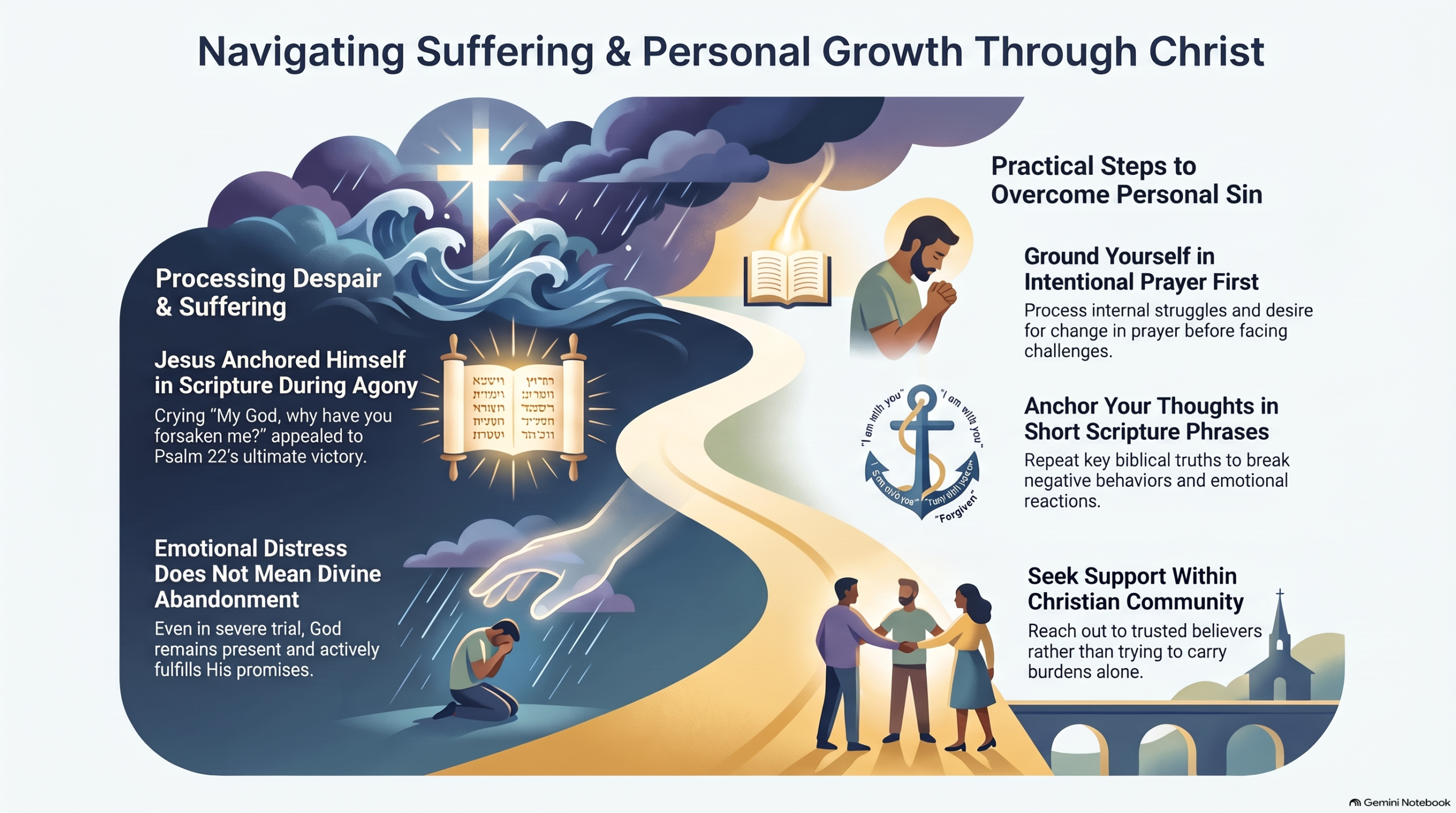
When Jesus cried out from the cross, "My God, My God, why have You forsaken Me?" He wasn’t abandoned by the Father. In His most agonizing, suffocating moment, Jesus was quoting Psalm 22—anchoring His heart in God’s Word and pointing everyone listening to a promise of ultimate victory.
Jesus took on the full weight of human pain and isolation so that we would never have to face life's darkest valleys alone. When we learn to fight our battles in honest prayer, anchor our minds in Scripture, and walk together in community, we find the strength to die to our old ways and live in real freedom. Even in the moments you feel most isolated, God has not left your side—His victory is already at work in your life.
TRANSCRIPT
Introduction
In this series, "Give Me Jesus," we have one or maybe two more sessions left, depending on how next week goes. Today, we are going to look closely at the crucifixion of Christ, before transitioning into His resurrection and His ascension in the coming weeks. Through it all, I do not want to lose the heart of this message: that we desperately need Jesus in the midst of everything we walk through.
We are going to be in Mark 15 today, and there is a tremendous amount of truth here. Over the course of this series, we have looked at Jesus as Healer, as the One who sets people free, and how He interacted with the sick and broken. We have looked at how to pray, who He is, what He does, and how He carries Himself. I do not want us to lose sight of any of that as we watch how Jesus dies and the willing manner in which He gives His life.
Throughout Scripture, we are called to die to ourselves, to follow Christ, and to lay down our lives just as He laid down His life. For a Christian, there is a very real sense in which we must die every single day. Unless Jesus returns first, every one of us will face physical death at some point. In our society, we do not handle death very well. We tend to fear it, worry about it, and pull away from it because of all the unknowns. Yet as we watch Jesus in His death and in His willing sacrifice for us, we discover profound truths about how to die to ourselves daily and how to face the close of this earthly life.
Before we read Mark 15, there is an important detail to keep in mind regarding language. Later in this chapter, Jesus quotes Psalm 22. At that time, Jesus, His disciples, and most people in that region spoke Aramaic and Greek; very few spoke Hebrew fluently. When bystanders misunderstand what Jesus cries out from the cross, it is very likely because He was speaking Hebrew, and they completely missed the point.
Mark 15: The Betrayal, Trial, and Condemnation
To set the context: Jesus had just shared the Last Supper with His disciples in the Upper Room, establishing what we celebrate as communion. He then went to the Garden of Gethsemane, entering into such agony of prayer that His sweat became like drops of blood. Judas, one of the Twelve, arrived with the authorities and betrayed Him. Jesus was taken into custody in Jerusalem.
Very early in the morning, the leading priests, the elders, and the teachers of religious law—the entire High Council—met to discuss their next step. They bound Jesus, led Him away, and took Him to Pilate, the Roman governor. Pilate asked Jesus, "Are You the king of the Jews?" Jesus replied, "You have said it." Then the leading priests kept accusing Him of many crimes, and Pilate asked Him, "Aren't You going to answer them? What about all these charges they are bringing against You?" But Jesus said nothing, much to Pilate’s surprise.
Now it was the governor’s custom each year during the Passover celebration to release one prisoner—anyone the people requested. One of the prisoners at that time was Barabbas, a revolutionary who had committed murder in an uprising. The crowd went to Pilate and asked him to release a prisoner as usual. "Would you like me to release to you this king of the Jews?" Pilate asked. For he had realized by now that the leading priests had arrested Jesus out of envy.
But at this point, the leading priests stirred up the crowd to demand the release of Barabbas instead of Jesus. Pilate asked them, "Then what should I do with this man you call the king of the Jews?" They shouted back, "Crucify Him!" "Why?" Pilate demanded. "What crime has He committed?" But the mob roared even louder, "Crucify Him!" So to pacify the crowd, Pilate released Barabbas to them. He ordered Jesus flogged with a lead-tipped whip, and then turned Him over to the Roman soldiers to be crucified.
The Brutality of Roman Scourging and Crucifixion
Jesus was completely innocent, Pilate knew He was innocent, yet Jesus still received the death sentence. Crucifixion was not merely an execution; it was designed to be as agonizing, public, and humiliating as possible. The primary mechanism of death on a cross was slow suffocation under the weight of one's own body. To draw a single breath, the victim had to push upward against the iron spikes driven through their feet, grinding raw, torn flesh against the wood.
When the mob cried out, "Crucify Him," they were not merely asking for His execution; they were demanding that He be tortured out of existence. Under Jewish law, a beating was strictly limited to thirty-nine lashes (forty minus one). But the Romans had no such limit. Roman soldiers routinely scourged prisoners until muscle, tissue, and bone were exposed, often killing the victim before they ever reached a cross. The fact that Jesus survived this scourging reveals both His physical endurance and His divine resolve.
The Mockery by the Roman Soldiers
The soldiers took Jesus into the courtyard of the governor’s headquarters (called the Praetorium) and called out the entire regiment. They dressed Him up in a purple robe, and they wove thorn branches into a crown and put it on His head. And they saluted Him and taunted, "Hail, King of the Jews!" And they struck Him on the head with a reed stick, spit on Him, and dropped to their knees in mock worship. When they were finally tired of mocking Him, they took off the purple robe and put His own clothes on Him again, and led Him away to be crucified.
Notice Scripture does not say they stopped because a time limit expired; they stopped only when they grew tired of it. Under the Roman worldview of that era, non-Romans—and Jews in particular—were regarded as subhuman. Treating a condemned Jew with utter barbarity meant nothing to them.
Yet these men were not merely mocking an ordinary man; they were tearing down the Son of God. As the Apostle Paul writes in 1 Corinthians, if the rulers of this age had understood what they were doing, they would not have crucified the Lord of glory. Behind these soldiers and priests stood demonic powers and principalities celebrating what they believed was their triumph over God. Whatever horror you picture Jesus enduring, the reality was infinitely worse.
Golgotha and the Mockery on the Cross
A passerby named Simon, who was from Cyrene, was coming in from the countryside just then, and the soldiers forced him to carry Jesus’ cross. (Simon was the father of Alexander and Rufus.) They brought Jesus to a place called Golgotha, which means "the place of the skull." They offered Him wine drugged with myrrh, but He refused it. Then the soldiers nailed Him to the cross. They divided His clothes and threw dice to decide who would get each piece.
It was nine o'clock in the morning when they crucified Him. A sign was fastened above Him announcing the charge against Him. It read, "The King of the Jews." Two revolutionaries were crucified with Him, one on His right and one on His left.
The people passing by shouted abuse, shaking their heads in mockery. "Ha! Look at You now!" they yelled at Him. "You said You were going to destroy the temple and rebuild it in three days. Well then, save Yourself! Come down from the cross!" The leading priests and teachers of religious law also mocked Jesus. "He saved others," they scoffed, "but He can't save Himself! Let this Messiah, this King of Israel, come down from the cross so we can see it and believe in Him!" Even the men who were crucified with Jesus ridiculed Him.
The irony is breathtaking: Jesus could have saved Himself in an instant. He possessed the power to step down from that cross at any moment. But had He saved Himself, He could not have saved the very people who were mocking Him, nor could He have saved us.
The Darkness, the Cry of Desolation, and the Temple Veil
At noon, darkness fell across the whole land until three o'clock. Then at three o'clock Jesus called out with a loud voice, "Eloi, Eloi, lema sabachthani?" which means, "My God, My God, why have You abandoned Me?"
Some of the bystanders misunderstood and thought He was calling for the prophet Elijah. One of them ran and filled a sponge with sour wine, holding it up to Him on a reed stick so that He could drink. "Wait," he said, "let’s see whether Elijah comes to take Him down."
Then Jesus uttered another loud cry and breathed His last. And the curtain in the sanctuary of the temple was torn in two from top to bottom. When the Roman officer who stood facing Him saw how He had died, he exclaimed, "This man truly was the Son of God!"
Some women were there watching from a distance, including Mary Magdalene, Mary the mother of James the younger and of Joseph, and Salome. They had been followers of Jesus and had cared for Him while He was in Galilee. Many other women who had come with Him to Jerusalem were also there.
Understanding Jesus’ Cry: Was the Trinity Severed?
A widespread misconception surrounds the cry of Jesus: "My God, My God, why have You forsaken Me?" Many have been taught that at this moment, the Father turned His back, broke fellowship, and separated Himself from the Son so that Jesus experienced total abandonment.
That concept may sound dramatic, but it is not what Scripture teaches. It is theological impossibility for the Father and the Son to be divided. If Jesus ceased to be in union with the Father and the Holy Spirit, He would cease to be God, and the Trinity would be broken. Throughout all of His suffering, the Father was with Him, and the Holy Spirit was with Him. Jesus was never abandoned by His Father.
Why, then, did He cry out those words?
Remember what crucifixion does to the human body: you cannot breathe, and you cannot speak. In His dying moments, suffocating and in agonizing pain, Jesus was quoting the opening line of Psalm 22. In Jewish tradition, quoting the first line of a psalm was the standard way to evoke the entire passage. Jesus was not declaring theological defeat; He was anchoring Himself in the Word of God and pointing everyone who heard Him to prophetic truth.
The Prophecy of Psalm 22
Consider the full text of Psalm 22 that Jesus brought to mind:
My God, My God, why have You abandoned Me? Why are You so far away when I groan for help? Every day I call to You, My God, but You do not answer. Every night You hear My voice, but I find no relief. Yet You are holy, enthroned on the praises of Israel. Our ancestors trusted in You, and You rescued them. They cried out to You and were saved. They trusted in You and were never disgraced.
But I am a worm and not a man. I am scorned and despised by all. Everyone who sees me mocks me. They sneer and shake their heads, saying, "Is this the one who relies on the Lord? Then let the Lord save him! If the Lord loves him so much, let the Lord rescue him!"
Yet You brought me safely from my mother’s womb and led me to trust You at my mother’s breast. I was thrust into Your arms at my birth. You have been my God from the moment I was born. Do not stay so far from me, for trouble is near, and no one else can help me.
My enemies surround me like a herd of bulls; fierce bulls of Bashan have hemmed me in. Like lions, they open their jaws against me, roaring and tearing into their prey. My life is poured out like water, and all my bones are out of joint. My heart is like wax, melting within me. My strength is dried up like sun-baked clay. My tongue sticks to the roof of my mouth. You have laid me in the dust and left me for dead.
My enemies surround me like a pack of dogs; an evil gang closes in on me. They have pierced my hands and my feet. I can count all my bones. My enemies stare at me and gloat. They divide my garments among themselves and throw dice for my clothing.
O Lord, do not stay far away! You are my strength; come quickly to my aid. Save me from the sword; spare my precious life from these dogs. Snatch me from the lion’s jaws and from the horns of these wild oxen.
I will proclaim Your name to my brothers and sisters. I will praise You among Your assembled people. Praise the Lord, all you who fear Him! Honor Him, all you descendants of Jacob! Show Him reverence, all you descendants of Israel! For He has not ignored or belittled the suffering of the needy. He has not turned His back on them, but has listened to their cries for help.
I will praise You in the great assembly. I will fulfill my vows in the presence of those who worship You. The poor will eat and be satisfied. All who seek the Lord will praise Him. Their hearts will rejoice with everlasting joy. The whole earth will acknowledge the Lord and return to Him. All the families of the nations will bow down before Him. For royal power belongs to the Lord. He rules all the nations....
Future generations will hear about the wonders of the Lord. His righteous acts will be told to those not yet born. They will hear about everything He has done.
A thousand years before the cross, King David wrote this psalm under the inspiration of the Holy Spirit. He described crucifixion before the practice even existed: bones out of joint, heart melting like wax, intense thirst, pierced hands and feet, and garments divided by casting lots.
When Jesus cried out that first line, He was identifying fully with human anguish and physical torment, while simultaneously directing our gaze to the end of the psalm: the promise of divine vindication, eternal victory, and the proclamation of God's righteousness to every future generation.
The Reality of Loneliness on the Cross
Even while maintaining unbroken divine union with the Father, in His human experience Jesus felt utterly and completely alone. He had been scourged until He collapsed under the weight of His cross. His disciples had fled. Those who loved Him were forced to watch from a distance, unable to touch Him, comfort Him, or speak to Him. He was suspended between heaven and earth, enduring the jeers of the crowd and the spiritual malice of the enemy.
Loneliness is one of the most painful realities of the human condition. When you are suffering, there is nothing like having someone present who understands and cares. Recently, I read an account of someone in deep crisis who contemplated suicide and called a helpline. The person answering did not rattle off clinical answers; he simply responded with genuine warmth and said, "Hey man, what's going on?" That simple human conversation changed everything.
On the cross, Jesus had no one to talk to. In His earthly walk, He was already uniquely alone because He was God in human flesh. And in His final hours, He took on the full weight of human rejection and suffering without a single human voice to bring Him comfort. If you have ever felt abandoned, isolated, or misunderstood, know this: you will never be more alone than Jesus was on that cross. He understands your pain intimately.
The Burial of Jesus
All of this happened on Friday, the day of preparation, the day before the Sabbath. As evening approached, Joseph of Arimathea took a risk and went to Pilate and asked for Jesus’ body. (Joseph was an honored member of the High Council, and he was waiting for the Kingdom of God to come.) Pilate couldn't believe that Jesus was already dead, so he called for the Roman officer and asked if He had died yet. The officer confirmed that Jesus was dead, so Pilate told Joseph he could have the body.
Joseph bought a long sheet of linen cloth. Then he took Jesus’ body down from the cross, wrapped it in the cloth, and laid it in a tomb that had been carved out of the rock. Then he rolled a stone in front of the entrance. Mary Magdalene and Mary the mother of Joseph saw where Jesus’ body was laid.
Even in His burial, the narrative emphasizes the complete finality of His physical death. Jesus did not merely faint; He died. Yet even in the grave, God had not abandoned Him. The cross was not a defeat; it was the battlefield upon which victory was won.
Learning to Die to Ourselves: Gethsemane Before Golgotha
What stands out so powerfully in Jesus’ trial and crucifixion is that He never defended Himself. He made no excuses. He did not call down twelve legions of angels to retaliate. Why? Because He settled the battle beforehand in the Garden of Gethsemane. It was in prayer, on His knees before the Father, that He wrestled through His anguish and declared, "Not My will, but Yours be done."
If we are ever going to overcome sin and die to ourselves daily, we must follow that exact pattern. We must lead with prayer.
Early in my marriage with Jamie, I struggled constantly with anger. I was quick-tempered and volatile; someone could bump my car mirror on a bicycle, and I would instantly go from zero to furious. It reached a point where Jamie told me that looking into my eyes when I was angry frightened her. I hated living that way. I knew it did not reflect Christ, and I wanted to change.
So I began to pray and saturate my heart in God's Word. Over time, the Lord gave me specific scriptures to anchor myself in whenever anger surged. In Ephesians, Scripture says, "Be angry, and do not sin." In James 1, it says, "Be quick to listen, slow to speak, and slow to anger, for the wrath of man does not produce the righteousness of God."
When fury tried to take over, I was often too upset to recite long passages, but I clung to that single phrase: "The wrath of man does not produce the righteousness of God." Just like Jesus calling out the opening line of Psalm 22, that short phrase tapped into all the hours spent in prayer and Scripture, anchoring my soul against the storm of my flesh.
What Would God Ask You to Change?
Ask yourself honestly: If Jesus were to stand before you right now and ask you to change one area of your life, what would it be?
Sin is not just doing what is forbidden; it is also failing to do what God commands us to do. Where are you falling short? Is it your tongue—participating in gossip or speaking harsh words? Is it what you look at in private? Is it laziness, gluttony, dishonesty, or pride?
Years ago, my cousin—who is not a believer—told me frankly, "Dustin, you're the most lovable jerk I know." While I appreciated the "lovable" part, I knew I did not want to be a jerk. Following Christ does not mean becoming a doormat with no boundaries, but neither does it excuse harshness or arrogance. There is a holy ground between being a doormat and being a jerk, and that is where Christ calls us to walk.
Whatever God is highlighting in your life right now, take it to your own Gethsemane. Get on your knees, spend time with God, and wrestle through it in prayer. Tell Him, "Lord, I need to die to this, and I don't know how on my own. But whatever You ask of me, that is what I will do."
Then, find the Scripture that directly opposes that sin. As Romans 12:21 commands, "Do not be overcome by evil, but overcome evil with good." Do not merely try to stop doing wrong; actively run toward what is right. If you struggle with lying, commit to radical truthfulness. If you struggle with cheating or shady dealings, practice radical transparency. If you struggle with speaking poorly about others behind their backs, refuse to speak unless you are honoring them.
The Power of the Christian Community
We cannot walk this path in isolation. When husbands and wives talk, it is so easy for conversations to slip into complaining, judging, and gossiping about others. Marriage does not magically sanctify ungodly speech. If we cannot say something uplifting, we need to hold our tongues and take our complaints directly to the Lord.
Moreover, we need one another. A hand cannot wash itself; it needs the other hand. The body of Christ was designed to function in mutual support. You do not have to carry your burdens alone. Whether you need prayer or help finding Scriptures to battle a specific sin, reach out to trusted brothers and sisters in Christ. We are called to bear one another's burdens and walk together in victory.
Romans 6: Dead to Sin, Alive in Christ
Jesus did not go to the cross merely so that we could have comfortable, happy lives. He died so that we could be redeemed, transformed into the image of God, and taught how to genuinely love Him and love others.
Paul writes in Romans 6:12–23:
Do not let sin control the way you live; do not give in to sinful desires. Do not let any part of your body become an instrument of evil to serve sin. Instead, give yourselves completely to God, for you were dead, but now you have new life. So use your whole body as an instrument to do what is right for the glory of God. Sin is no longer your master, for you no longer live under the requirements of the law. Instead, you live under the freedom of God’s grace.
Well then, since God’s grace has set us free from the law, does that mean we can go on sinning? Of course not! Don’t you realize that you become the slave of whatever you choose to obey? You can be a slave to sin, which leads to death, or you can choose to obey God, which leads to righteous living. Thank God! Once you were slaves of sin, but now you wholeheartedly obey this teaching we have given you. Now you are free from your slavery to sin, and you have become slaves to righteous living.
...When you were slaves to sin, you were free from the obligation to do right. And what was the result? You are now ashamed of the things you used to do, things that end in eternal doom. But now you are free from the power of sin and have become slaves of God. Now you do those things that lead to holiness and result in eternal life. For the wages of sin is death, but the free gift of God is eternal life through Christ Jesus our Lord.
Jesus broke the power of sin once and for all. We do not have to remain trapped in the habits, addictions, and attitudes that lead to death. We can surrender them, nail them to the cross, and walk in the resurrection life that Christ has provided.
Closing Prayer
Father, thank You for Your Word. Jesus, I pray that our lives would continually reflect our deep gratitude for Your sacrifice. When we discover anything in our hearts that displeases You, Lord, grant us the grace and humility to lay it down immediately.
You know every struggle, every addiction, and every weakness we face. You understand our hearts, and You know our desire to walk in holiness. Lord, I pray for each of us today: reveal the things that need to be surrendered. Teach us to fight in prayer in our own Gethsemane. Teach us to anchor our minds in Scripture, remembering that every promise points to Your ultimate victory.
Remind us that even when we feel alone, You are always with us. Give us the courage to reach out to one another in the body of Christ so that we never walk through trial alone. Set us free—not only in theological truth, but in the everyday practice of our lives. Break every chain, destroy every excuse, and make us truly Yours.
We love You, Lord, and we surrender ourselves to You. In Jesus' name, Amen.