
The Unexpected Ways of Jesus | Matthew 15 & Mark 7 | Give Me Jesus

Dustin Woolam | Pastor & Lead Elder
The Heart of the Message Summary

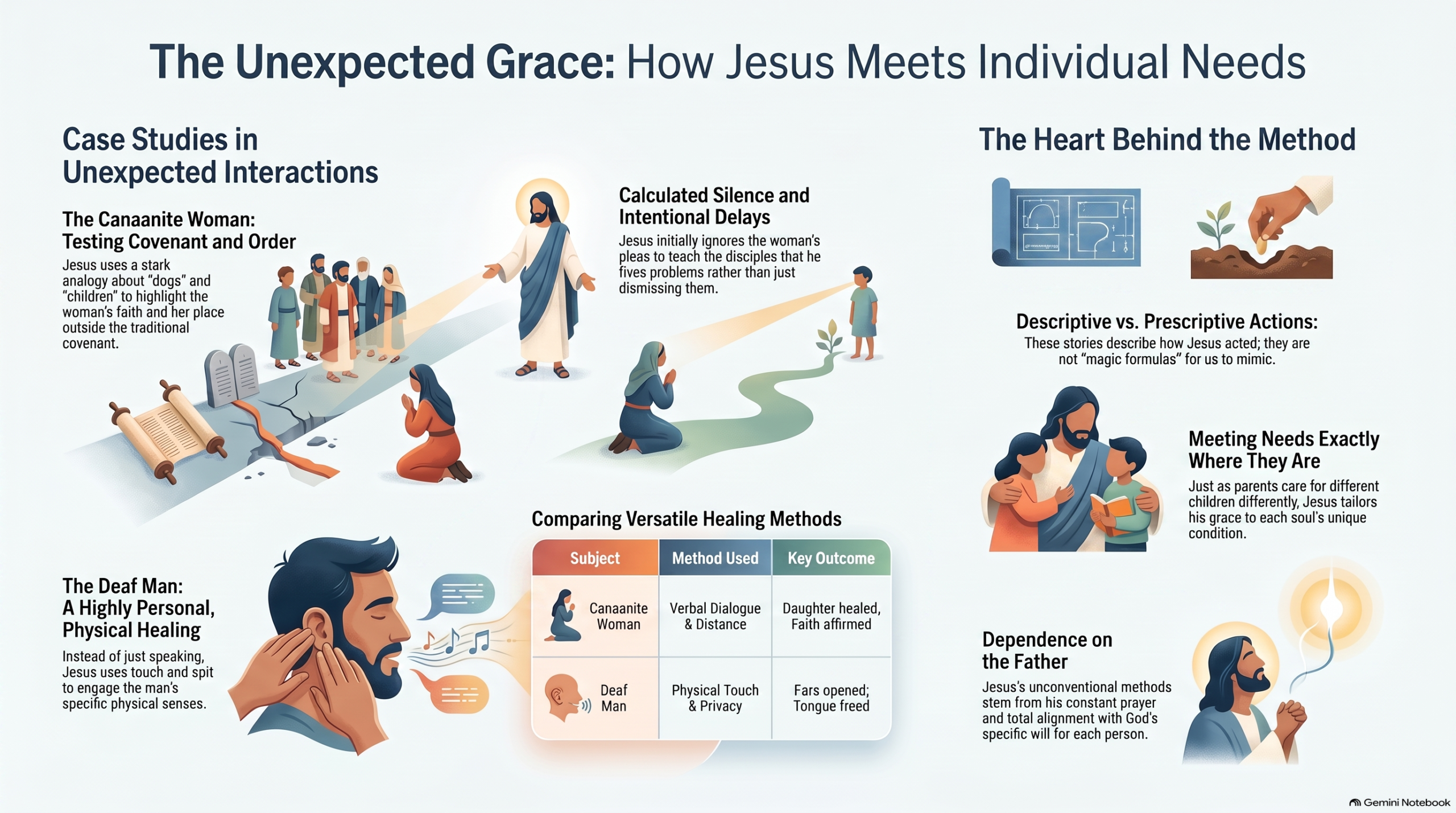
In this message from the "Give Me Jesus" series, Pastor Dustin Woolam tackles some of the most challenging interactions of Jesus found in Matthew 15 and Mark 7. By examining Jesus' surprising responses to a Canaanite woman and a deaf man, we learn that Jesus consistently acts in unexpected ways that break human expectations and cultural barriers. Rather than following rigid, man-made systems, Jesus works out of His deep connection with the Father to bring grace, healing, and redemption to those far off. The primary call to action is to stop forcing God into our predictable formulas or systems. We are invited to trust His kindness, recognize that He intimately knows our deepest needs, and receive the unexpected grace He offers.

TRANSCRIPT (word for word)

The Unexpected Ways of Jesus

Welcome and Opening Prayer

Good morning. Welcome to church. It's good to see all of you. Let's pray. One of the things I wanna think about as we pray and I would like to encourage us to think about throughout the week is, it's really easy to get caught in our own lives. And what's happening in front of us and what's happening in our families, but just this week, my encouragement to us all is to let's pray for everybody who's here today and everybody who's missing from today, like Caitlin and Alex and their babies. And they have valid reason to not be here. So, let's just think about, let's pray for each other. Let's be community minded this week. Father, thank You for today. Thank You for these people.

I pray Lord for healing and bodies that need healing. I pray for peace and souls that need peace. I pray for wisdom for minds that need wisdom. Or You know each of these things that, in fact, Jesus, You tell us that the Father knows what we need before we even ask. But we still come and ask. And so Lord, we pray for Your goodness and Your peace and Your protection and Your saving in all of us this week and Lord, even in this moment. I pray that as we open Your word, Holy Spirit, You speak clearly to us just as Jesus promised that You would come and You would teach us. And so we want to be good students. I pray, God, that what's of You would remain and that what's not of You would not remain, that there be no distractions or anything from ourselves or from any other source. In Jesus' name, Amen.

The Fundamental Nature of Prayer

Not in my notes, but one of my favorite preachers, Alistair Begg says that prayer is not supplemental, it's fundamental, right? It's the core of our Christian life. So, thanks for everybody who prayed. We're gonna be in Matthew 15. And we're gonna start in verse 21.

The Story of an Old Testament Scholar

But before I read, one of my all-time favorite theologians tells a story about when he was looking for a—he was at the time looking for a new church. And this guy happens to be like an Old Testament scholar and ancient language scholar. And part of that means that he's reading books other than just the Bible in his education.

There's a whole block of literature. It's called Second Temple Jewish Literature. And it's the kinds of books that Jesus and the disciples and the rabbis and all those people would have been reading. Like if you go to Mardel or a Christian bookstore and there are a whole bunch of books, this is kind of their version of that, right? And so some of those books get quoted in the New Testament. So for example, the book of First Enoch—there are four books of Enoch. The book of First Enoch is quoted both by Peter and by Jude. This will all make sense in a second.

And so him knowing this, he's visiting a church and the pastor's going through this part of Peter, where Peter is quoting these texts. And he's kind of going verse by verse, but when he gets to all that, he just skips it. And it's kind of an interesting portion of scripture and you kind of have to know some things and work with it. But this guy said, "I would rather him have dealt with it poorly than to not have dealt with it at all."

Facing Uncomfortable Texts

And now I'm not saying that to let y'all know I'm going to mess something up. I'm going to do my best not to mess up. But the thing that always challenges me is like don't skip things in the text that are uncomfortable. And I just kind of have this thing in life anyway—I raised my kids this way—is that when something is uncomfortable or you feel a little bit ashamed or something feels bad, you should lean into that. You should press into when something feels bad because when things are hard, that's often when we grow, right?

So when my kids were little, if they were afraid to do something, I made them do it because they were afraid. And fear was not allowed to win, right? So the only problem here is that you're scared; you have to. Now if there are other problem safety things like this, I'm not crazy. I'm not just out here making my kids go play with like a pack of wolves or something, right?

But if they're having to do something new and they don't want to do it just because they're scared because it's new, we're going to talk about it. We're going to work through it. I'm not just going to tyrannically say, "Do it or else," right? There's not a whip behind them. But we don't let fear win, especially like as Christians we should not, but in my house I've kind of internalized that and fear just doesn't get to win. And so if there's a part of the text that we read and we're like, "Man, I really don't know," then I find that Christians do one of two things.

Two Responses to Challenging Scripture

One, we're like, "Man, God's in control and I don't understand this. I'm going to have to come back to it later." That's okay. We can do that. There's some things that when we read the Bible, they're challenging to us. Or if they're not challenging to us, they're confusing to us, they're new, there's something we haven't heard. And we're just not sure what to do with it. And we say, "You know what? I'm going to put a pin in this, I'm going to come back." That's okay. We can do that. And then there are things, but at some point, there are things in the text like that moment is going to return and we're going to have to do something with that part of the text.

The Canaanite Woman: A First-Century Scandal

And so the story we're going to read today, we're in our series, Give Me Jesus. And we're looking at the things that Jesus did, not just His teachings, but the things that He did. And we're going to be in Matthew 15 and Mark 7 today. And this is one of, if not the most challenging thing from a modern perspective that's in the gospels. One of the things we're going to read today is that Jesus basically infers or directly says, depending on the way you're reading it, that this woman that He's talking to is a dog. And we're like, "Jesus, why could You, how could You do that?"

But as we read the text, one of the things that I would encourage you to see is that to the Jewish people, whether or not Jesus called her a dog was less scandalous than the fact that this woman was a Canaanite. And so let's, now we're going to read it. We're going to see what it all has to say, like the Bible says what the Bible says. And so we're going to look at it and say, "Jesus, You're all this wonderful person, all these songs we're singing, all the stuff we know about Jesus, how does this event fit into all of that?"

And so by the end of it, stick with me, stick with the scriptures. We're going to see if we have a title or a theme today, it's that Jesus does unexpected things. And some of that is the way that He interacts with this woman, and some of it is the way in Mark 7 He interacts with this guy who is deaf. Jesus does some stuff. And if we're not careful, we'll take moments—instead of the whole text of scripture, we'll take moments and we'll make judgments, right? And so we'll take something we're confused about or something we love or something that we're offended by or something that we think everyone should do and we'll run with that and forget the other 90% of the text.

Historical Context: The Judgment on Canaan

So let's read, starting in verse 21—so the version I'm using will say Gentile, other versions in the Greek, it's Canaanite. Let me say something about the Canaanites right quick. Here's why the scandal is that Jesus was talking to a Canaanite at all: because in both Deuteronomy and in Joshua, God said, "Kill every single one of them." He says, "Get rid of them." And now it's like, why would God talk about genocide?

Well, because we see in different parts of the scripture—at some point, maybe I'll teach about this—but we see in different parts of the scripture that when God is saying to clean out the land, the Canaanites, there are scriptures that say He gave them every chance to repent, that He reached out to them and He sought after them, and then there's language in the Old Testament that says that their sin has filled up, that they've had every chance and they've still rejected God. And so then the punishment or the response from God is that they would be eradicated, and we can read in the scripture that some of them did live. In fact, this lady lived all the way up through Jesus' time.

So the Canaanites were absolutely pagan in every regard, and they were marked, not just like, "Hey, don't have anything to do with them," but be done with them entirely. And so that's who this woman is.

Scripture Reading: Matthew 15:21-22

So Jesus left Galilee and went north to the region of Tyre and Sidon. A Gentile woman, a Canaanite woman who lived there, came to Him pleading, "Have mercy on me, O Lord, Son of David, for my daughter is possessed by a demon that torments her severely."

Understanding the Title 'Son of David'

Now, her calling Jesus, Lord, may or may not have had anything to do with her believing that He was God. Certainly we know that Jesus was God, but when she's coming to Him it could have just been an honorific of some kind. So let's not just immediately assume that she believes that Jesus is God.

However, this phrase, "Son of David" is really important because as a Gentile, in a Gentile land—I think when you look on the map, He's roughly 50 miles outside of Jewish lands at this point, like He's gone pretty far into Gentile lands. And so it would have been a couple of days' travel, right? If they're traveling 17, 18, 20 miles a day, He's two days and change, or two long days away from Jewish lands, and she still calls Him Son of David. She's still recognizing Him as the descendant of David, and that this language is like Jesus is the Messiah.

Now, whether or not she fully understands that, she's using the title, understanding who she believes Him to have been or who she's heard Him to be. So she's not just coming to some Jewish rabbi; she's coming to someone she believes can actually do something about her situation. So it's not just this, "Oh man, here's this Jewish guy doing miracles," it's the Son of David.

Scripture Reading: Matthew 15:22 continued

And she says, "Have mercy on me, O Lord, Son of David, for my daughter is possessed by a demon that torments her severely."

A Mother's Plea and Severe Torment

The interesting thing to me in this is that she's saying, "Have mercy on me because of my daughter's condition." She's not asking for mercy for her daughter; she's asking for mercy for herself. We won't dig too much into that right now, but let's keep going.

And then she says, "This demon torments her severely." We've read some stories about Jesus dealing with demons already. Some of them just make it where someone can't hear, some of them make it where someone can't hear or speak, some caused seizures, some caused guys to tear chains and be naked and cut themselves in cemeteries. We don't know what's happening with her, but we know that it's severe, and by the markings of the text, it's probably really bad, right, for the Bible to tell us that it's severe.

Scripture Reading: Matthew 15:23

Jesus gave her no reply, not even a word. But then His disciples urged Him to send her away. "Tell her to go away," they said. "She is bothering us with all of her begging."

The Disciples' Idea vs. Jesus' Purpose

I just want to point out that if you read the gospels, every time the disciples say, "Send them away," Jesus is about to do not that, right? He's about to do exactly the opposite.

"Jesus, send all these people away, they're hungry and we don't have any food." "No, you feed them." "Jesus, send these beggars away," and the lepers, and then Jesus heals them. And "Jesus, send all these kids away"—they're trying to shoo the kids away, and Jesus says, "No, bring them to Me." And so I always like when it's the human idea to get rid of the problem, Jesus just fixes the problem. He doesn't get rid of it. There's a difference there, right? He doesn't send her away and forget it. So they're saying, "Jesus, get rid of her."

Scripture Reading: Matthew 15:24

Then Jesus said to the woman, "I was sent only to help God's lost sheep, the people of Israel."

Covenant Priority: The Jew First

Now, let's read quickly. One verse, Romans chapter one, should be verse 16, if I remember properly. There's something interesting when Jesus says this that I don't want us to get too far away from. Paul tells us—and he's summarizing a bunch of the Old Testament—but Romans chapter one verse 16 says, "For I'm not ashamed of the good news about Christ. It is the power of God at work, saving everyone who believes, the Jew first and also the Gentile."

We also see in Matthew 28 when Jesus gives the Great Commission. He says, "Go to Jerusalem, Judea, and to the ends of the world." It's not that the Gentiles will never be saved. It's that at this point of Jesus' ministry, He's come to the Jews. God first came to His covenant people and then expanded into the rest of the world. So He's saying there's an order happening here when He says, "I was only sent to the lost sheep of Israel," and we'll see that more when we read in Mark chapter seven: "I was sent to Israel first."

Scripture Reading: Matthew 15:25-27

But she came and worshipped Him, pleading again, "Lord, help me." Jesus responded, "It isn't right to take food from the children and throw it to the dogs." And she replied, "That's true, Lord, but even dogs are allowed to eat the scraps that fall beneath the master's table."

Scripture Reading: Matthew 15:28

And "Dear woman," Jesus said to her, "Your faith is great, Your request is granted," and her daughter was instantly healed.

Scripture Reading: Mark 7:24

All right, let's go to Mark seven. We'll start in verse—excuse me—verse 24. Then Jesus left Galilee and went north to the region of Tyre. He didn't want anyone to know which house He was staying in, but He couldn't keep it a secret.

Seeking Quiet Time Outside Jewish Lands

So Mark's already giving us additional details. Jesus is like maybe going on this offsite with His disciples or something, right? Like maybe He's going to teach them or something like that. Maybe He's just trying to get away and have some like study time, who knows, but He's leaving a far distance from the Jews and He wants to keep a secret where He is.

Scripture Reading: Mark 7:25-26

Right away, a woman who had heard about Him came and fell at His feet—a woman who had heard about Him came and fell at His feet, her little girl was possessed by an evil spirit. And she begged Him to cast out the demon from her daughter.

Continuous Begging and Syrian Phoenicia

And in English, we don't really have the tense that the Greek has, but in the Greek, the idea here is that she's continually begging Him, right? There's this, "You gotta help me, you gotta help me," this constant.

Scripture Reading: Mark 7:26-30

And since she was a Gentile, born in Syrian Phoenicia, Jesus told her, "First I should feed the children, My own family, the Jews." So there's that order, right? "First I should feed My own family. It isn't right to take food from the children and throw it to the dogs." She replied, "That's true, Lord. But even the dogs under the table are allowed to eat the scraps from the children's plates." "For such a good answer," He said, "now go home, for the demon has left your daughter." And when she arrived home, she found her little girl lying quietly in bed and the demon was gone.

Deep Dive: The Meaning of 'Little Dog'

So we had this weird situation where Jesus is saying that this woman is a dog. And what's interesting? I'm not a Greek scholar by any stretch; I can hum a few bars. But what's interesting is that this is the only time this particular usage of this word "dog" is used. Anywhere else in the Bible you read dog or animal or whatever, it's a completely different word. And it's actually this word that's like "little dog," right? So it's a dog that would be in the home, not like some feral wild dog or something like this.

And people are like, "Well, Jesus, You still call her a dog. Even if she's a cute little pug or a Chihuahua, You still call her a dog. Like, what's happening here?" And that's fair to ask that question. And that's kind of the uncomfortable part that I kind of wanna lean into: why did Jesus do this?

Now, let's just put our minds in the heads of the disciples. Not saying this is modern sensibilities at all, but Jewish men and women, Jews of all ages in the first century, would have looked at this woman and said that Jesus was being kind by only calling her a little dog, because she was a Canaanite.

So He—now, I'm not saying that Jesus was being kind, but I'm saying from their perspective, it's like, "Wow, He was actually kind of gentle with her." And so when we read it in 2026, and when they read it in the first century, we have to understand that we have different perspectives of what's going on. And the scandal for us is not the scandal for them, but the beauty of the scriptures is that they're written for all of us through all times.

So when we look at why did Jesus call this woman a dog, the Bible's making a point to us with that terminology that it made to them with Canaanite. And really what Jesus is telling this woman, what He is affirming to this woman, is that she is so far removed from the people of God that it's the difference in a child and a dog in a kitchen.

The Priority of the Table and Divine Order

Now, I would not—if I had children sitting at the table now, knowing my son, we had dogs when he was little, he would have been feeding them, right? Or I would have; I have a tendency to feed the dogs. But there's this thing that happens where—but as a parent, I would never take all this great food that I made for my kid and serve it to the dogs and give my son the scraps, right? Just wouldn't do it.

And it doesn't make sense; the order is wrong, right? Like if you see somebody who is taking really good care of their animals and really bad care of their children or their parents or whatever, it's completely upside down. It's completely backwards; it's completely wrong.

And so Jesus being good to a Canaanite when He needed to be good to Jews, that order would have been wrong in the Jewish mind. And Jesus telling this woman, like, "Look, the order's wrong. I came here for the Jews and it's not good to give the scraps to the little dog," or "It's not good to feed the little dogs." And she's like, "But look, can we at least get the scraps of the goodness that You have?"

Challenging Interactions and Nicodemus

And I think that, you know, you see some people kind of twist this. They're like, "This woman spoke truth to power," and all this kind of stuff. And I'm like, "Man, you just missed the point." Like, let's just forget for a second—they weren't anywhere except for in that room with Jesus and this woman. And let's try to forget all the things that we've come to the text with.

And let's just think about: Who is Jesus? And what are the kinds of things that Jesus says to people? In John 3, Jesus says to Nicodemus, unless someone's born again, they can't come into the kingdom of heaven. And Nicodemus is like, "Dude, I'm old. How am I supposed to be born? Am I going to climb back into my mother's womb? Like, what are you talking about?" And Jesus says, "Are you the teacher of Israel and you don't understand?"

And then the rich man comes and he says, "Jesus, I want to come follow You." And Jesus says, "Get rid of everything you have and come follow Me." And other people come and they're like, "Jesus, I want to come and follow You," and He says, "I don't even have a home. I am homeless."

And so every time Jesus is talking to someone in the scriptures, He's saying something and asking them to give something and asking them to understand their situation. Even later in the text, Jesus will say that you're supposed to love your neighbor, and these people are trying to play gotcha and they're like, "Well, Jesus, who is my neighbor?" and Jesus tells the story of the Good Samaritan and He's like, "Everybody's your neighbor."

Jesus Teaches Order and Grace

And so in this situation with this woman, if we know all that about Jesus with all these other people, then what is He saying to her when He says, "I can't give the children's food to dogs"? And He didn't—like if you read carefully, He didn't overtly call this woman a dog, though people will say that He did. He didn't overtly say, "Oh, you're a dog," but He's saying the children's food shouldn't go to dogs, and in the same way, the promise of the Jews, it's not time for it to go to the Gentiles; things have to be in order.

And so it's easy for us to be like, "Oh my gosh, He called this woman a dog," but let's read it carefully. And Jesus is talking to her about order, and He's talking to her about what is right, and He's talking to her about doing things the right way. But she's not deterred, right? She's like, "Fine, get it, I get it, there's order. There's order, Jesus, I understand. But can I just have the scraps, right? Can I just—like let the kids eat, but surely there's something for me."

And Jesus responds. And so it's not that Jesus says, "Hey dog, woman, get out of here. Hey Canaanite woman, get out of here." Jesus is helping this woman to understand, because He knows that this woman's child is going to be healed. But He's helping this woman understand that what He gave her was actually out of order a little bit, and it was a blessing and a kindness to give it to her early.

The Calculated Silence of the Savior

And so the whole story is this package where, first off, Jesus is ignoring her, right? Everything that Jesus is doing is calculated. He starts out not paying attention to her at all. She comes in, she's begging, she's doing all this stuff. Jesus wants to be alone, which is weird because in other places we see Jesus walking—like in a couple of the last two weeks, we've seen Jesus walking, someone shows up, He stops everything He's doing and He pays attention to that person, right?

But now here's Jesus doing something: He's in a house trying to not be noticed. Just a few chapters ago, a couple of blind guys break in and Jesus heals them. But this woman breaks in and He ignores her. And we're like, "Is this the different Jesus? Is He bipolar? Is He crazy? Like, what's happening?"

The only thing that we can assume is that Jesus is teaching everybody something, that He's engaging with people in a way that's important to them in that moment. And so when we say, you know, you hear all these like—all these flare-ups: "Jesus called a woman a dog and she talked back to Him and she got what she wanted," which is kind of a big famous thing with some people who think they're Christians. That's not what's happening.

Let's read it and look at it with the lens, right? So Jesus left Galilee and He went north to the region of Tyre. He didn't want anyone to know which house He was staying in; the Bible doesn't tell us why, we can't guess. Well, I mean, we can have some assumptions, but we don't know, right? So we can guess but we can't know.

But He couldn't keep it a secret. Right away, a woman who had heard about Him came and fell at His feet. Her little girl was possessed by an evil spirit, and she begged Him to cast the demon from her daughter. Jesus is trying to be alone; He can't keep it a secret. That's kind of a pattern in the gospels.

And it says right away, this woman didn't think twice. She ran straight to Jesus. She calls Him Son of David in Matthew. This woman comes to Him looking for an answer. She's desperate. She's repeatedly asking, she's begging, "I need help. I need Jesus' help."

And since she was a Gentile, born in Syrian Phoenicia, Jesus told her—and Matthew tells us He was ignoring her at first until the disciples interceded, and then He doesn't ignore her, He actually helps her. Jesus told her first, "I should feed the children, My own family, the Jews." And then He gives like almost like a little parabolic statement or like a little statement of parable, right? He says, "It isn't right to take food from the children and throw it to the dogs."

It's a similar statement to when Jesus says, "Hey, if you don't hate your family, you don't love Me, right?" It's these like statements where Jesus is saying something and He's saying it so starkly to draw out the point. He's saying, "Listen, blessing you now is taking food out of the children's mouths. And it's not even giving it to other people, it's giving it to animals. This isn't right."

And that's why when she says that's true, she's not saying, "Yes, I understand I'm a dog." That's not what's happening here. What she's doing is saying, "It's true that it's not right, that this situation is not in order, but I still need Your help, right?"

And so Jesus says, "What a great answer." So let me back up. She says, "That's true Lord, but even the dogs under the table are allowed to eat the scraps from the children's plates." So she's like, "I get it, but let me have something." And Jesus says, "Good answer, go home for the demon has left your daughter." And then it tells us that when she arrived home, she found her little girl lying quietly in bed and the demon was gone.

Grace that Transcends Desert

The unexpected thing that Jesus does here is deliver a Canaanite woman. The expected thing from all of thousands of years past, all the way back to Joshua, was that Canaanites should be killed, that Canaanites deserve the judgment they're receiving. No Jew would have faulted Jesus for not delivering this young girl from a demon because the Canaanites had earned it.

And so Jesus unexpectedly delivers this little girl from what history says that she earned. And for Him to say, "Look, why am I giving the food of children to dogs?" like, that's not right. And she's like, "I know it's not right. You're exactly right. None of this is right, but I need Your help." And Jesus gives her help.

And there are lots of times in our lives that we are wallowing in the mud of our own decisions. And I am right where I belong. I've done everything to get myself here with no help from anyone at all. There's a preacher that I like what he says. He's like, "Some of y'all blaming the devil, but the devil's like, 'They're doing fine on their own. They don't need my help, right?'"

So some of us are right where we have put ourselves. And when we go to Jesus, if God says to us—if we read the Scriptures, if other Christians tell us—"You're right where you put yourself," then our response should be, "Yeah, I know. But I need help." And Jesus will help you, right? Like, there's never a time in the Scriptures where we don't see Jesus' help. He always helps.

Scripture Reading: Mark 7:31-35

The next thing that Jesus does that's unexpected, it says He's leaving Tyre. And He went up to Sidon before going back to the Sea of Galilee. So He's still traveling around in this Gentile area. And before returning to the Sea of Galilee in the region of the ten towns, a deaf man with a speech impediment was brought to Him. And the people begged Jesus to lay His hands on the man and heal him. Jesus led him away from the crowd so that they could be alone. He put His fingers into the man's ears and then spitting on His own fingers, Jesus spits on His own fingers. He touches the man's tongue. And looking up to heaven, He sighed and said, or I'm not gonna butcher, but let's give it a shot, "Effata," something which spines, but it means, "Be opened." Instantly, the man could hear perfectly and his tongue was freed so he could speak plainly.

Scripture Reading: Mark 7:36-37

Jesus told the crowd not to tell anyone, but the more He told them not to, the more the news spread, the more they spread the news. They were completely amazed and said again and again, "Everything He does is wonderful. He even makes the deaf to hear and give speech to those who cannot speak."

Avoiding Formulas in Faith

I was in a church service not too long ago—like in the last couple of years, I guess actually it was a little bit longer than I realized—but somebody read this story and they were inspired, so they wanted to go put their fingers in people's ears and say these words in Greek or Arabic or whatever language this is that Jesus is speaking, and that's how God will heal you. They conveniently skipped the part where they spit on their own fingers and touch people's tongues because that's gross, but they don't mind touching people's ears.

When I was young, junior high-ish, there was a guy, my same age, a little bit younger, who was like, "Man, look, Jesus when He healed this little girl, He said, 'Little girl, arise.' So when we pray for people, let's say, 'Little girl, arise.'" And people are trying to mimic these actions that Jesus took to see healing.

I'm not necessarily saying that's wrong; I think there could be a moment where the Holy Spirit might lead us that way. But what I wanna be careful about is creating some kind of formula that forces the Lord to work.

So we see Jesus healing some demon-possessed people and we see He cast those demons into pigs. We see Him healing the demon-possessed girl just from earlier and He just says the word and she's delivered. We see Jesus heal blind people by putting mud on their eyes. We see Him heal deaf people by putting fingers in the ears and touching their tongues with His fingers that have spit. In fact, Jesus sighed. So like, do we have to put that in the formula?

And so we see Jesus do these different things. We see Him talk about children and dogs and food and order. We see Him talk about leave all your things behind. We see all these things that Jesus does. And if we're not careful, we'll miss what's behind all of those things.

The Constant View of the Father

And what's behind all of those things is all throughout the text, Jesus goes alone to pray. Jesus goes to be alone. Jesus goes to do this. Jesus goes to do that. And what we see is this constant dependence and view of the Father.

It says Jesus went alone to pray like last week in Matthew 14. We looked at that Jesus was going to be alone, but all the people showed up, so He ministers to them and then He still finds time to be alone with the Father. And then there's another scene where the disciples are trying to cast out a demon but they can't. And Jesus comes back from prayer and He's able to cast this demon out.

So I think that if we weren't careful and we were looking at Jesus and we're like, "Look how clear Jesus was. Look at how He talked to this woman," or "Man, look how Jesus healed the deaf man. We've got to just put our fingers in somebody's deaf ears and they'll be healed," I think we're missing the point.

The point is that Jesus is good and kind and everything He does is wonderful. And Jesus tells us that He does what He sees the Father do. And so Jesus' connection to the Father and Jesus' leading by the Father and by the Holy Spirit is why He acts and does the things that He does.

He's not out here trying to play gotcha. He's not out here trying to win. Jesus knew who He was according to the Gospel of John: it says knowing who He was, He washed people's feet.

And so Jesus doing things like this, they're descriptive, right? It's describing the way that Jesus acted. They're not prescriptive; they're not telling us what we must do. Now, if God tells you to do it, then do it, right, by all means, but let's not inadvertently make a system out of something that's an example.

A Modern Story: Divine Encounter in Ghana

There's a story of a modern story that I've told more than once, but I love the story, so I'm going to tell it again about a deaf man. He's a Muslim, he's deaf. He's on a crawl, which is in Ghana, and he misses his train. So he's looking for a place to sleep until the next train comes.

And he goes to this big square where they have big conferences and stuff; it's an outdoor amphitheater sort of a thing. And he had been able to hear in the past and had lost his hearing. There's some medicine apparently that's helpful to him and he isn't able to buy it, so he's deaf. And so he's just looking for a place to sleep, can't hear anything. And he sleeps.

And then there's this big like worship service, conference evangelism service, and people are being healed. And he wakes up because of the sound. In his sleep, God healed him when no one was praying for him.

And he comes up on stage and he's like, "I gotta talk to y'all about this." And when he's talking about it, you're watching this guy convert from Islam to Christianity on stage. And he's talking about like, "As a good Muslim, I have to believe, da, da, da, da, da, da."

And the preacher says to him, he's like, "No, Jesus isn't a prophet, He's God, right?" And the guy's like, "Yeah, yeah, that's right." He's like, "I'm gonna worship only God." And he says, "If you know me," he says, "tell my wife, tell all my friends that Jesus is God." And you're watching this guy get saved in real time.

And then they do a next-day interview with him, and he's talking a little more about his story. And the thing that he says that always, just man, when I'm watching him say it, I always tear up, which is why we're not watching it today. He says, "We're not made to worship a God that we don't know."

And if we're not careful, we could look at that story like, "Well, God just heals the deaf. If you don't do anything, you just gotta bring him around." Sure He does. But what's important is that the deaf man in the Bible, the woman, the Syrophoenician woman in the Bible, the Canaanite woman in the Bible, this man from a recent story and his statement, "We're not made to worship a God we don't know"—what's important in all of this is that God did the exact right thing for each of those people to find Him and to meet Him.

This woman needed to go to Jesus. That whole scenario had to happen for her and for us; that's why it's in the scripture. The man with the deafness and his tongue was messed up, that had to happen. And even modern stories of healings and things like this: God is in each of those, speaking to each of us as we need it.

The Pursuit of God and Highlands

I told the story—I don't know how many times I'll share a brief version of it. I spent a lot of my time trying to pursue the Lord as a young person. I want to be wherever God is.

If there was a prayer line—I had a friend, his name was Luke, he was in every prayer line ever. And I was right there, just almost every prayer line ever. But Luke would literally, if they said, "Hey, we want all the women to line up here, we're going to pray for them," Luke would get in line. And I was like, "Luke, this prayer is for women." And he's like, "I don't care, Jesus is up there. I'm getting prayed for." Like, that was Luke, right? Love that guy. He went on to be a pharmacy tech or something, so maybe a pharmacist at this point.

And I would go to as many as I felt like I was allowed to, right? If it was like, "Hey, if you're a mom, come up here," I didn't go. I didn't have kids; I wasn't married. But I spent all this time chasing the Lord. And in my head, I have to get God, I have to chase Him, I have to get Him, I have to pursue Him, I have to do all this stuff. And even some of my online names were different things that indicated that I was chasing God.

And when my dad was dying, there's a song from Hillsong called "Highlands," or it's the Song of Ascent. And I think maybe the week or two before my dad died, I listened to that song on repeat for like six hours, and that's not an exaggeration. I was just praying and talking to the Lord. My heart was breaking as my father was dying.

And one of the lines in that song says, "I could search and stop at nothing, but You're just not that hard to find." And I don't think that all of those years of seeking were bad, and I don't think that the Lord didn't use them, but He had to remind me that the whole time He's just right there—that in all of my seeking and all of my struggling and all of my wanting, God was never far away.

And the thing that God does that's unexpected in the woman's life and in this man's life in Mark 7 is that He knows them. And we forget that, that He knows us. And He knows our weakness, and He knows the things that we need. So God comes and meets me in a song and heals my heart. He tells a woman about scraps and He heals her daughter. He spits on a guy's tongue and heals him.

Like, yeah, I don't know if you're like me: I don't share food. Like, my wife does not eat off my plate. We've been married 26 years. I would not want for Jesus to spit on my tongue or on His fingers and touch my tongue. Now, would I argue with Him if He did? Probably not, but God meets each of us where we are.

And to someone else looking into our life, they might say, "Why would a God treat you that way? Why would a God act that way toward you? Why would a God act in this way towards that person?" But we don't know the condition of that person, and we don't know what they need from the Lord. But God knows exactly what they need, and He's going to meet them exactly where they are.

And so when we read something in the text, we're like, "God, why?" Let's not think of it as just a story, but let's think of it as God interacting with people. "Lord, what did that person need? Why did that have to be said? Why is that the answer?" And it's not that God changes; God's the same all the time. He's always God; He's always the same. But the way He acts towards one is what they need.

A Father's Love: Swaddling Calista vs. Ian

When—this is the last thing I'll say—when my kids were little, when they were babies, Ian, as much like his mother, as soon as he falls asleep, his body temperature rises like 50 degrees. Like Jamie and Ian both, when they fall asleep, they just turn into ovens. It's great in wintertime, which is not very long in Texas.

But so for Ian to sleep peacefully, we had to make sure that he wasn't wrapped up or covered up, because he'd wake up in a rash and sweat and it was gross for him. And we're like, "Oh, my little baby, it's all wet and mushy."

Calista on the other hand, nothing to do with temperature. But if we didn't swaddle her and bundle her tightly, she could not fall asleep. She's completely different.

Well, the same parents cared for both children. So we would bundle up Calista. Like all those old pictures you see of a little baby, like a papoose or whatever, all bundled up, and Calista wouldn't fall asleep. And if we didn't have her blankets or if she was too hot, then it was my job to hold her legs still and to hold her arms still and to hold her really tight until she passed out and then to not let her go, because if she wiggled in her sleep, she was awake and the crying was back. Very different kids. Same parents with the same goal. I love my kids to sleep well.

And so one person might say, "Well, why didn't you swaddle your son like you did your daughter? Don't you love him?" Of course I do, but he needed something different, right?

And so in the same way, when the Lord comes to each of us, the truth doesn't change. My kids needed sleep. Well, we need Jesus. He's not going to have different rules for different people. All the rules are the same. But He's going to get us there on the path that we need to walk.

So whether—and then now for us, the challenge for us is if Jesus is so personal with us, and He is, then when I'm interacting with someone telling them about Jesus or giving them something from the Lord, then my prayer should be: Holy Spirit, what do they need to hear? Right? What do they need? Not what do I want to give, not what—look how great You made me, Jesus, I'm going to go tell them all this stuff. Because there's some people who need all the facts and the figures and the lessons and everything, and there's some people who just need you to give them a hug. Both are just that they need to be led by God.

Closing Prayer

Let's pray. Father, thank You that You know us. Thank You that You see us as we are. And You tell us what we need to jar us out of our situation or to gently guide us into our situation or to affirm our situation. Whatever the case might be, we're grateful to You, Lord, that You meet us where we are. And that in that meeting, Lord, every time You met someone where they were, You took them to the place You wanted them to be.

And so, Lord, it's not just about showing up and telling someone, "Hey, you're exactly great the way you are." You didn't leave the woman's daughter possessed and You didn't leave the man deaf and dumb. And You don't leave us as You find us, but You come right where we are. As we talked about last week, You walk right through the storm and the dark right to where we are.

And so, Lord, we're grateful to You that You're personal. And that the unexpected thing to us sometimes is that You deal with one differently than You deal with another. But the goal is to get us all to the same place. We love You and we're grateful to You.

Lord, I pray that as we're walking with You this week, that You give us opportunities to reach out to those who don't know You or maybe they do know You, but Lord, they need something from You. And I pray You'd help us to see things the way You see them and that we would see from Your perspective and that we would serve from Your perspective. Lord, help us. Give us Your Spirit and empower us in Jesus' name. Amen.


Tags


You may also like

Leave a Reply

Your email address will not be published. Required fields are marked

{"email":"Email address invalid","url":"Website address invalid","required":"Required field missing"}