
Is Jesus Your King | Palm Sunday

Guest Speaker Donna Woolam | Recorded March 29, 2026
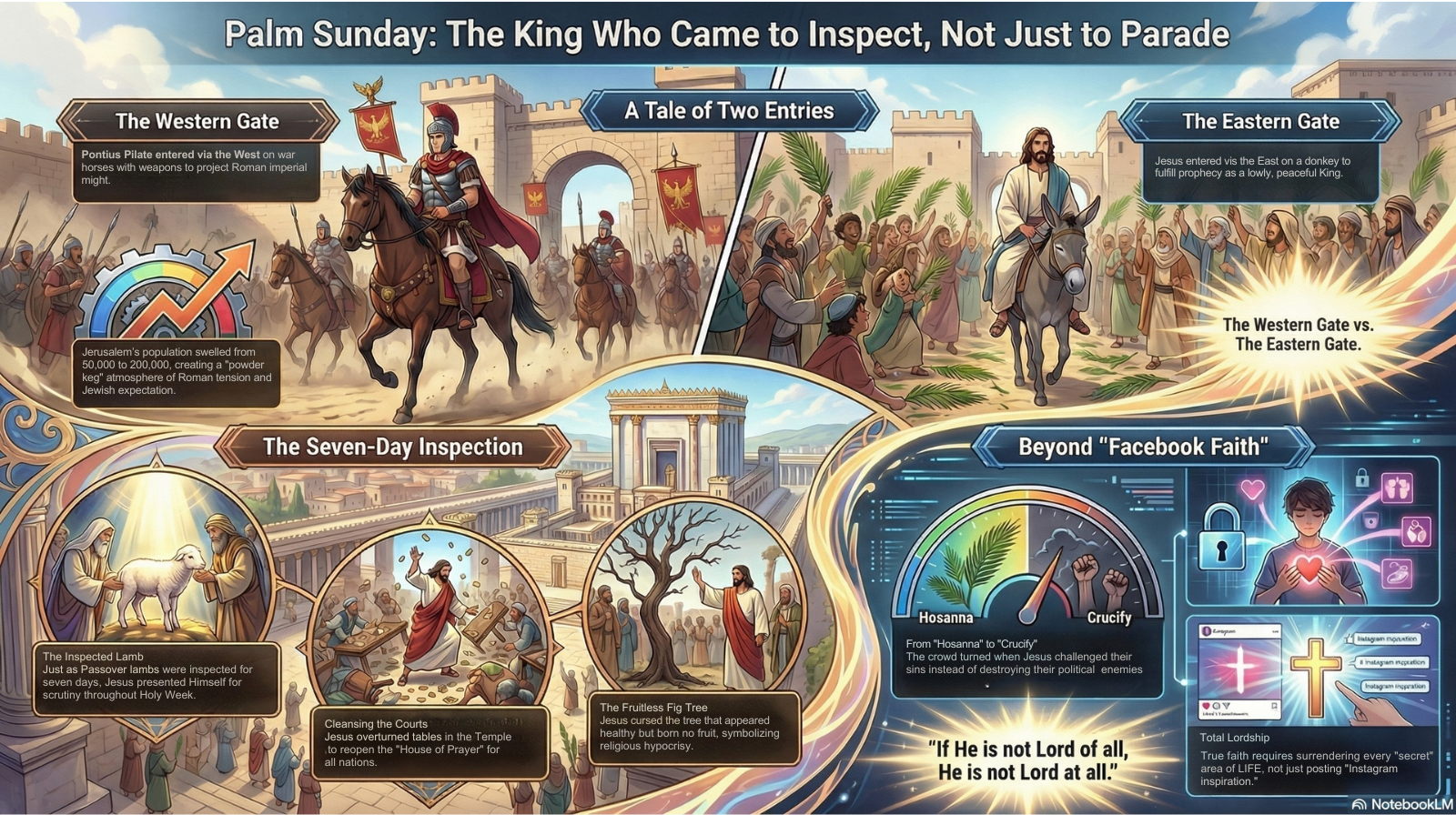
Jesus Didn't Come to Make Friends Palm Sunday Infographic

The Heart of the Message Summary

In this Palm Sunday message, guest speaker Donna Woolam challenges the common perception of the Triumphal Entry, reframing it as a week of divine inspection rather than a simple celebration. While the crowds in Jerusalem sought a political warrior to liberate them from Roman rule, Jesus entered as the sacrificial Lamb of God to confront the deeper bondage of sin. Through a historical lens, Donna contrasts Jesus' humble entry through the Eastern Gate with Pontius Pilate's militaristic display at the Western Gate, highlighting that God's power often looks like weakness to the world. The core spiritual truth is that Jesus is not seeking to fit into our lives as a "miracle-worker" friend but demands to be Lord of all. We are called to move beyond superficial faith and invite Him to cleanse the "garbage" from our hearts through true, transformative repentance.

TRANSCRIPT

The History and Hype of Palm Sunday

It is Palm Sunday. I am curious: how many of you have ever been to a Palm Sunday celebration where they had branches and waved them around? Or maybe the kids had a Palm Sunday pageant or any of that, and you were like, "Why are they doing that? We do not really have palm trees around here. What are we doing?"

I want to give you just a little bit of history of Palm Sunday and show you what it looked like in Jerusalem. The Bible calls this the Triumphal Entry. Now, I am not going to say the Bible is wrong, but those little headings above the chapters were put there by people. I want to change your thinking a little bit. He is triumphant, but I think there was something else going on, and I think I can prove that by Scripture. We are going to talk about that in a minute.

First of all, I am going to pray. For those of you wondering if I am going to pray, yes, I am.

A City Under Pressure

Think about this: the normal population of Jerusalem at this time was 20,000 to 50,000 people. That is a pretty good-sized city, but during a Passover season, the pilgrims coming in would swell that population up to 200,000 people. To put that in perspective, if we took all the people from Hewitt to Bellmead and squashed them into downtown Waco between 18th Street and the river, that is what it was like.

Then you have the Roman government there as well. There were 1,000 police officers walking through, and they were not just trying to be cordial. They carried Roman authority with their swords and shields to keep order because they were afraid of an insurrection. They feared the Jewish people would revolt. While 1,000 Roman soldiers might not seem like enough, they were powerful and mighty, and the people were "soft targets." They did not have the weapons, skills, or training to defend themselves.

On an average Sunday morning, we have about 45 people who come to church here. If we suddenly had 180 people in this room, what would that feel like? Many of you say you like our small congregation, but if we all brought three guests, we would have 180 people. There is a challenge for us in that.

Opening Prayer

Let us pray. Father, we are Your people called by Your name, set in the earth for Your purposes. We are not here by accident; we are here on assignment, on call, and commissioned. Holy Spirit, I pray that You would take whatever words I speak and make them appropriate and relevant for the hearer, giving them just what they need to hear today. Lord, I even say, speak first to me. If there is anything I missed in preparation, let me say it and hear it for myself. Lord, we want You to rule and reign over us. We want You to be our King, but we do not always know what that means. Sometimes we are rebellious people looking for insurrection. Father, I pray You would help us today to hear, to obey, and to be the people of the Most High God. In Jesus' name we pray, amen.

Prophecy and the King on a Donkey

I am going to read from Matthew 21. You can also find this story in Mark 11:1-14, Luke 19:28-42, and John 12:12-13.

Matthew 21:1-11 says:

Now when they drew near Jerusalem and came to Bethphage at the Mount of Olives, then Jesus sent two disciples, saying to them, "Go into a village opposite you, and immediately you will find a donkey tied and a colt with her. Loose them and bring them to me. And if anyone says anything to you, you shall say, 'The Lord has need of them,' and immediately he will send them." All this was done that it might be fulfilled which was spoken by the prophet, saying: "Tell the daughter of Zion, behold, your King is coming to you, lowly and sitting on a donkey, a colt, the foal of a donkey."

The disciples did as Jesus commanded. They brought the donkey and the colt, laid their clothes on them, and set Him on them. A very great multitude spread their clothes on the road, while others cut down branches from the trees and spread them on the road. Can you see that picture? All those people were excited, throwing their coats on the ground. The multitudes cried out, "Hosanna to the Son of David! Blessed is He who comes in the name of the Lord! Hosanna in the highest!" When He entered Jerusalem, the whole city was moved, asking, "Who is this?" The multitude replied, "This is Jesus, the prophet from Nazareth of Galilee."

Misunderstood Messiah

Jesus does not look like a triumphant warrior here; He is a guy on a donkey. Matthew tells us this was to fulfill prophecy. We must understand that the people of Israel at that time were waiting for a warrior king to set them free. They wanted a king to destroy the Roman armies so they could take over their land and rule again. That was the Messiah they were looking for.

They had heard rumors about Jesus and His power. One Gospel says they followed Him because of His miracles and mighty acts of power. They were following Him not because He was the Savior of the world, but because they thought He was going to kick the Romans out of Jerusalem. Welcoming Him with clothes and branches was the historical way Israel welcomed a conquering king. They were saying, "We believe You are our Messiah King who has come to deliver us."

The Two Processions

This happened during the Passover season. Passover was established when the children of Israel were slaves in Egypt. God sent ten plagues and delivered them. They were commanded to take a lamb into their house, sacrifice it, and put the blood on the doorway so God would deliver them and kill their enemies. This is the kind of deliverance Israel wanted from Jesus.

Tensions were high. Something interesting you may not have heard is that there was another great procession happening at the same time. Pontius Pilate usually lived in Caesarea, but during this holy season, he would come into Jerusalem as the ruling authority. Jesus came in through the Eastern Gate on a donkey. Pontius Pilate and the Roman army came in through the Western Gate on horses with weapons. They were the exact opposite of Jesus.

This matters today because we often look at the world and think it has more power and authority over us. But Christians must understand that Jesus—who looked unlike any reigning king we would expect—is the one with all the power, glory, and strength to bring us true deliverance.

Jesus Is Not Making Friends

The people were happy and shouting "Hosanna," but what happens next is not the picture of a man trying to get everyone on his side. Jesus was not trying to gather a following for an insurrection. In fact, during what we call Holy Week, He did the opposite.

In Matthew 21:12, Jesus goes into the temple, makes a whip, and begins throwing it at people, turning over tables, and chasing them out. Does that sound like a guy trying to get on your good side? It might have seemed like they were doing a good thing by buying and selling animals for sacrifices and exchanging money for pilgrims. You might ask, "Why is Jesus being so mean to them? I thought I was doing the right thing."

But they were in the Court of the Gentiles. This was the place God set aside for people from other nations to draw near to Him and pray. Jesus said, "My house is supposed to be a house of prayer." It was supposed to be a place where anyone could come close to God. Instead, they were robbing people by telling them their animals and money were not good enough and charging them three times what things were worth. They were keeping out the very people God wanted to come in.

The Fruitless Fig Tree

The next morning, Jesus saw a fig tree full of leaves. It looked glorious and gave the appearance of bearing fruit, but when He walked up to it, there was no fruit. He cursed it, and by the next day, it was dead. It looked like one thing but acted like another.

Throughout the week, Jesus continued to offend people. He told them they should pay taxes to Caesar. When they asked whose picture was on the coin, He said, "Give to Caesar what belongs to Caesar, and what belongs to God." Since we are made in God's image, we belong to Him.

By the middle of the week, everyone was offended. They thought He was coming to rescue them, but instead, He told them everything that was wrong with them. Consequently, the same people shouting "Hosanna" at the start of the week were screaming "Crucify Him" within a few days.

The Inspected Lamb

To me, that entry does not look like a "triumphal" entry yet. The real Triumphal Entry is when Jesus returns to take all authority over the earth.

This week was actually about the Lamb. Exodus says you bring the lamb in for seven days to inspect it. Jesus stood before the people all week and said, "Here I am. See if you find any fault in Me. I am the Lamb of God who takes away the sin of the world." He did not come to make life easier; He came to take authority and power over what is rightfully His.

We often pray, "God, I need You," but when Jesus starts taking over, we get cranky. We want a "Hosanna King" who performs miracles and gives us resources, but we do not always want a God who says, "I want all of you—your mind, soul, spirit, what you do in secret, and what you do in public." We like things easy.

A Personal Turning Point

I want to share part of my story. At age 12, I was sitting in a small Presbyterian church. I heard the Gospel, and as a 12-year-old girl, I realized I was a sinner in need of a Savior. I was saved right then.

But then nothing happened. I did not know how to read the Bible or pray, so I just did my own thing. Before long, I was living as if I had never met Jesus. It was bad—sexual immorality, drug abuse, lying, and stealing. I got married at 17 to a long-haired hippie from California and had two babies by the time I was 20. We lived a wild life.

Throughout that time, I would hear God's voice calling me. I would get out my Bible, but then we would want to go to a party, and I would throw it aside. Yet the Holy Spirit kept whispering. He put people in my life. There was a lot of witchcraft and demonic activity in my background keeping me from the truth.

In my late 20s, my sister got saved and began to pray for me. I started going to church again, thinking, "I am a Christian, so I will do Christian things." One day, I was sitting on my couch reading Hebrews 10:26-31:

For if we sin willfully after we have received the knowledge of the truth, there no longer remains a sacrifice for sins, but a certain fearful expectation of judgment... It is a fearful thing to fall into the hands of the living God.

My heart stopped. I ran to my room, fell on my face, and cried out, "Oh God, have I rejected You so often that there is no place for me?" I realized I needed real saving.

Lord of All

I read earlier in that chapter that sacrifices could never take away sins. It did not matter how many great things I did; they were never enough. But Jesus, after offering one sacrifice for sins forever, sat down at the right hand of God. By one offering, He perfected forever those who are being sanctified. He promised to write His laws on our hearts and remember our sins no more.

We cannot have a "Facebook faith" where we post "Christianese" alongside our garbage. Jesus wants to pull out the garbage. We cannot just have "Instagram inspiration" and think that makes us right with God. It must be a declaration: "I belong to Him. He is the King. He has the only say in my life." If He is not Lord of all, He is not Lord at all.

We want to add Jesus to our day for five minutes and then do what we want. We are not perfect, but He is. If we are willing and obedient, we shall eat the good of the land. When we give Him everything, He rules and reigns, and there is no better King.

A Call to Repentance

I am not talking about political statements. I am asking: Who is your King? Who has the final say? If it is not Jesus, I ask you to examine your heart. Have you truly repented?

Repentance is not just saying, "I am sorry." If you rob a store and tell the police you are sorry, it does not remove the penalty. True repentance is saying, "I realize everything I have done is wrong. I have broken God's law, and Jesus is the only one who can wash me clean and deliver me."

Then He comes in and does the beautiful work of cleaning the house, putting things where they belong, and writing His laws on our hearts. We cannot do it perfectly on our own, but through the power of the Holy Spirit, we can be the people of God.

My prayer this Palm Sunday is that we would look at our lives and ask, "Lord, what in me is opposed to You that needs to be crucified so that You can rule?" During Holy Week, the tradition was to clean out all the "leaven"—the sin—from the house. They would search every corner with little brooms.

Let us check our own hearts today. If He is not truly Lord, this is your opportunity. I want to give anyone the chance to make a new commitment. Publicly declaring your faith is saying before others, "I choose Jesus."


Tags


You may also like

Baptism Service May 16, 2026

Baptism Service May 16, 2026
Leave a Reply

Your email address will not be published. Required fields are marked

{"email":"Email address invalid","url":"Website address invalid","required":"Required field missing"}