
IT MATTERS WHAT YOU BELIEVE | Mental Health and Healing

Pastor Dustin Woolam | Recorded March 22, 2026
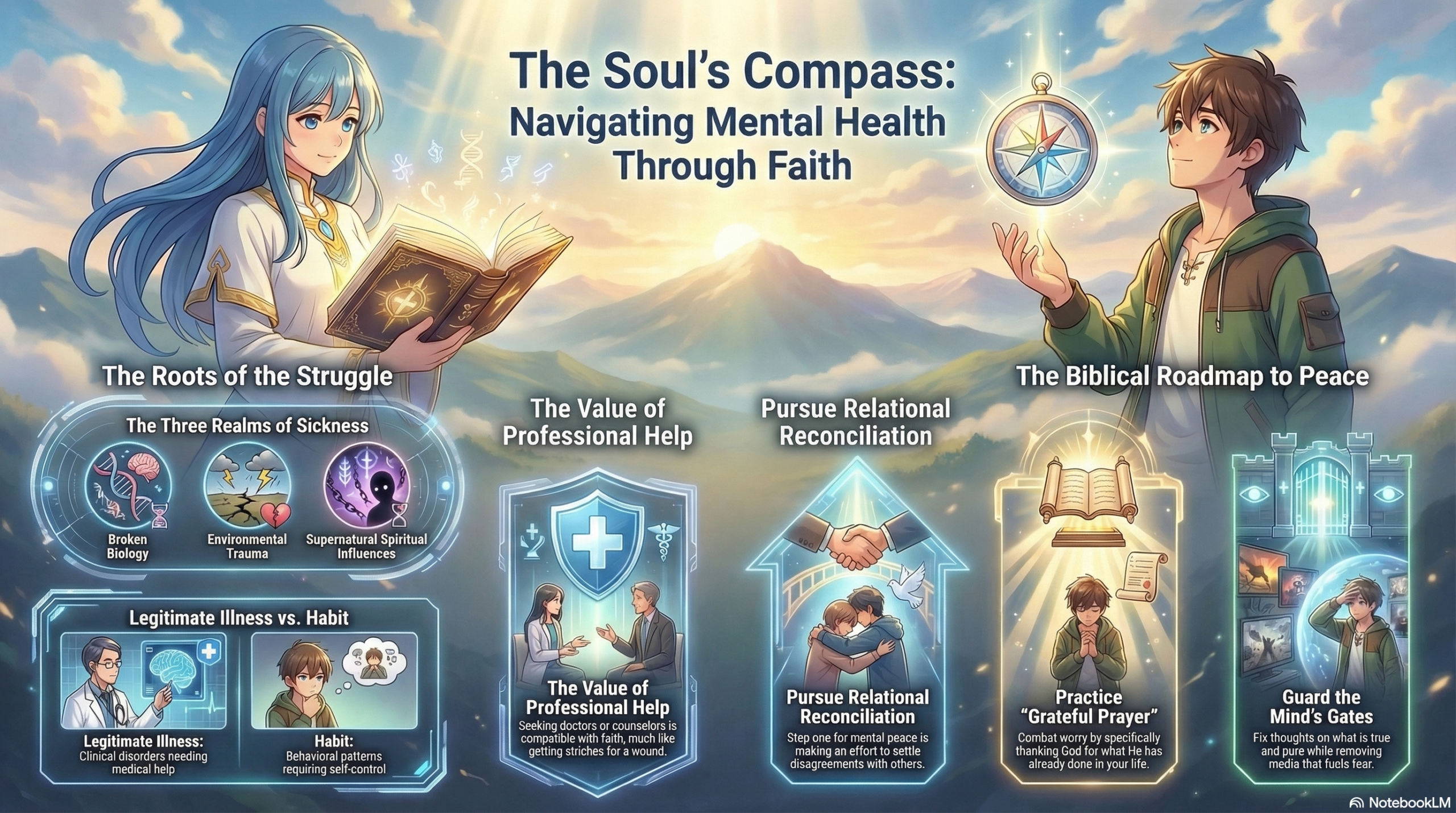
Mental health and the Bible landscape

The Heart of the Message Summary

In this third installment of the healing series, Pastor Dustin Woolam addresses the complex intersection of biblical faith and mental health. The core spiritual truth is that while we live in broken bodies and a fallen world that can trigger anxiety and depression, God provides a practical, sovereign framework for peace through the renewal of the mind.

Pastor Dustin calls the church to move beyond simplistic "demon-only" explanations or modern "self-diagnosis" excuses. Instead, he invites us to a lifestyle of "doing the basics": reconciling with others, practicing gratitude, and strictly guarding our mental intake against things that destroy the soul. The primary call to action is to take an honest inventory of our lives—seeking professional medical help when necessary—while submitting our thought patterns to the clear instructions of Philippians 4 and 1 Thessalonians 5.

TRANSCRIPT

Introduction and Prayer

Father, thanks for today. Thanks for the gift of your Word and thanks for your people. Thanks for the community that you have put us in. I pray that you would teach us to be great members of one another, Lord, as we practice being great followers of Christ. I pray that what is of you would remain and what is not of you would fade. Lord, we give you this time in our hearts and our lives, in Jesus' name. Amen.

This is week three, and next week will more or less be a wrap-up of this healing segment regarding what we believe matters. Next week we will talk about something adjacent to it, but it is a little bit of a turn. In week three, we are talking about healing. As we go through this, I will say some things that are high-level reminders. If it seems like it is missing context, you can go online and check out the two previous weeks to see the progress.

A Biblical Perspective on Mental Health

This week we will talk about mental health. As a disclaimer, I am not a trained psychologist in any way, shape, or form, and I am not going to pretend to be. I do not want to come up here and say a whole bunch of stuff I read in a paper. I do not want to take away from the value of people who have attended those schools and learned those things. However, I think the Bible does say some things about mental health, and I want to talk about those things.

In the scope of that, let's remember last week when we talked about where sickness comes from. It comes from our environment, our choices, and supernatural powers. Depending on where that sickness comes from, there are different ways those things might be addressed in our physical and mental lives. For example, we read in the book of Mark that there was someone who could not speak or hear; when Jesus cast out the demon, they were able to do both.

So, there could be something mental health-related that is spiritual, like a demon. The danger in saying that is that people immediately think, "Well, you just think I have a demon." For a long while in the church, everything was a demon. If someone was depressed, you had to cast out the demon of depression. If someone was anxious, you had to cast out the demon of anxiety. While I do believe that demons can cause those things, I want to start out by saying I do not want to deny the fact that we are in broken human bodies.

The Intersection of Physics, Environment, and Trauma

Sometimes there are things physically wrong with us that cause those behaviors. There can be something physically wrong that causes depression, or something environmentally wrong, such as trauma, that causes anxiety. Even though I do not have an anxiety disorder, I think about going to the doctor. I have surgery on Tuesday, and if I am honest, I am a little bit anxious and nervous about that.

Growing up, my family history was that we did not go to the doctor much. We rubbed dirt on it and took a walk. If it was not broken, you were fine. I have some interesting scars from not getting stitches, but I’ll take the scar. However, I remember many people in my family going to the doctor at the end of their lives. Many chose to use tobacco and died from tobacco-related cancers. I saw more than 15 people in my formative years die from cancer.

In my mind, it is hard to go to the doctor because I do not have a habit of it being good. I have experience with people dying even under a doctor's care. Thinking about being put to sleep for surgery brings some anxiety. But on the way to church this morning, I was thinking about all the babies in the church and the life that comes from medical care. I do not need to be unnecessarily anxious or worried.

There are supernatural things that must be dealt with, there are natural things where environment creates anxiety that practical wisdom helps you overcome, and there are neurological things where diet, exercise, and medication can help. These things often intermingle. Imagine a child who was taught that being sad was bad. As an adult, they may never express "negative" emotions. But I think God would say they are just emotions. What is good or bad is what we do in response to how we feel. The Bible says "be angry and do not sin"; it does not say "do not be angry." It says "in your sorrow act like this"; it does not say "do not be sad."

The Modern Mental Health Crisis

In the last 10 to 15 years, the amount of mental health problems has skyrocketed. Some connect this to the collective trauma of COVID. I saw a paper questioning if certain diagnoses are still valuable because so many people are self-diagnosing. When I was a college minister, students would ask, "Dustin, do you think I am autistic?" My gut response was, "No, why would you think that?" Others claimed executive disorder, and I thought, "That's because your mom didn't make you clean your room when you were five."

Speaking as Gen X, in my environment, it did not matter if you did not want to do it; it still had to be done. Some people experiencing these disorders just need to do something—anything. They need to get started to overcome patterns of behavior and trauma. I want to acknowledge two things: one, there are people legitimately facing mental health difficulties; and two, there is a crowd muddying the waters with self-diagnosis because they are lazy or lack self-control. God knows both exist.

The wisdom of Scripture, like Romans 12:21, tells us to overcome evil with good. The Bible tells us how to live in spite of the years we live in. Whether in togas or in 2026, the right thing is still the right thing. Regarding mental health, let's be mindful of what a doctor says. If I sliced my hand, I could pray, but I still might go get stitches. If you are struggling, yes, let's pray for deliverance, but that does not mean you shouldn't talk to someone or get help.

Lessons from Philippians 4

In Philippians chapter 4, Paul is wrapping up his letter. In verse 2, he appeals to Euodia and Syntyche to settle their disagreement because they belong to the Lord. These were women who worked hard with Paul telling others the Good News, and now they are fighting. Paul says to please solve this because you both belong to Jesus.

He continues in verse 4: "Always be full of joy in the Lord. I say it again, rejoice." Verse 5 says, "Let everyone see you are considerate in all you do. Remember, the Lord is coming soon." We are considerate because Jesus is coming back. Paul says, "Don't worry about anything; instead, pray about everything. Tell God what you need and thank him for all he has done." We are thanking God for what he has already done, which feeds us hope in his character for the future.

Then you will experience God's peace, which exceeds anything we can understand. His peace will guard your hearts and minds. Finally, he says to fix your thoughts on what is true, honorable, right, pure, lovely, and admirable. Think about things that are excellent and worthy of praise. Keep putting into practice what you learned and saw me doing; then the God of peace will be with you.

Practical Steps for Mental Health

When we think about the healing we want from God, are we doing the basics? Am I at odds with another believer? I should make peace right away. Jesus says in Matthew that if you are giving an offering and remember your brother has something against you, go and be reconciled. You should make the effort, even if the other person chooses not to. People will know we are disciples of Christ because we love each other.

Step one is to be right with God. If you are not a Christian, become one. Your soul is broken until you are saved. When you come to Christ, you aren't immediately healthy. It takes work and time. I was a Christian for 35 years before I knew I was depressed and needed to be healed. Just because someone becomes a Christian doesn't mean they are okay right now; they might still need to "wear the cast" while things get better.

Step two is to be right with people. If you can make peace in a relationship, your anxiety often reduces. Mental health involves parts of our lives we aren't in control of—anger, sadness, or the inability to feel sadness. Self-control is a fruit of the Spirit. When we are healthy, we have more awareness of what is going on inside of us.

Joy is not happiness. You can be sad or broken and still experience joy. Sometimes we excuse sin, like laziness, as a mental health trouble. We need to know: am I in sin or am I stuck? If you are stuck, you can still find joy in being aware that you are stuck and that God is working on you. Joy is an antidote for anger. In men, depression is often revealed as anger. In my life, being angry was the only time I felt alive because of the adrenaline. But James says the wrath of man does not produce the righteousness of God.

The Lord taught me to navigate anger. He told me to go somewhere by myself and just breathe. Years later, I learned that oxygen dilutes adrenaline in the bloodstream. The Lord knew how my body worked before I did. We can find places to rejoice by remembering God's past goodness.

Living Considerately and Without Worry

We must be considerate because Jesus is coming back. I tell my kids to think of the next person coming behind you. If you leave a mess in the kitchen, the next person has to deal with it. One of the best ways to get unstuck is to stop looking at yourself and start looking at how you can contribute to others. There is a group called "The Strenuous Life" where you must do a good deed every day for weeks without anyone noticing. If you live thinking about God and others, it breaks the "stuck on me" cycle.

As we grow, we should stop being so selfish. Often, we think people are doing things "to us" when they are just making decisions that happen to impact us. It doesn't hurt to serve; it might cost you something, but God will care for you. For the joy set before him, Jesus endured the cross.

Regarding worry: pray about everything. God cares about you more than the birds and the lilies. If you are worried, take it to the Lord. Be thankful for what he has already done. Practice being grateful, even for the smallest things. The "Olympic win" of being grateful might start with just not falling when you stand.

Guarding the Mind

Fix your thoughts on what is good. A lot of people with troubled mental states fill their minds with things they shouldn't. As a Christian, you should never watch a horror movie for any reason. You are entertaining demons and shouldn't be surprised when something negative happens in your mind. Fear is the opposite of faith. Stop watching things that make you angry or are sexually explicit. You cannot watch those things and wonder why your relationships are broken.

It may be unpleasant to do what is healthy in the beginning, like switching from energy drinks to water. But over time, the Word of God becomes life-giving. The Bible never says it is easy, because God is telling us to live as visitors in a world that functions differently.

Final Instructions

In 1 Thessalonians 5, Paul urges us to warn the lazy, encourage the timid, and take care of the weak. Be patient with everyone. Do not pay back evil for evil. Always be joyful, never stop praying, and be thankful in all circumstances. Stay away from every kind of evil.

Before we self-diagnose, let's take inventory. Am I doing what the Bible says? The maker of the stars knows your name and what you need. Maybe you need to forgive someone or admit you were mistreated. I was instantly healed of depression, but for my physical health, the Lord made me go to the doctor. He doesn't waste anything—not the pain, the struggle, or the sorrow. Look at Philippians 4 and 1 Thessalonians 5. Start with what God is asking you to do.

Father, thank you for a clear way to live that puts our hearts in order. You speak clearly and give us guidance. I pray for strength for all of us as we look at the broken, tender places. Give us courage to open the closet doors we’ve kept shut. Teach us to be kind and patient. We love you. Amen.


Tags


You may also like

Baptism Service May 16, 2026

Baptism Service May 16, 2026
Leave a Reply

Your email address will not be published. Required fields are marked

{"email":"Email address invalid","url":"Website address invalid","required":"Required field missing"}