
You're Asking the Wrong Question | Give Me Jesus

Dustin Woolam | Pastor & Lead Elder
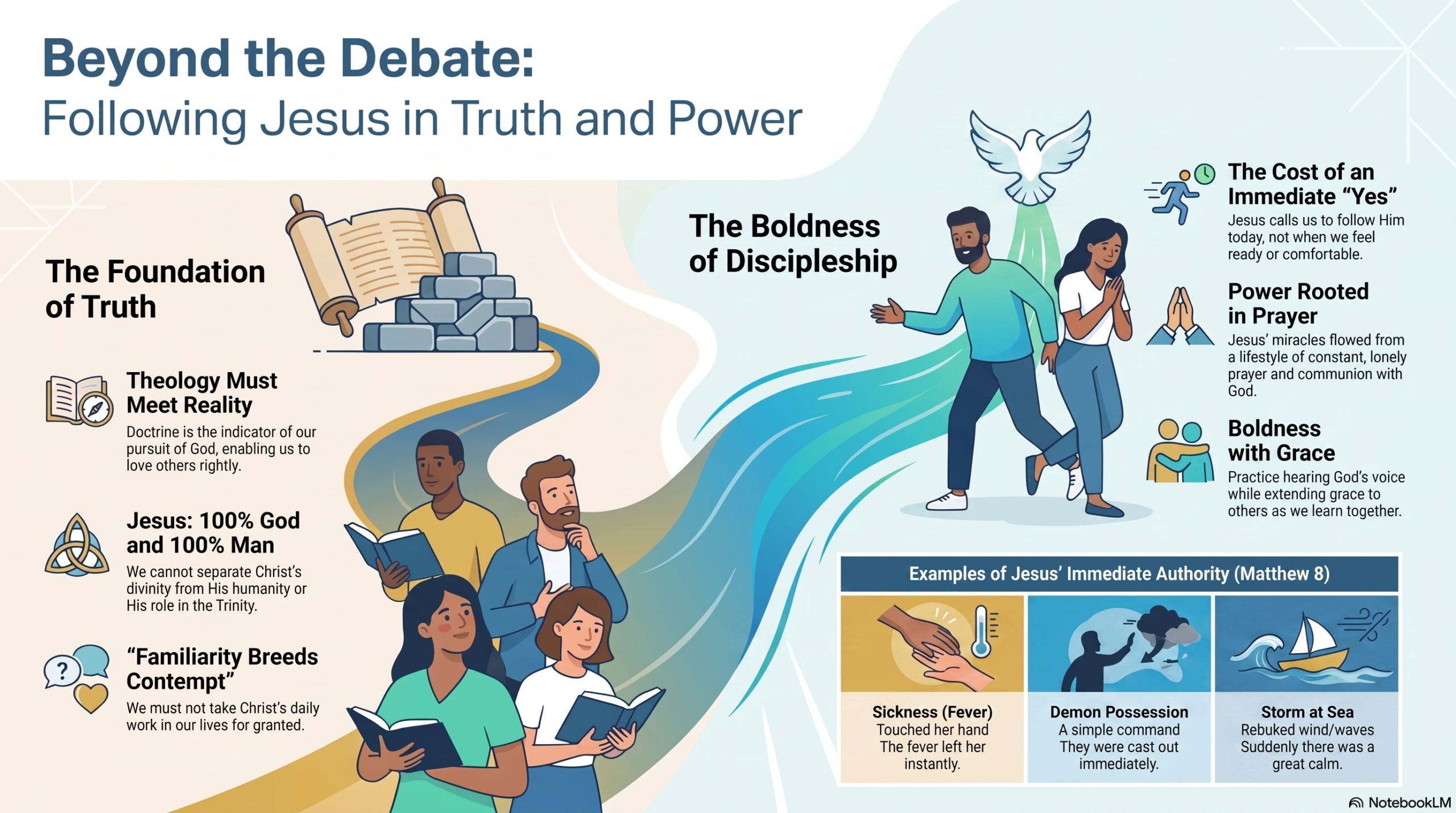
You're Asking the Wrong Question Infographic

The Heart of the Message Summary

In this sermon, Pastor Dustin Woolam explores Matthew 8 to highlight the reality of living out a wholehearted faith. True discipleship requires more than intellectual debates over doctrine or passive Christianity; it demands a willingness to count the cost and follow Jesus immediately. Jesus demonstrates divine authority over sickness, spiritual torment, and the elements, yet He calls His followers into total devotion and a vibrant life of prayer. We are invited to step out in bold, compassionate action—praying for the sick, sharing truth in love, and listening for God's direction—while extending grace to one another as we learn. The primary call to action is to say an unconditional "yes" to Jesus today, cultivating a daily lifestyle of prayer and active faith rather than settling for spiritual familiarity or fear.

TRANSCRIPT (word for word)

Hey, welcome to church. Let's pray.

Father, thank You for today, the gift of Your Word, and the gift of Your body. Lord, I thank You for just a place to meet and to come and to know You. I pray, as I always pray, that You speak to us today. Lord, the things that are of You would remain, and the things that are of us or anyone else would fade away, in Jesus' name. Amen.

Balancing Theological Debate and Practical Love

I will be in Matthew 8 if you want to turn there. I was thinking a lot this week about changes in life and trying to reflect on things. I had some interesting conversations, and then even what Rufus shared with us just now kind of all goes along with the thing I was thinking about. So, it's not all the time, but this week was a higher number of things.

I tend to find myself in these conversations about theology or doctrine or points of view, partly because those are the things that interest me, and partly because since I'm interested, people think I know, so I try to study and make sure that I do.

In some of the conversations I had this week, Jamie was watching some stuff on the internet and asked me, "What do I think about eternal torment versus annihilation?" This is something I've thought about in the past, so she and I talked about it. I was talking with someone else about the nature of God when it comes to His glory, His greatness, and the way different groups of Christianity talk about it.

I spent some time studying through different views of spiritual freedom—as far as inner healing or praying for someone for deliverance—and all these different things. So I am chasing that trail and having conversations about it.

I am also working through a debate in Christianity. In my experience, when there is debate, usually both sides have something right and both sides have something wrong. There is this debate between: Did Jesus do His miracles because Jesus was God, so as God He could do whatever miracle He wanted to do? Or did Jesus come to earth functioning solely as a human, not using His power at all as God, but instead all the miracles that Jesus did were done through the power of the Holy Spirit?

That is a big tension, and as I have said many times, I am with both perspectives. There are things in the Scriptures that undeniably speak to the fact that Jesus' miracles were done by the power of the Holy Spirit, and there are things in the Scriptures that undeniably point to the fact that Jesus did things because He was God.

When you start trying to figure out if it was Jesus or the Holy Spirit, I think about one of my favorite theologians who lays out all this stuff and then says, "Wrong question." The point isn't how Jesus did these miracles; the question is who is doing the miracle, and it is God. God is doing the miracle. Jesus is 100% human and He is 100% God; you cannot separate those two things. In the same way, you cannot separate Jesus from the Father or separate Jesus from the Holy Spirit. To do so makes Him not a person of the Trinity in unity, but that leads to partialism, which is heresy.

I love thinking about all these things, and I think there is value in them, but then what happens in the midst of all these conversations? Our neighbor talks to my wife, and her daughter, who is only 19, has a ton of protein in her blood. They don't know why and think it could be leukemia. They go get tested, and they say, "It's not leukemia, but we don't know what it is."

At the end of the day, how much does annihilation versus eternal damnation matter to that lady in the parking lot? What mattered was that Jamie was there with her to talk with her, listen to her, and pray with her. It doesn't mean those other things don't matter. They are good, right, and important. The fact that Jamie had that question is an indicator of her pursuit of God, and in her pursuit of God, she found a way to be available in a tangible way.

So it's not one or the other. We can't just say, "Theology and doctrine don't matter because I'm just going to love people." You could love them right into destruction if you don't know truth. But also, you can't be so busy saying, "Hold on, I have to study and get every little minutiae right or I can't love you the right way." You can't do that either.

As we look at Jesus through the Gospels in this series, the thing I always want to be mindful of is that Jesus was all of that at once.

Speaking Truth in Truth and Love

The example of Christ is sitting down with religious leaders. Jesus is talking with the Sadducees, and the Sadducees only believe in the five books of Moses as Scripture. The Torah—Genesis, Exodus, Leviticus, Numbers, Deuteronomy—that's it. They don't believe in the resurrection of the dead.

So the Sadducees come to Jesus and tell Him a scenario based on Levirate marriage. The way it worked was if a man got married and died without having a child, his brother would marry the woman to care for her and continue the bloodline. The Sadducees say, "A woman was married to a man, he died with no children, so the second brother married her, and so on down to seven brothers. Whose wife is she in the resurrection?"

They were trying to trap Him because they didn't even believe in the resurrection. But Jesus doesn't argue all of that with them; He tells them the truth about how the resurrection works. Then He points out that God is not the God of the dead, but the God of the living. When God speaks to Moses, He says, "I am the God of Abraham, Isaac, and Jacob," not "I was." God is indicating that Abraham, Isaac, and Jacob are still alive.

When we talk with people on the internet, in person, or wherever, we want to speak the truth. We want to have enough knowledge of the Scriptures that we can be like Jesus. Jesus says in the Gospel of John and in Matthew that the Holy Spirit will teach us what to say in those moments. It is about standing in truth without trying to just win an argument or get someone, because Jesus still loves the people He comes in contact with.

Authority Over Sickness and Darkness

As we look at Matthew 8, starting in verse 14:

"When Jesus arrived at Peter's house, Peter's mother-in-law was sick in bed with a high fever. But when Jesus touched her hand, the fever left her. Then she got up and prepared a meal for him. That evening, many demon-possessed people were brought to Jesus. He cast out the evil spirits with a simple command and he healed all the sick. This fulfilled the word of the Lord through the prophet Isaiah who said, 'He took our sicknesses and removed our diseases.'"

Skipping down to verse 28:

"When Jesus arrived on the other side of the lake in the region of the Gadarenes, two men who were demon-possessed met him. They lived in a cemetery and were so violent that no one could go through that area. They began screaming at him, 'Why are you interfering with us, Son of God? Have you come here to torture us before God's appointed time?'"

Jesus went into a region that was mostly Gentiles. These demons are asking why He is interfering there.

"There happened to be a large herd of pigs feeding in the distance. So the demons begged, 'If you cast us out, send us into that herd of pigs.' 'All right, go,' Jesus commanded them. So the demons came out of the men and entered the pigs, and the whole herd plunged down the steep hillside into the lake and drowned in the water. The herdsmen fled to a nearby town, telling everyone what had happened to the demon-possessed men. The entire town came out to meet Jesus, but they begged him to go away and leave them alone."

Then in Matthew 9:1:

"Jesus climbed into a boat and went back across the lake to his own town, Capernaum. Some people brought to him a paralyzed man on a mat, and seeing their faith, Jesus said to the paralyzed man, 'Be encouraged, my child, your sins are forgiven.' But some of the teachers of religious law said to themselves, 'That's blasphemy! Does he think he's God?' Jesus knew what they were thinking, so he asked them, 'Why do you have such evil thoughts in your hearts? Is it easier to say your sins are forgiven or stand up and walk? So I will prove to you that the Son of Man has the authority on earth to forgive sins.' Then Jesus turned to the paralyzed man and said, 'Stand up, pick up your mat and go home.' And the man jumped up and went home. Fear swept through the crowd as they saw this happen, and they praised God for sending a man with such great authority."

Overcoming Spiritual Familiarity

When we look at these moments—Peter's mother-in-law, the demon-possessed men in the cemetery, and the paralyzed man—we see the fulfillment of Isaiah: He took our sicknesses and removed our diseases.

If we are not careful, these miracles become just great stories that Jesus did a long time ago. But Jesus is still alive, and He still came to remove diseases and heal sicknesses. The question becomes: To what degree do we see that in the world today, and to what degree should we see that?

There is a phrase: "Familiarity breeds contempt." If you are used to something, you can take it for granted. A friend of my dad's, Roger, noticed one day that his son Michael walked through the room and casually flipped a light switch without having to reach up for it. Roger realized his son had been growing up, but because he was around him every day, he hadn't noticed the gradual change.

Sometimes that happens with us in Christ. We don't realize all that He is doing in our life all the time. We start wondering where He is and what He is doing, like a fish in water looking for water, not understanding the nature of what surrounds it. We are not aware of air until we don't have it or until someone points out your breathing.

I was in a meeting on Friday with someone who knew me years ago before the Lord healed me from depression. He was describing me based on who I used to be. But other people in the room were sharing how kind I was, which caught me off guard. The difference is that growth often happens day after day, step by step, in ways we don't immediately track.

We read these stories about Jesus doing miracles and wonder how to process them. We live in a culture where people are skeptical because so many have done deceitful things in the name of God. There are leaders who turn out to be frauds, and it leaves people wondering if biblical accounts were real.

We don't just want a passive belief that can't be reasoned with. In Jude and Hebrews, the writers mention wanting to talk about deeper, complex things, but the believers still needed basic nourishment. I don't want us to look at Jesus' miracles and reduce them to mere talking points or dismiss them as things that only applied to Him. They are examples of the kingdom power made available to us.

The Cost of Following Jesus

In Matthew 8:18:

"When Jesus saw the crowd around him, he instructed his disciples to cross to the other side of the lake. Then one of the teachers of religious law said to him, 'Teacher, I will follow you wherever you go.' But Jesus replied, 'Foxes have dens to live in and birds have nests, but the Son of Man has no place even to lay his head.' Another of his disciples said, 'Lord, first let me return home and bury my father.' But Jesus told him, 'Follow me now. Let the spiritually dead bury their own dead.'"

Then Jesus got into the boat, a fierce storm arose, and Jesus was sleeping. The disciples woke Him shouting, "Lord, save us, we're going to drown!" Jesus asked, "Why are you afraid? You have so little faith." Then He rebuked the wind and waves, and suddenly there was a great calm.

Peter's mother-in-law was sick, then she was well. The paralyzed man was immobilized, then he walked. The storm was raging, and suddenly there was a great calm.

Jesus makes it clear that there is a cost associated with being His disciple. To one man, He explains that following Him means relinquishing comfort and security. To the other man, who wanted to wait until a future time after managing his family affairs, Jesus says, "Follow Me now." He calls for immediate obedience, not waiting until it is convenient.

Following Jesus isn't just punching a ticket or making a one-time decision. It means walking with Him as He casts out darkness, forgives sins, heals the broken, and confronts systemic error. In Acts, people recognized that Peter and John had been with Jesus because they preached boldly and operated in His power. Paul encountered Jesus, and his life was so completely transformed that he considered living as Christ and dying as gain.

Walking in Boldness and Prayer

Dietrich Bonhoeffer said, "When Christ calls a man, he bids him come and die." Following Jesus requires surrendering our self-will. It means having our "yes" ready for whatever He asks.

We need balance in the church. We need those who eagerly pursue where the Holy Spirit is moving, and we need those who carefully test things against the Word of God. Both work together so the body functions healthy and grounded.

As a body of believers, let's commit to saying "yes" to the next thing Jesus asks of us. If you feel prompted to do an act of kindness or pray for someone, step out in faith. Use wisdom and humility. Don't speak recklessly or manipulate situations by claiming "thus saith the Lord" over someone's personal decisions. Instead, approach people with gentleness: "I was praying and had this thought; would you pray about this with me?"

When praying for the sick, pray boldly. Scripture records Jesus and the apostles laying hands on the sick and seeing them restored. While we know full ultimate healing rests in God's sovereignty, our responsibility is to trust His goodness and pray with confidence. We don't need performance or fanfare; we simply ask our good Father to do good things.

All of this flows from a life of prayer. Jesus frequently withdrew to lonely places to pray. His ministry power was rooted in His constant communion with the Father.

What would our lives look like if we prayed about everything? I encourage you to make prayer a regular part of your day. Listen to the Scriptures, play worship music, and talk openly with God.

Additionally, prioritize corporate prayer. On the first Wednesday of every month, we gather for worship and prayer. Jesus prayed alone, but He also brought His disciples with Him to pray in Gethsemane. There is distinct power when the church gathers to seek God together.

Let's be a people who cultivate a heart turned toward the Lord so that sharing His love and walking in His power becomes natural.

Let's pray.

Father, thank You for Your Word. Thank You for the example of Jesus and the reminder that Your grace is costly. Help us to be attentive to what You are asking of us individually. Give us wisdom in how we love, pray for, and encourage one another. Teach us to walk as Jesus walked, with true spiritual boldness and deep humility. Remove fear and replace it with faith. Help us to follow You faithfully every day. In Jesus' name, Amen.


Tags


You may also like

Leave a Reply

Your email address will not be published. Required fields are marked

{"email":"Email address invalid","url":"Website address invalid","required":"Required field missing"}