
Jesus' Perspectives Jesus' Priorities | Give Me Jesus

Dustin Woolam | Pastor & Lead Elder
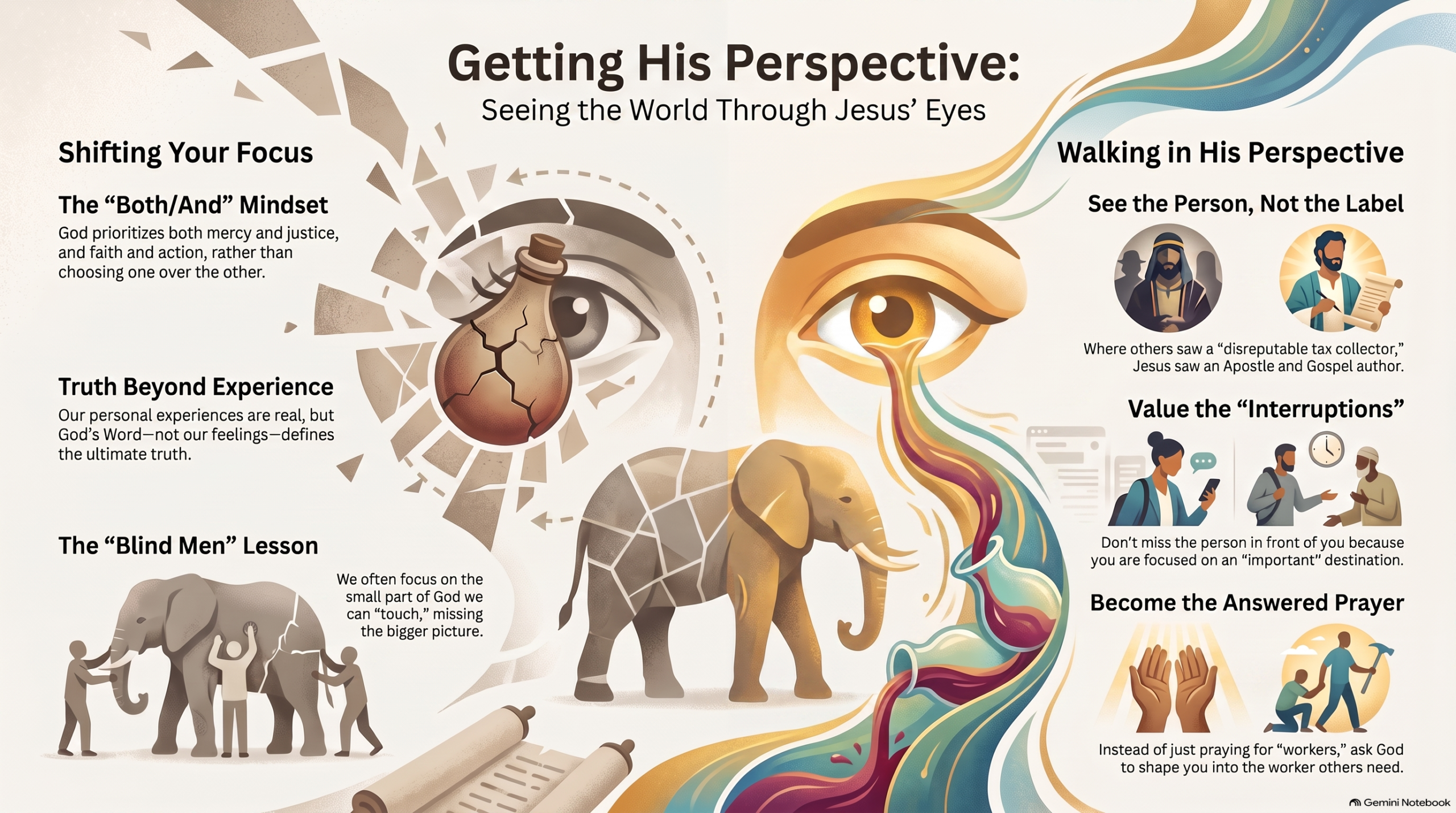
The Heart of the Message Summary

In this message from Matthew 9, Pastor Dustin Woolam calls the church to align their personal perspective with the heart of Jesus. Rather than trapping ourselves in narrow "either/or" thinking or letting limited personal experiences define God's truth, we must see people through Christ's eyes of mercy and compassion. Jesus actively engaged with tax collectors, outcasts, and the hurting, proving that God desires transformed hearts over empty religious rituals. The primary call to action is twofold: stop relying on superficial religious box-checking, and step into the harvest field as active workers. We are challenged to extend God's grace into every everyday interaction, praying not only for God to send workers, but asking Him to shape us into workers in His harvest field today.

TRANSCRIPT (word for word)

Opening Prayer and Introduction

Father, thank you for today. Thank you for the gift of your body. Thank you for the gift of your Spirit. We're going to pray that as we look into your word today, what's of you would remain, and what's of us or what's of any other source would just not rest, or that we would go from this place having learned from you and having been washed in your word. We give you this time, we give you our hearts, and we place all our hope in you. In Jesus' name, amen.

In our series, "Give Me Jesus," it sounds weird because He's already given for us, but I like the name "Give Me Jesus" because that's where I want my heart to be. We're just working through the Gospels. In Matthew 9, there are some stories. We've already talked about some of it, but Jesus calls Matthew. They talk about fasting. Jesus heals some people—a lot. And then He talks about needing workers. Any of these individually, we could talk about and do a lot of teaching on, but one of the things that struck me as I was praying and thinking through the next portion of Matthew was that each of these snapshots revealed to us something about Jesus' perspective on things.

Understanding Jesus' Perspective

The thing I want to share today, and the thing I think the Lord is wanting us to understand today, is that there's His perspective on stuff, and His perspective is often not ours. I think that sometimes what happens is that we'll look at things in the scripture, and we as people—maybe it's just the people I've been around, so maybe this doesn't resonate with you—but the people I've been around, it's often either/or. It's this or it's this. It's that thing right there, but not this thing right here. We have this sort of priority system.

I think a lot of what happens in God's priorities is He really places priority on a lot of things. It's not of this or that; it's both of these. It's mercy and it's justice, right? It's faith and it's grace. It's faith, and once you have faith, there's things you should do. Where we would say one or the other, God's like, "Yes to all of it." That's where theologians kind of get a bad rap—there's funny memes out there like, say the word "theologian," it's "both/and," and then it's this funny thing. But it is "both" a lot with the Lord.

As we go through this and look at some of Jesus' priorities, when Jesus says we need people to work in the harvest, He's not saying that His healing the sick is less important, right? And He's not saying that the blind seeing is less important.

The Illustration of the Blind Monks

I was thinking about this, and one of the stories that I've heard a lot growing up—and they always try to use it to teach you critical thinking, perspective, or all these other things—is an old story. I think the origin is India, don't quote me on that, but the story goes either four or six monks, depending on the version, sitting on the side of the road, and they're all blind. They've had these conversations about what an elephant might look like, but they've never experienced an elephant, even though they sit by the road and hear them go by.

Finally, somebody's passing by with an elephant, and they're like, "Hey, we hear that you have an elephant. Can we experience this elephant? We're blind. Would you allow us to put our hands on this elephant so we can know what it's like?"

The first monk reaches up and touches the elephant on the side and he's like, "Oh, an elephant is like a wall, right?" The next blind man grabs the elephant's trunk and says, "No, no, no, the elephant is like a snake. You're wrong, it's not like a wall." The third guy grabs the elephant by the tusk and says, "No, if it's like anything, surely it's like a spear. That can't be what an elephant is." Another man grabs the elephant by the leg and says, "No, no, it's like a young, strong tree, is what an elephant is like." And then finally, this last guy grabs the tail and he's like, "You guys are all crazy, an elephant is like a rope."

Are any of these guys wrong? No, they're all correct. They just have a limited experience of what an elephant is. A lot of times when we in the church or we in our own lives begin to think about God's priorities, we will sometimes focus on just the thing that we were able to touch or just the thing that's most recent in our lives.

At times when life is hard, we'll say that the Christian life is suffering. We should suffer well, and that's true. At times, like I was thinking this morning, how grateful I am for how wonderful things in my life are working out right now, so the Christian life is blessing. Well, yes to both. Sometimes we're in the valley, and sometimes we're out of the valley. But that doesn't mean that all of my life should be suffering, and it doesn't mean that all of my life should be blessing. If I get a choice, obviously I'm going to take blessing. But there are camps in the church that will argue with each other about which is the true Christian experience.

What I want us to do as we read in Matthew is begin to look at what is the experience that Jesus is teaching us as we explore the scriptures. What is Jesus' perspective on the human existence? First off, God made us, so He knows what He intended.

Expanding the Heaven and Earth Space

When I think about what the Lord's intent for humanity was, I like to always go back to the garden. That's where He put us. He put us in the garden and He said, "Hey, here's this garden, this really great place. What I want you to do is spread this garden over the whole earth." The garden in the Old Testament is this heaven-and-earth place where heaven and earth overlap. It's where God would come and be with humans, and humans would be with God. As the Garden of Eden spread, the heaven-and-earth place would spread.

When Jesus comes, He makes His home in our hearts, and we together are the temple. Now, until the end of time when God makes everything new again, everywhere we go should be that heaven-and-earth place. From God's perspective, what does that look like today? That's what I want to look at while we go through Matthew.

The Story of All My Glory on Six

Let me say this just because I was thinking about it. My uncle Dennis, my dad's younger brother, his son Brian, and my brother Monty are the characters in this story. Had some other cousins there, Nikki and Rachel; they're the audience. I did not attend this event, but my brother tells it in the most wonderful way.

Brian is about seven years younger than me, and my brother's a year and a half younger. For whatever reason, my brother Monty went to my uncle Dennis' house to spend the night, and they're playing the Game of Life. We're all familiar with this game. You spin the wheel, you drive around in your little car, and at the end, you have to figure out who wins Life—which is funny because we all want something different, but in the game, it's the person with the most stuff who wins. In fact, at the end of the game, you can trade in your family for money because money is the way you keep score. You can just roll up to the end and be like, "I have it all, I win," or you can go into retirement and take a respectable second place.

In the version of Life that they were playing—and I don't know if this is house rules or real rules—there's this rule where you can put all of everything you have on a number, like one through nine. You spin the wheel, and if it lands on the number you pick, you win, no matter how much you put down. If you're willing to bet everything, you win, or you just punch out and you lose—you're dead last. You could go from second to last, or third to first.

My uncle was playing with his kids—Nikki, Rachel, Bryan—and my brother Monty was there. Bryan is so far ahead of everybody. He's a little guy, elementary school for sure, and he's so excited he's beating his dad at this game. My uncle Dennis uses this phrase that I've heard my brother and cousin say—when they get together, they've told this story many times: My uncle Dennis says, "I'm putting all my glory on six."

I've heard "all my glory on six" over and over. Bryan's excited because now Uncle Dennis is going to go from last place to really last place. Bryan just wants to win, like all of us in our family love to win. Uncle Dennis spins the wheel, and it lands on six! He cheers, everybody points at Bryan and starts laughing, and Bryan gets mad and just flips the board like you do.

There's just this moment of, man, he went all in on six and he wins. The problem is, as funny as that story is, every time I've played Life since with any of those people, when it comes to the end of the game, they always choose six. Every time! And nobody's won since; only my uncle has won.

God Defines the Truth

The thing of it is, we can get so committed to one perspective and one amazing moment that we miss so much of the rest of life. As we start looking through these stories, let's be inspired. The other thing that I don't want to do, kind of like the thing with the six, is I don't want us to get to the point where it's like, "My experience is what defines the truth, right?"

What defines the truth is God—and not just what, but who. God tells us what's true and what's not. There is a right answer to a lot of the questions we have in the scripture. Rich Mullins famously said, "God didn't give us the Bible so that we could prove who's right. He gave us the Bible to prove He's right and the rest of us are guessing."

When we read things like 1 Corinthians 14, Paul says, "Earnestly desire spiritual gifts, especially that you may prophesy." Depending on what you believe about prophecy in the modern age, you're going to change what that means, but God meant something when He said it. What we need to do as readers is to be careful to understand what God was saying and not base it off of our experience.

There are two really strong errors I think about regarding that scripture. I promise we're going to Matthew, but I'm not going to rush there too much because I want this example. When you read that, if you come from a camp of Christians—the two titles we'll use are continuationist and cessationist. What does that mean? A continuationist means you believe the gifts of the Spirit still continue—all the gifts—and you might have different ideas about how they continue, but you believe that they continue. A cessationist would say, "Nope, when the apostles died or when we got the canon, all those miracles stopped." So God still speaks to us, but He speaks to us only in His word.

If you're on the cessationist side and you read 1 Corinthians 14, one thing I'll often hear people way over on that side say is, "Well, prophecy is preaching, right, because the Old Testament prophets spoke for God. So on Sunday morning when the minister speaks, that's prophecy because the minister is speaking for God." Then there's way on the other side where people will say, "Well, you can teach someone how to prophesy; just imagine what Jesus would say and say that, and then that's prophecy." The problem is, neither one of those are gifts, right? The Bible says that prophecy is a gift of the Spirit.

Sometimes when we hear things, we'll be wrong. We'll follow down the wrong road, and that's not the end of the world most of the time. The important thing is that we remain teachable as we seek the Lord's perspective. When we approach something that we're really not sure about, let's just be okay with not knowing and asking God for the answer.

Matthew 9: Calling a Tax Collector

Finally, as promised, Matthew chapter 9, we're going to start in verse 9:

"As Jesus was walking along, he saw a man named Matthew sitting at his tax collector's booth. 'Follow me and be my disciple,' Jesus said to him, so Matthew got up and followed him. Later, Matthew invited Jesus and his disciples to his home as dinner guests, along with many tax collectors and other disreputable sinners. But when the Pharisees saw this, they asked his disciples, 'Why does your teacher eat with such scum?' When Jesus heard this, he said, 'Healthy people don't need a doctor, sick people do.' And then he added, 'Now go and learn the meaning of this scripture: I want you to show mercy and not offer sacrifices. For I have come to call not those who think they are righteous, but those who know they are sinners.'"

Jesus is walking through and He sees Matthew. Where all of the religious people see a tax collector, Jesus sees the author of one of His gospels, right? So He says, "Matthew, come and follow me, come here." Matthew is so excited about Jesus. Who knows—maybe Jesus has been passing through town, or this is the only compartment where Jesus has been, so Matthew is probably aware of Jesus in some regard, right?

I always had this imagination as a kid that Jesus just shows up in the town—I don't know if you've seen the movie Rambo: First Blood, but John Rambo just shows up to town and he's passing through and the cop's like, "No, keep going, buddy." In my head, that's how Jesus showed up. Just out of the blue, He's walking down the coast, He's like, "Hey, James and John, come with me, I'll teach you how to be fishers of men." With zero context, these guys said yes. In my mind, I'm like, "This is crazy town; who would do this?" Maybe James and John, right? They are the Sons of Thunder, which means maybe they're prone to some examples.

Knowing more now about how that first century worked, Jesus probably showed up and started teaching, and that was His habit, right? We learned from earlier in Matthew that He would go to the synagogues, He would teach, and He would do these things. He's interacting with the Pharisees. So there's something about Jesus that when He says to Matthew, "Come and be my disciple," Matthew's like, "Yeah, this is worth everything I have."

It's not just "come and be my disciple" and "come and be my learner," but there's a whole context where Jesus is saying, "Come and live my life, right?" We talked last week about the guy who wants to follow Jesus and He says, "I don't have anywhere to live, but if you want to come, come along." So Matthew says, "Yeah, I'm going to be Jesus' disciple."

Mercy Over Sacrifice

So what does he do? Because he's a party animal and just barely saved—if he's even saved at all at this point before Jesus' death—you know how it goes. Somebody who's just barely saved and likes to party and they're excited, they're going to throw a party. So what does Matthew do? He's like, "Man, I'm a disciple, this is great; let me invite all my sinner friends over to a party and we're going to talk to Jesus."

I've seen this done well in media, and I've seen it done poorly, but the thing that I really like about what the Bible says is it's kind of scandalous, right, that we have Jesus coming at the invitation of Matthew and all these other people. I kind of wonder if there wasn't a part of Matthew's heart that was turned toward the Lord, but he found himself stuck because money is really nice. We don't know, and I don't want to speculate too much. But based on the Pharisees' response, I feel certain that if Matthew had invited a Pharisee, that Pharisee would not have come.

Based on what I know about tax collectors—because it says tax collectors and other disreputable sinners—tax collectors are disreputable. Would Matthew have even been welcome at the synagogue? But here's Jesus, who's doing all this amazing stuff, who says, "Follow me." Matthew responds to the call and invites Jesus.

The Pharisees are like, "What are you doing?" The thing that I like that Jesus says—He assumes that Pharisees know the scriptures. There's no debate there. In fact, if you look at history, what we know is that the expectation of a Pharisee, a Sadducee, or these leaders is that they would have memorized the entire what we call the Old Testament, and probably a lot of other stuff. So Jesus doesn't tell them, "Hey, go read the scripture you've never heard of." He says, "Learn what this means."

What Jesus' perspective was: God established the sacrificial system. God wanted them to do it. In fact, in Romans 7, Paul says that the law is good, right? The law is good, but what Paul says is that it can't save you. So God, in this quote from the minor prophets, is telling the people of Israel, "I desire mercy and not sacrifice."

There's this thread that goes all through the Old Testament where God says, "I wish you would rend your heart and not your garments." And He says, "I'll take a heart of stone and I'll give you a heart of flesh." David, who's a train wreck, is a man after God's own heart. What we see is this thread all through the Old Testament of what God wants is the people's hearts. The sacrifices are the way that they make it to God, that they can be fit for holy space and even pay for their sins annually on the Day of Atonement.

When Jesus says to them, "Learn what this means," and pairs that with, "Hey, it's the sick that need a doctor and not the healthy," He's saying something that gets lost. A lot of times, we'll see this if you're very much on the internet or in the news: We'll see people who are Christians who are really like, "I'm right and you're dumb, right?" It's not even "I'm right and you're wrong," it's "I'm right and you're dumb." We have all this "it's this, it's this, it's this."

Then we have other people who are not Christians who are like, "Even if Jesus is real, you're kind of a jerk and I'm not super interested." Then we have Christians who are really rejecting being a jerk, so they're like, "Just come and be whatever you want, Jesus loves everyone." Yes, but you can't stay the way you came! Jesus never let anyone stay the way they came. Simon the Zealot had to dial it back, right, and Matthew, who was a sinner, had to dial it up. They had to get to where Jesus was, and He taught them and walked with them.

Jesus' perspective on people who are outside is that He's going to reach out to them because they need Him, and that should be our perspective.

A Time for Celebration and Fasting

This next little section, verse 14:

"One day the disciples of John the Baptist came to Jesus. Now the disciples of John the Baptist were the people who were like, 'We're done being sinners; we're going to get ready for the Messiah.' So these are very, very devout disciples. And they ask Jesus, 'Why don't your disciples fast like we do and like the Pharisees do?'"

It's a great question: Why aren't you fasting? Fasting was a big part of the Jewish faith, and it's been a big part of the Christian faith since Jesus died and rose back to heaven. We're awaiting His return, so fasting is an important part of Christian living.

"Jesus replied, 'Do wedding guests mourn while celebrating with the groom? Of course not. But someday the groom will be taken away from them, and then they will fast. Besides, who would patch old clothing with new cloth? For the new patch would shrink and rip away from the old cloth, leaving an even bigger tear than before. So no one puts new wine into old wineskins, for the old wineskins would burst from the pressure, spilling the wine and ruining the skins. New wine is stored in new wineskins so that both are preserved.'"

I think the most amazing thing to me about this scripture is the day that I realized that the new wineskins was about fasting and not about a new move of the Holy Spirit. Every time you hear "new wine, new wineskins, new cloth, old cloth," in modern parlance growing up, everybody's attaching it to a new move of the Spirit. What Jesus is doing is using it as an example of, "This is just nonsensical; nobody would do this."

In today's world, I might say something like, for those of you who are involved in vehicles, you would never put diesel fuel in a gasoline car, right? It just doesn't make sense. You wouldn't do it because then the car won't run the way it's supposed to. Or you wouldn't put monster truck tires on a motorcycle. You might actually—that could be fun—but what Jesus is saying is it's nonsensical.

These people have this idea of what religious experience and practice should look like, and what Jesus is saying is, "Man, I'm right here right now; this is what it should look like. It should look like feasting and celebration; the Messiah is here with you." Now in Christian living, when we fast—Jesus even says, "When you fast, fast this way" in another part of the scriptures—fasting is valid, important, and good. It teaches us, but Jesus compares fasting to mourning. He says you wouldn't mourn at the wedding.

What Jesus is saying is, let's be aware of the moment that we're in, right? A lot of times I would go to church—and I don't mean to do my whole "this is my church experience," but I'm hoping that some of you who are in church have experienced this—I would be in church and the pastor would chastise us. He would say, "Well, you cheer at a football game; how come you don't cheer at church?"

I think the answer to that question is because at church, we sometimes aren't aware of how obvious the win is, right? When do you cheer at a sporting event? At the goal, right? The World Cup just happened, and these people freak out—they start screaming "Goal!" and all these things. We have this natural response to shared struggle and achievement and all these things. Some of us, no matter what—like me—I'm just not going to cheer at a game. It's not who I am. So I was like, "Well, then does that mean I get a pass and I don't have to cheer at church?" Maybe.

The thing is: What's the moment that we're in? In the Old Testament, there's a time where God calls a solemn assembly, and everyone comes and they're quiet before the Lord, and they're repentant, and worship is facilitating that. That's good and right. I mean, if somebody stood up and started banging a tambourine and cheering, they might be a little bit out of the path of what God was doing in that moment.

What I want to take from God's perspective is that I want to know the moment that I'm in. Am I at a wedding and not a funeral? Am I making new clothing? Am I making new wine? What's the moment that I'm in so that I can be appropriate? Jesus didn't say old wineskins were bad; He said old wineskins were not for new wine, right? Let me just be really clear: There's some really great songs about giving new wine and new wineskins. Fine, I don't have a problem with those songs, I just don't want to miss the other subtext of this passage of knowing the moment that I'm in.

Interrupted by Faith

All right, next part. Jesus was saying this about fasting when the leader of the synagogue came and knelt before Him:

"'My daughter has just died,' he said. 'But you can bring her back to life again if you just come and lay your hand on her.'"

So Jesus and His disciples got up and went with him.

"And then a woman who had suffered for twelve years with constant bleeding came up behind him. She touched the fringe of his robe, for she thought, 'If I can just touch his robe, I will be healed.'"

Interesting side-fact: There's this Jewish prayer shawl that you'll see Jews wear, and it has fringe on the end. I don't know if this is true, but a Jewish guy makes this comment: In the Old Testament, there's a scripture that says that the Messiah has healing in His wings, and those fringes on the end are sometimes called wings. In this moment, when she's like, "If I can touch the fringe of His garment," she's making a statement about who Jesus is. You don't need that to understand this story, but I thought it was cool, so there—you can have it.

"Jesus turned around, and when he saw her, he said, 'Daughter, be encouraged. Your faith has made you well.' And the woman was healed at that moment. When Jesus arrived at the official's house, he saw the noisy crowd and heard the funeral music. 'Get out!' he told them. 'The girl isn't dead; she's only asleep.' But the crowd laughed at him. Now after the crowd was put outside, however, Jesus went in and took the girl by the hand, and she stood up. The report of this miracle swept through the entire countryside."

The thing I really love about this story is that in another gospel, the disciples are like, "Jesus, you're being pressed from every side. What do you mean, 'Who touched you'?" Jesus talks about feeling power go out of Him.

It's easy to be in the hustle, the bustle, the busyness, and all the things of life. In fact, Jesus was on His way somewhere important. If I'm going to be like Jesus, and if I'm going to be led by Jesus, then I want to have His perspective about the important things along the way to the important thing, right? I can't quickly bypass the important things just because I have something that I believe is important.

This is where the "both/and" thing comes in, right? It was important for Jesus to go see Jairus' daughter. It was also important that He respond to the woman who had touched Him in faith. He tells her, "Be encouraged." There's a lot of reasons for that encouragement.

Number one: She is not supposed to be in that crowd at all. She's unclean by Jewish law. She's not supposed to be touching people, and people aren't supposed to be touching her. She is ceremonially unclean, a lot like Matthew, right? Matthew can't go to the synagogue, and the synagogue won't come to him. She's in the same boat as Matthew: She can't go, and they won't come to her.

Jesus, passing through, calls Matthew. There's almost, in the way the story's told, like the purpose was to call Matthew, and that's really cool. But Jesus also takes the time to respond to someone who just reaches out in faith, and He tells her, "Be encouraged. It's okay now; your faith has made you well."

How many times have we as humans missed that? How many times have I been in a hurry to go somewhere—like maybe I'm on my way to church, and I'm really in a hurry to get to church because I'm running late, or I think it's really important that I be there earlier? Fill in the blank for all the reasons. Or maybe I'm going to visit somebody, and they've got to talk about something really important, but I miss the person right in front of me because I'm so focused on what's "truly" important.

I don't want to take away from the importance of where Jesus was going, but I miss a chance to just talk to somebody about Jesus across the counter at the gas station I'm in. I don't want to miss both; I don't want to miss one for the sake of the other.

How does Jesus do this? The Bible doesn't really tell us in that exact moment how He does that, but what we see time after time is that Jesus is in prayer, and He's talking to His Father. In one part of the Bible, Jesus says He only does what He sees the Father doing. There's this part of me that wants to think that Jesus knew it was going to happen, right? Like He woke up in the morning and the Father gave Him a whole list of what's going to happen: "You're going to be talking about fasting, Jairus is going to show up, you're going to go heal his daughter, and people are going to laugh at you; but on your way, this woman's going to touch you."

I don't know about y'all, but my experience with God's direction is not that detailed, right? How can we have the perspective of Jesus so that no matter where we're headed, we don't miss what's around us? Truly, the Holy Spirit's help is how that happens.

Bold Faith and Persistent Asking

After Jesus left the girl's home, two blind men followed along behind Him shouting, "Son of David, have mercy on us!" If Jesus selected Matthew, went to a party, and then raised a girl from the dead, and I'm blind, I'm like, "Yeah, sure, why wouldn't He heal me, right?" So they're chasing Him—which is kind of interesting anyway because how do they do this if they're blind—but they're crying out, "Son of David, have mercy on us!"

Then this is my favorite part: They went right into the house where He was staying, and Jesus asked them, "Do you believe I can make you see?" In my mind, this is like the most inappropriate thing someone could do. Jesus is in a house, and the blind dudes just walk right in like, "Hey, we need this." It just seems so... I wouldn't just walk into someone's house and ask for something, but they did.

Jesus' response is, "Do you believe that I can make you see?" "Yes, Lord," they told Him, "we do." He touched their eyes and said, "Because of your faith, it will happen." And when their eyes were opened, they could see.

Jesus sternly warned them, "Don't tell anyone about this." Well, we already know these guys do whatever they want, right, because they just walked into somebody's house! Instead, they went out and spread His fame all over the region.

The thing that I really like about these blind guys is it's the same as the woman: Jesus is saying that it's your faith that's done this. A lot of times we think about faith like this energy that we have to build up; we kind of treat it like the Force or willpower—if you have enough, you can do this or that. But really, faith is just: Do you believe, and do you trust? It's not a lot more complicated than that.

Even a guy who comes to Jesus says, "Hey, can you heal my son who's throwing himself in a fire when the demon takes over him?" Jesus says, "Do you believe?" And he says, "I believe; help my unbelief!" And Jesus responds and casts the demon out of the boy.

I don't want us to read about faith and think, "Man, I could never believe that much." Okay, so what? Do you believe Jesus is God? Do you have trust in Him to be good? Then ask. That's it! That's it, right? I trust that God is good, great, and loving, and His thoughts toward me are so much more than even my own thoughts about myself, so of course I'm going to ask Him.

His perspective on these blind guys was not to be upset that they barged in and asked for something. I can say that in my own personality, I might be timid to ask because it seems inappropriate: "Oh, you can't bother the Master; He's busy." "Oh, someone's so busy, I could never interrupt them."

Never in all of my life in the past—and I hope this is true for all of the future—was there ever a time where I felt like my kids were bothering me if they needed my attention. I remember when my kids were little, Callista specifically—Ian hadn't been born yet—Callista was walking and toddlering around, just fast enough to be hard to catch. You've got to bend over, and somehow that bending over makes it where you forget how to move when you're trying to grab a kid.

She would come into church, see me, yell, scream, and run towards me. Then, no matter what was happening, all those conversations were over. I would kneel down, get her, she would tackle me, and I would fall down. In hindsight, I'm like, man, I'm in my early 20s rolling on the ground in the sanctuary with my daughter, and I never cared what anyone thought except for Callista. I'm still that way to this day.

What I fail to see when I read about these blind guys is I'm like, "Man, they really shouldn't have bothered the Master." It's like in the other story where Bartimaeus is yelling from the side of the road, "Son of David!" and everybody's like, "Shut up, He's busy." But Jesus isn't too busy for him, right?

The perspective of Jesus is not to be mad when the man comes through the roof and his friends drop him down and He's like, "Hey man, your sins are forgiven, right?" There's all this stuff that's happening, and Jesus never responds the way that I think He'll respond to me.

When I say, "Lord, I'm coming to you for forgiveness again; I'm still an idiot, I'm still screwing up all the time, I'm sorry," He just wants me to come to Him, right? He doesn't say, "Oh man, seriously, blind guys? Didn't you just see me raise somebody from the dead? Why are you bothering me with this?" He just touches them and He heals them. Then He tells them something He knows they're not going to do: "Hey, don't tell anybody." They run out the door, "Hey, that guy right there just healed me; I was blind, but now I'm not!" These guys run around and make Him famous, but He's still just as available.

Praying for Workers in the Harvest

In all of this, all of the things that people need from Jesus, at the end of Matthew 9, He says, "There's something I need from you." Verse 35:

"Jesus traveled through all the towns and villages of that area, teaching in the synagogues and announcing the good news about the kingdom. And he healed every kind of disease and illness. So when he saw the crowds, he had compassion on them because they were confused and helpless, like sheep without a shepherd. And he said to his disciples, 'The harvest is great, but the workers are few. So pray to the Lord who is in charge of the harvest; ask him to send more workers into his fields.'"

Jesus is really busy doing a lot of amazing things, and we can watch Him and be inspired by Him—and we should. If you're the type of person who cheers, cheer, right? If you're the type of person who thinks deeply and reflectively, do that. Interact with Jesus. But let's not miss that in the midst of all that Jesus came and did, and all of the greatness of it all, He says, "Pray for more workers." He has compassion on all of these people.

Later, some of the most haunting words in all of scripture: Jesus is on the Mount of Olives looking into Jerusalem and He says, "Jerusalem, Jerusalem, how I longed to gather you, but you would not have me." So Jesus says very early in His ministry, or at least early in the book of Matthew, "Pray for more workers."

What I would like to think is that we will pray that. I've said before, I took a big turn in the way that I was a husband and a way that I was a father when I changed the way I prayed. I used to pray for my wife and my kids to be more loving and more like Jesus and all the other things. Then one day I realized that, wait a second, God put me in their life so that we could do life together. Look at how much I've learned from each of them, how much better I am because of their influence in my life, the interactions I've had with each of them, and the things I had to learn to be better as a dad or better as a husband.

Then it dawned on me—not by my own imagination, but I really believe the Lord through the power of the Holy Spirit—the Holy Spirit said to me, "Really, the way this prayer works out better, at least in your life—I'm not giving you a dictate, but I want to encourage you to try it—is I began to pray: Make me the husband that my wife needs. Make me the father that my daughter needs. Make me the father that my son needs. Make me the employee that I need to be. Lord, shape me into the role that you have for me."

Yeah, let's pray that God would send workers into the harvest, but let me not forget to say, "Lord, make me someone who harvests on your behalf; make me a worker in your harvest." I don't want to just pray that God would go do something great, and then I feel like I've accomplished what I'm supposed to accomplish. I want to love the person at the gas station, at the grocery store, in the halls of the office building that I'm in, and wherever else I am in my life.

I want to go and do important things for Jesus and catch all the important things on the way. I want to reach out to the people like Matthew that don't have a place in the church—at least in their own mind, or maybe in truth. Look at what Jesus did: He took a tax collector and made an apostle.

Becoming the Family of God

I want to have the perspective of Jesus. When I look at people, I don't want to be angry; I want to be filled with compassion. It's hard to be angry, frustrated, or hateful towards someone that you can show pity or compassion to. I want to show mercy. I don't want to be so convinced that I've given my sacrifices or checked my boxes—"I read my Bible, I prayed, I went to church, I shared that Christian thing on Facebook or X or Instagram, I have a Jesus on my desk so when people walk by I'm like, yeah, you should have a little Jesus in your life"—I don't want to check all of those boxes of sacrifice and forget to show mercy.

I want to be like Jesus. The harvest is great, the world needs Jesus, and we take Him just like at the very beginning with the garden. We take Him everywhere we go. The heaven-and-earth place—God has decided to reside in His people. Every time you pass by someone in sin, lost, or in some darkness, you're a word or a touch away from extending Eden figuratively, right?

I don't say that to beat us up; I say that to help us realize what God wants of us. He doesn't want us to just get saved and then live in the backyard; He wants us to be part of the family.

I would imagine—and I'll end with this—I would imagine that all of us have looked at different families and said, "I really don't know what's going on with them, but that seems like a family that would be fun to be a part of." Sometimes when you're young, you just want parents who won't tell you what to do, right? "Man, look at that family, those kids do whatever they want." Then when you get older, you're like, "Man, look at that family, their kids behave, right?" There's this flip-flop. Or maybe they have things where they live somewhere, or their dad doesn't yell, or their mom's not crazy, so we're constantly looking.

What I would love is for us as the family of God, for people to see how great God is in our life. Quoting someone who was talking about Rich Mullins: He was in Ireland and there's this guy who's a priest or something, and he's talking about how in Ireland they have a phrase where they say, "I don't know what he's having, but I'll have a pint of that, right?" And he said, "That's how I felt when I met Rich Mullins: I didn't know what he had, but I wanted it."

The best way for us to do that is to have the perspective of the world that Jesus has. That takes time and it takes effort; it takes work. It takes putting our old self away and letting the old person die so that we can begin to see as Christ sees.

Listen, I don't want us to leave discouraged because maybe we think we are terrible at this and we think we failed. What I want us to do is to leave encouraged because when God gives us all these things, let's remember in John where Jesus says that He'll send the Holy Spirit so that we can do what He asks, right? And then He will come and He will empower us to live the Christ life.

Let's pray.

Father, thank you for sending the Holy Spirit to help us to live like Jesus. Holy Spirit, I pray you'd help us to hear you clearly. Isaiah says that when you're walking, you'll hear in your ear, "This is the way, walk in it." Help us to be people who hear you clearly, even to the point of where the Psalms say that you'll guide us with your eye. I just want to see what Jesus sees when He looks at the world. The old song says, "Give us your eyes for just one second." I want to have your perspective.

Lord, when we run into something that's challenging, help us to be humble enough to say, "I don't know, I've got to figure this out." What I know is that Jesus said He would come and dwell with us, and along the way He'll teach us. So Lord, help us to just take the next step in faith, to just believe and to trust in you and who you are and that you're good.

Lord, if we're in a moment of suffering, help us to understand that it's just not all suffering all the time in the Christian life. And if we're in a moment of blessing, help us to be grateful and to not take it for granted. We love you, Lord. We pray that you would send workers to the harvest, and that you would make us workers in the part of the harvest you would have us to be a part of. In Jesus' name, amen.


Tags


You may also like

Leave a Reply

Your email address will not be published. Required fields are marked

{"email":"Email address invalid","url":"Website address invalid","required":"Required field missing"}