
The Unexpected Ways of Jesus | Matthew 15 & Mark 7 | Give Me Jesus

Dustin Woolam | Pastor & Lead Elder
The Heart of the Message Summary

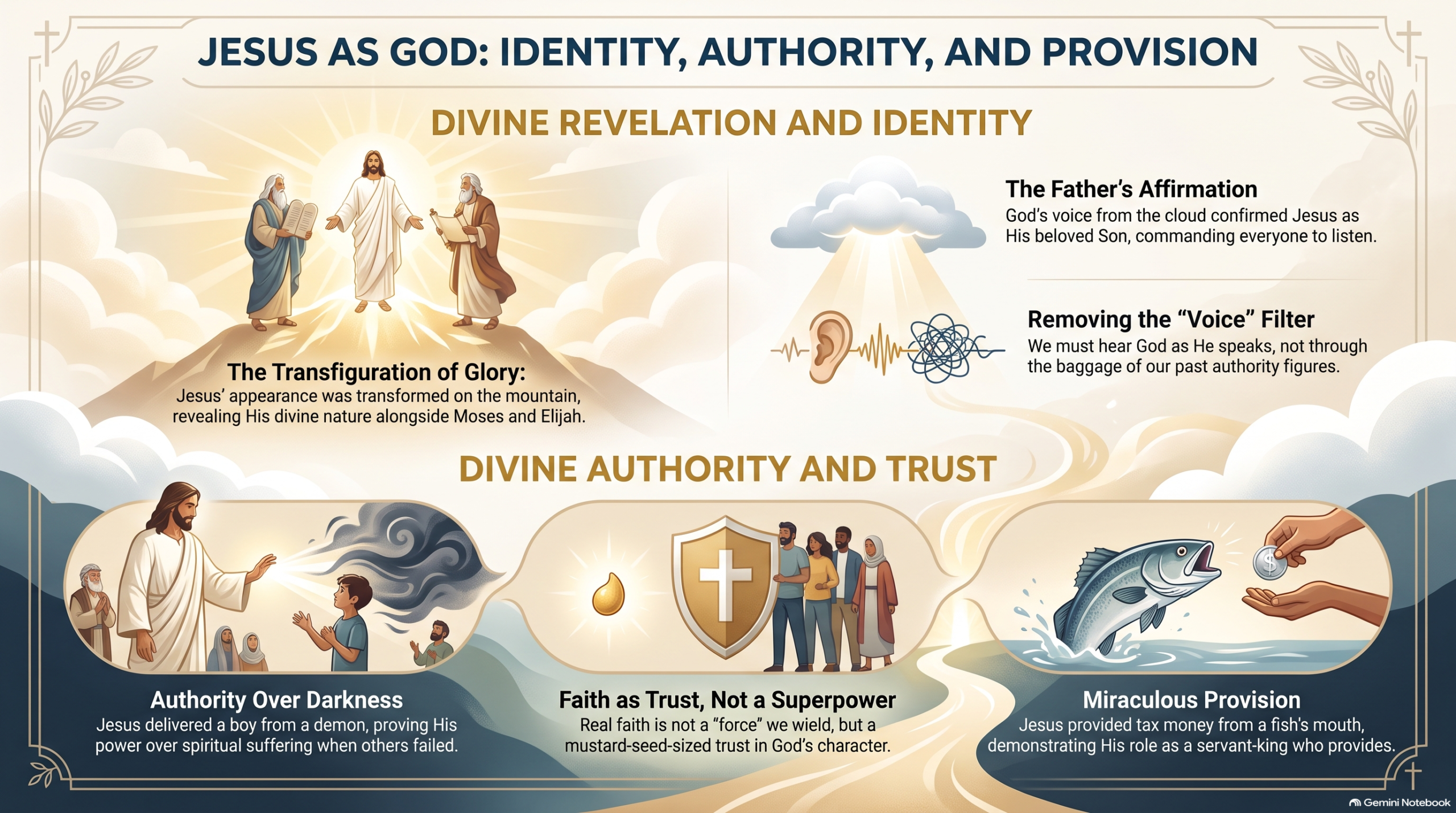
In this week’s sermon, Pastor Dustin Woolam unpacks Matthew 17 to confront how personal experiences, baggage, and human authority figures distort our perception of God’s voice. We often misinterpret Jesus’s words through the lens of past trauma or strict authority, hearing anger where He offers grace, or self-effort where He demands faith. True faith is not a force we conjure or manipulate like a superpower; it is deep trust in the character and sovereignty of Jesus. Even when our understanding falters or our prayers feel unheard, Christ remains unshakeably good, actively meeting our needs and inviting us to rest in His divine authority rather than our emotional projections. Pastor Dustin calls the church to drop its filters, let Scripture speak for itself, and step into daily, persistent trust in our sovereign Savior.

TRANSCRIPT (word for word)

Opening Prayer: Inviting the Presence of the Holy Spirit

Well, thanks for today. Thank you for the gift of Your body, Your people, whom You used to bring life to us, that we all give life to each other, even when we don't feel like it. The pinky might not feel very valuable in a five-mile run, but Lord, It would be really valuable if It was missing and we felt It. So, Lord, I'm grateful for all who are here...

...and Lord, for those who are traveling or have newborns or whatever the case might be. Lord, I pray You be with them now. Lord, like that pinky, we miss them or the big toe or whatever—elbows, hands—whatever they are in Your world in this body. Lord, we're grateful to them. And I pray You bless them, be with them. Lord, I thank You for the gift of Your Word.

And I pray that as we open It together, Holy Spirit, You speak and teach us just as Jesus said You would do in the Book of John. I pray that the things that are of You, God, would remain and the things that are of human origin or any other origin, or those things which is fated, or they'd have no place. In Jesus' name, amen.

Overcoming Our Filters: How We Misread and Hear God's Voice

I—we're gonna be in Matthew 17. I was thinking this morning about different examples of how we might misread a text that someone sends us or a letter, if you're old enough like me to have received a letter in the mail, or to have sent one, or an email, or to have misheard something somebody said. And I was trying to think of a good example, and then I just did it to myself this morning when talking to Joe and Bill. And then I was thinking about that there's a really good chance that for every guy here, you have said something where you have inserted one or both of your feet in your mouth. And for every woman here, you've been embarrassed by the men in your life who have done that, right? Pretty good chance. But maybe some women have done it too, but it seems less likely, at least in my life.

And the reason I was thinking about that is there's a lot of times when we read the Bible or read anything—and the Bible is a book, it's text. And so when we read it, we have a tendency to read it as we might any other book. We read our own personality, our own thoughts, and our own experiences into the text. So there are things that when Jesus says them, we hear them differently, right? So we may hear when Jesus—well, we'll get here in a second—but we may hear Jesus say something and we may hear it as a rebuke. We might hear it as an encouragement. We might hear it as despair. We might hear it as like, "What am I going to do with you people?" Or we could hear it like Jesus is chuckling. He's like, "Crazy people. What are you doing, right?" There's so many different ways to read what Jesus says. And what I want to do, to the best of our ability, is let the words be the words.

And I think that some of what happens is that the experiences we've had when we read the text, we bring those experiences. That's human nature, that's normal. But what we need to do is be aware of that because the experiences I've had with the authority figures in my life growing up when I read God's speaking—whether it be my parents or a boss or a pastor or a Sunday school teacher—if I'm not aware of what I'm doing, I hear God in their voice. And so if a Sunday school teacher thought I was a bonehead and was constantly running me down because I wasn't paying attention, then that's how I hear God sometimes, right? Or if my dad was very stern and very stoic, or if he was excited and exuberant or whatever he was—if whatever he was most of the time, then if I'm not careful because God is Father, I hear God in my father's voice. So if my father's absent, then I don't have a box for God's voice. I have to look at other fathers.

The Transfiguration: Jesus Reveals His Glory as God

And so as we look at today, we're continuing our series, "Give Me Jesus." And this might seem like one of the most low-hanging fruit things we could talk about, but I just want to talk about Jesus as God, right? So Jesus is God. And we're going to look at how He shows Himself as God. And we're going to read some things that He said and we're going to think about how we might hear those things. So when Jesus says, "You have little faith," do we hear a rebuke? Do we hear like whatever it is we might hear? And we're going to get to that towards the end, but we're going to start at the beginning of Chapter 17 of Matthew, and what's called the Transfiguration.

So to transfigure is to change your figure, to change your appearance, or to change potentially what you are. And so let's read and see why this has this title, or why the Church has called this this for a long time. You'll remember that we're going through, and so we'll read some of Jesus' words, but we're focusing on Jesus' actions in this series.

Verse one: "Six days later, Jesus took Peter and the two brothers, James and John, and led them up a high mountain to be alone." Peter, James, and John were the disciples. This—some of you will know this, some of you know this is going to be free—there are 12 disciples who were called Apostles, capital A Apostle, they're like the 12 guys, right? Apostle gets used for some other people later in the Scriptures, lowercase a, they're not the 12. Then out of those 12, there are Peter, James, and John. They're like the guys who are super close to Jesus. He's spending a lot of time with them. James and John are brothers. James and John are called the Sons of Thunder. Also, James and John famously went to Jesus. One version says—one Gospel says their mother went; one says they went. In that culture, their mother going for them is an intermediary; it's kind of the same thing. We'll get to that story eventually. But the story goes that they want to sit at the left and right hand of Jesus. They want to be really important. And then Peter ends up being like the one most important one. Even though John is the disciple Jesus loved—is how he describes himself, which I love all the way through the Book of John. John's like, "I'm the one Jesus loved and I beat Peter in a race."

But Peter is the one who acknowledges Jesus as God, and as the Messiah, and Jesus says, "On this rock I'm going to build My Church." And some people will say that Peter is the rock. Some people will say the truth is the rock. Some people will say the rock that they were standing next to is the rock. There's a bunch of different stuff, and I don't want to get into all that. But these three guys are kind of like Jesus' inner circle among the 12 who are His immediate disciples. And they go with Him on the mountain, and they go with Him in the Garden of Gethsemane, and they go to all these different moments with Jesus. So these three going together with Jesus—this is, I think, the first time we see this in Matthew, but Jesus is showing something to these guys, that even amongst the 12, He's showing them something.

Verse two: "As the men watched, Jesus' appearance was transformed so that His face shone like the sun and His clothes became as white as light." Suddenly Moses and Elijah appeared and began talking with Jesus. What did Moses and Elijah matter? Moses was the guy, capital P Prophet, who is the leader of the people of Israel. Moses says there'll be a Prophet, capital P—it's like a title, like him coming, referring to Jesus. So Moses gives the Law. He's the law giver. He leads the children of Israel out of Egypt, out of captivity. He does a lot of things that are foreshadowing of who Jesus will be. So Moses: super big, important. So him meeting with Jesus, there we go.

Now Elijah is one of only two people in the Bible recorded who never died, Enoch being the other one. Genesis tells us Enoch was walking with God and was no more. The joke goes that Enoch was out walking with God, and they were closer to God's house than Enoch's, so Enoch just went home with God. But the story of Elijah—Elijah and Elisha. Elisha's done all this really great stuff, he's done all these miracles, and then he has Elisha come follow him. They travel all the way to this mountain, and then Elijah is doing some praying and some stuff, and then he gets taken up in a chariot of fire to heaven. And Elisha comes back and then continues Elijah's ministry. So Elijah kind of just disappears. He was like the guy, and he's wrestling with Baal; he's doing all this amazing stuff. He's fighting against the enemies of God. And so Elijah and Moses both are meeting with Jesus, they're talking with Jesus about whatever it is they're talking about; the Bible doesn't tell us. But Jesus is transfigured. So this is a really big deal. It's like finally we see Jesus as God through just His physical flesh.

The Father's Voice and the Human Heart

Peter exclaims, verse four: "Lord, it's wonderful for us to be here. If You want, I'll make three shelters," as memorials, "one for You, one for Moses, and one for Elijah." So Peter's a good Jewish boy, right? He's like, "Man, look at this great event." And he's thinking about the memorials and things like that in the Old Testament. When they crossed the Jordan River to come into the promised land, they grabbed 12 stones and they built a memorial. And there's all these different things throughout the Old Testament where they would build memorials to these events. And so Peter understands something really big is happening here, and he says, "Let me build some shelters." But even as he spoke, a bright cloud overshadowed them, and a voice from the cloud said—I like that, like Peter is speaking, "I'm going to build these memorials," and then there's just this cloud—and then this voice says, "This is My dearly loved Son, who brings Me great joy. Listen to Him." The disciples were terrified and fell face down on the ground.

The thing I like about this image is that the Father is saying about the Son: "This is My Son," right? This is the second time we see this. The first time was in the baptism of Jesus, that the Father speaks from heaven and the dove comes and rests on Jesus. But in front of people who reside in heaven and in front of people who reside on earth, and Jesus, who is the one who's crossing between both, God says, "This is My Son and I'm pleased with Him." And so there's this affirmation. And the thing that's interesting about that is that when Jesus started His earthly ministry, the Father affirms Him. And this point in the Scriptures, Jesus on the mountain, this transfiguration moment, is Jesus solidly turned toward the cross. It's at this moment that He makes His turn. And like we'll see in the Scriptures previously where it's like, "Oh, they were trying to kill Him," so He left, or the people on earth are trying to run Him off a cliff and He passes through. And it's at this point that we see Jesus just turn and march toward the cross. And He's going to make some statements about the gates of hell not prevailing and some other things. And so Jesus is beginning to goad the enemy into killing Him. And this is the beginning of that turn. And so we see the Father affirm Him in front of heaven and earth: "This is My Son. Listen to Him."

And so the disciples are terrified. I would be! If there was a cloud and some voice, I would probably be scared, especially in a world with like little to no technology. I mean, they had—I mean, if you argue the wheel is technically technology, but that's not the point. And so Jesus came over and touched them. Something happens. Who knows how much time passes. Jesus touched them. "Get up," He said, "don't be afraid." And when they looked up, Moses and Elijah were gone, and they saw only Jesus. This is one of those things where: who is Jesus in this moment? Do you think when you hear, "Get up, don't be afraid," how do you hear Jesus say that in your own mind, in your own heart? And has that ever changed in your life? Did He come to them and say, "Hey guys, it's okay. It's all right. Don't be afraid"? Or did He walk up to them and touch them and be like, "Fellas, come on. Don't be afraid. What are we doing here? Don't be afraid"? How do you hear Jesus when you read it? And is there a right or wrong way on which you'd hold onto that? We're going to talk about that some more, because we have some more things Jesus is going to say.

Descending the Mountain: Elijah's Return and the Son's Suffering

As they went back down the mountain, Jesus commanded them: "Don't tell anyone what you've seen here until the Son of Man has been raised from the dead." This is interesting. Verse 10: The disciples asked Him why the teachers of the law insist that Elijah must return before the Messiah comes. I think I might be asking questions about: what do you mean, "raised from the dead"? Like, I might be asking a different question. But something's happening here. And so they asked Him, and then Jesus replies, "Elijah is indeed coming to get everything ready. But I tell you, Elijah has already come, but he wasn't recognized, and they chose to abuse him. In the same way, they also will make the Son of Man suffer." Then the disciples realized that He was talking about John the Baptist. But Jesus didn't change topics. They're still going to make the Son of Man suffer. So He says, "Don't tell about this until the Son of Man rises from the dead." And then they ask about Elijah, and then He says, "The Son of Man is going to suffer." He's beginning to tell them what's going to happen. And they're probably not getting it. And honestly, would any of us? Like, you just see this crazy, miraculous thing, and you're like, "Why does Elijah have to come?" And you're like—you're not going to hear it, because there's nothing in their mind that says Jesus is going to die. So why would Jesus rise from the dead? There must be something else happening here. But Jesus tells them, no, the Son of Man is going to suffer. He stays on track, even while answering their question.

Healing the Demon-Possessed Boy: God's Voice in Jesus' Rebuke

So there's this demon-possessed boy that they come down the mountain to. Verse 14: "At the foot of the mountain, a large crowd was waiting for them." I like this, too. Like the kids right now are learning about the Ten Commandments and some other stuff. Moses went up to the mountain and got the law and brought it down to the people who were waiting. And the people had sort of acted up and started worshiping some false idols. But in this case, Jesus goes up and the crowd's still waiting at the bottom of the hill for Him to return. And so there's these weird little things that happen all throughout Scripture, and maybe it means something and maybe it doesn't. And maybe it's just a pattern that's helpful as part of like me putting together everything in my own head about Jesus. But when He comes down, the crowd is waiting, and there's a young boy—or a boy. It says a man came and knelt before Jesus and said, "Lord, have mercy on my son. He has seizures and suffers terribly. He often falls into the fire or into the water. So I brought him to Your disciples, but they couldn't heal him." Last week, we talked about a woman coming for her child, and this week a father for his son. And what's interesting is last week, she said, "Have mercy on me." And this week the father says, "Have mercy on my son." Both children were suffering from demons, but there's something about like both of them get their prayers answered, and it doesn't really matter how they asked. Jesus met the need, right?

And so Jesus replies, "You faithless and corrupt people! How long must I be with you? How long must I put up with you? Bring the boy to Me." This is another thing Jesus says. Think about how you've always heard or read your internal monologue. How have you heard the voice of Jesus? If you watch the Matthew movie—I was talking with Curtis about this last week—it's literally just the NIV word-for-word acted out. It's the Book of Matthew. And if you read—if you watch this passage, Jesus is tender and kind, and He's like, almost like kind of weepy, "How long?" But the thing that strikes me—and maybe that's how Jesus said it, but the thing that strikes me is that Jesus has just been on the mountain. He's just been affirmed as the Messiah by His Father: "This is My beloved Son, listen to Him." And He comes down, and His first interaction with people is the same interaction we read over and over and over in the Old Testament. When God talks to the people of Israel, He repeatedly says something like, "You faithless and corrupt people." We see it all throughout the prophets: "How long must I be with you? How long must I put up with you? Bring the boy here to Me." And so Jesus is speaking the way God speaks in the Old Testament. And He doesn't say, "How long does God have to put up with you?" right? The way Elijah or Isaiah or Jeremiah or the other prophets: "How long are you guys going to kick against God?" Jesus says, "How long do I have to put up with you?" So He's not just speaking as Jesus the human—He is Jesus the human, but He's also Jesus who is God. And He's saying, "How long do I have to do this? How long do I have to put up with you?" And so—and even the way I said that is probably you're hearing part of how I hear God in my head, right? Like it's impossible to remove the filter from how we read. If you were a kid who was always in trouble, maybe you messed up all the time, or maybe you didn't—maybe you just always felt like you did—you're going to read this and you're going to hear Jesus is mad and frustrated because you constantly screw up. Or if you're a kid who every time you messed up, your parents were like, "Hey, you know what, it's going to be all right," you're probably hearing some kindness in Jesus saying, "How long do I have to put up with you?" Verse 18: "Then Jesus rebuked the demon in the boy and it left him, and from that moment the boy was well."

Meeting the Need: God's Sovereign Grace

Regardless of how you read Jesus when He speaks, don't miss that Jesus still answered. He's not worried about our strengths and our failings when it comes to answering us. He wants us to grow. He wants us to get better. He wants us to stop failing. But He's not withholding good things from us as we learn about Him. In the same way that when a child comes to a parent and they can't say a word properly, the parent still feeds them. I remember when our kids were little—it's funny to me just because of words—but Jamie would feed, I think it was Ian who was little at the time of this... Call of the Story Kids, I apologize in advance. But she would say, "Eat your chicken," or she would say, "Eat your meat." And so Ian never called chicken "meat." And so he had on his plate something, not chicken, and he says, "I don't want meat. I want chicken." And I was like, "What do you mean you don't want meat? Chicken is meat. Like, what's going on here?" But I didn't have his language in my head. But he's two and upset; it's not time for a language lesson, right? It's time to like take care of my son in his emotion. And so Jesus does say, "How long do I have to put up with all of you?" or, "How long do I have to deal with all of you?" or, "How long do I have to do all of this?" But it doesn't stop Him from meeting the need of the father and the boy who need deliverance from a demon. And so you don't have to get it all right, because Jesus, as God, understands what we need. And no matter how we hear Him, He's good to us.

Faith and the Mustard Seed: Finding God's Will

And so afterward, the disciples asked Jesus privately, "Why couldn't we cast out that demon?" Jesus says, verse 20: "You don't have enough faith," Jesus told them. "I tell you the truth, if you had faith, even as small as a mustard seed, you could say to this mountain, 'Move from here into there,' and it would move. Nothing would be impossible." This is another place where we sometimes hear Jesus the way that we're taught about Him. I've been in many different kinds of churches—I've said this before. In my growing up years, my parents were saved in a church, and it was a time before the internet. I'm not even sure that like the local library had very good resources, and so it was whatever Christian TV, radio, and churches my parents could find, whatever books they might get a hold of. I remember my mom came home with a whole bunch of books from like a garage sale or a yard sale or something, is just a bunch of... I still have the Living Bible she got from that on my shelf at home.

And so there were some other books. For example, there was a book she got, it was called Jews for Jesus. And I was very confused because I had learned that Jesus was a Jew. So what do you mean, "Jews for Jesus"? Obviously, it's Jews for Jesus! I didn't realize that in the modern world, the national Israel is mostly atheist. They're Jewish in culture, but not in religion. And in fact, modern Israel is very far from biblical Israel. And so groups like Jews for Jesus are trying to bring them to the Messiah. And so I'm learning about these things, I'm seeing these things, in the same way my parents, who are older and their brains are fully developed, are moving through these things. And I attended a church that was what would now be called Word of Faith. I don't know what it would have been at that time—probably prosperity gospel, Word of Faith, one of those buckets. And we went there for a little while as my parents are journeying through finding the church that we would be at. And if I had read this Scripture there, if I had learned this Scripture there, because of the bucket from that church, they would say, "Whatever you say, you can have. If you have enough faith, tell that mountain to go into the sea and it will happen."

And I've talked about this in the last couple of weeks, but it was that teaching that got me to the point where I would stand on the side of a swimming pool and be like, "I can walk on this water, I just have to have enough faith." And so as a young child—11, 13, whatever I was—I would like step out into the water, and people thought I was walking into the pool funny, but I was hoping to walk on water and tell them all about Jesus: "Look at me standing on water! This is because of Jesus; you should all get saved." That's how I filtered this all through my head. So that's one way that we could read this: "If you have faith like a mustard seed, you could tell the mountain to go into the sea and it will." But now, that teaching misses a really important thing: that we only get what God wants us to get. James says you ask and you don't receive because you ask for the wrong reasons, and John says—and I think it's First John—that you don't receive because you ask for the wrong things; you're not asking for what God wants. And so the first thing we have to do when we look at the rest of the text is get on the right page with God: what does God want to give us?

Yoda vs. Jesus: Faith is Trust, Not "The Force"

Now, that still doesn't have—you know, we see these kinds of things where I go, "Okay, so maybe I can't pray for every mountain to go into the ocean," or, "Maybe I can't walk on water just because I believed hard enough." But we still have to do something with—now Jesus has said, "You only had a little bit of faith." "Well, it's okay. Well, I had a little, but You said it could be as small as a mustard seed. Was my faith smaller?" And then we start chasing down... I grew up watching Star Wars and loving Star Wars. And so in my head, whether I wanted to or not, when I was reading the Bible, faith was like the Force, right? If I have enough Force, then I can make the rock lift. And I'm watching Luke Skywalker with Yoda on Dagobah lift the rock, but he can't lift the X-wing. And Luke says, "I don't believe it," and Yoda says, "That's why you fail." And I'm like, "Oh man, that's my problem with faith! I don't believe." Yoda's right! And I'm like, "How did I get from Jesus to Yoda? How did this happen?"

And it's because I wasn't careful when I read the text. It's because I brought my experience into the mouth of Jesus. And so as we look at who Jesus is—Jesus being God—if we want to understand Him, then we have to understand the Scriptures. I have to understand what the Scriptures teach us. Ian sent me a thing. There's a guy named Ruslan—great guy, if you ever find him on the internet. I often say, "I'm not his audience," but I really like what he has to say. There's a—I don't know, maybe I'm too old and crotchety, but I like what he has to say. And he was talking about that there's a lot of Christians who are out here having these Avengers superpowers, right? Like they have prophecy, they have miracles, they have all this. He says, "But somehow, none of them have discernment." So something happened in my life and in Ruslan's life and some other people's lives who grew up Pentecostal Charismatic, where we were like, "Hold on a second, this is crazy town. Like, we don't need this. It doesn't mean that there's not something real."

And so what happens then, as you read this stuff about faith—and this is the opposite end, right? Like we talked about the part that's a little bit too far, "I can move any mountain or walk on the water," but here's the other side: you will see abuses of these things, and if you're not careful, you'll throw them all out. But we don't want to throw out the gifts that God has given to the Church. We want to somehow find the middle where Jesus is, or maybe be above it all, or whatever, and we want to hear the things that Jesus says. When Jesus says, "You didn't have enough faith," what is He saying? What is it about Jesus that they're supposed to believe that they're missing?

Faith in the Unchanging Christ

And then here's the other thing, too—let's talk about that for a second, just put it in there. If I say, "I believe in you. I'm going to go run a race." "No, I don't know if I can win." "No, I believe in you, you can do it." "I don't know if I can do this job, it's bigger than I am." "I believe in you, you can do it." Do we say that the same way we say we believe in Jesus? "I believe in Jesus, He can do it." Is it just some positive kindness, or do I really, truly put all of my hope and stay, as the hymn says, in Christ? When I believe in Jesus, do I believe in the Jesus who's walking around teaching the Sermon on the Mount, or do I believe in the Jesus who's transfigured on the mountain, or do I believe in both? Because Jesus is Jesus. And so Jesus the teacher and Jesus the Messiah who dies and rises from the dead for us—there's no difference in these two Jesuses. It's all the same Jesus. And so when I believe in Christ, do I believe He says good things I should do? Yes. Do I believe He died on the cross and rose from the dead and ascended to heaven? Yes.

But do I also believe that He rebukes demons and they're cast out? Do I believe that He heals the sick, that He gives sight to the blind, that He gives hope to the hopeless? Yes. And I think that when Jesus says we have little faith—at least in my life, you may resonate, or you might have some other thing—I think the thing is that when I have a little faith and I'm praying, there's this sense of like, "Sure, God does it for people, but I don't know if He'll do it for me. Yeah, yeah, Jesus healed some people 2,000 years ago. Sure. Yeah, He was walking around the earth and He cast out some demons." But if Hebrews is right—and it's the Bible, so It is—It tells us that Jesus Christ is the same yesterday, today, and forever. And that's in the Old Testament, too. I think It's Micah 6:9, something like that, but It says, "I'm the Lord, I don't change. That's why you're not consumed." And so if Jesus is always the same, however I hear Him, and whatever filter I hear Him in—disappointed ("How long do I have to put up with you?") or just sad that I haven't figured it out ("Like, man, I really wish you figured this out. How long do I have to put up with you?")—It doesn't change that He's good, and It doesn't change that He works on our behalf, and It doesn't change that Jesus is God who loves us.

Persistence and the Goodness of God

And then we wrestle and we pray. I was having a conversation this week with someone, and I said, "Man, I feel like the heavens are brass when I pray, and that my prayers just aren't going anywhere." But that doesn't mean that God's not listening; it's just how I feel. My feelings don't change reality. And that's where faith shows up, because even though I felt like the Lord wasn't listening and that my prayers weren't being answered, I continued to pray, because I know the Lord is faithful. And so eventually God answers. But I wonder how many times we give up because we don't have faith? Do we give up because we're tired, because it's hard, because, "Jesus, I'm out of gas and I can't do it"? Or do we give up because we think He doesn't care? But the Bible doesn't teach us that God doesn't care. The Bible teaches us that God cares a lot.

And so, Jesus in His "you of little faith"—where's my faith missing? I don't think it's as simple as, "I don't have enough." I think it's, for me again—and I think probably true for a lot of us—is that: do I have a broad faith? Do I trust that Jesus is good, and do I trust that He loves me? And do I trust that He'll be good to me? And even if His answer is no, then no is good. And if His answer is wait, then I'm not going to give up. "Okay, well, Jesus said wait, I'm just going to cruise." No, I'm still going to pray. I'm still going to seek, like in Luke 11 where the woman is persistent, and these other things. There's some sense of persistence that matters. So Jesus says—I'm going to read verse 20 again: "You don't have enough faith," Jesus told them. "I tell you the truth, if you had faith, even as small as a mustard seed, you could say to this mountain, 'Move from here to there,' they would move. Nothing would be impossible." Do we believe nothing is impossible? The things that are possible are everything.

Paying the Temple Tax: Freedom and Avoiding Offense

Let's look at this in work. On their arrival in Capernaum, verse 24, the collectors of the temple tax came to Peter and asked him, "Doesn't your teacher pay the temple tax?" "Yes, he does," Peter replied. Then he went into the house. Notice either one of two things is true: Peter has seen Jesus pay the temple tax, so he knows that Jesus does; or Peter assumes that Jesus pays the temple tax and says yes. Either is possible with Peter—we see him do some crazy stuff. But either way, Peter says yes. And before he had a chance to speak, he went into the house. Jesus asked him, "What do you think, Peter? Do the kings of the earth tax their own people or the people they have conquered?" "The people they've conquered," Peter replied. "Well, then," Jesus said, "the citizens are free. However, we don't want to offend them. So go down to the lake and throw in a line. Open the mouth of the first fish you catch, and you will find a large silver coin. Take it and pay the tax for both of us."

We see Jesus following the laws of the land, even though He didn't have to; the children are free. Now what's more, He's got to do what He wants, right? All the Psalms are full of it. Like my favorite Psalm says, "The Lord is in heaven and does as He pleases." And so Jesus literally could do whatever He wanted. He could just be like—yeah, He could, like... what is it, *Men in Black*? The little flashy thing. He could flashy-thing those guys, right? "No, I already paid the temple tax, it's fine." Like—but He doesn't. He's teaching us something. He says, "So that we don't offend people, just pay the tax, Peter. We're free, but we're going to follow the rules so that we don't offer offense." And so Jesus comes as a human on earth. He talks about faith. He's transfigured. I mean, if I was Jesus—thank God I'm not—it would have been really easy for me to be like, "I'm not paying the taxes! Didn't they just see me like shining and glowing up there? Didn't they hear my dad say, 'Listen to me'? Well, listen to me, I'm not paying the tax, right?" It would be easy. But Jesus doesn't do that. He didn't come to be in charge; He came and was already in charge. And He took His authority and His position, and He served. He took His authority and His position, and He was an example to all of us.

Notice, He says to Peter, "Go get a coin for both of us." He pays Peter's tax while He's teaching Peter about paying taxes for the temple. And so we see this thing about having faith in Jesus and trusting Him well. But then, Jesus doesn't just leave us there, right? Like last week, Jesus didn't leave Peter in the water. "Hey, you need to have faith, you need it." Like, "Hey, you have a little faith, it's okay." Like this whole transfiguration crazy thing: "Just have some faith." "Oh, yeah, you couldn't cast out this demon because you didn't have faith. Peter, go get us a silver coin out of the mouth of a fish." No conversation about faith at all. Just showing him that the Lord provides, and the Lord can be trusted.

The Goodness of God and the Challenge of Faith

And so, Peter is corrected two times: "Why don't you have faith?" Well, maybe Peter and John and James got out of it because they're like—I would have been like them, like: "We're up on the mountain, and we didn't mess up. These other nine... no, man, they don't have enough faith. But look at us! Look how good we are." Nope. They were on the mountain, they saw some stuff, and got, "Hey, it's okay. Don't be afraid." So here, Jesus just does things. And I think that sometimes—and this is where I'll end—I think sometimes that's the challenge in faith: is that, "Lord, why are You doing all of these things, but on the stuff I believe, they don't appear to be happening?" Well, all these things the Lord's doing for you that you don't ask for is proving that He's good and right and faithful and just, so that when you have a request, you already have something to depend on.

So Jesus says, "Why are you worried about what you're going to eat? Why are you worried about what you're going to wear? The Lord feeds the bird and He clothes the lilies of the field, and He cares more about you." And then He says, "How many of you, if your son asked for a fish, you would give him a snake? Or if he asked for bread, you would give him a rock? And isn't the Lord in heaven so much better?" And Matthew says He'll give you what you're asking, and Luke says He'll give you the Holy Spirit. And so there's all of this evidence that the Lord is good. You can walk outside and see that the Lord is good. We live on a planet that's perfectly suited for us. And so then, "Lord, where are You? The heavens are brass. Where are You?" Well, He's good. He's caring for us even when we're not aware of it. He's watching over us and He's keeping us and He's carrying us when we don't even realize how oppressed we are. I had a boss once years ago, he broke his ankle or something, had to have surgery—maybe both. And he was in a cast, and then he ended up—like, he was on crutches and hated it, and they gave him a scooter, and he was riding around and he still hated it.

And then finally, he was walking again and he could go play golf again. And he said, "Man, it feels so great to feel whole again." And he said, "I didn't realize how depressed I'd gotten when I couldn't use my foot." And we can see that physically. Right? I had COVID. I almost died—no big deal, I'm safe now. But when I began to feel better, I was like, "Man..." One of my previous bosses also said he was sick around the same time. He says, "It just feels good to feel good." And a lot of times in our life, the Lord will show up and He will rescue us, and our soul will lighten. And we never knew that there was weight in our hearts and in our souls.

And so Peter gets corrected a couple of times, or the disciples in general get corrected a couple of times, and probably a lot as Jesus is teaching them. But we see these things where Jesus just lifts them up a little: "Hey, just go get us some coins. Go get us a coin. Go pay the tax for you, Peter, I'll take care of it." It's not lost on me that Peter, who's found fishing with nets, gets one fish with a line. He gets exactly what he needs. He didn't have to go catch 500 fish, or 100-something fish and dig through them all. He just went and got the one that he needed. And so Jesus is showing up while correcting us, and all of us, for our faith. "Hey, have more faith. Trust Me more," right? Faith is not the Force. Faith is trust. I trust that the Lord is who He says He is, and I trust that the Lord will do what He says that He does.

So, "Trust Me also along the way while you're learning to trust Me. I'm going to take care of you. I'm going to do good things for you." And so we see Jesus as God on earth, physical Jesus walking around, who is God and is human, doing the same things that God has done all throughout the Old Testament, showing us that He's God. And if we'll zoom out a little bit, and when we read the text—I don't want to read my angry uncle, or my angry boss, or my mom who's desperate for me to not be an idiot, or my aunt who thinks everything on the earth is funny and just wants to laugh and have a good time. I'm not reading all of that into the voice of God. I'm letting God speak as God speaks, and I understand that, as one of my old pastors says, He's altogether other. Even though Jesus became human, He's still God, and He still speaks from God's perspective into our lives and into our hearts. And I want to hear Him the way He speaks, not the way my baggage causes me to hear Him.

Closing Prayer: Seeking Discernment and Ground of Truth

Let's pray. "Father, thank you for today. Thank you for teaching us through all the different methods You've taught us. Lord, I've said a lot about how we sometimes hear Your voice through the mouths of other people, and I've talked about how that can be bad, but in so many ways in my life, that's been good. In so many ways, I've heard Your kindness and Your mercy, and I've heard Your correction out of the voice of Your servants. Lord, it's a good thing to be part of the Body. And Lord, humans aren't evil and terrible; we just need to hear You the way You speak.

And so, Lord, I pray You grant us discernment. Let us hear You the way You speak, and let us not be too worried about people too far one way or too far another way when it comes to the things that You say to us. But Lord, let us find the ground right where You would have us to stand. And frankly, Lord, that's a little bit terrifying, but You tell us not to be afraid. And so, Lord, as we go through this week and we want to be mindful of You, I pray that You would help us to hear You in Your Word, and to hear You as You speak to us in everyday life. In Jesus' name, amen.


Tags


You may also like

Leave a Reply

Your email address will not be published. Required fields are marked

{"email":"Email address invalid","url":"Website address invalid","required":"Required field missing"}