
Why Did Jesus Flip Tables and Turn Water to Wine | John 2 | Give Me Jesus
Dustin Woolam | Pastor & Lead Elder
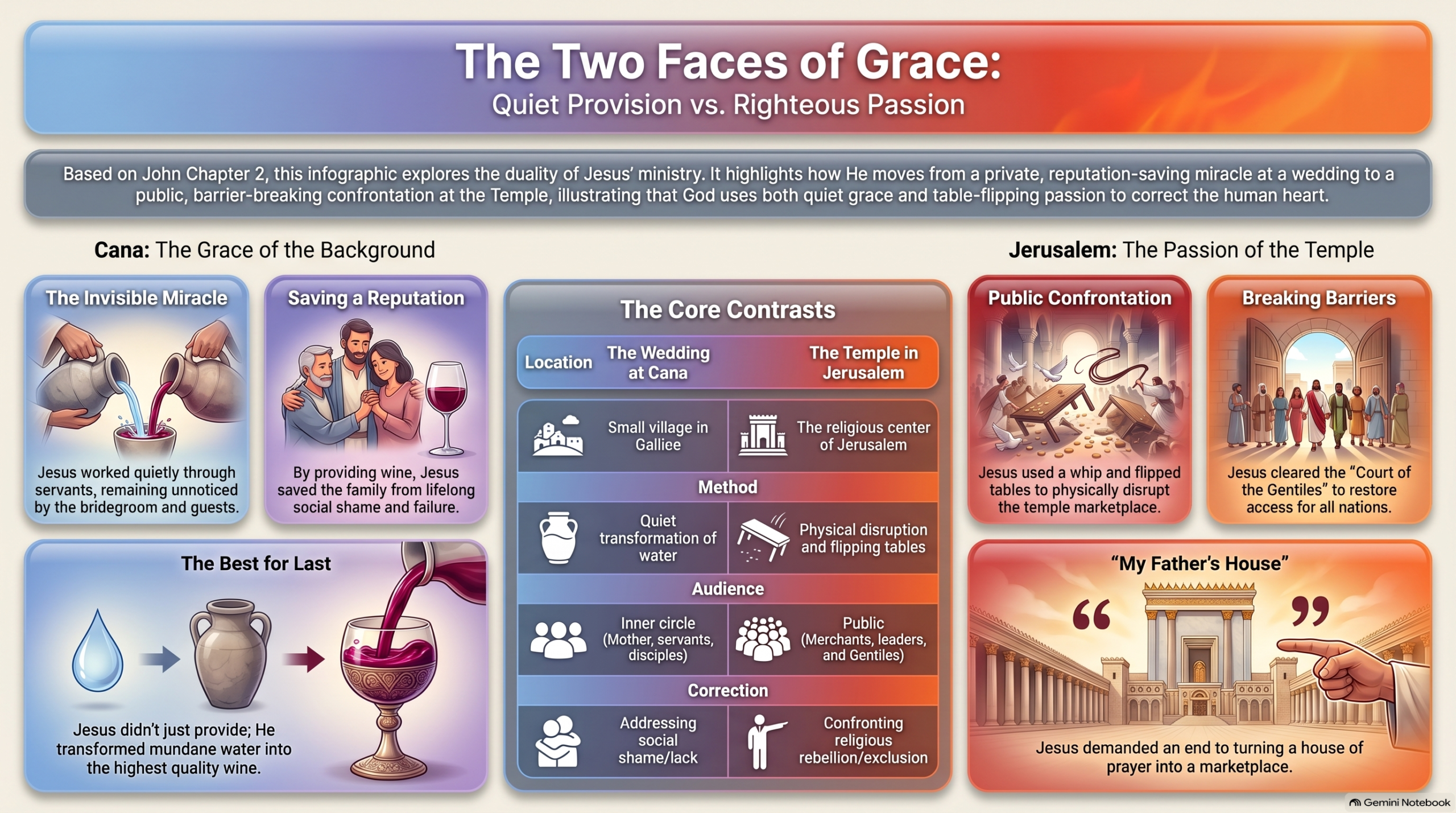
The Heart of the Message Summary
In this week’s sermon, Pastor Dustin Woolam unpacks John 2 to confront how a self-focused, comfortable Christianity distorts our understanding of God’s active presence. We often reduce Jesus to a convenient, non-disruptive accessory, settling for the mere outward trappings of faith while failing to expect His actual intervention or make room for His transformative power. True faith is not a self-serving pursuit of personal blessings or comfortable heavenly rewards; it is a posture of surrender that welcomes both His quiet, background grace at the wedding in Cana and His disruptive, table-flipping corrections in our lives. Even when His hand remains invisible, Christ is unshakeably generous, rescuing us from generational shame with His best provisions and clearing away the spiritual barriers that keep us from His Father’s house. Pastor Dustin calls the church to abandon its inward focus, yield to the corrective breaking of the Holy Spirit, and step into daily, bold evangelism to make Jesus famous throughout the nations
TRANSCRIPT (word for word)
Opening Prayer and Gratitude
Let's pray. Father, thank You for today. Thank You for the gift of Your Word and the gift of Your Body. All right, I know I say that a lot, but I mean it. Without Your Word, there would be no life in us. We wouldn't know You. Without the Body, Lord, we couldn't fully live in the Christian expression. We belong to each other, and we need each other. And I'm grateful.
I'm gonna pray that Your words would remain, and anything not of You would be swept away. Lord, we give You this time—our hearts and our intention—in Jesus' name. Amen.
Introduction to the Gospels
So, in this series, 'Give Me Jesus,' we're moving through the Gospel. So I'm probably gonna be out of the book of Matthew for a while because I wanna—when we look at the end of Jesus' life, I wanna look at it all at once from all the Gospels. There's an interesting thing that happens with the Gospels. And gospel just means 'good news,' right? So it's the Gospel of Jesus. These four books are telling the good news of Jesus.
And each of them are written—I'll give you a little history before we dive into it, John. If you wanna turn ahead, we're gonna be in John chapter two. We're gonna look at the wedding in Cana and some other events in John chapter two.
But before we do that, as far as we can tell, Mark was the first Gospel written. And then Matthew borrows heavily from Mark and builds off of Mark. The purpose of Mark is—it doesn't tell us inside of the book why Mark was written. Mark is generally accepted as Peter's words, Peter's telling of the Gospel. Did he dictate it to Mark and then Mark wrote it, or did Mark write it later based on all the things he heard from Peter? We're not sure, but pretty confident that it's Peter's telling of the story, which is why we have a Gospel written by not an apostle.
And then Matthew later builds that out. And Matthew—and so Mark is quick and fast: 'Here's Jesus,' right? Let's get the story of Jesus out, and that's kind of the purpose of Mark, as far as like from a why did Mark get written. Matthew takes Mark and builds on it and adds in all this stuff about the Jewish Messiah. It even opens up with a genealogy, which, interestingly, lots of things in the Bible—in the Old Testament, especially—open with genealogies. The book of Numbers, like the first seven chapters, are genealogy. Then we go to Genesis—a big chunk of the first part of Genesis is a genealogy. And so Matthew continues that type of telling of what happens, telling of the events, drops into Jesus establishing that He's from Abraham and David, and then tells the story.
The Purpose of the Gospels and Miracles
John tells us at the end of John—and so John and Luke are great, they tell us exactly why they wrote the books they wrote. John chapter 20, verse 30, it says the disciples saw Jesus do many other miraculous signs. John only tells us about seven in detail in addition to the ones recorded here. But these are written—these seven, this event is written—so that you may continue to believe that Jesus is the Messiah, the Son of God, and that by believing in Him, you will have life by the power of His name. So John tells us He's writing so that we'll continue to believe and we'll have life.
Luke chapter 1, verse 1, he tells us flat out: many people have set out to write accounts about the events that have been fulfilled among us. They use the eyewitness reports circulating among us from the early disciples. Having carefully investigated everything from the beginning, I also have decided to write a careful account for you, most honorable Theophilus, so you can be certain of the truth of everything you were taught.
So the Gospels, in general, are written so that we can believe in Jesus. So as we're in this series, as we're in this idea of 'Give Me Jesus,' that's what the Gospels are for: they're to tell us the good news. Jesus shows up, He says, 'Repent, the kingdom of heaven is at hand.' And then Jesus begins to do a bunch of things, and teach a bunch of things, and show us a bunch of things. He does lots of miracles, and His miracles serve purposes, right? There's a sign so that you can believe—which is interesting because Jesus also says that people who are looking for a sign are wicked. And so how does that all parse out? And I think it has to do with the condition of the heart of the person who's asking.
The Gospel of John and the Meaning of Numbers
But John does something interesting that other writers don't do. If you look at the book of John as a whole, He's doing a lot of things on purpose, and He's weaving in all this kind of code throughout the book. So we'll see that John, in the opening chapter of John, tells us: 'In the beginning was the Word, and the Word was with God, and the Word was God.' He's essentially establishing that the Bible, the Word, but the logic and the mind and the reason of God is also God. He's telling us that Jesus is God, and everything is created through Jesus.
And He does this interesting thing after He establishes all that: He tells us about John the Baptist, and then John the Baptist tells us that Jesus has the Spirit of God without measure. And like, what does that mean? Why is it important that Jesus has the Spirit without measure? Well, He's comparing Him to these other stories you may have heard—whether you're a good Jewish boy or girl and you've heard the stories of the Spirit of God coming on Samson and him doing amazing things, or maybe you're a Greek or some other nationality, and you've heard about these people like Hercules doing things because they have the gods' power or whatever. But John the Baptist says He has the Spirit of God without measure.
And so He's reinforcing that there's something different about Jesus. And He does this thing through the first chapter. He says, 'and the next day,' 'and the next day,' 'and the next day,' 'and the next day.' And so He starts out with this idea of creation and then follows the days—not one-to-one, right? Like, it's not day one is day two, but He's showing us some days.
And then in the beginning of chapter two, this version—the New Living Translation—says, 'The next day, there was a wedding celebration in the village of Cana in Galilee.' The Greek text and other English translations will say, 'On the third day this happened.' If you're counting—if you go back to chapter one and start counting—you can make a case for seven, but it's explicitly five. So this third day doesn't follow John's pattern of days.
Another thing John does a lot is there's a ton of sevens. Jesus does seven miracles; He says seven different 'I AM' statements. And so the number seven shows up a lot. The number three shows up a lot. The number five and six pop up here and there. We want to be mindful—you know, if you look at the number five, every time it shows up in the Bible, somebody will tell you five is the number of grace, and that might be true biblically. And six is the number of man, seven is perfection, three is this, 12 is that, and 40 is this. And so we have all these numbers.
And then as you start looking up those things, somebody will tell you that every time you see the number seven anywhere at all in your life, it means—fill in the blank. It doesn't have to be that way. What we're looking for is, in the Bible, when the number seven is used, what does it mean in the Bible? When we see the number 12, what does it mean? It doesn't mean that every time we see the number 12, right? Like, it's just a dozen donuts. It's not something about the 12 apostles or the 12 tribes—it's just a dozen donuts. So 12 doesn't have to always mean like this chosen group. Though some of us who love donuts might like to say that a dozen donuts is a chosen group of donuts, and that means it's holy for us to eat them! That's stretching the intent of the Bible with numbers.
So as I talk about some numbers today, I don't want us to leave and think that every time we see the number six, it means something or whatever. But in the Bible, it often does. Put this down, I'm ready to read.
John Chapter 2: The Wedding at Cana
All right. John chapter two, verse one: 'On the third day, there was a wedding celebration in the village of Cana in Galilee.' I'll talk some about first-century weddings in a moment, but it's not like ours. So take the wedding celebration that we have out of your head for the rest of this story.
Jesus' mother was there, and Jesus and His disciples were also invited to the celebration. The wine supply ran out during the festivities, so Jesus' mother told Him, 'They have no more wine.'
'Dear woman, that's not our problem,' Jesus replied. 'My time has not yet come.' 'My time' is a phrase that shows up, or 'the time' or 'a time' shows up a lot in the Bible. But His mother told the servants, 'Do whatever He tells you.'
That's like my mom, right? Like, do y'all have moms like that? People would say, 'Man, I need my grass mowed.' And my mom would be like, 'What a coincidence! I have two sons with nothing to do on Saturday,' and we were mowing grass or raking leaves. Mothers are good for us.
Standing nearby were six stone water jars, used for Jewish ceremonial washing. Each could hold 20 to 30 gallons. Jesus told the servants, 'Fill the jars with water.' When the jars had been filled, He said, 'Now dip some out and take it to the master of ceremonies.' So the servants followed His instructions.
When the master of ceremonies tasted the water that was now wine, not knowing where it had come from—of course, the servants knew—he called the bridegroom over. 'A host always serves the best wine first,' he said. 'Then, when everyone has had a lot to drink'—read between the lines, when everybody's drunk—'he brings out the less expensive wine. But you have kept the best until now.'
This miraculous sign at Cana in Galilee was the first time Jesus revealed His glory, and His disciples believed in Him. After the wedding, He went to Capernaum for a few days with His mother, His brothers, and His disciples. We'll continue reading about the temple here in a second.
The important thing to know in John is that He's really not concerned with timeline. The first thing He tells us about—He tells us, 'This was Jesus' first miracle'—and then we're gonna skip over, short step, whatever the word I was looking for there, to something that happens towards the end of His life, where He's gonna clear out the temple. He doesn't clear out the temple a bunch. And so John has put this wedding story at the start, not only because it was the first miracle, but because it's the first thing He wants us to know about what Jesus did. He could have told the story in any order He wanted. And as you look through the book of John, you begin to see that He's less concerned. And so the question then is: why did John choose this story, and why doesn't it show up in other places in the Bible, and what's significant?
First-Century Marriage vs. Modern Love
There's a parable that Jesus tells, and it's about ten virgins—ten young women who are getting prepared to be married. And He talks about them making sure they have oil, and some run out and some have oil. And it's this whole story about always being ready. Always have enough oil, always be ready. And that connects here to this as well. Here's why.
So back in the day, 2,000 years ago—and who knows how much longer after—weddings were very, very different from the way that we would have a wedding now. What would happen is marriages were pretty much arranged by the family. They would decide what was good for the boy and what was good for the girl. These kids might be five when they get matched up, right? Like, way beyond any age that we might determine is okay to decide who's going to marry who. And then individual agency didn't really matter that much. It doesn't really matter if your daughter doesn't want to marry this guy. Love is a byproduct of marriage, not a reason for marriage. And so, you will be married.
There's a great movie, 'Fiddler on the Roof.' It's a musical. Tevye and Golde are the main two characters, and their daughters are coming to their father, saying, 'We want to be married.' The first one comes, and Tzeitel says, 'I love this guy. I want to marry him, Daddy. Please give me your permission.' And he's like, 'All right, I give you my permission. You can marry this guy, Motel the tailor.' He had picked someone else—a rich butcher—but Tevye is like, 'Well, what am I going to do?' And so he gives her the blessing, his permission.
And his second daughter comes, and she says, 'Dad, I'm getting married to Perchik. I want your blessing.' And he's like, 'Oh, I know. The older sister came and I gave her my permission. So you think, "I'll give you my permission." But no, you don't have my permission.' So he's like, 'No, no, that's—you don't understand. I just want your blessing, I don't need your permission. I'm marrying this guy.' And he does this whole thing: 'Oh, man, what am I going to do?' So he turns around, and being the good father that he is, he says, 'I've decided to give you my blessing and my permission to get married, right? Dad stays in charge.' And so if you ever hear me say, 'You have my blessing and my permission,' you probably don't need either. I'm making a joke based on the movie—that's a side note.
And then his third daughter comes, and she wants to marry outside of the Jewish faith, in the Jewish community, and she gets married and she's like anathema, right? So all this stuff is happening. And in the midst of all this, Tevye is talking to his wife, Golde. And he's like, 'Hey, do you love me?' And she's like, 'What's that matter? We have like five kids! Like, what do you mean, do I love you? I cook your meals, I clean your clothes, I work on the dairy farm, I do all this stuff.' She's like, 'What does it matter?' And he's like, 'No, no, no, Golde, do you love me?' And there's this back and forth—it's a cool song. The end of the song is, 'Sure, I love you.' It doesn't really change anything. We've lived together all this time, and yes, I love you. It doesn't change a thing, but it's nice to know.
And that's marriage in the Bible. It doesn't matter if there's love; it matters that you're married. And so, why does all of that have anything to do with anything? It's because for the Jews, for God to say that Israel is His bride, or for us as Christians in the early church to say that the church is the bride, doesn't have to mean love—it just means marriage. But then when Jesus tells Paul, and Paul tells us in the book of Ephesians, 'Husbands, love your wives the way God loved the church,' He's completely changing everything about marriage. Because a man didn't have to love his wife until Jesus says, 'Love your wife and lay your life down for her.'
And so Jesus starting His ministry at a wedding is significant for a couple of reasons. One, I love themes in the Bible. So, where do we see God interacting with Adam and Eve? Here's a marriage. Revelation chapter 21: here's a marriage. The Bible is bookended by weddings and marriages, and right in the middle, where Jesus starts His ministry, is a marriage. But Jesus, like He does in so many other things, shows up and changes marriage.
Marriage is not a time that—you know, let me just say, God understands humans and He understands love. And just because of what society was doesn't mean our society is wrong. Like, Western society has developed and built off of what God gave us, and what God has taught us, and what Jesus has done with the New Covenant, like we just talked about during communion. And so marriage now being because of love is a result of Jesus telling Paul to tell us, 'Husbands, love your wives,' right? So it's not that this is better—it's just different.
The Betrothal Process and Jesus' Perfect Timing
But when Jesus shows up to this wedding, first off, why did He get invited, and why does His mom care about the wine? Did they know the family, right? Like, if you watch some popular TV, apparently, you know, Mary knows these guys, and Jesus happens to be in town and He gets an invite because His mom was there. Or they could have all been invited because of Jesus. A traveling rabbi with his disciples would have been invited to any wedding. It would have been like a good sign or a good omen or something, right? That, 'Hey, we have a traveling rabbi in town at the time we're going to get married.' And so we don't really know why Jesus and Mary and—well, we know why the disciples were there: they were there because Jesus was there. But why were Jesus and Mary invited? Maybe it was a village where they knew people, or maybe they were just passing through and got invited. We don't really have that answered for us. What's important is that Jesus is there.
And the timing is important too, because what would happen? We're going to make a contract—a young woman, a young guy, or old women and old guys, whatever—they make a contract to be betrothed. And we see this in Mary and Joseph, right? They were betrothed, and Mary gets found to be with child. Well, that betrothal was a contract as binding as marriage, even though they didn't live together, they hadn't consummated their relationship physically, or any of these kinds of things. They were as married then as they would be 50 years down the road with 10 kids. And so Joseph, when it says 'put her away,' he's divorcing Mary.
But the way betrothal worked is: okay, y'all are going to get married. And now the marriage doesn't happen until two things occur. One, the groom pays all of the dowry—whatever that is, however much it is, based generally on status, right? In a poor community, it could be like seven cows, and in a rich community, it could be like a whole—'Here's a village I'm giving to you for your princess,' or something, right?
And then the next thing that would happen is He would have to prepare a place for her to come and live, and He would have to get everything ready. And so, Jesus showing up at the wedding wasn't like, 'Oh, there's a wedding on December 15th or January 12th,' or whatever the case might be. Jesus was in town at the same time the groom was ready to go get his bride. And so Jesus' timing on showing up in Cana—it wasn't like, 'Oh, yeah, my friend's getting married in three months, I should show up.' It was right on time, right? And Jesus shows up at the event to be there in the moment that He needs to be, which is interesting, because He tells Mary, 'It's not My time yet,' but He shows up right on time.
And so Jesus is at this event—it wasn't like He—you know, the Lord, obviously the Holy Spirit, timed everything out, but from an external perspective, watching Jesus happen to be coincidentally in Cana at the right time. And He's at this wedding, some days have gone by, they're out of wine, they've drunk all this wine. And then there's these six jars, right?
The Significance of the Six Stone Jars
So Mary comes to Jesus, He says, 'It's not My time,' but then she says, 'Do whatever He tells you.' We could unpack a lot of that, but I want to focus on how Jesus is responding at the wedding. And so there are these six stone jars, and it says they're used for purification. That's not from the Old Testament. Jewish tradition—there's this whole thing about stone and clay, and how they absorb. I don't know if y'all have ever had purple Kool-Aid in your life, but if you put it into a plastic cup, the odds of that cup turning purple are really high, right? And so, yeah, or if you always put tea in the same pitcher, it eventually will turn brown, and you can swear that it's clean, but it doesn't look the way that it used to if you have these plastic pitchers.
And so clay was very similar, and maybe even more so. And so this ritual purity event that the Jews did had to have pure water, and the stone would resist all of that. And so there's no—you know, I love how God's even thinking ahead to like the things that people would do, because, 'Oh, yeah, well, these were wine jugs, and they dipped water out of wine jugs, of course it tasted like wine! Of course it did.'
Well, the stone jars—that's not likely. First off, they were set aside for only water, ever. That's part of the reason it's important that they were purity jugs, because they had no other purpose. It reinforces the miracle, and the servants know. And I almost wonder too if the servants aren't like, 'Whoops, we're going to be in a lot of trouble here, because there's now wine in the water jars, right?' You ever think about like—of course, I don't think Jesus is trying to get people in trouble, but the servants are now—Jesus shows up, and He takes something mundane and turns it into something they have to think about, they have to work on. And He'll do that with us a lot too, right?
So, we see Jesus moving through this event, and He's making a change of water into wine. But what about the servants? They may not even know who Jesus is. I mean, maybe they're talking with the disciples, right? Maybe they're—you know how it is, if you've ever worked like a blue-collar job, or maybe in retail or food service, when it's not super busy, you're just kind of talking, passing the time.
So maybe the disciples were there—like, if Jesus had a disciple who used to be a servant, and it's not necessarily the 12 apostles, right? It's His disciples. And so maybe they're talking like, 'Who's this Jesus guy?' They're hearing stories. A couple of days have gone by—enough days to where wine is running out. And then Jesus says, 'Let's do this.' And now the servants have more than just stories about Jesus to interact with; the servants now have what just happened to interact with. This sense of: 'Wait a second, Jesus—Jesus—I know there was water in these jars, and I know that we filled them up, and then—but now it's wine.'
I took it somewhere, and I like to ask these questions—this is a useless question from the perspective of 'What does the Bible mean?' but I like these questions: When did the water change to wine? Did it change to wine when they put it in the jug? Did it change to wine when they poured it? Did it change—like, did they pour water and like, 'Uh-oh,' and hand it to the guy, and then it was wine? Like, when did this happen? I don't know, but I like to think about that because what courage it must have taken for them to just take this water anyway. I'm guessing it probably turned into wine before they took it to deliver it, just because of like what's going on.
A Miracle in the Background
But the point is they knew. They knew that Jesus did something, and they began to believe. And this is an interesting miracle because Jesus says His time hasn't come yet, and then He changes the wine anyway. And we're like, 'Jesus, why did You do it?' But notice that no big explosion of Jesus' fame showed up after this. It's the only miracle that I can think of, and that I was able to find, where when Jesus did a miracle, it actually stayed quiet. Not everybody in the world knew, not everybody came to worship Jesus or to get a miracle or to get anything. Jesus just was like, 'Okay, look, I'll do this thing My mother's asking Me to do,' and it didn't like launch His ministry, right?
Of course, all the merchants might have loved Him, and been like, 'What? This guy can make wine out of water! Look how rich we can get, right?' So maybe there's some wisdom there.
The other thing that's interesting to me is that this is really about the groom and the bride, and they're in the background in this story. We don't even learn their names, or what they're doing, or what's going on. We're focused on Jesus and the servants, and then we see the bridegroom get talked to, but he doesn't really say anything. But for all of the people there at the wedding, Jesus is just working in the background, and they're maybe not even aware of Him until much, much later. When the servants are finally like, 'Oh my gosh, I can't believe that happened,' and they slip in front of the wrong person, and then the story of Jesus began to sneak out.
Maybe Jesus is already down the road with His mother and His brothers, like the Bible tells us He went with them. The important thing is that Jesus isn't on the center stage, like we would necessarily think He is, right? Like, from their perspective, He's not. But He's still changing things, and He's still working on things, and He's still making a difference. And not a little difference—it's the best wine. And so a lot of times in our lives, we casually go through our lives, we wander through our lives, and here's Jesus just quietly making everything that matters to us work.
Hidden Interventions in Our Daily Lives
I don't know how or why things happened in my life the way they did, and I don't know what things God did for me that were miraculous, and which things God did for me which were just because of the way He made the world. I remember driving to Hillsboro with the family, and we pull into a parking lot, and as soon as we pull into a parking lot, our tire just goes flat. I had nails somewhere on I-35 between Waco and Hillsboro. Was that a miracle? Or was that something to do with physics, because there was a nail on the tire, and the tire was moving?
What I could tell you is as soon as I stopped, the tire went flat. Was this God's intervention? Was this Jesus making wine that I was unaware of, or was it some other common grace of the Lord? Either way, God did something I was unaware of, and He made a difference in my life that I was unaware of. Because it was a Sunday, and what would I have done? How much would it have cost me?
And instead, the only thing I had to do was fill up the tire with this guy who was there in the parking lot with me, gave me some like Fix-a-Flat, and I drove to Walmart and got a fix. It didn't cost me hundreds of extra dollars just because I ended up on the side of the road with a flat tire. A tire exploding and all this other stuff? Didn't happen. There was a catastrophic failure, and that's what would have happened: it would have been a catastrophe.
Generation-Saving Redemption
And to us, it's like: they ran out of wine, so what? But this wedding feast would have been everyone in the village. This bride and groom—their entire reputation in that society is on the line. Because of what's happening at their wedding, if they run out of wine, it marks them for the rest of forever, because now this guy's not a good provider. And then the wife's family is in trouble because they picked a guy who was a loser: He couldn't prepare enough for the wedding for all the people who were coming. And there's all this sense of like what would happen in the village, and the loss of face, and the shame that would come. And even their kids, and potentially their grandkids, would bear the shame.
That doesn't make sense to us now in our world, because if your parent or your child is a loser in today's world, you'd be like, 'Oh, that's my kid, what am I going to do?' or, 'That's my dad, you know, he left me, he's a criminal,' whatever—it's going to be that way. But in the time of Jesus, He's literally saving generations by being invisible and fixing wine. And Jesus isn't just giving something good enough; He gives the best.
And I think a lot of times in our lives, Jesus is—we've invited Him to whatever we're doing, but we don't really expect Him to do anything but just show up and be there. 'Yeah, Jesus, come on. I'm going to work, why don't You come with me, Jesus? I got a little Jesus by my monitor. Life's better with a little Jesus. I got the little plastic Jesus, or I put the little Scripture by my monitor.' I have this or that or whatever, I have all these things. I have the trappings of Jesus around me. He's invited. And oh, not only is Jesus invited, but the people who are important to Jesus are invited to my life.
Not expecting Him to really make a difference, and maybe not even aware that I need Him to. How aware was the bridegroom of what was happening? We don't know, but we know that Jesus made the biggest absolute splash in the pool.
Chasing the Money Changers from the Temple
Shortly after this—maybe we'll talk about this a little bit next week, but I want to compare and contrast. John chapter 2, verse 13: 'It was nearly time for the Jewish Passover celebration, so Jesus went to Jerusalem. In the temple area He saw merchants selling cattle, sheep, and doves for sacrifices. He also saw dealers at tables exchanging foreign money. Jesus made a whip from some ropes and chased them all out of the temple. He drove out the sheep and the cattle, scattered the money changers' coins over the floor, and turned over their tables. Then, going over to the people who sold doves, He told them, "Get these things out of here! Stop turning My Father's house into a marketplace!"'
Other Gospels say 'den of thieves.' Then the disciples remembered this prophecy from the Scriptures: 'Passion for God's house will consume Me.'
But the Jewish leaders demanded, 'What are you doing? If God gave You authority to do this, show us a miraculous sign to prove it.'
Jesus replied, 'Destroy this temple, and in three days I will raise it up.'
'What?' they exclaimed. 'It has taken 46 years to build this temple, and You can rebuild it in three days?' But when Jesus said 'this temple,' He meant His own body. After He was raised from the dead, His disciples remembered He had said this, and they believed both the Scriptures and what Jesus had said.
There are going to be other times in our lives—let me just make one comment. Jesus flipped tables in Jerusalem, but not just because He was going to 'get His' or 'be right.' Like, Jesus wept over Jerusalem before He flipped those tables. And Jesus reached out, and He called, and He had three years of ministry and still with no response, before He flipped tables. Right? So, we don't just get to go flipping tables. Also, this guy says, 'Hey, you could probably flip tables in your father's house, right?' Not my kids, don't flip my tables! But...
So Jesus shows up, right? We see this thing where He's starting His first miraculous sign, and He kind of stays in the background by choice, right? If He wanted to be front and center, He could have been.
The Court of the Gentiles and Spiritual Exclusion
But now we have this thing that's happening in the temple where they've turned this whole area into a marketplace. And as you do some more research, what you'll find is that the area that they turned into a marketplace was the only place the Gentiles could come and worship God. It was—it's this place called the Court of the Gentiles, and they had turned it into a marketplace. So now the Jews, by their actions, are keeping everyone out except for themselves.
And that's why Jesus says, 'It's a house of prayer for all nations,' because He's like, 'No, everyone can come to God.' And so Jesus makes a whip and He casts out all this stuff, and He flips all these tables. And they say, 'Give us a sign, show us the... blah, blah, blah, blah, prove to us You're God.' And Jesus says, 'Fine, all right, destroy the temple and I'll raise it in three days,' and they totally missed the boat. But that's not the point, because later they remembered.
And I think the thing that happens when we compare and contrast these things: there are times where Jesus is doing stuff, like at the wedding, where we never see His hand until the great, great, awesome thing comes that He's done. And we may not even realize that we needed it. And there are things that happen where Jesus shows up and starts flipping tables, and we're like, 'Jesus, why are You mad? Why are You so upset about all this?' not realizing that way, way back, we got off the road that we were supposed to be on.
The Jews should never have set up a marketplace there. There was never a time that that was okay. And, you know, there's some—you know, depending on who you're looking at, they're talking about: were they cheating people because somebody came in with their Syrian money and traded it for Jewish money, and were the weights and measures even honest? The Bible doesn't give us that story. In fact, I think that's less important. The important thing is not whether or not they're cheating people who came; the important thing is that they're cheating Gentiles out of the presence of the Lord at the temple.
It's not about how much money they did or didn't take from amongst themselves, right? Probably there were those who were honest and there were those who were dishonest—that's how humans work. But as a whole, God says in the Old Testament, 'Hey Abraham, I'm going to make you a father of many nations, and I'm going to save the world through you. I'm going to come through this family and change the world.' And the Jews, instead of taking that, said, 'Nope, just us. No one else, just us.' And they pushed everybody out, and they turned it into a marketplace because who would want to come worship where there's animals being sold? Only the most out-of-it. And all these other terrible things happening in Jerusalem, with the Romans showing up, and it's a trade center, and all this stuff.
And so Jesus shows up, and He cleans it out. He makes a difference. And there are things in our lives that we absolutely need to be grateful for.
Flipping Tables: Passion and Grief
Jesus shows up, and He makes a difference. And, 'Lord, like we talked about a couple of weeks ago, give me Your perspective. Let me see the things You're doing for me that I'm not aware of so I could continue to be thankful.' What happened in my life that one time where I was like, 'Yeah, I'll wait five minutes to go home,' or, 'I'm going to leave early,' or, 'I'm going to turn left or turn right,' or, 'You know what? Let me talk to this person and see what happens.' All these little things that happen is essentially Jesus turning water into wine and working through, right? So there are these six jars, and just working through human means, right? Nothing fancy.
And then there are going to be times in our lives where Jesus has worked and worked and worked and called. And for centuries, God has called His people with no response. And the Messiah shows up. And when He shows up, He begins to teach and He begins to work, and all these things begin to happen. And then finally, He's like, 'You're just not getting it, I'm flipping tables,' right?
The lament of Jesus on the hill before He flips the tables, right? The triumphal entries happen—you can see this in Matthew and some other Gospels. The triumphal entries happen, Jesus is showing up, people are saying, 'Hosanna!'—which is how you would greet the King, it's just 'Save us now.' And so Jesus is showing up. And then He goes out of Jerusalem, and He sits on the Mount of Olives, and He weeps: 'Jerusalem, Jerusalem, how long I gathered you, but you would not have Me.' And that's not just the years Jesus was on earth, but it's the heart of God through all the centuries calling the people of Israel.
And it's in that moment, it's in that grief, that He begins to flip tables. Paul says in Romans chapter 1 that the Gospel is for the Jews first and then for the Gentiles. And so Jesus comes to give the Gospel to the Jews, and He flips the tables and makes room for the Gentiles. There is room for everyone in Christ.
And Jesus establishes that pattern, or reestablishes it, or reaffirms it—whatever the right word is there—that God had way back with Abraham and then with Moses. And this is how people live among you who are not Jewish, and all the patterns all the way up.
Inviting Jesus to Shake Our Lives
And so when we look at Jesus, when we say 'Give Me Jesus,' of course, you know, as I said for weeks, He's already given Himself for us. I want really both, if I'm honest: I want Jesus to do things that I'm never aware of. I want Him to fix things that I never have to be worried about, I never have to be anxious about. Like, all I want to do is like, 'Man, why did this wine get suddenly way better? What happened here?' and Jesus is just doing things, and I find out after the fact that He's done something wonderful for me. That's like the move up, right?
I don't want to have to be stressed about all these troubles in my life. I just want to see the good fruit of God's work. And as much as I can say, 'This is what I want,' man, if Jesus needs to flip tables in my heart, I want Him to! If there's a part in my life where I haven't paid attention—you know, hopefully if Jesus walks in the room and He's like pushing tables and trying to give me hints or speaking directly like, 'This table should go,' and I'm not paying attention—then I want Him to flip that table. I want Him to show up and to change me.
So yes, man, I want the blessings, and I want the peace, and the kindness, and the mercy, and the goodness of God. But man, where I'm rebellious and hard, I want Jesus to break me, right? And there's not a right or a wrong in that, God. I just want God to do what God needs to do so that I can be more like Jesus. I want God to do whatever it takes to make me more like Jesus.
Because, frankly, why? Not just so I can be like Jesus. So what if I'm more like Jesus, if it only benefits me? Jesus already died for me, I'm already going to heaven. What does being more like Jesus do for me? Nothing! It's so that the world will know, right? Like, is my life going to be better if I'm good and loving and kind to my wife and children? Sure, but lost people do that, right? Lost people do that.
Moving Beyond Self-Focused Christianity
I have a friend I've been trying to lead to Jesus for some years. Some years ago, he said, 'Dustin, man, I have everything I need. Why do I need Jesus?' He's like, 'I've done all the things you've told me—I'm better to my wife, I'm this, this, this.' He's like, 'I've applied all the Christian teachings, my life is great. Why do I need Jesus?' And so, somehow, in the midst of telling him all about Jesus, somehow I didn't communicate to him that he needs a Savior.
And maybe that's because I didn't say enough how much I needed a Savior. And maybe it's just that this guy is still—you know, the ground's just hard, and God's going to speak, and I pray that I still see fruit in this guy's life.
But man, a Christianity that is self-focused, a Christianity that's like: 'Look at how great Jesus gave me this wine!' Yeah, but remember that good wine. Not only did Jesus save him from a bad name in the community, Jesus gave him a better voice in the community by giving him that blessing, because He did the surprising, unexpected thing by having a better wine later. And it shows His generosity, and it shows His goodness, and it shows His ability to care for His wife. It sets up this person who, I hope and pray, I'll meet one day. Tell me about that—tell me about the day Jesus turned water into wine in your house! How cool would that be, right? When did you learn? What did that—like, tell me about that!
But at the end of all of that, man, it's not just about what Jesus did in my life for me. And I'm grateful for that, and if He never did anything else, it would be enough for me. But like we talked about with Jesus saying that there's lots of harvest, there's not lots of workers. And Jesus being kind—like making wine at a wedding—or Jesus flipping tables: that's not about me being a good person, that's not about me getting a better house.
Like, there's this old song, and I'll end with this. I don't know if you've heard the song, and I don't even know the lyrics of all of it or even the title, but the chorus goes something like—the story of the song goes that the guy ends up in heaven and he doesn't have that big of a place. And he's like, 'What the heck? I thought I was going to have a mansion.' And then the angel tells him, 'Well, that's all the lumber you sent.' Maybe you've heard this song. So he goes back to earth and does all these good works and does all these things, and then he gets to heaven and he has this big, giant mansion because that's all the lumber he sent. And man, what an absolute miss for all of that!
I would rather the song—we were in a Baptist church when I was saved, and it was that we would have like a mission Sunday once a year or something like this. And we would always hear this song, 'Thank You for Giving to the Lord.' 'I'm so glad you gave.' And it's another one of those story songs. So you end up in heaven, and all these people are like, 'Thanks for all you gave!' and it's Sunday school teachers and people all over the world who are in heaven because you gave money—which also kind of misses the point.
But I would rather get to heaven with people that I helped to be more like Jesus, or people that I led to Jesus, or people that I loved well, or even enemies who maybe they really were like—man, this guy is blah, blah, blah, blah. But the Lord heals that, or like I just love them and I do what I'm supposed to do and all of this—not for any praise or glory of my own, because Jesus also says that anything He does is for the glory of the Father.
And so I want everything that I do to be for the glory of the Son, because if God receives the glory for all of my life and for all that I do, then when I do really well—well, then I can't take credit and I don't get to be proud. And when I fail and mess up, then I can trust the Lord to just help me do better. If my whole life, my whole purpose is turned toward the Lord, then I won't care if anyone ever knows if I'm in the back row like Jesus was, making wine. And I won't care if anyone sees me flipping tables, because I'll be right in the pocket doing exactly what Jesus wants me to do.
A Call to Evangelism and Making Jesus Famous
Later in John, we'll get to it, Jesus says He only does whatever the Father's showing Him to do—some versions of the Bible use 'whatever the Father teaches Me, that's what I do.' And I just want to be taught by Jesus. I just want to do whatever I see Him doing. I want to be the servant who faithfully dips the water and takes it. I want to be the person who's—I don't want to be the Pharisees: 'Jesus, why are You doing this? Prove to me that You're allowed to do this.' I just want to be a good, faithful recipient of the Lord's blessing, the Lord's correction. I want to be more like Jesus so that wherever I go, I can make Jesus famous.
I don't care about my own fame or the fame of any other Christian—I just want people to know Jesus. That's the point of it all. And I think that in our hearts and our lives, especially the church in the West—if the church in the West, in America, in Europe, has anything to repent for, in addition to all of the sins and the corruption and all that stuff, man, it's like going further back in those courts where Jesus is flipping tables. Were they selling animals in the temple? Were the animals clean? Were they dirty? Were they cheating people out of money? Were they doing all that?
Man, if you go all the way back, it should have been for the Gentiles, right? There was an initial wrong that led to all of the other wrongs. And if I was going to trace back what I think is really, truly wrong with the church in the West, it's that we stopped trying to make Jesus famous. It's that we stopped caring about making Him known. He became familiar to us. And to talk about Jesus is easy because nobody cares if I talk about Jesus. 'Yeah, you're a Christian, so what?'
But man, what if He changes my life, and I live like my life has changed? And what if I tell people like, 'Hey, you know what? I know you're going through a hard time, but I know the answer to your future. If you'll just listen, let me tell you about Jesus.' And you don't even have to know anything, right? Like, look at the thief on the cross. The guy's literally just hanging out—no baptism, no confession, no nothing. He's just there and realizes that this dying man next to him is God. That's all it takes to get to heaven. And that's all it takes to tell anyone else because we look at the two thieves, and we see that one thief tells the other, he says, 'We're here justly, but this man is innocent.' Even in that moment, barely beginning to understand the Gospel, he's teaching the Gospel. You don't have to know a whole bunch. You don't have to be ready. You don't have to know anything except for Christ and Him crucified.
So that's what I long for: for all of us as a people to change our focus in life. Maybe your focus is already here, and I'm preaching to a bunch of people who are like, 'Why are you saying this?' and maybe it's only me, but I don't think so. I think that all of us need to turn our hearts to this idea. Every Christian should be an evangelist. Now, you may or may not have the gift of evangelism, but there's somebody in your life who needs to hear about Jesus from you. And then there's someone else—I would like for all of us to begin to pray fervently and desperately that God would give us sinners who need to be saved. People who need Jesus.
Closing Prayer and Dedication
Let's pray. Father, thank You for sending Your Son, and Jesus, thank You for teaching us that there's lots of different ways to meet needs. Sometimes it's just quietly in the background. The impact is maybe long-reaching, but not loud. And there are times where tables will be flipped, and whips will be swung around, and yelling will be done. It's not so much about the method as it is about the results and about the Source. Teach us to be like You, God. Holy Spirit, come and whisper in our ear, give us the way to walk in. You always show up right on time, and You always do the exact right thing. Jesus, we just want to do the same thing.
Change our hearts as we begin to seek those who are lost, who need You. I pray You give us the words, and give us confidence, or give courage to those who are scared, and give knowledge to those who feel unequipped. Lord, give peace to those who feel like they don't have people. Lord, I pray that whether people ever join this church or not, as a church, we would begin to lead people to You, and lives would be changed. Not just for our own good, Lord, not just so that we can rack up lumber in heaven, but Lord, so that people can be saved.
They need a Savior. Sure as if they were drowning in the ocean, we would try to do something, where people are drowning in their sin and death, help us to see it the way You see it. In Jesus' name, Amen.