
Living Water and the Spirit of Truth | John 4 Sermon | Give Me Jesus
Dustin Woolam | Pastor & Lead Elder
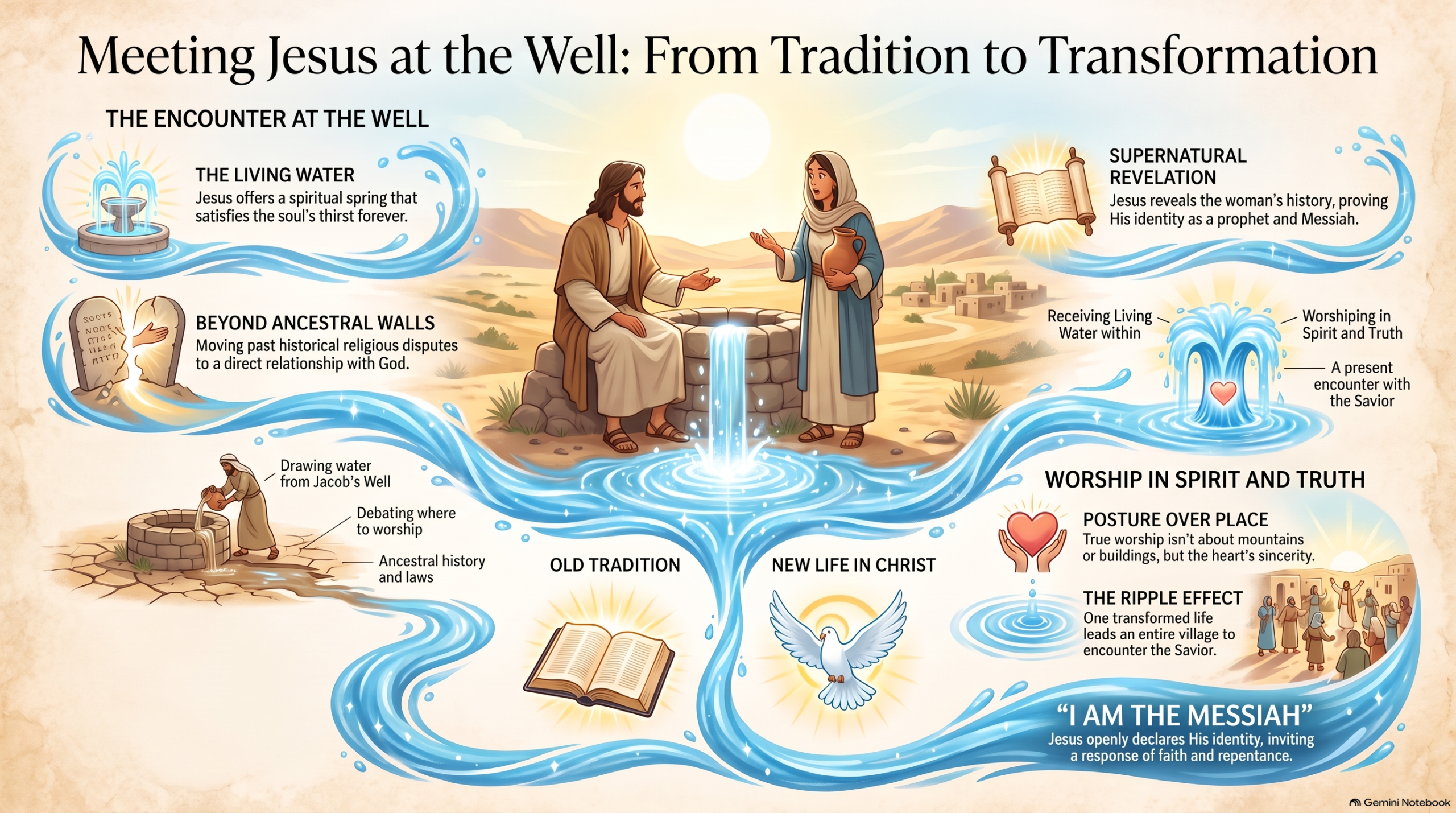
The Heart of the Message Summary
Centering on Jesus' encounter with the Samaritan woman at Jacob's well in John 4, this week's sermon by Pastor Dustin explores how true faith extends beyond historical divisions, religious debates, and human traditions. Offering her "living water" to permanently quench eternal thirst, Jesus reveals supernatural knowledge about her personal history, not to condemn her, but to align her life with God. Shifting the focus away from physical locations like Mount Gerizim or Jerusalem, Jesus reveals that God seeks true worshipers who will worship Him "in spirit and in truth". As the woman's testimony moves her whole village to stream out into the fields ripe for harvest and confess Jesus as the Savior of the world, the message challenges believers to abandon passive routines, embrace both the Word and the Holy Spirit, and respond actively to God in daily life.
TRANSCRIPT (word for word)
Opening Prayer
Welcome to church. It's good to see all of you. If I didn't say hi before church, hello to our church. That's right, Father, thanks for today. Thank You for these people. Thank You for Your word. I pray that as we open Your word and look at the life of Jesus and who Jesus is, Lord, that we'll see things that You want us to see.
I think sometimes we're excited about what's new, or we're determined to stay with only what's old, or Lord, whatever's in between. But Father, I just pray that we would see Jesus as we're supposed to see Him today in this moment. That Lord, as You say in the Old Testament, "I'm the Lord, I do not change." In the book of Hebrews, Jesus Christ the same yesterday, today, and forever.
Let us see Him today the way that He is. Lord, we give You this time and we ask that what's of You would remain and what's not of You would fade. In Jesus' name, Amen.
Historical Context of Samaria and the Samaritans
We're in John 4 and it's interesting that Jesus is passing through Samaria. So if you're familiar with John chapter 4, it's a pretty popular passage, I think probably because John is popular. Jesus is in Samaria, so what does that mean? I've heard lots of pastors make lots of—He had to go to Samaria or something like this, right? There's lots of things you could do about that, but who are the Samaritans? Why does it matter that Jesus is there? What's going on?
So before we read this story, just bear with me for a little bit of history of the Samaritans. Samaria at the time Jesus is there is a region, and the region is named after a city that was built by King Ahab's father named Omri. And Omri gets in charge; He builds this great big city. And Samaria, the city actually, is one of the greatest cities of the old times, stronger and more fortified than Jerusalem, but of course Jerusalem outlasted it.
And then coincidentally Omri's son Ahab—who Ahab and Jezebel, if you've read the Old Testament, Ahab is the most effective militarily of any Jewish king, better than David, better than all the others, he conquers more land. The nation of Israel, the northern kingdom—so the kingdom splits between the southern kingdom of Judah and Benjamin and the ten tribes in the north. And Samaria becomes the capital of this northern kingdom. And it's just very strong, very powerful; Judah by comparison is very small.
There's also some other interesting differences. The kingdom of Judah lasts for about 400 years. The northern kingdom, which I'll call Israel, lasts for about 200 years. The kingdom of Israel has 10 different dynasties, 20 different kings over 200 years, give or take. The kingdom of Judah has one dynasty, the house of David, and the same amount of kings for twice as long. And so there's all these differences. So at the time of Jesus, when we see the Samaritans and the province of Judah in place, they have a very different history.
So the Samaritans are kind of Jews. It depends who you listen to. There's this history that says that Assyria came in, wiped out the northern kingdom, and separated out all the 10 tribes, and they're lost to history. Archaeology will tell us that while that did happen in large population centers, like in the hills and stuff, the native Jews stayed. And then we just see a history of population decline.
And so there's a good chance that at this time during the Roman Empire, the people who were there are kind of Jewish, which is a problem if you're completely Jewish, because you don't want something like Nehemiah to happen again, right? Nehemiah comes back, he rebuilds all the parts of Jerusalem that he rebuilds between Nehemiah and Ezra. They do some rebuilding, but Nehemiah makes a comment. He says, "Hey, listen, if you've married anyone not a Jew, you're out. You can't live in Jerusalem, you can't be here". And so there's this history that trickles all the way down generations later with Jesus and this woman He's about to talk to who's a Samaritan.
So Jesus passing through Samaria is like distant cousins that you don't want to be around, right? This is like—I have cousins who are wonderful, and if I met them, man, I could spend a whole week with them, it'd be awesome. I have cousins that if I met them, it'd be like, "Technically you're in the family, I mean, you know, but..." And I'm sure they might think that about me too, right? So this woman, the Samaritan woman, is kind of not really Jewish enough.
Religious Tension and the Samaritan Pentateuch
And let me back out—there's one more thing from history that'll help us. The Samaritans have a slightly different version of the Pentateuch. So what's the Pentateuch? It's the first five books of the Bible: Genesis, Exodus, Leviticus, Numbers, Deuteronomy. The Jews have the Pentateuch that was passed down to them all the way through the centuries. But the Samaritans—and we'll hear about this—they believe that Mount Gerizim is more important than Mount Zion. So their Pentateuch, depending on which version you get, changes Zion to Gerizim and all their stuff, and talks about how it's the right one and the good one.
So there's this big argument, not only whether the Jews were the true Jews and the Samaritans are only kind of Jews, but also who has the right version of the Bible. So imagine there's all this religious tension, all this stuff happening, and that's the world that we find this story in.
Jesus Meets the Woman at Jacob's Well (John 4:4–26)
So we're going to start in chapter 4, verse 4:
He—this is Jesus—had to go through Samaria on the way. Eventually, He came to the Samaritan village of Sychar near the field that Jacob gave to his son Joseph. Jacob's well was there, and Jesus, tired from the long walk, sat wearily beside the well about noontime. Soon, a Samaritan woman came to draw water, and Jesus said to her, "Please give Me a drink". He was alone at the time, because His disciples had gone into the village to buy some food.
The woman was surprised, for the Jews refused to have anything to do with Samaritans. She said to Jesus, "You are a Jew, and I'm a Samaritan woman. Why are You asking me for a drink?"
Jesus replied, "If you only knew the gift God has for you, and who you are speaking to, you would ask Me, and I would give you living water".
"But sir, You don't have a rope or a bucket," she said, "and this well is very deep. Where would You get this living water? And besides, do You think You're greater than our ancestor Jacob, who gave us this well? How can You offer better water than he and his sons and his animals enjoyed?"
Jesus replied, "Anyone who drinks this water will soon become thirsty again. But those who drink the water I give will never be thirsty again. It becomes a fresh, bubbling spring within them, giving them eternal life".
"Please, sir," the woman said, "give me this water, and I'll never be thirsty again. And I won't have to come here to get water".
"Go and get your husband," Jesus told her.
"I don't have a husband," the woman replied.
And Jesus said, "You're right. You don't have a husband. For you have had five husbands, and you aren't even married to the man you're living with now. You certainly spoke the truth".
"Sir," the woman said, "You must be a prophet. So tell me, why is it that you Jews insist that Jerusalem is the only place of worship while we Samaritans claim it is here at Mount Gerizim where our ancestors worshiped?"
Jesus replied, "Believe Me, dear woman. The time is coming when it will no longer matter whether you worship the Father on this mountain or in Jerusalem. You Samaritans know very little about the One you worship, while we Jews know all about Him. For salvation comes through the Jews. But the time is coming and indeed it is here now when the true worshipers will worship the Father in spirit and in truth. The Father is looking for those who will worship Him that way. For God is Spirit and those who worship Him must worship Him in spirit and in truth".
Let me read a little more and then we'll take a break.
The woman said, "I know the Messiah is coming, the One who is called Christ. When He comes, He will explain everything to us".
Then Jesus told her, "I am the Messiah".
The Disciples Return and the Harvest of Samaria
So just then the disciples come back. They were shocked to find Him talking to a woman, but none of them had the nerve to ask, "What do You want with her? Why are You talking to her?"
Then the woman left her water jar beside the well and ran back to the village, telling everyone, "Come and see a man who told me everything I ever did. Could He possibly be the Messiah?" So the people came streaming from the village to see Him.
Meanwhile, His disciples were urging Jesus, "Rabbi, eat something". But Jesus replied, "I have a kind of food you know nothing about".
"Did someone bring Him food while we were gone?" the disciples asked each other.
Then Jesus explained, "My nourishment comes from doing the will of God who sent Me and from finishing His work. You know the saying, 'Four months between planting and harvest,' but I say, wake up and look around! The fields are already ripe for harvest. The harvesters are paid good wages and the fruit they harvest is people brought to eternal life. What joy awaits both the planter and the harvester alike! You know the saying, 'One plants and another harvests,' and it's true. And I sent you to harvest where you did not plant. Others had already done the work, and now you will gather the harvest".
Many Samaritans from the village believed in Jesus because the woman had said, "He told me everything I ever did". When they came out to see Him, they begged Him to stay in their village. So He stayed for two days, long enough for many more to hear His message and believe. And they said to the woman, "Now we believe, not just because of what you told us, but because we have heard Him ourselves, and now we know that He is indeed the Savior of the world".
Supernatural Knowledge and the Heart of Jesus
The thing that sticks out to me the most in this story about Jesus is this is the first time we see Jesus interacting with a large group of people who come to Him and believe in Him, but He didn't do anything like a miracle other than—I mean, He did do a miracle, right? In the sense of 1 Corinthians 12, we call this like a word of knowledge, right? Jesus told her something He could not have known except for the fact that He had supernatural knowledge, right—either because He's God or because the Holy Spirit tells Him, depending on how you slice Jesus on earth. But God knows this stuff about this woman. And Jesus tells her that, and all of a sudden she's like, "Oh man, You have to be a prophet". But no one's raised from the dead, the sick aren't healed, there's no walking on water, there's no calming storms.
But then after two days, all these people believe in Him because of the things that He said. Which is an interesting thing that I think we sometimes think about and spend time with, and it's good, but we sometimes stop there and don't move all the way through the rest of the story.
And when Jesus tells her, "Those who worship Me will worship Me in spirit and in truth"—and so this woman comes, interestingly enough, we talked about John last week or the week before, these different numbers that show up in this pattern. This woman is with not one of her five husbands, but a sixth person. So the number six has come up again with humans and their effort and their failure. Not really pertinent, just like to throw that in there.
And this woman is coming at noon, and you can see lots of depictions of this woman in Christian media over the last 2000 years. This is maybe one of the best-known stories, probably because John is one of the most used books in the modern age, and that's great; the book of John is awesome. If you've watched the shows, this woman's portrayal is almost kind of ridiculous—like her whole portrayal is just this kind of silly lady.
And if you listen broadly, you'll hear everything from: "Well, this woman was basically a trashy lady who couldn't keep a husband, going from one man to the next living her best life, and now she's with someone else, an outcast who had to come to the well at noon because nobody wanted to talk to her". That's one end of the spectrum. The other end of the spectrum is: "This poor old lady has buried five husbands, and now she's just living with a guy who's taking pity on her, working as his maid, cooking and cleaning, and didn't have time to get to the well until noon".
The Bible doesn't tell us any of that—it's all a guess. What we know is that she showed up at noon and it was just her and Jesus. And that's really what matters. The rest of it, the only thing Jesus really focuses on is spirit and truth. He doesn't really focus too much on her whole husband situation. Now, I think from the way Jesus talks about it, there's probably something going on, right? It's probably more than just that she's buried five husbands. But we don't really know.
Because when Jesus says, "Hey, bring your husband," and she says, "I'm not married," and Jesus is like, "That's true, because you've had five," there's something that Jesus is pointing to. But the thing that Jesus ultimately is doing is He's telling her all of her history in that sentence. That's why she says, "He told me all I ever did".
Seeking True Worship over Religious Debate
And when you think about the fact that here are the Samaritans, thinking they're worshiping God properly, but all the prophets are coming through the southern kingdom, now she's like, "Well, who's right?" She's a woman in the first century, so it's unlikely that she's had access to a lot of theological education or learning the scriptures in general. And with the history of the Samaritans, there's a chance she's heard a couple different versions.
And so here's Jesus who says to her something true about her history that there's no way He could know. And she's like, "Hey, You're a prophet. I have a question for You: What's right? What are we supposed to do?"
And Jesus gives her the answer. Now, if Jesus was answering the question 50 years prior, the correct answer was Jerusalem—Zion was the place. But Jesus had come to declare His kingdom. In fact, later He says that they believed His message because of what He said. Well, Jesus' message in the beginning of Matthew is, "Repent, the kingdom of heaven is at hand". And so Jesus' message pretty much universally everywhere He went was that the kingdom was coming. That's why we see Him cast out demons, we see Him heal the sick; He does all the things the Messiah does. And we have to remember that the Messiah is, in the Jewish mind, a King. And so Jesus tells her, "Look, I'm the Messiah," and His message is repent and turn.
So He shows up to the Samaritan people through this conversation with this woman. She runs out and tells everybody, "You've got to come see this guy; He told me everything". Everybody would have known that she's had five husbands and that she's with number six and they're not married. Whether she's living with him as a husband and wife or something else, we don't know for sure. What we know is her situation was bad.
But none of that really matters to Jesus. And I start to wonder how much of it matters to her as I study, because what she's concerned about is not whether or not she got caught or all her sorrow. What she's concerned about is: "Where am I supposed to worship? Where am I supposed to go meet God? What am I supposed to do?"
And there's a sense in that question, because it seems out of the blue, right? When Jesus talks to Zacchaeus, Zacchaeus responds by restoring what he took fourfold. When Jesus talks to Nicodemus about being born again, Nicodemus asks how an old man can be born again. This woman seems to ask a question that has nothing to do with what Jesus just said.
Except that's kind of the beauty of Jesus, right? He said what she needed Him to say so that she could ask the right question so He could give her the information that she needed.
Spirit and Truth: Balancing Both in the Church
They have this big conversation about water, and you see the Jewish-Samaritan tension. Jesus says, "Hey, if you knew who it was, you'd ask Me for a drink and I'd give you living water". And then Jesus hooks her with, "Go get your husband," leading her all the way down the road, and turns it into a conversation about worshiping in spirit and in truth.
And the thing I really love about this is the balance of the two. It's easy now to go anywhere in the world and see Christians argue—Catholics, Charismatics, Reformed—everybody claiming, "We worship the true Jesus". Rich Mullins once said in an interview: "God didn't give us the Bible so we could prove that we were right. He gave us the Bible to prove that He's right and the rest of us are guessing".
And so this woman shows up worried about where to worship God, and Jesus says, "No, this is how you worship God: in spirit and in truth". Even in the Old Testament, God made provisions for people in different situations. And Jesus is saying the day is coming, and it's now, that Jesus is the provision for all of that. He comes to her and offers this living water.
The Fields Ripe for Harvest
She runs away, the disciples show up, and all these people start streaming out from the village like a crowd gathering. She's running around telling people, and as people get excited, they trickle out to the well to see Jesus.
And as they're moving, Jesus tells His disciples, "The fields are ready for harvest". Imagine being Bartholomew, John, or Peter, hanging out at the well, trying to figure out what He ate. Jesus says, "No, you don't understand; the fields are ripe for harvest," and He goes to work taking His guys with Him. For two days, He spreads His message.
Many Samaritans believed because of the woman's testimony, and many more believed after hearing Him themselves, saying, "Now we know that He is indeed the Savior of the world". That's interesting because Jesus' name means Savior. In Matthew, God tells Joseph, "Name Him Jesus because He'll save His people".
Living Spiritually Minded in a Physical World
When I contemplate this, I keep coming back to the book of Acts. I watch how people come to Jesus in Acts and in the Gospels. People ask Paul, "What must I do to be saved?" We see Christians in the moment doing the same thing Jesus did—taking advantage of the moment. Priscilla and Aquila teach Apollos; Ananias goes to Paul; Peter and John heal the man at the temple gate. People were so impacted that their heart was to respond.
I think about growing up in church. How many services did I sit in where the preacher begged people to come get saved at an altar call? We've taught ourselves social cues that we have to wait for the right moment. When do I come to Jesus? The answer is now. Why do I come to Jesus? For whatever you need—this woman needed the truth. Jesus didn't talk to her about getting her life right with man number six; He talked to her about getting her life right with God.
Jesus meets each of us as we need Him—some in bread and wine, some walking on water, some at the well. In my own life, as I pray and study, I have this sense of being like a two-year-old with Jesus saying, "Look, I can tie my shoes!" and God patiently showing me I've just made knots. But it's about learning the basics and understanding that when people meet Jesus, their response is to tell others.
In the midst of all this, we still have Judas, who went out with the twelve and did miracles, yet missed what was going on. I'd rather be the Samaritan woman at the well who doesn't belong than Judas, who was a betrayer.
Understanding the Gift of God
Jesus tells us in John 4:10, "If you only knew the gift God has for you and who you are speaking to, you would ask Me, and I would give you living water".
Do we really understand the gift that God wants to deposit in us? Jesus replied, "Anyone who drinks this water will soon become thirsty again. But those who drink the water I give will never be thirsty again. It becomes a fresh, bubbling spring within them, giving them eternal life".
The woman appeals to history—Mount Gerizim and Jacob's well. But Jesus says, "Believe Me, dear woman. The time is coming when it will no longer matter whether you worship the Father on this mountain or in Jerusalem... True worshipers will worship the Father in spirit and in truth".
Tradition vs. Transformation
I love tradition—I love Advent, Easter, and Holy Week. I think old traditions are valuable. But a tradition that moves us away from God or separates us because we're stuck in our ways is bad. There's a rule called Chesterton's Fence: never move a fence until you know why it was built.
I want an encounter with Jesus where He expands our understanding. When we designed our church logo with the dove and the Bible, I wanted the idea of Spirit and truth built into it. I've been in very somber, ritualistic churches, and I've been in wild, charismatic churches. By God's grace, I had examples of churches heavy in truth and churches heavy in Spirit. With all my heart, I want to follow Jesus and be both.
Responding to Jesus Today
We've got to do more than just church every Sunday. We can't just show up, get truth or Spirit, and do nothing with it. I want the Word of God to slice right through us like Jesus telling the woman, "Go get your husband," so that we can receive living water.
I want us to live spiritually minded in the physical world—to have both Spirit and truth. I want to grow in what the Lord has for us individually and as a church so we can change our world.
I'm not chasing metrics, KPIs, or baptism campaigns. What if we just preach Jesus? I want to see the move and power of God in my life so that people are compelled to come to Christ.
Jesus told the Samaritan woman there is another way, and He changed her life. My walk with Jesus is five or ten minutes at a time looking more like Him to bring others to Him. In my Father's house there are many rooms, and I want more people to fill those rooms.
Closing Call and Prayer
I want to encourage us all to spend today contemplating: What is it that God wants from me? When Jesus comes, we end up doing things we couldn't or wouldn't do before—Zacchaeus gave his money back, the lame walked, the blind saw, and this woman received living water.
Let's pray:
Father, I want to be like the people we see interacting with Jesus. All of them had a response. Lord, I don't want to be like the last guy in the parable of the talents who buried what You gave because of fear. I want to do whatever You say to do and be wherever You say to be.
Jesus says He has food to eat that no one knows about, which is to do the will of God. Lord, let it be a change in our hearts and lives so that we say with the prophet, "Here I am, send me".
Help us to be faithful in whatever You put in our hands, whether ten talents, five, or one. Wherever the conversation goes, Jesus—if we talk about water, You talk about our life, You reveal You're the Messiah, and people believe.
Lord, I'll take whatever You have for each of us. I don't want to settle for crumbs; I want to sit at the table with You. We love You. Holy Spirit, come and teach us and change us. In Jesus' name, Amen.
Would you like me to extract key sermon quotes or generate a summary of the main theological themes to include in your video description?