
Dustin Woolam | Pastor & Lead Elder
The Heart of the Message Summary
In a culture driven by routine and transactional interactions, Pastor Dustin Woolam reminds us that the Gospel is far more than a set of moral values or a better way of living—Jesus is the ultimate cure for spiritual death. Challenging believers to move past passive coexistence, Pastor Dustin calls us to recognize every daily encounter as a God-given opportunity to boldly share our story and introduce a dying world to the life-saving hope of Jesus Christ.
TRANSCRIPT (word for word)
Opening Prayer
Good morning. Welcome to church. Let's pray.
Father, thank You for all that You do in our life. Or we wouldn't even be breathing without Your decision to create. So we're grateful to You. Father, thank You for the body. I thank You for all of the people that You brought, and Lord, for those who are unable to come, I pray You be with them, speak to them, speak to their hearts. Lord, I pray that as we open Your Word that Holy Spirit, You'll teach us as Jesus said You would. I pray, Lord, that what's of You would remain and what's not of You would fade. Lord, we give You this time, we give You our hearts and our minds in Jesus' name, amen.
A Break from the Series: Sharing Faith Beyond Transactions
So we're in this series about "Give Me Jesus." And I realized that in the last couple of weeks, or a couple of times in the last few weeks, that I've talked about that Jesus makes the comment that the harvest is ready and that we need workers. And we've looked at the scriptures where it talks about the need to tell people about Jesus. And I thought that we would take a short break from the series, but it's adjacent. So it's kind of like when you pull off on the rest stop as you're driving. I just want to talk about: what does it mean to talk to someone about Jesus? What does that look like? What does it sound like?
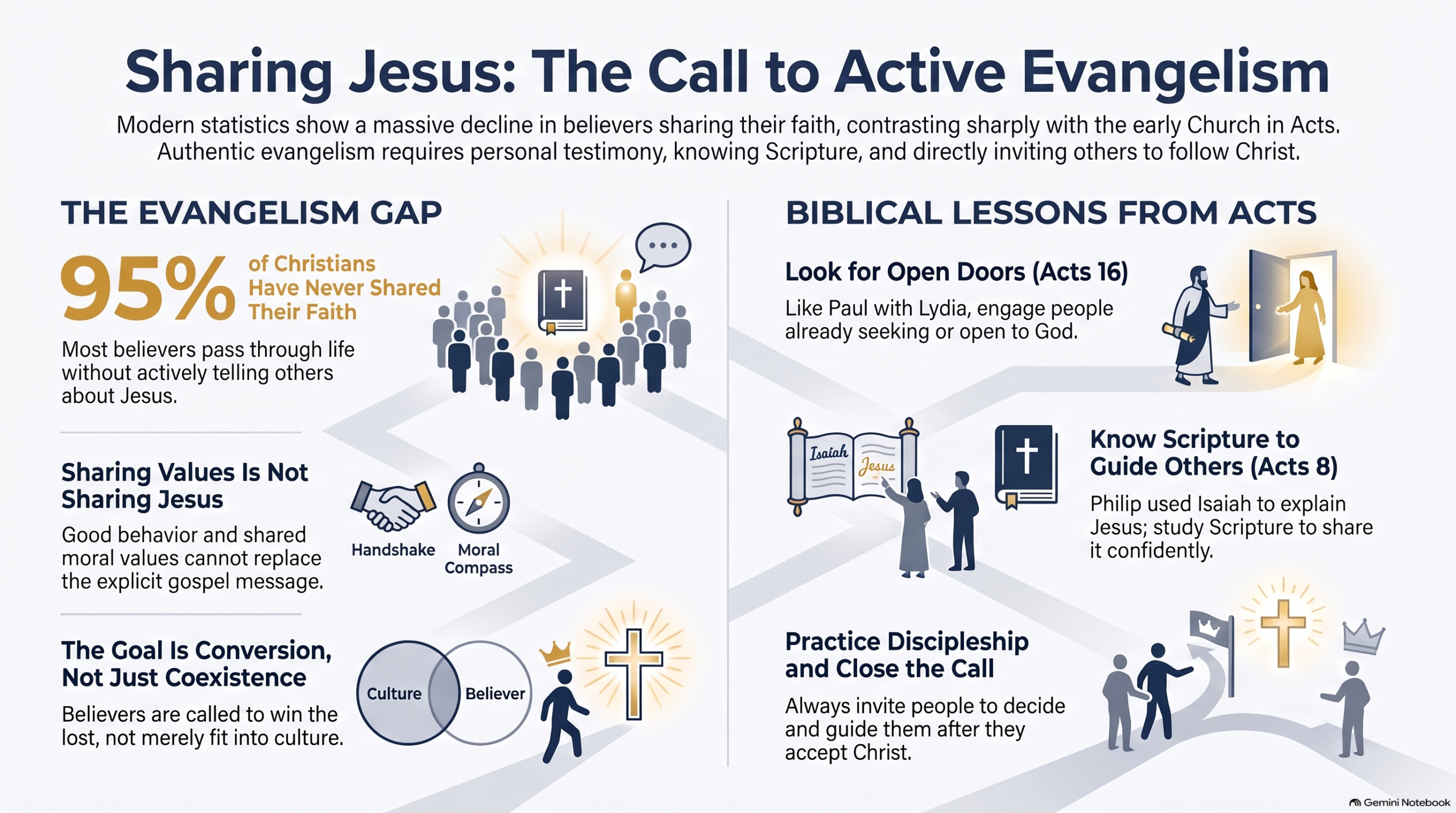
There's a statistic from last year, maybe the year before, that says that 95% of Christians—so if you have a dollar, 95 cents—have not shared their faith with anyone. 95%. And I got to thinking about that. Some of that could be the technology age that we live in. "I shared a meme about Jesus and/or some inspirational picture." And so are we counting that in the 95%? But in this particular thing, when we're talking about sharing our faith in Jesus, what does that even look like? What does that sound like?
The Transactional World vs. Being Human
And in our culture too, I think about like in the first century, sharing your faith probably didn't sound the same as it does to us. Did they care about the percentage of people who were sharing their faith? Were they tracking that kind of thing? Or did they need to? Were people so excited that they were just telling people about Jesus everywhere that they went? So, you know, what kind of problems did they have? What was going on?
But another thing that I think about in our modern society is that we're very transactional in all that we do. I went to the gas station this morning and I bought things. There was a transaction. I get on a call or a meeting or whatever, and there's an exchange of information. There's an exchange of niceties. There's all these rules. I'm sending and receiving emails or all these things. Even as you're walking through a door, holding the door open or whatever, there's all these moments that, if we're not careful, just become transactions. They're not human moments.
I got into a habit because of the location of the building that I work in. I go to H-E-B every day. I walk over there, I walk through, and I was talking with one of my coworkers. He goes once a month and like stocks up everything and has his little thing, and that's not bad. Like I'm not saying I'm better than him, but I do it mostly because I want to walk. I want fresh air, I want sun, I want whatever, and I'll go to H-E-B with people who are going just to go, right? I won't even buy anything. I just want to get out of the building.
And I made a comment to this guy who buys things and stores things up. I was like, "Man, I'm just in the business of being human, right? I just want to be out and about. I don't want to be anchored to this desk or the screen in front of me." I don't want this, but I realize that even in that, I want to be more than just in touch with being human, because I'm human no matter what. But if Jesus has changed my life, I want to say something about Jesus. I want to live in a way that honors Christ, of course.
The Cure for Death and the Reality of Sin
And then there's this like, well, you don't want to force it on people. Like, "Man, I can't just force Jesus down people's throat." I heard an example this week. This guy said, "If you had the cure for cancer, don't you think you might shove it down people's throat? If it was a pill, you might just stick it in their mouth and make them eat it, right? Well, you know, you could die of cancer if you want. Or would you try to convince them? No, no, no, look, here's millions of people whose lives have been changed by this pill. They've taken this pill, they're clear of cancer, their life, all these changes happen." But as Christians, I wonder if we think about Jesus as the cure to death, right?
Ultimately, Jesus came and defeated death. He died and freed us from our sin, from bondage to sin. Paul says in Romans like 5 through 8, he has this whole big section, but he talks about that the wages of sin is death, but the gift of God is eternal life. And he says that we were slaves to sin, but now in Christ we're free. And that we were bound to the law through sin, but that we die in Christ and were raised in Him, and now we have a new life.
When's the last time we told anyone that? When's the last time we thought about that the person next to me is on their way to hell, and we did something about it? If I knew somebody was going to get in a car and that eventually, in some unknown time period, maybe in the next 30 seconds, maybe in the next 90 years, that that car's brakes were going to fail and they were going to die in a car wreck, I would tell them something about it: "Hey, don't get in that car, those brakes are bad." But the problem is that we see people driving these vehicles all the time and the brakes aren't failing. So we're not worried about it. But when Jesus comes and changes our lives, there's the good news like I want to share.
Personal Encounters and the Danger of Moralism without Jesus
So I have a friend that I've talked to you all about a lot. We're going to be in the book of Acts today; we're going to start in 16. But I have a friend that I've said a lot about. When I very first met him—and this was, gosh, who even knows how long ago this was, 20-something, a long time ago—he said that when he met me, he originally thought that I was an atheist, right? And I was like, "Why did you think that?" And he's like, "I don't know." And he's like, "There just didn't seem to be..." He's like, "You were just a good guy. It didn't seem to be anything spiritual about you."
And this was like, I mean, my dad was still alive and I was still kind of arguing with God about how I felt about things, right? So for someone to pick up on me being the atheist, it's like, well, at least he didn't pick up I was mad at God, right? So there's a small win there. But for the most part, I was living and working in Waco. This was like 2014, 2015, maybe longer. And so we start talking, we start interacting. I start telling him, he meets Jamie and the kids. In fact, when he met the kids, they were like this tall, right? So yeah, it has to have been a long time ago.
And we've known each other... Yeah, he and I just talked about his baby being born last week, right? So like, we're still in touch, and he knows now where I believe and where I stand. But, you know, I try to tell him about Jesus and he would tell me about his lifestyle: "You should do this." And I'm like, "No, you should do this." "And no, just this and this." And we go back and forth with whose lifestyle, and he begins to explore like just religion in general. And he's come to this idea that he believes there's a higher power, but maybe it's just the universe. But there's something out there, and he's trying to get me to understand that my views on God are really just his view of this higher power.
And finally, a couple of years ago, I really feel this sense of like, man, this guy needs to become a Christian. He needs to be saved. And so I start really kind of pressing him about Jesus, not just the claims of Christianity, not just the values of Christianity, not just all of the "this is why we believe or what we believe." Because he's curious about all this stuff; he's a smart guy. And I start telling him about Jesus and he says to me, "Dustin, I've done all the things that are in the Bible and my life is good. Why do I need Jesus?"
And I'm like, "'Cause you're going to hell, man! Like, you're dead in your sins. You need to be alive." He's like, "But my life is good, man. I don't need all that." And so somewhere in the midst of all of that, I failed to make Jesus important.
Converting the Lost vs. Coexisting
And so when I'm talking about sharing our faith, I don't mean sharing our values. And when I'm talking about sharing our faith, I don't mean telling people there's a better way to live. And when I'm talking about sharing our faith, I'm not talking about "what's good for me is good for me and what's good for you is good for you, live and let live." Man, we are not called to coexist; we are called to convert the lost. Now you've got to be friendly, right? And you've got to make things work. And if you work with someone and your job has rules, man, can I just tell you, find the edges of those rules and push? Because if your job told you you couldn't hand out cancer pills or you'd be fired and your friend was dying from cancer, you would give them the pill. Or you'd find a way to put it in front of them where they take it themselves. If you couldn't actively give it to them, you'd be like, "Let me just leave it on your desk."
And we, as Christians in the U.S., maybe not us in this body, but the church in general is losing ground because we're not serious about Jesus. We're real serious about our politics and we're real serious about living the right way or living this way or making these decisions, but the church in America is in decline because Jesus isn't important to us. And if He is important, well, "He's important to me," but Him telling me to go into the world and preach about Him has not been important to me.
And I just want to say like, maybe that's you individually, but as a member of the body of Christ, this has been true about the church in America. There's been seasons of revival, there's been seasons of renewal, there's been all of this stuff, but look at the history. In the last 200 years, we've had nothing but steady decline with every once in a while it lifts, and then it declines, and it lifts, and it declines. And we know that in Timothy, the Bible tells us that things will go from bad to worse. I'm expecting things to become worse, but they don't have to get worse in my lifetime, right? They don't have to get worse in my circle.
I repeatedly have said that I want to make sure that the people who are close to me know that I love them and they know about Jesus. But man, what about the people I drive next to every day? What about the nice young lady at the gas station this morning that when Kalista and I were there, she's like, "You know, on the Lord's Day, you'd think people would be nice." And in the stereotype, Christians are the worst tippers on the planet and they're mean and they're hateful on Sundays. I don't know if that's still true, but it was true 10, 15 years ago.
Lessons from Acts 16: Paul and Open Doors
Let's look at Acts chapter 16. Paul becomes a Christian in a very spectacular way. Let me tell you the story in case you don't know. There's a song that goes with it. I won't sing it to you. You're welcome. It's for me, too. So the lyrics of the song say: "Paul was walking on the road to Damascus. Big bright light walked up and asked him, 'Darkness to light, come follow Me, and once I was blinded, I could finally see.'" And I like that. Once I was blinded, I could finally see. And then the next line, the person singing about themselves, it says, "I once was lost, but the Lord walked in, captured my heart and took away my sin. Now I'm living for Jesus because of all that He's done." God gave mercy through His only Son, right? If y'all don't like God, don't go looking for this song. God used to be the thing when I was in high school; it's music for band nerds.
So in the book of Acts, Paul tells that story twice. We get the telling of the story originally, and then two more times when Paul is defending the faith or his faith or talking about himself, he tells that story.
But in Acts 16, Paul ends up in Philippi. So we'll start in verse 11, Acts 16:11. And the "we" here, Luke is narrating this. So the Gospel of Luke, the same author wrote the book of Acts. So in fact, sometimes you'll hear people say "Luke-Acts." It's like First and Second Samuel, First and Second Kings—Luke-Acts, right? They're the same story from the beginning of Jesus until the church gets going. So if you infer some long chapters and a lot of words, it's awesome.
So verse 11: "We boarded a boat at Troas and sailed straight across to the island of Samothrace. And the next day we landed at Neapolis. From there we reached Philippi, a major city of that district of Macedonia and a Roman colony. And we stayed there for several days. On the Sabbath, we went a little way outside of the city to a riverbank where we thought people would be meeting for prayer. And we sat down to speak with some women who had gathered there. One of them was Lydia from Thyatira, a merchant of expensive purple cloth who worshiped God. As she listened to us, the Lord opened her heart and she accepted what Paul was saying. She was baptized along with the other members of her household, and she asked us to be her guests. 'If you agree that I am a true believer in the Lord,' she said, 'come and stay at my home.' And she urged us until we agreed."
So Paul goes to Philippi. There's a whole story about why he's going here and what's happening. And when he goes to Jewish lands and Jewish areas, his habit is to go to the synagogue on the Sabbath and talk about Jesus. He's just going to show up to a place where, frankly, it's a bunch of Jews. They have the Law. They're waiting for the Messiah. Maybe they've heard of Jesus, maybe they haven't. But he shows up and he tells them about Jesus. And he gets a lot of trouble for it in a lot of places.
Then he goes to Philippi and they go to a place where they think people might be praying on the Sabbath. And we see that Lydia's already—she's probably a Gentile who is serving God, right? They were called God-fearers. And so Paul's looking for these kinds of open doors when he's ministering to people.
So as we're walking through our lives, how many people do you know that grew up and used to go to church? Or their grandma goes to church, or their grandma's praying for them, or "Oh yeah, my grandma talks about the Bible all the time." That's your open door, just like Paul had. That's your moment to go to someone and to say, "Man, let me tell you what I know about Jesus." And what does Paul share? He shares the truth of the Bible, all the Old Testament and all the things about Jesus. We see in other places that Paul will stand up and say, "Hey, this God that you think you know, let me tell you who He really is." Paul is looking for opportunities.
Lessons from Acts 6 & 8: Persecution and Uncompromising Faith
Now in Acts chapter 6, we get the story of some guys being selected. There's some trouble in the church, so they have to pick some deacons. And chapter 6, verse—well, let's just start in verse 1. It says, "But the believers rapidly multiplied and there were rumblings of discontent." That makes sense. "The Greek-speaking believers complained about the Hebrew-speaking believers"—and yours might say Hellenists for the Greek ones—"saying that their widows were being discriminated against in the daily distribution of food." So they're complaining about racism, right? That's racism in the church.
"So the Twelve called a meeting"—the Twelve being the Twelve Apostles called a meeting of all the believers—"and they said, 'We apostles should spend our time teaching the Word of God, not running a food program. So brothers, select seven men who are well respected, full of the Spirit and wisdom, and we will give them this responsibility. And then we apostles can spend our time in prayer and teaching the Word.'" So being full of the Spirit and being wise is important for distributing food, like distributing food's not a small thing.
"Everyone liked this idea and they chose the following: Stephen, a man full of faith and the Holy Spirit"—he gets killed later in this chapter—"Philip, Prochorus, Nicanor, Timon, Parmenas, and Nicolas of Antioch, an earlier convert to the faith. These seven men were presented to the apostles, who prayed for them as they laid their hands on them. So God's message continued to spread. The number of the believers greatly increased in Jerusalem. Many of the Jewish priests were converted, too."
Okay, so we have these seven guys, full of the Spirit, wise, and well-respected. One of them gets killed pretty much immediately. That's Stephen. And when Stephen gets killed, persecution starts. We're going to go to chapter 8. It says that all these people, as persecution started, were going out everywhere telling people about Jesus. So persecution, rather than stopping the Word—and this is true in like church history across the board, as Christians become persecuted, people begin to convert.
There's the story I shared a couple of weeks ago. There's like 20 guys who are Christians being beheaded because they're Christians. There's one guy who got caught up in the mix. And so the Muslims who are killing them are like, "Hey, are you a Christian?" "Yep." "Okay, we kill you, right?" And like, let's don't get this lost, right? Like, I'm going to say this again, but I want to be crystal, absolutely clear: There is no harmony between Christianity and any other worldview. There's zero harmony—not with Hindus, not with Muslims, not with atheists, not with Latter-day Saints, not with anybody. Jesus says, "It's Me or not at all." And that's why we have to tell people about Jesus.
And so when people are being persecuted because they're preaching Jesus, what they're saying is, "Hey, everybody, you're wrong." Now, you don't have to be, "I'm right, you're dumb." That's not handy, right? You don't have to be mean, you don't have to be hateful. But there is no—like, there's a faith called the Baha'i Faith that came from Islam, and it says that all gods are the same God and we all are just worshiping the same God. That's crazy town. There's no way, like—and do you know why? Because just look at all the gods, they're different! The god of Islam says convert or die, and the God of Christianity says, "If you run away, I'll come find you," right? There's a difference.
And so when we start looking at persecution, when we start looking at stuff... and so for these Muslims to be killing these Christians, Muslims are doing what Muslims are supposed to do. That's what the Quran teaches. And so, hey man, faithful Muslims, do you want to see what they look like? That's what they look like. Now, there are other faithful people. You see faithful Jehovah's Witnesses, you see faithful Latter-day Saints—they're out preaching all about their faith. They do a better job of preaching their faith than we do preaching Jesus. And we should be ashamed of that, right?
So there's no mixture. This is why the Israelites ended up in Babylon: because of mixture. The whole thing about—they were out, and Stephen talks about this in his teaching. He's like, "You're out worshiping your stars and you're out worshiping your gods, so God sends you to Babylon, and here you are."
And so, we see these guys all get executed because they're Christians. And then this one guy at the end, like I said, I've told this story before, they're like, "Hey, are you a Christian?" And he says, "Their God is my God." Like, he converts in the moment, knowing he's going to die. So yeah, talking about Jesus, we should expect it to bring some level of persecution. And frankly, some of us are like, "I'm suffering for Jesus." You know, you're suffering because you're a jerk, right? This isn't about you and Jesus; this is about you running around acting crazy.
Philip in Samaria: Pointing People to Christ
But as the church gets spread out, we catch up with Philip. He's now out and about. And Philip ends up in Samaria. Now, I remember a couple of weeks ago, Jesus was in Samaria. He talked to the Samaritan woman. There was this whole big thing in the city of Sychar, but Samaria is bigger than Sychar. So Philip is just out and about.
And so let's go to verse—well, we'll go to verse 4. It says, "But the believers who were scattered preached the good news about Jesus wherever they went." So they kick... and we see this pattern in Paul's life, right? Like, "Hey, Paul, get out of here. Stop talking about Jesus." What does he do? He goes to the next town and talks about Jesus. And he gets kicked out, and he talks about Jesus. And there's this constant thing, right?
And so Philip, for example, went to the city of Samaria and told the people there about the Messiah. Verse 6: "Crowds listened intently to Philip because they were eager to hear his message and see the miraculous signs that he did. Many evil spirits were cast out, screaming as they left their victims. And many who had been paralyzed or lame were healed. So there was great joy in that city. A man named Simon had been a sorcerer there for many years, amazing the people of Samaria and claiming to be someone great. Everyone from the least to the greatest often spoke of him as 'the Great One, the power of God.' They listened closely to him because for a long time he had astounded them with his magic. But now the people believed Philip's message of good news concerning the kingdom of God and the name of Jesus Christ. As a result, many men and women were baptized."
I just want to make a comment. We don't know exactly what Simon was teaching. The Bible doesn't tell us a lot more than this. But what we know is that he's doing magic or pretending to do magic. There's some stories that this guy was actually flying around and stuff. Who knows if that's true? It's old stuff, and you know how those stories go. Some guy's like, "No, I totally saw Simon flying." Well, maybe he was jumping off a rock! But what we know is he's drawing people to himself with these powers. And there's a rash on social media of Christians talking about Jesus, but they're not building a congregation for Jesus; they're building a congregation for themselves, right?
And so Philip shows up, and what is his message? The kingdom of God and the name of Jesus. He's pointing people to Christ. And so you don't have to be perfect to talk about Jesus. You don't have to be Philip, full of the Spirit and wisdom. Like, let's pray that God fills all of us with His Spirit and His wisdom. But Philip is pointing people to Jesus. And so people may say things like, "Oh, well, this or that, or what about, what about, what about, what about?" Man, it's not about me or about my failures or about my struggles; it's about what Jesus can do for all of us, or has already done.
And so he preaches. And then eventually, verse 13, it says, "Then Simon himself believed and was baptized. And he began following Philip wherever he went, and he was amazed by the signs and the great miracles that Philip performed." So Simon—if he's believed and if he's baptized and all of this is true, then he's lost all of his powers for the sake of Jesus, right? Because those are all demonic.
So when the apostles in Jerusalem heard that the people of Samaria had accepted God's message, they sent Peter and John there. And as soon as they arrived, they prayed for these new believers to receive the Holy Spirit. The Holy Spirit had not yet come upon any of them, for they had only been baptized in the name of the Lord Jesus.
Discipleship and the Danger of Wrong Motives
Then Peter and John laid their hands upon the believers and they received the Holy Spirit. When Simon saw that the Spirit was given when the apostles laid their hands on people, he offered them money to buy this power. "Let me have this power, too," he claimed, "so that when I lay my hands on people, they will receive the Holy Spirit." He didn't know, right? He's barely saved, right? It's an honest mistake. If you're like, oh, if he's got a lifetime... it says for a long time he'd been amazing people with his gifts or his talents or his whatever. He understands all this spiritual stuff to be a means of gain in his life. And so his statement to Peter is wrong, but it's at least sincere, right? It's honest, it's coming from like, "Oh man, this is awesome." And so maybe he's like even waiting for Peter and John to take up an offering or whatever it is, right?
But Peter doesn't respond the way that maybe Simon was expecting. He says, "Let me get this power." And so in verse 20, Peter replied, "May your money be destroyed with you for thinking God's gift can be bought! You can have no part in this, for your heart is not right with God. Repent of your wickedness and pray to the Lord. Perhaps He will forgive your evil thoughts. For I can see that you are full of bitter jealousy and are held captive by sin."
"Pray to the Lord for me," Simon exclaimed, "that these terrible things that you have said won't happen to me."
After testifying and preaching the Word of the Lord in Samaria, Peter and John returned to Jerusalem. And they stopped in many Samaritan villages along the way to preach the good news.
It's not enough to introduce someone to Jesus and to pray a prayer with them. Simon prayed a prayer, Simon was baptized. Simon still was bound by sin and wrong thinking. Simon needed to be discipled. And I imagine that Peter was the exact right guy to talk to Simon, right? Like, think about Peter, and he's like, "Hey man, let all that perish with you." That sounds really harsh, but isn't Peter the guy that heard Jesus say, "Get behind me, Satan," too, right? Isn't Peter the guy that received that harsh rebuke from Jesus?
There are going to be people in our lives that—hey man, let me tell you all about Jesus. You need to be saved. You're dead in your sins. You are dying and you are on your way to hell. Let me tell you about Jesus. But you're not done if they say yes. Now you have a baby to take care of or to make sure that they have care. And so talking about Jesus is—that's why making posts on social media is not enough, because you're now responsible for the believer that you've led to Christ. And maybe you don't know enough, so maybe your responsibility is to make sure that together you'll find good teaching or you talk about the things you're learning, or whatever the case might be.
Growth Takes Time: Five Minutes at a Time
I am, like Michael Heiser, the product of five minutes at a time; all of us are. I play this silly game on my phone. I've been playing really since at least 2019, the same phone game. Jamie started playing it. I'm watching her play it and I'm like, you know, right? I'm kind of cringing like, "That's not the move. Don't do that." But why? Well, because in my five minutes every morning, ten minutes every morning, whatever it is I do, switch all the colors, spend my five lives, die, don't play again till the next day. I've gotten all the way up into level 13,000. And I'm not proud of that, but that's where I am. In my what, from 2019 to 2026, how many was that? Seven years, 13,000 levels! There's probably some people out there like, "Amateur," right? Like, I'm not... but how did I get to 13,000? Five minutes at a time.
And how do I help Jamie get to 13,000? Just show her some of the things I learned along the way. That's how simple Christianity is. It's not more complex than that. Five minutes at a time. A little bit of time with the Lord every morning, getting better every time I come to the thing. A little more, a little more. And so right now, man, I can't believe it. I'm so angry. You know, I get saved and all these people are driving me nuts. And I'm thinking about, how do I make money off of Jesus? Because that's where I came from in my old world, like Simon, or whatever the case might be. And then, up, up, up, up, up. Here we are with Peter: three years with Jesus. "Hey man, let all that perish with you, and I hope you're forgiven." That's the Christian walk. It's a little at a time, a little at a time, a little at a time.
And the Holy Spirit comes. And that's the beauty of the Holy Spirit: He's been around forever. There's never a time the Holy Spirit didn't exist. So when He comes and dwells in us, He's the One that showed Peter what was happening inside of Simon.
Philip and the Ethiopian Eunuch: Prompt Obedience and Knowing the Word
One more story about Philip. So Peter and John are preaching through Samaria on their way back to Jerusalem. But in verse 26, it says, "As for Philip, an angel of the Lord said to him, 'Go south.'" So Peter and John head to Jerusalem; Philip goes south. He says, "Go south down the desert road that runs from Jerusalem to Gaza." So he started out and he met the treasurer of Ethiopia, a eunuch of great authority under the Candace, the queen of Ethiopia. The eunuch had gone to Jerusalem to worship, and he was now returning. So this is another example, kind of like Lydia: somebody who's worshiping God, but he's not a Christian. How do we know he's not a Christian? We keep reading.
"And he was now returning, seated in his carriage, and he was reading aloud from the book of the prophet Isaiah." It's chapter 53, where Jesus is dying. So the Holy Spirit says to Philip, "Go over and walk along beside the carriage."
Now remember way back, Philip got chosen because he was full of the Holy Spirit. And we see now that the Holy Spirit is whispering in his ear, like the Bible tells us that God will whisper in our ear: "This is the way, walk in it." So He's telling Philip, "Go over there."
Now let me pause here. I want to give you all some encouragement. If you think God is telling you to do something, and it's not something that's opposed to Scripture, right? There's a lady in the church that I used to be on staff in. She wasn't talking to me, she was talking to another staff member. She said, "Hey, I think God's telling me to divorce my husband." No, He's not, because God hates divorce. God's not telling you that. Now He might... now, I'm not saying you have to live in a house... I'm not saying you have to be unsafe, but I'm telling you God's not commanding divorce, right? And so if you think God is telling you something and it's not opposed to the Scriptures, just do it. See what happens, right?
So God says, "Go over and walk along beside the carriage." So Philip ran over. And I like that. God says, "Go over," and it says, "Philip ran over," right? Philip's excited about following the leading of the Lord. I want to be excited like Philip.
So Philip ran over and he heard the man reading from the prophet Isaiah. Philip said, "Do you understand what you're reading?"
The man replied, "How can I, unless someone instructs me?" And he urged Philip to come up into the carriage and sit with him.
This is like one of the key, easiest things to talk about Jesus. Somebody's like, "Man, I don't know, there's some weird stuff happening, like the universe is out there manifesting or whatever." First off, manifesting is just demonic stuff, right? Like, don't manifest anything; that's the devil. If you want more details, I'll tell you. But so people will talk about spiritual things, and what you can tell them is, "Hey man, let me tell you what I have seen to be true. Let me tell you about Jesus. Let me tell you about how God came, and all this that's happening in your life, man, that's the devil just trying to keep you away from God. Let me tell you about it," right? Or if somebody's reading something and they don't understand it, it's a great opportunity to start talking about Jesus. And you can just slide it in. And it doesn't have to be a lot; it could be a lot, but it doesn't have to be.
And so he urges Philip to come up in the carriage and to sit with him. Verse 32: "The passage of Scripture he had been reading was this: 'He was led like a sheep to the slaughter, and as a lamb is silent before the shearers, He did not open His mouth. He was humiliated and received no justice. Who can speak of His descendants, for His life was taken from the earth?'"
If anybody says Jesus had kids, He didn't, right? It's right here in Isaiah and it's right here in Acts.
"The eunuch asked Philip, 'Tell me, was the prophet talking about himself or someone else?' So beginning with this same Scripture, Philip told him the good news about Jesus."
Listen, we talk a lot about being in the Word. You have to be in the Word. Philip started with that Scripture and went to a lot of places. Do you know how he was able to do that? First off, the help of the Holy Spirit. Thank You, God, for Your help. But he was independent. Like, what are you going to do if you want to tell someone about Jesus and you don't have internet access on your phone? Do you know the Word well enough to share it without a phone or without a paper Bible in front of you? Philip could start with Isaiah and talk all through the Scriptures about Jesus because he knew the Word.
If you want to know God, you have to know the Bible. You have to. Why can I say with such conviction all the things I say about other religions? Because I know the Word. And I've taken time to study and to see what they believe and all those other things, and I can see how the Word is compared to them.
Or if somebody says to me like, "Man, I'm having horrible nightmares all the time." Well, stop watching horror movies! Number one, no Christian should watch a horror movie. Period. As we're going into October, just stop. Fear, all that death, destruction, everything—that's all from the devil. The devil came to steal, kill, and destroy. He's the father of fear. These things are all opposed to everything that God has for you. So why would you go play in sewer water? Right? Why would you do that? So if you're watching horror movies, just quit. If I could tell you anything: Stop. Just gosh... like, "I don't know why the devil's in my life." I don't know, what are you doing to get him in, right?
So, Philip... where was I? Sorry. I'm not sorry, actually! But let me find out where I was. So Philip is answering him based on his knowledge of the Scriptures. And there are things that we can say with absolute conviction because we're ignorant, "because I'm right. Look how much I read, I read Psalm 23, I know all about God." You know what Psalm 23 says about God, but there's 66 books that tell us all about God. That tells about Him and about His nature and about who He is, and how He loves us and how He cares for us. How He hates sin—not just when we commit sin, but the damage that sin puts into our lives. And so sometimes we feel like God is mad at us, but really He's mad for us. He's mad on our behalf.
And so they ride along, and Philip's sharing all this good news. And the eunuch said, "Look, here's some water! Why can't I be baptized?" And he ordered the carriage to stop, and they went down into the water, and Philip baptized him. When they came out of the water, the Spirit of the Lord snatched Philip away. He teleported! He was invisible now, he's somewhere else. The eunuch never saw him again, but went on his way rejoicing. Meanwhile, Philip found himself further north in the town of Azotus. He preached the good news there and in every town along the way until he came to Caesarea.
Personal Testimony: Remembering When You Met Jesus
This time I've said a lot of stuff. And my whole goal is to get us to talk to people about Jesus. But we've got to be right inside of our own selves. I wonder if... let me back up. If you're a Christian, can you tell the story of how you met Jesus? I could tell you how I met Jamie. I could tell you how I met Rufus. I could tell you how I met Robert, Joe, and everyone else here. I could tell you how I met Jesus.
I could tell you that year or year or year, in my young age... I remember starting going to church around five. I remember leaving our home and Dad sitting on the couch, and Monty and I—Monty's my brother—going to church with our mom and saying, "How come Dad gets to stay home?" And it was in this moment like, my dad wasn't a Christian, and I'm having to go to church, and I'm learning all these things, and I'm learning all these things.
And then somewhere around seven now, I'm at church with my mom in another town, in another place. My uncle Dennis, who's now in heaven, but at the time was not a Christian, he comes and he sits in the back of the church. It's got to be a Sunday or Wednesday night. It's cold outside. He's wearing like his white long john shirt with a gray hoodie or a zipper jacket, right? And I see him and I love my uncle Dennis, my favorite uncle. And I sneak my way, as kids are wont to do—I wasn't brave enough to just get up and go down the aisle, so I'm moving chairs like playing Frogger all the way back to where my uncle is. And I sit right next to him, and I can smell the alcohol. And later talking to my uncle, he's like, "Well, yeah, if I was in church, I was drunk." That was kind of the thing at that time in my life.
And the pastor says, "Who wants to be saved?" Now, let me tell you, I've been saved every Sunday for the last year. That's what I did every Sunday morning. But my uncle says to me, "Do you want to go to the front?" And I said, "You know what, yeah, actually I do." And it was that night that I met Jesus. And that's a great story. I've grown up in church. I didn't have to be some terrible train wreck of a person to prove that Jesus can save me. I can look at my family and see what Jesus did for me, because I could have been them. I would have been them. But Jesus started me on a new path.
And then some years later, my dad... I jokingly tell people—this isn't true, but I jokingly tell people that I never did drugs because my dad did my share, right? My dad started at 14 and stopped at 35, and he did a lot of drugs and he drank a lot of alcohol. But I've heard him tell many times how he met Jesus and how it changed his life.
And my grandfather, my mom's dad, years after my dad has been saved, finally comes to Jesus, and he says, "If it works for Richard, it works." Because he knew who my father had been.
And so I can point just in my life to these moments. And now some of us may have this sense of like, "Well, what did God really do for me?" Well, let me just encourage you that you're breathing and you can see, so let's start there. But those are okay questions to have as a Christian. Yeah, I've been walking with Jesus for a long time. I've been in the water, I'm like a fish, I don't even see the water anymore. How many of us are even aware of the air that we're in, right?
And so, like I've talked about a little bit, I had my season where I was angry with God, and we go through all of these moments. But you know, I can tell you of another time that I met Jesus when I was like 18 or 19. My dad is a pastor at the time. We have a Wade Kerns comes and preaches at our church, and we're just having service. It's whatever. I don't remember if it was the first time or the second time. But I remember sitting in the back of the church, and I am just hit like a truck with the unfairness of the crucifixion, right? Like, it's absolutely unfair that Jesus died, especially for me. Like, just think about yourself on your best day and ask if it's worth God dying for you. And the answer's no.
And so then I find myself laying on the back pew, just crying. And I'm pretty sure they left me there cause I had a key to the church. I don't know, maybe they just went outside and waited for me to come out. I don't remember that. What I remember is meeting with Jesus.
And I remember when my dad was dying, listening to the same song over and over and just meeting with Jesus. And I remember some years later realizing how absolutely depressed and broken I was, meeting with Jesus. And six months later, when God didn't just make me not depressed, but gave me hope, meeting with Jesus over and over and over.
And yesterday, just sitting down listening to a whole bunch of nerd stuff that nobody's ever going to hear about, maybe, about what does the Bible say about this and this and this, and just falling in a deep hole of all this like just doctrine and theology stuff, and the joy that it brings to my heart, meeting with Jesus.
And the guy from Chariots of Fire, Eric Liddell, is running, and he goes off to be a missionary, but he's running and somebody's asking him, 'cause he's in the Olympics, and he makes this comment. He says, "God made me fast, and when I run, I feel His pleasure." What did God make you for? And just tell somebody that stuff, right? Like, it would be easy for me to be like, "Yeah, I used to be depressed, but I got better." I could say that and people would be like, "Wait, what is that like?" if I'm trying to be coy and get them to open up a conversation. Or I can say, "Man, I remember how I used to be depressed, but Jesus changed my life." Which one of those points to Jesus, and which one of those points to just me being silly? And maybe one is appropriate, maybe the other's appropriate.
And I realized that, man, we're past... but we have to tell the world about Jesus. We have to. They're dying. And we have to know about Jesus in our own heart that we're unshakable in our faith. Because when we start talking about Jesus, conviction will come—it's going to happen. And it might just be somebody that doesn't like you. It might be you don't get a raise. It might be that you get pushed out of this job and you get pushed out of friend groups. But man, give me Jesus and let the world burn as long as I have Him. As far as like all that stuff... but man, you know what I don't want to see burn is people! And you can't love Jesus if you don't love people. You can't. It's not possible. Because now you might struggle with loving people, but you've got to make the commitment to do it. And I say you're going to... first off, I'm not even sure love is an emotion, but I'm not going to say you're going to feel some kind of way about people, right? Like affection is an emotion, but is love, or is love a choice? I don't know. When I didn't have any emotions, I loved my wife.
Call to Reflection, Practice, and Closing the Sale
Listen, I could talk about this all day, all day. Here's what I want to do. I want all of us to take a moment. I want you to think about the time that you met Jesus, like for real. Not that you heard about Him, but I want you to think about the time that you met with Jesus. And it doesn't have to be like what I explained, or like my grandfather or my dad or whatever else. Some people, man, I watch people get baptized and they come up and like the pastor and the guy helping the pastor had to hold them out of the water because they just lost it. Like the Holy Spirit showed up, and they were like... getting the look... like thankfully, people were there.
Let's take a minute. Just think about it. When did you meet Jesus? Maybe it was the time you were saved, right? I gave some examples of different times I met Jesus in my life. And how could you take that story and just tell someone about Jesus? Like, I can't tell you what Jesus has done in all your lives, but man, I can tell you if it wasn't for Jesus, I don't know where my life would be. And not only just me, that I get to stand up here and talk and people get to listen to me and be held captive... I mean, I don't know where I would be if I walked out that door without Jesus. So let's be quiet for a moment. A couple... like, it always feels longer than it is, but just lean into that. It's going to feel like a long time. Let's just think about that. Tell the story to yourself.
Responding
Okay. So here's what I want us to do with these thoughts. First off, if you couldn't think of a time that you met with Jesus and you want to find somebody, meet Jesus today. It can be me, it can be Rufus, it can literally be anyone, like just, "Hey, do you know Jesus? Will you introduce me?" Like, it doesn't... you don't have to do this, like come to the front to get saved. Just talk to somebody, get saved. And that's the point, right? We're saved. It's not just "I was bad and I need Jesus to forgive me." It's "Man, I need to be saved." But we do need forgiveness.
And I want you to think about that story about how you met Jesus, and I want you to think about who you can share that with this week. Even if it's someone who's already a believer, just practice it. "Who can I tell about when I met Jesus?" Get the reps in so that when you need it, it's there, right? I don't practice just to practice; I practice so that, like Bruce Lee says, so that when I want it, it's there, right?
I want us to pray. I'm going to pray for all of us. And then while the singing is happening, don't just sing and leave. And if you've got to respond, reach out to the person next to you, right? Reach out to the person behind you or in front of you, like, "Man, I need some prayer." I would be happy to pray with anybody who wants to pray, but can I just tell you that the whole body is full of people who are gifted in prayer. Just find somebody to pray with you.
And then at the end of all of this, this is what I want to say that I forgot to say, and then we're done: You've got to close the sale, right? You can tell somebody all about Jesus, but if you don't ask them if they want to meet Him, all that talking, you end up like I did with my friend: "Dustin, why do I need Jesus? I'm okay." Because I never told him in all those years of talking to him about Jesus that he needed Jesus and not just Jesus' words. Do you want to meet Him? Do you want to give your life to Him? He changed my life and He'll come in your life.
Closing Prayer
Let's pray.
Father, thank You for the patience of these people as I went a little bit longer than normal. I pray You bless them and return the time to them. Father, I pray for Your presence to just come and for us to be aware of You, that You would come and meet with us right now. For those of us who are faithful followers, or those of us who are maybe rocky followers, but Lord, for any of us who have put our hope in the name of Jesus, would You come and just meet with us in a way that we could know that You're here?
Lord, for those of us who are unsure maybe... Lord, we've been hiding in the pews of the church for 50 years and we've never really given You our lives. But would You tell us that so that we could come to You? So that we could make things right with You, as the old pastor I used to say... what would say, "You need to do business with God."
Lord, would You change our hearts, speak to us, meet with us. If we need to be convicted, then Lord, convict us. If we need to be encouraged, then Lord, encourage us. But Lord, whatever we do, help us, speak to us so that we can declare You to a dying world—not just my walls and my kids. Lord, I know that's all a stress for us as adults with children. But Lord, for the nice lady down the road at the gas station who wonders why Christians aren't very nice on the Lord's Day, we want to make a difference. We want to be the living water that Jesus talks about. We want to be the hands of the Shepherd bringing people back. We love You, Lord. In Jesus' name, amen.